Indonesia provides global buyers with access to agricultural commodities for food, beverage, ingredient, wholesale, distribution, and industrial applications. However, sourcing wholesale agricultural products Indonesia buyers can rely on requires more than identifying a commodity and comparing the lowest price.
International buyers searching for wholesale agricultural products Indonesia need to evaluate product specifications, origin, processing, quality consistency, available volume, packaging, samples, documentation, logistics, and long-term supply capability. Agricultural products can vary by harvest, origin, processing conditions, and supplier. Therefore, a structured sourcing process is essential when purchasing wholesale agricultural products Indonesia for commercial or industrial use.
Official BPS data also demonstrate the commercial scale of Indonesia’s agricultural exports. From January through July 2026, exports classified by BPS as agricultural-sector products reached approximately US$3.153 billion. Coffee alone recorded approximately US$1.008 billion in agricultural export value during the same January–July period.
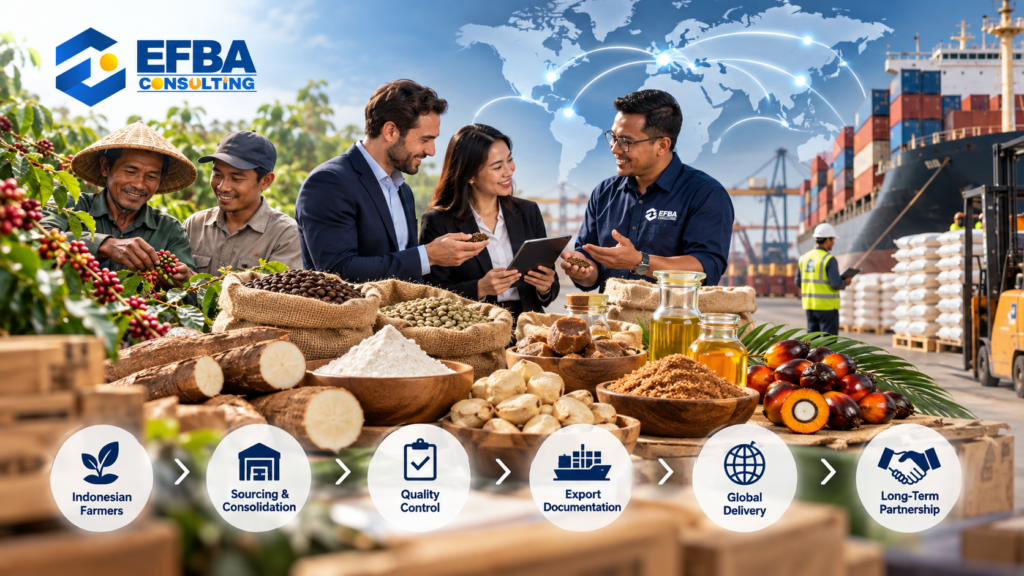
For global buyers looking for wholesale agricultural products Indonesia, EFBA Agro International focuses on procurement, processing, wholesale supply, and export of Indonesian agricultural commodities. Its verified portfolio includes cassava derivatives, coffee beans and cascara, candlenut, palm products, and Arenga palm sugar.
Through a specification-based sourcing approach, buyers can evaluate wholesale agricultural products Indonesia based on product suitability, quality requirements, commercial volume, packaging, and export readiness rather than price alone.
What Are Wholesale Agricultural Products Indonesia Buyers Can Source?
Wholesale agricultural products Indonesia refers to Indonesian agricultural commodities or processed agricultural ingredients supplied in commercial quantities to importers, distributors, manufacturers, food businesses, wholesalers, and other B2B buyers.
Depending on the commodity, buyers may source raw materials, semi-processed ingredients, processed agricultural products, or ingredients prepared for further manufacturing. Therefore, buyers searching for wholesale agricultural products Indonesia should define the intended application before requesting a quotation.
A practical procurement framework is:
Product → Origin → Specification → Volume → Sample → Quality → Packaging → Documentation → Logistics → Repeat Supply
This framework matters because suppliers offering similar wholesale agricultural products Indonesia may provide different grades, moisture parameters, processing methods, packaging configurations, minimum quantities, and shipment arrangements.
Therefore, buyers should compare products based on equivalent specifications and procurement requirements rather than considering price as the only factor.
Why Source Wholesale Agricultural Products Indonesia?
Indonesia has a large and diverse agricultural base. Its tropical environment supports coffee, cassava, spices, palm commodities, and other agricultural products that serve domestic and international markets. As a result, wholesale agricultural products Indonesia can serve different applications across food manufacturing, beverage production, distribution, retail supply, and industrial processing.
BPS data updated on September 21, 2026 show that agricultural-sector exports reached approximately US$3.153 billion from January through July 2026. Meanwhile, the broader SITC category of food and live animals recorded about US$12.564 billion in exports during the same seven-month period, although this broader category should not be interpreted as equivalent to agricultural-sector exports.
However, national export scale alone does not guarantee that a particular supplier or shipment will meet a buyer’s requirements. Buyers sourcing wholesale agricultural products Indonesia still need to verify the actual commodity, specifications, samples, supply availability, packaging, documentation, and commercial terms.
Therefore, global buyers evaluating wholesale agricultural products Indonesia should use a structured sourcing framework before committing to commercial quantities.
1. Start with the Product and Intended Application
The first question should not be, “What is your cheapest commodity?” Instead, buyers should define what they need and how they intend to use it.
For buyers sourcing wholesale agricultural products Indonesia, the intended application should come before price comparison. A food manufacturer may need cassava-derived ingredients with specific technical characteristics. A coffee roaster may prioritize origin, processing, moisture, defects, and cup profile, while a distributor sourcing palm sugar may focus on product format, packaging, volume, and consistency.
Start with:
Application → Product → Specification → Required Volume → Target Market
This approach gives the supplier clearer information and reduces unnecessary product matching. In addition, it helps buyers identify which wholesale agricultural products Indonesia are most suitable for their commercial requirements.
EFBA Agro’s quotation process follows a similar principle. Its website asks buyers to specify product of interest, required quantity, order frequency, grade or quality, preferred packaging, certification requirements, destination country, destination port, Incoterm, shipping method, and purchasing timeline.
2. Match the Commodity with the Right Indonesian Supply
Not every agricultural product fits every buyer. Therefore, global buyers should first understand the available portfolio before discussing commercial quantities.
EFBA Agro currently publishes several core commodities:
MOCAF → Gayo Arabica Coffee → Cascara → Candlenut → RBD Palm Olein → CPO → Granulated Arenga Palm Sugar → Molded Arenga Palm Sugar
Each product serves a different market. Consequently, sourcing wholesale agricultural products Indonesia should begin with product-market fit rather than a generic request for “Indonesian agricultural products.”
For example, food manufacturers, roasters, distributors, ingredient companies, and wholesalers may require different specifications, packaging, and order volumes. Therefore, buyers should match wholesale agricultural products Indonesia with their actual market and operational requirements.
3. Verify Specifications before Comparing Prices
Terms such as premium, export quality, or high quality are not sufficient for professional procurement. Buyers need measurable or clearly defined specifications appropriate to the commodity.
When evaluating wholesale agricultural products Indonesia, procurement teams may need to discuss grade, moisture, purity, appearance, particle size, processing method, defect tolerance, sensory characteristics, packaging, or other technical parameters.
For example, EFBA Agro’s cassava sourcing content advises buyers to define grade, moisture, appearance, packaging, particle size, and other technical specifications when evaluating cassava products.
A better comparison therefore becomes:
Price + Specification + Quality + Packaging + Commercial Terms
rather than:
Supplier A Price vs Supplier B Price
This approach creates a more accurate comparison because buyers evaluate equivalent wholesale agricultural products Indonesia rather than comparing prices without considering quality and specifications.
4. Request Samples before Committing to Bulk Orders
Product descriptions and photographs cannot replace physical evaluation. For many agricultural commodities, a sample allows buyers to inspect whether the actual product matches their requirements.
For buyers purchasing wholesale agricultural products Indonesia, sample evaluation can help verify appearance, moisture, aroma, texture, processing quality, or other relevant characteristics before placing a larger order.
EFBA Agro publishes a collaboration process in which the client provides product requirements, specifications, and quantity. Its team then matches the requirement with available products, raw materials, and its farmer network before preparing a sample for client evaluation.
The published process is:
Buyer Requirement → Product Matching → Sample → Sample Testing → Client Confirmation → Partnership
For wholesale agricultural products Indonesia, this step can reduce the risk of committing to a larger purchase before the buyer evaluates the actual material.
5. Evaluate Quality Consistency, Not Only the First Sample
A successful sample is an important starting point, but repeat procurement requires consistency. Agricultural commodities can change with harvest cycles, raw-material availability, weather, post-harvest handling, and processing conditions.
Therefore, buyers sourcing wholesale agricultural products Indonesia should establish clear reference parameters after sample approval. The agreed specification can then become a basis for subsequent procurement and quality discussions.
For recurring sourcing, use:
Approved Sample → Agreed Specification → Procurement → QC → Shipment → Buyer Evaluation → Repeat Order
EFBA Agro states that it works with producers and processing partners to maintain product consistency from origin to destination. Its published wholesale approach also emphasizes clear specifications and reliable supply arrangements.
For long-term procurement of wholesale agricultural products Indonesia, consistency is important because importers, manufacturers, and distributors often depend on predictable product quality across multiple orders.
6. Match Packaging with Wholesale Requirements
Packaging is not merely a visual element in B2B agricultural trade. It needs to support handling, storage, shipment, and the buyer’s operational requirements.
Buyers of wholesale agricultural products Indonesia should consider packaging as part of the overall procurement specification. A manufacturer purchasing ingredients may require a different format from a specialty distributor or retailer.
Consequently, buyers should discuss net weight, inner packaging, outer packaging, labeling requirements, pallet configuration where relevant, and shipping method.
Use:
Product → Weight → Inner Protection → Outer Packaging → Label → Pallet → Shipment
Packaging specifications can differ by commodity and destination. Therefore, buyers sourcing wholesale agricultural products Indonesia should confirm the final configuration for the actual order rather than assuming one packaging format applies across EFBA Agro’s entire portfolio.
7. Understand Volume and Supply Requirements
Wholesale procurement needs realistic volume planning. A buyer testing a new product may need a different quantity from an established importer supplying several markets.
Before requesting a quotation for wholesale agricultural products Indonesia, define:
Initial Order → Monthly/Quarterly Demand → Order Frequency → Forecast → Growth Requirement
This information helps the sourcing partner evaluate available supply and commercial feasibility.
EFBA Agro’s current quotation form specifically asks for required quantity and order frequency. The company also positions its operations around bulk and wholesale agricultural supply.
However, buyers should confirm MOQ individually for each product. A published MOQ for one commodity should not automatically be applied to another.
For recurring wholesale agricultural products Indonesia, buyers should also discuss expected demand growth and purchasing frequency so the supplier can assess long-term supply capability.
8. Check Export Documentation and Logistics Requirements
International sourcing continues after product approval. The commodity still needs suitable packaging, documentation, shipment coordination, and destination-specific import compliance.
For international buyers sourcing wholesale agricultural products Indonesia, export documentation and logistics should be discussed before the shipment stage.
EFBA Agro publishes the following general export process:
Need & Demand Analysis → Procurement & Quality Control → Packaging & Documentation → Shipping & Logistics
Its website specifically references documents such as Certificate of Origin and Bill of Lading within the general export workflow. However, document requirements can differ according to commodity, destination, Incoterm, buyer requirements, and applicable regulation.
Therefore, buyers sourcing wholesale agricultural products Indonesia should confirm destination-country requirements with their customs broker or relevant authority before shipment.
This approach can help reduce delays, documentation issues, and unexpected logistics costs.
9. Compare Suppliers Beyond the Lowest Quotation
Price matters in wholesale trade, but a low unit price does not automatically create a low landed cost or low procurement risk.
For wholesale agricultural products Indonesia, buyers should compare suppliers using a broader set of commercial and technical factors.
A more useful supplier comparison is:
Product Price + Specification + Quality Consistency + Packaging + Documentation + Logistics + Communication + Supply Reliability
A cheaper commodity can become less attractive if it requires additional sorting, fails the buyer’s specifications, creates packaging problems, or produces inconsistent results in manufacturing.
Therefore, global buyers comparing wholesale agricultural products Indonesia should evaluate equivalent specifications and commercial conditions. This creates a more accurate basis for procurement decisions.
10. Build Procurement around Long-Term Supply Capability
The first shipment proves that a transaction can happen. However, it does not automatically prove that a supplier can maintain the same sourcing relationship over multiple purchasing cycles.
For recurring wholesale agricultural products Indonesia, buyers should discuss harvest conditions, supply planning, expected order frequency, product availability, alternative sourcing options, and communication when conditions change.
A long-term procurement cycle can follow:
Forecast → Requirement → Product Matching → Sample/Specification Approval → Order → QC → Shipment → Evaluation → Repeat Procurement
This approach gives both buyer and sourcing partner more visibility than treating every shipment as an entirely new transaction.
In addition, long-term planning can help buyers manage supply continuity, quality consistency, logistics scheduling, and commercial expectations. For buyers that depend on recurring wholesale agricultural products Indonesia, this type of structured procurement relationship is more sustainable than one-time transactional sourcing.
Main Wholesale Agricultural Products Available through EFBA Agro
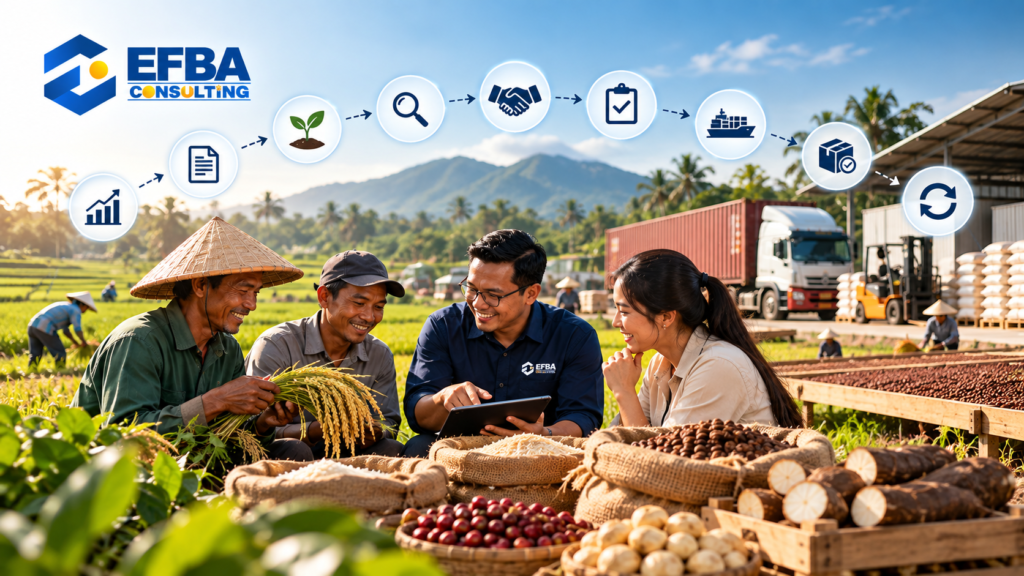
EFBA Agro’s current website identifies cassava and its derivatives, coffee beans and cascara, candlenut, palm oil, and palm sugar among its primary commodity areas. The website also provides individual product descriptions for several items within those groups.
For buyers searching for wholesale agricultural products Indonesia, the following verified portfolio provides a practical starting point. Each commodity serves different applications, technical requirements, packaging needs, and commercial markets.
1. Modified Cassava Flour (MOCAF)
MOCAF is a fermented cassava-based flour. EFBA Agro describes the product as having a lighter aroma and improved elasticity compared with regular cassava flour and positions it as an alternative ingredient for bread, cakes, and other processed foods.
For buyers evaluating wholesale agricultural products Indonesia in the cassava category, MOCAF can serve as one option for food manufacturing and ingredient applications.
Global buyers considering cassava-based ingredients should define the intended application and technical specifications before ordering. More detailed procurement considerations are available in EFBA Agro’s Indonesian Cassava Supplier guide.
2. Gayo Arabica Coffee
Gayo Arabica originates from the highlands of Aceh and forms part of EFBA Agro’s published coffee portfolio. The company describes it as a premium Arabica origin with full body and complex flavor characteristics.
Coffee is also one of the important categories within wholesale agricultural products Indonesia, particularly for roasters, importers, distributors, and specialty coffee businesses.
However, coffee buyers should go beyond origin name. They need to evaluate processing, moisture, defects, grade, sensory profile, packaging, and actual lot availability. EFBA Agro discusses these procurement considerations in its Indonesian Arabica Coffee Supplier guide.
3. Cascara
Cascara is dried coffee cherry skin that can serve beverage applications such as brewed cascara, tea-style beverages, syrup, kombucha, and other formulations.
EFBA Agro publishes cascara sourced from Arabica coffee fruit associated with Gayo, Aceh. Its current cascara specification includes sun-dried processing, 10–12% maximum moisture, 99% minimum purity, and a reddish-brown appearance. However, buyers should still reconfirm specifications for the actual lot.
For buyers sourcing wholesale agricultural products Indonesia, cascara represents a specialized coffee-derived product that requires clear specification, packaging, and application requirements.
For detailed specifications, packaging, MOQ, sampling, and sourcing considerations, see Cascara Wholesale from Indonesia.
4. Candlenut
Candlenut, or kemiri, is another commodity listed in EFBA Agro’s verified portfolio. The company describes it as an ingredient used in Indonesian cuisine for flavor and texture, while candlenut oil also has applications beyond food.
Wholesale buyers considering candlenut as part of wholesale agricultural products Indonesia should specify the intended application, grade, quality requirements, packaging, volume, and destination before requesting supply.
These requirements help EFBA Agro match the inquiry with suitable available sourcing and commercial arrangements.
5. RBD Palm Olein
EFBA Agro lists RBD palm olein among its agricultural commodities. The company describes it as refined palm oil commonly used as cooking oil and suitable for frying, baking, and processed-food applications because of its heat stability.
Within the broader market for wholesale agricultural products Indonesia, RBD palm olein may serve food manufacturers, distributors, and other commercial buyers that require palm-based products in larger volumes.
Commercial buyers should discuss the actual product specification, volume, packaging, required documentation, destination, and shipment terms before procurement.
6. Crude Palm Oil
Crude Palm Oil, or CPO, also appears in EFBA Agro’s published portfolio. EFBA Agro describes CPO as unrefined oil from palm fruit pulp that serves as a raw material for several downstream applications.
For buyers evaluating palm-based wholesale agricultural products Indonesia, CPO requires more than a basic price quotation. Commercial, regulatory, sustainability, logistics, and destination-market requirements may influence the transaction.
Therefore, buyers should establish these requirements before confirming procurement.
7. Granulated Arenga Palm Sugar
Granulated Arenga palm sugar provides a crystalline format that is easier to portion and use in various food and beverage applications. EFBA Agro currently lists this product among its wholesale agricultural commodities.
For buyers looking for wholesale agricultural products Indonesia in the natural sweetener category, granulated Arenga palm sugar can serve food manufacturing, beverage, distribution, and retail applications.
Buyers should confirm grade, particle characteristics where relevant, packaging, volume, documentation, and any certification requirements for the intended destination.
8. Molded Arenga Palm Sugar
EFBA Agro also lists molded Arenga palm sugar. The product uses Arenga palm sap processed into solid blocks and carries the characteristic caramel-like profile associated with palm sugar.
The choice between granulated and molded formats should follow the buyer’s manufacturing, distribution, retail, or food-service application rather than price alone.
Therefore, buyers comparing wholesale agricultural products Indonesia should consider product format and intended use as part of the purchasing decision.
Official Data: Indonesia’s Agricultural Export Base
BPS provides current evidence of Indonesia’s role in international agricultural trade. Its September 21, 2026 update records US$3.1534 billion in agricultural-sector exports from January through July 2026. July alone accounted for US$565.5 million.
For buyers evaluating wholesale agricultural products Indonesia, these figures provide useful context regarding the scale of Indonesia’s agricultural export activity.
Coffee represents one visible component of that export base. BPS records approximately US$1.0076 billion in coffee exports from January through July 2026, with a net export weight of approximately 208.1 thousand tonnes during the same period.
Medicinal, aromatic, and spice plants generated approximately US$313.8 million in export value during January–July 2026, according to the same BPS agricultural table.
For palm-derived products, classification matters. BPS records palm oil and coconut oil within its industrial export statistics rather than the narrower agricultural-products table. Therefore, those figures should not be mixed directly with the US$3.1534 billion agricultural-sector total.
BPS also released its Monthly Foreign Trade Statistics: Exports, July 2026 on September 30, 2026. The publication covers exports by sector, commodity, destination country, HS group, and province of origin.
These figures demonstrate the scale of Indonesian trade. However, national export statistics do not prove the capacity, quality, or availability of an individual supplier or commodity lot.
Therefore, procurement teams sourcing wholesale agricultural products Indonesia should use national trade data as market context rather than as a substitute for supplier verification.
The correct sequence remains:
National Supply Context → Commodity → Supplier → Specification → Sample → Commercial Verification
What Should Buyers Check Before Ordering Wholesale Agricultural Products Indonesia?
Before purchasing wholesale agricultural products Indonesia, buyers should create a procurement brief rather than requesting only a price.
The brief should answer:
What Product? → What Application? → What Specification? → What Quantity? → What Packaging? → What Destination? → What Documentation? → What Timeline?
After that, evaluate:
- Product and origin
- Technical specification
- Quality parameters
- Sample availability
- Required volume
- Order frequency
- Packaging
- Certification requirements, where applicable
- COA or laboratory-report requirements, where applicable
- Destination country and port
- Incoterm
- Shipping method
- Purchase timeline
This checklist helps buyers compare wholesale agricultural products Indonesia using technical and commercial requirements rather than price alone.
EFBA Agro’s current quotation form asks buyers for these categories of information, making them a useful framework for preparing a sourcing inquiry.
How Does EFBA Agro Handle Wholesale Agricultural Products Indonesia Sourcing?
EFBA Agro positions itself as an Indonesian agricultural sourcing and export partner. Its website states that the company works with producers and processing partners and uses a network that includes farmers to match buyer requirements with available products and raw materials.
For buyers looking for wholesale agricultural products Indonesia, this process begins with understanding the actual product requirement rather than immediately offering a generic commodity quotation.
The collaboration process currently published by EFBA Agro is:
Submit Requirements → Product Matching → Sample Provision → Sample Testing → Client Confirmation → Partnership Begins
This workflow helps buyers evaluate whether the selected wholesale agricultural products Indonesia match their required specifications before moving to larger procurement.
Its export process then covers:
Need & Demand Analysis → Procurement & Quality Control → Packaging & Documentation → Shipping & Logistics
Through this structure, EFBA Agro can support buyers across product matching, sample evaluation, procurement coordination, quality control, documentation, and shipment planning.
For recurring wholesale agricultural products Indonesia, buyers should also discuss order frequency, forecast volume, quality consistency, packaging, destination, and long-term supply expectations.

This model positions EFBA Agro as a sourcing bridge between international buyers and Indonesian agricultural supply networks. However, the exact farmer, producer, processor, documentation, specification, and logistics arrangement can vary by commodity and transaction, so buyers should verify those details during procurement.
EFBA Agro Expertise in Indonesian Agricultural Supply
EFBA Agro International specializes in procurement, processing, wholesale export, and agricultural commodity sourcing. Its verified current portfolio focuses on cassava and derivatives, coffee beans and cascara, candlenut, palm products, and Arenga palm sugar. Efba Agro International
The company’s published sourcing model starts with buyer requirements rather than forcing buyers into one standard product. EFBA Agro asks about specifications, quantity, packaging, destination, documentation requirements, and purchasing timeline before moving through product matching and sample evaluation. Efba Agro International
For international buyers, this creates a practical procurement structure:
Global Buyer → EFBA Agro → Product/Farmer/Producer Network → Product Matching → Sample → Quality Review → Commercial Order → Export Coordination
The model is particularly relevant for companies that want to source several Indonesian commodities through a procurement partner rather than beginning an independent supplier search for every product.
EFBA Agro is part of the broader PT EFBA Digital Mulia ecosystem. For this article, however, all agricultural product and sourcing claims remain limited to the capabilities published by EFBA Agro itself.
Why Source Wholesale Agricultural Products through EFBA Agro?
The value of a sourcing partner is not simply access to products. International buyers also need a process for converting procurement requirements into an actual commercial supply arrangement.
EFBA Agro’s published model supports that process through requirement analysis, product matching, sampling, quality control, packaging, documentation, and logistics coordination. The company also states that it works with producers and processing partners to maintain product consistency from origin to destination. Efba Agro International
For buyers searching for wholesale agricultural products Indonesia, the sourcing framework can therefore be summarized as:
Buyer Requirement → Indonesian Supply Network → Product Matching → Sample → Approval → Procurement → QC → Packaging → Documentation → Shipment
Buyers should still verify the final specification, available volume, certification, documentation, commercial terms, and shipment arrangement for each transaction. That verification is especially important because agricultural products can vary by commodity, crop, processing, and destination market.
FAQ About Wholesale Agricultural Products Indonesia
What wholesale agricultural products can buyers source from Indonesia?
Indonesia supplies many agricultural commodities to global markets. Within EFBA Agro’s currently verified portfolio, buyers can explore MOCAF, Gayo Arabica coffee, cascara, candlenut, RBD palm olein, CPO, granulated Arenga palm sugar, and molded Arenga palm sugar. Efba Agro International
The appropriate product depends on the buyer’s intended application, specification, volume, packaging, destination, and regulatory requirements.
What is the best way to source wholesale agricultural products Indonesia?
Start by defining the product, application, specification, quantity, packaging, destination, and purchasing schedule. Then evaluate suppliers based on sample quality, specification consistency, commercial terms, documentation, communication, and supply capability rather than price alone.
For repeat orders, buyers should also establish agreed specifications and review consistency between shipments.
Does EFBA Agro work with farmers?
EFBA Agro’s current website states that its product-matching process can use its network of farmers, while its supply model also involves producers and processing partners. Efba Agro International
The exact sourcing structure can differ by commodity. Buyers requiring farm-level traceability should therefore request the relevant origin and traceability information for the specific product.
Can international buyers request samples?
Yes. EFBA Agro’s published collaboration process includes sample provision and client sample testing before confirmation and partnership. Efba Agro International
Sample availability, quantity, courier arrangements, and costs should still be confirmed for the specific commodity and destination.
Does EFBA Agro supply Indonesian coffee?
Yes. EFBA Agro currently lists Gayo Arabica coffee from Aceh as part of its agricultural portfolio, alongside cascara derived from coffee fruit. Efba Agro International
Coffee buyers should confirm the required origin, process, grade, moisture, defect parameters, packaging, quantity, and current lot availability before purchase.
Does EFBA Agro supply cassava products?
Yes. Cassava and its derivatives form part of EFBA Agro’s published focus, and its current portfolio includes Modified Cassava Flour or MOCAF. Efba Agro International
EFBA Agro’s cassava sourcing guide also discusses cassava flour, tapioca flour, MOCAF, cassava starch, and other cassava-based ingredients as product categories buyers may encounter; actual availability should be confirmed before ordering. Efba Agro International
Does EFBA Agro supply palm sugar?
Yes. EFBA Agro currently lists both granulated and molded Arenga palm sugar in its commodity portfolio. Efba Agro International
Global buyers should specify the required product format, volume, packaging, quality parameters, documentation, and destination market when requesting a quotation.
What information should I provide when requesting a wholesale quotation?
Provide the product, required quantity, order frequency, grade or quality, packaging, certification requirements if applicable, COA or laboratory-report needs if applicable, destination country, destination port, preferred Incoterm, shipping method, and expected purchasing timeline.
These fields closely follow EFBA Agro’s current quotation process. Efba Agro International
How does EFBA Agro support agricultural exports?
EFBA Agro publishes an export workflow covering need and demand analysis, procurement and quality control, packaging and documentation, followed by shipping and logistics. Efba Agro International
Actual export requirements vary by commodity and destination, so buyers should confirm transaction-specific documentation and import requirements before shipment.
How can buyers reduce risk when importing Indonesian agricultural products?
Use a structured process: define specifications, request samples, compare equivalent offers, confirm packaging and documentation, verify shipment requirements, and monitor consistency after delivery.
For recurring wholesale agricultural products Indonesia, buyers should also share forecasts and discuss future volume requirements early rather than treating each purchase as an isolated transaction.
Source Wholesale Agricultural Products from Indonesia
Sourcing Indonesian agricultural commodities should not begin and end with a price request. Global buyers need to evaluate Product → Specification → Sample → Quality → Volume → Packaging → Documentation → Logistics → Consistency before building a recurring procurement program.
EFBA Agro International provides a sourcing route for buyers looking for Indonesian agricultural commodities, including cassava derivatives, Gayo Arabica coffee, cascara, candlenut, palm products, and Arenga palm sugar. Its published process connects buyer requirements with product matching, sampling, quality review, packaging, documentation, and export logistics. Efba Agro International
For global buyers searching for wholesale agricultural products Indonesia, start with a clear procurement brief:
Product → Specification → Quantity → Packaging → Destination → Timeline
Then request product matching and samples before moving toward a commercial order. This creates a stronger foundation for quality, consistency, and long-term agricultural sourcing from Indonesia.