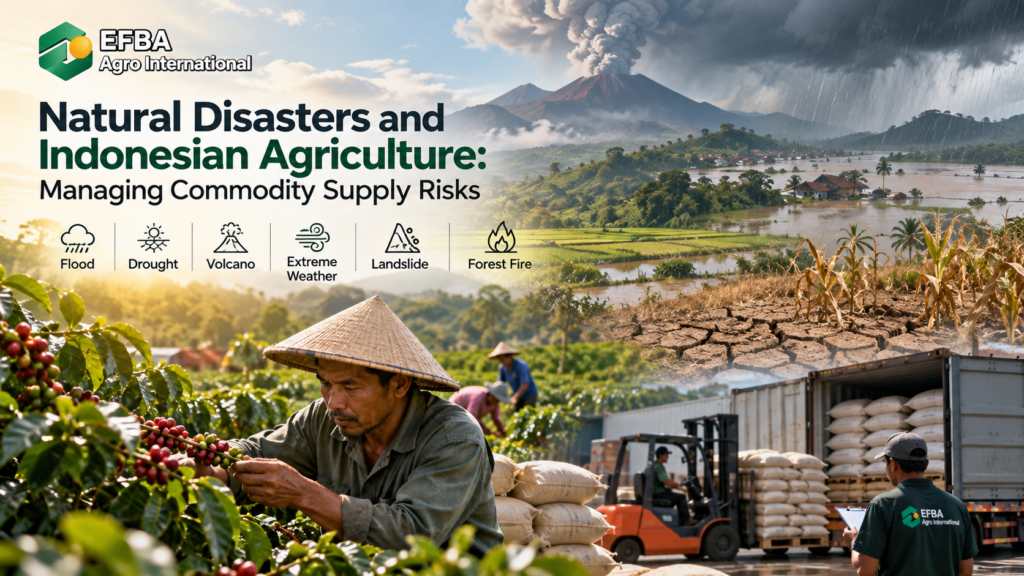
Natural disasters can affect Indonesian agriculture at several points at once. Farms may face floods, drought, landslides, wildfires, or extreme weather, while roads, warehouses, processing facilities, and logistics routes can also experience disruption. For international buyers, the impact can appear as changes in commodity availability, quality, harvest timing, lead time, transportation, and ultimately supply continuity.
The issue of natural disaster agriculture Indonesia therefore extends beyond what happens on a farm. Buyers of coffee, cassava derivatives, palm sugar, candlenut, and other Indonesian agricultural commodities also need to understand how weather and disaster events can influence sourcing regions, processing, inventory, transportation, and export schedules.
Recent official data show why this deserves attention. BNPB reported that more than 90% of Indonesia’s disaster events in June 2026 were hydrometeorological. Forest and land fires accounted for 37 events, floods 25, drought 20, and extreme weather 15.
For international buyers, understanding natural disaster agriculture Indonesia does not mean avoiding Indonesian agricultural sourcing. Instead, procurement teams should identify where disruptions could occur and prepare appropriate sourcing, inventory, quality, and logistics responses.
A structured approach follows:
Risk Identification → Supply Assessment → Alternative Sourcing → Specification → Sample → Inventory Planning → Logistics → Monitoring
EFBA Agro International operates within this procurement environment as an Indonesian agricultural commodity sourcing and wholesale export business. Its official website lists cassava and derivatives, coffee beans and cascara, candlenut, palm oil, and palm sugar among its focus commodities and describes a sourcing process involving product matching, samples, testing, quality requirements, packaging, and international delivery arrangements.
How Does Natural Disaster Agriculture Indonesia Affect Supply Chains?
The relationship between natural disaster agriculture Indonesia and commodity supply involves both direct and indirect disruption. Direct impacts occur when farms, plantations, crops, water availability, or harvesting activities face adverse conditions. Meanwhile, indirect impacts can occur when transportation routes, storage, processing, labor availability, or logistics become constrained.
The effect also depends on the commodity and location. Drought can create different problems from excessive rainfall, while flooding near a transportation route can disrupt shipments even when the production area itself remains unaffected.
For B2B buyers, the relationship can be understood as:
Natural Hazard → Production Area → Harvest → Processing → Quality → Inventory → Logistics → Export → Buyer
Therefore, procurement teams evaluating natural disaster agriculture Indonesia should not ask only, “Was the farm affected?” They should also assess whether processing, storage, transportation, ports, documentation, or delivery schedules could experience secondary disruption.
Why Natural Disaster Agriculture Indonesia Matters for Agricultural Buyers
Indonesia’s agricultural sector remains economically significant. In Q2 2026, Indonesia’s economy grew 5.29% year-on-year, while Agriculture, Forestry and Fishing recorded the highest quarter-to-quarter growth among production sectors at 12.26%.
At the same time, Indonesia’s geographic and climatic conditions expose different areas to different hazards. During June and July 2026, BNPB repeatedly reported drought, forest and land fires, floods, extreme weather, and landslides across multiple regions.
For international buyers, natural disaster agriculture Indonesia becomes relevant because a large agricultural production base does not eliminate supply risk. Commercial buyers still need to assess individual commodities, production areas, harvest schedules, processors, logistics arrangements, and supplier capabilities before making procurement decisions.
For recurring agricultural procurement, buyers can use:
Commodity → Origin → Hazard Exposure → Supply Impact → Alternative → Inventory → Logistics → Monitoring
This provides a more useful decision framework than reacting only after a disruption has already occurred.
How Natural Disasters Can Affect Agricultural Commodity Supply
Different disasters create different operational risks. Therefore, procurement teams assessing natural disaster agriculture Indonesia should separate the type of hazard from its potential commercial impact instead of treating every natural disaster as the same problem.
1. Drought Can Reduce Water Availability
Drought can affect agricultural areas by reducing water availability for communities and production activities. BNPB reported increasing drought impacts during Indonesia’s 2026 dry season, including events across Java and other regions. By early July, drought had become one of the dominant disaster conditions reported by the agency.
For agricultural procurement, the relevant questions concern how long dry conditions persist, whether the commodity depends heavily on water at the affected production stage, and whether harvest or processing schedules change.
The potential chain is:
Low Rainfall → Water Stress → Farm Operations → Harvest → Raw Material Availability → Processing → Supply
However, buyers should avoid assuming that a drought report automatically means a national commodity shortage. Within the context of natural disaster agriculture Indonesia, buyers should assess the effect by location, crop, timing, and severity.
2. Flooding Can Disrupt Farms and Transportation
Flooding creates another type of risk because water can affect production areas while simultaneously disrupting roads, warehouses, processing, or transportation. BNPB’s June 2026 disaster bulletin recorded 25 flood events, making flooding the second-most frequent disaster category that month after forest and land fires.
Agricultural buyers should therefore monitor more than crop conditions. A supplier may have sufficient inventory, but road access or transportation schedules can still create delays.
The potential chain becomes:
Heavy Rain → Flood → Farm / Road / Warehouse → Transport Delay → Processing or Shipment Delay
For export procurement, the important question is whether the disruption changes the agreed delivery schedule, quality condition, or logistics plan.
3. Forest and Land Fires Can Affect Agricultural Areas
Forest and land fires became the most frequently reported disaster category in BNPB’s June 2026 bulletin, accounting for 37 events or 34.9% of recorded disasters that month. BNPB continued reporting fires across several regions during July.
Some fires can directly affect agricultural land. For example, BNPB reported a July 2026 fire in a sugarcane area in Mojokerto, East Java, while another report described a fire in Sragen that spread to sugarcane plantation land.
These events illustrate why natural disaster agriculture Indonesia requires location-specific analysis. A fire in one production area does not automatically indicate a nationwide agricultural supply problem.
For commodity buyers, fire risk may require evaluation of production location, stored inventory, processing facilities, transport access, and potential delays.
The appropriate response remains commodity-specific:
Fire Event → Location Check → Supplier Impact → Inventory Check → Alternative Supply → Logistics Review
4. Landslides Can Affect Access to Production Areas
Agricultural production frequently takes place outside major urban logistics corridors. When landslides affect roads or surrounding infrastructure, commodities can face transportation problems even when crops themselves remain intact.
This distinction matters particularly for products sourced from highland or remote production areas. Buyers should therefore understand the route from farm or processor to warehouse and onward to the export gateway.
A useful mapping process is:
Farm → Collection Point → Processor → Warehouse → Main Road → Port
Identifying this route helps procurement teams understand where disruption could occur and where alternative transportation arrangements may be required.
5. Extreme Weather Can Affect Harvest and Post-Harvest Handling
Extreme rainfall, strong winds, unusual dry periods, and other weather conditions can influence harvesting and post-harvest activities. The impact differs according to commodity, maturity, production system, and processing method.
For commodities that require drying, buyers should pay particular attention to post-harvest conditions. Coffee, cascara, spices, cassava-derived products, and other agricultural commodities may have specific moisture or processing requirements before commercial shipment.
Therefore, natural disaster agriculture Indonesia can influence not only how much agricultural material remains available but also its post-harvest condition and suitability for commercial requirements.
The supply-chain question becomes:
Weather → Harvest → Drying / Processing → Moisture → Quality → Storage
This is why specifications and sample testing remain important even when the commodity itself remains available.
6. Quality Can Change Even When Supply Remains Available
Natural-disaster risk does not always result in complete supply interruption. Sometimes the commodity remains available, but buyers need to pay greater attention to physical condition, moisture, processing, storage, or lot consistency.
For B2B procurement, availability and suitability are different questions.
A buyer should evaluate:
Is the commodity available? → Does it meet specification? → Is quality consistent? → Can the required volume be delivered?
This distinction becomes particularly important when evaluating natural disaster agriculture Indonesia from a procurement perspective. A disruption may create quality or consistency issues without completely stopping supply.
EFBA Agro’s existing sourcing process follows this specification-based approach. Buyers communicate their required product, specification, and quantity; EFBA Agro matches the requirement with available products and its farmer network, prepares samples, and allows the client to test them before confirmation.
7. Commodity Prices Can Face Additional Pressure
Supply disruptions can contribute to price pressure when availability falls or logistics become more difficult. However, agricultural commodity prices also respond to many other variables, including global demand, currency movements, inventories, harvest cycles, production costs, international prices, and trade conditions.
Therefore:
Natural Disaster ≠ Automatic Price Increase
A more accurate framework is:
Disaster → Potential Supply/Logistics Impact → Market Availability → Cost Conditions → Possible Price Effect
Procurement teams assessing natural disaster agriculture Indonesia should therefore avoid attributing every price change to weather or disasters without supporting market data.
8. Logistics Can Become the Critical Bottleneck
A commodity can be harvested and processed successfully but still arrive late when transportation becomes disrupted. Floods, landslides, damaged road access, port congestion, or other operational problems can affect the movement of goods from producing areas to processing facilities and export gateways.
International buyers should therefore evaluate:
Origin → Processing Location → Warehouse → Inland Transport → Port → Vessel → Destination
This end-to-end view is especially important for time-sensitive orders and recurring industrial requirements.
EFBA Agro asks prospective buyers to specify destination country, destination port, preferred Incoterm, shipping method, purchase timeline, and target delivery date when requesting a quotation. This information helps connect product sourcing with logistics planning.
9. Single-Source Procurement Can Increase Exposure
When a buyer depends entirely on one production area, one processor, or one supply channel, a local disruption can have a larger impact on procurement.
Within a natural disaster agriculture Indonesia risk strategy, supply diversification can help buyers identify alternatives before a disruption affects commercial requirements. However, diversification does not mean replacing a reliable supplier without reason.
Instead, buyers can map which products are critical, which origins are available, how much inventory they require, and whether they can evaluate alternative supply before an emergency.
A practical framework is:
Primary Source → Backup Source → Approved Specification → Sample → Available Volume
Alternative suppliers or origins should still pass normal quality and commercial evaluation. Emergency sourcing without specification control can simply replace supply risk with quality risk.
10. Continuous Monitoring Supports More Reliable Procurement
Disaster risk changes over time. Flood risk may increase during periods of heavy rainfall, while drought and land-fire risk can become more relevant during dry conditions.
BNPB’s June 2026 bulletin illustrates this dynamic: more than 90% of recorded disasters that month were hydrometeorological, while July updates increasingly highlighted drought and forest or land fires during the dry season.
Therefore, buyers managing natural disaster agriculture Indonesia risks should treat monitoring as an ongoing procurement activity rather than a one-time assessment.
For recurring agricultural procurement, buyers can use:
Monitor → Assess → Update Forecast → Confirm Supply → Adjust Inventory → Review Logistics
This creates a more proactive procurement model instead of waiting for a shipment problem before evaluating risk.
Which Agricultural Commodities Face Natural Disaster Risk in Indonesia?
Exposure to natural disaster agriculture Indonesia differs between commodities. Coffee grown in highland environments, cassava cultivated across tropical agricultural areas, palm-derived commodities, and other crops do not share identical production cycles or risk profiles.
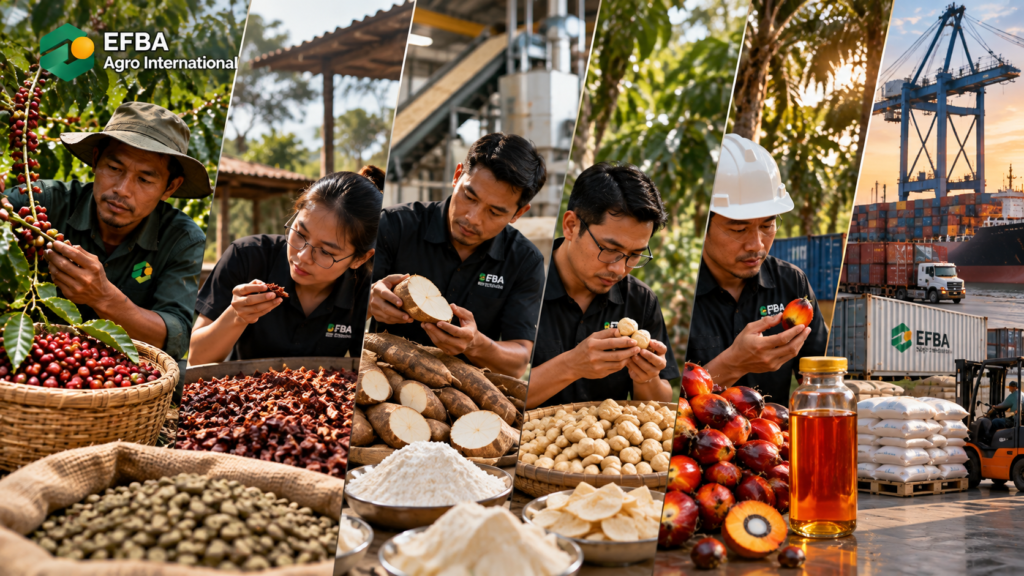
EFBA Agro currently focuses on cassava and its derivatives, coffee beans and cascara, candlenut, palm oil, and palm sugar products. Its website positions these commodities for wholesale export and applications across food, beverages, supplements, and industrial uses.
For buyers of these commodities, risk assessment should therefore remain product-specific:
- Coffee: monitor origin, harvest, processing, drying, storage, and transportation.
- Cascara: monitor coffee-cherry availability, drying conditions, moisture, purity, and storage.
- Cassava derivatives: monitor raw-material availability, processing capacity, specification, inventory, and logistics.
- Candlenut: monitor harvest availability, drying or processing, storage, and quality.
- Palm products: monitor raw-material supply, processing, packaging, and transportation according to the specific product.
This commodity-specific approach provides a stronger framework for managing natural disaster agriculture Indonesia than assuming that one disaster affects every Indonesian agricultural commodity in the same way.
Official Data: What Do 2026 Disaster Reports Show?
Indonesia’s disaster situation in 2026 demonstrates why agricultural buyers should include environmental disruption in supply-chain monitoring. For international procurement teams, understanding natural disaster agriculture Indonesia helps separate actual supply-chain exposure from general disaster headlines.
BNPB recorded 106 disaster events in June 2026 based on the categories listed in its monthly bulletin. Forest and land fires accounted for 37 events (34.9%), floods 25 (23.6%), drought 20 (18.9%), extreme weather 15 (14.2%), landslides four, earthquakes three, and tidal waves or abrasion two. More than 90% of the events were hydrometeorological.
The pattern continued into July. BNPB reported that drought dominated significant disaster events by July 3, while its July 18 monitoring described forest and land fires, floods, landslides, and drought among events occurring across Indonesia.
For buyers monitoring natural disaster agriculture Indonesia, these disaster statistics provide useful risk context. However, disaster-event data should not automatically become evidence of agricultural shortages.
Agricultural output data provide another useful perspective. BPS reported that Indonesia produced 4.92 million tonnes of dry unhusked paddy in May 2026, down 3.43% from May 2025, while harvested area fell 2.35% year-on-year. BPS did not attribute that entire decline to natural disasters, so the figures should be treated as production context rather than evidence that disasters caused the change.
BPS’s food-crop dataset, updated September 1, 2026, also shows the scale and monthly variation of national agricultural output. It records paddy production of 3.01 million tonnes in January, 5.01 million in February, 8.71 million in March, 7.63 million in April, 4.93 million in May, 4.29 million in June, and 4.75 million in July; May–July figures were preliminary at the time of publication.
Therefore, buyers assessing natural disaster agriculture Indonesia should separate three different types of data:
Disaster Data → Agricultural Production Data → Supplier-Specific Availability
A disaster event does not automatically prove a commodity shortage, and national production does not automatically guarantee that a particular supplier has the required export-ready volume. This distinction helps buyers avoid drawing commercial conclusions from national data without checking the actual commodity, location, and supplier.
What Should Buyers Check During Natural Disaster Agriculture Indonesia Risk?
International buyers should build a clear risk checklist when evaluating natural disaster agriculture Indonesia before making or renewing large agricultural procurement commitments. The objective is not to predict every natural disaster, but to identify which parts of the supply chain require confirmation when conditions change.
A practical checklist includes:
- current production origin and sourcing area;
- commodity and harvest availability;
- raw-material condition;
- processing status and capacity;
- quality and product specifications;
- representative sample availability;
- inventory already available;
- expected production or procurement lead time;
- warehouse and storage condition;
- inland transportation route;
- alternative logistics route where relevant;
- export port and shipment schedule;
- backup sourcing availability;
- packaging requirements;
- required certifications or laboratory reports;
- destination-country requirements;
- Incoterm and shipping method;
- buffer inventory for critical requirements;
- order frequency and future demand forecast;
- communication and monitoring schedule.
The checklist should support better procurement decisions rather than create unnecessary alarm. Buyers can prioritize the items that materially affect their specific commodity, volume, and destination.
For this reason, natural disaster agriculture Indonesia risk assessment should remain commodity-specific and location-specific instead of treating every disaster event as a national supply problem.
How Can Buyers Manage Natural Disaster Agriculture Indonesia Supply Risk?
A resilient agricultural procurement strategy combines supply visibility, quality control, alternative planning, and logistics monitoring. Buyers managing natural disaster agriculture Indonesia risk should therefore evaluate the complete sourcing chain rather than focusing only on conditions at the farm.
The process can begin with:
Commodity Requirement → Supply Mapping → Risk Identification → Supplier Confirmation → Sample → Quality Approval → Inventory Plan → Logistics Plan → Monitoring
For critical commodities, buyers can also distinguish between normal procurement and contingency procurement. The normal process optimizes quality, cost, and delivery, while contingency planning identifies actions that can be activated when the primary supply chain experiences disruption.
A useful structure is:
Normal Supply → Early Warning → Risk Assessment → Contingency → Alternative Supply → Recovery
Buyers should define triggers based on actual operational conditions, such as supplier notification, delayed harvest, processing interruption, route closure, inventory decline, or shipment delay rather than reacting solely to national headlines.
This approach turns natural disaster agriculture Indonesia monitoring into a practical procurement process rather than a general assessment of disaster activity.
How Does EFBA Agro Handle Agricultural Commodity Sourcing?
EFBA Agro International describes itself as an Indonesian exporter and direct source for agricultural commodities. Its current portfolio focuses on cassava and derivatives, coffee beans and cascara, candlenut, palm oil, and palm sugar.
Its published collaboration process begins when a client provides product requirements, specifications, and quantity. EFBA Agro then matches those requirements with available products, raw materials, and its network of farmers, prepares a sample, allows the buyer to test it, and moves forward after buyer confirmation.
The process can be summarized as:
Buyer Requirement → Product Matching → Sample → Sample Testing → Client Confirmation → Partnership
This structure becomes relevant when buyers need to respond to natural disaster agriculture Indonesia supply risks because an alternative commodity source still needs to meet the buyer’s specification. Switching supply without sample validation or quality checks could simply replace supply risk with another commercial risk.
Therefore, alternative sourcing should continue to follow normal procurement controls:
Alternative Source → Specification → Sample → Testing → Commercial Approval → Supply
EFBA Agro’s quotation process also asks buyers to communicate order frequency, quality or grade, packaging, required certification, laboratory-report requirements, destination, Incoterm, shipping method, and purchase timeline.
These variables help connect commodity sourcing with the buyer’s actual commercial and logistics requirements.
EFBA Agro Expertise in Natural Disaster Agriculture Indonesia Supply Requirements
EFBA Agro’s relevant expertise in the context of natural disaster agriculture Indonesia lies in agricultural procurement, product matching, quality requirements, wholesale supply, and export coordination. Its official website states that the company specializes in procurement, processing, and wholesale export of agricultural products.
The company also states that it works through available products, raw materials, and a farmer network when matching buyer requirements. Samples then allow clients to evaluate whether the commodity meets their required specifications before commercial cooperation proceeds.
For international procurement, EFBA Agro’s role can therefore be positioned as:
Buyer Requirement → Indonesian Agricultural Network → Product Matching → Sample → Quality Evaluation → Commercial Supply → Export
This does not mean EFBA Agro can prevent natural disasters or guarantee that every agricultural commodity remains continuously available during major disruption. Instead, its relevant value in managing natural disaster agriculture Indonesia supply exposure lies in sourcing coordination, matching buyer requirements with available supply, sample validation, commercial communication, and export support.
The wider EFBA Group provides the corporate ecosystem around EFBA’s business activities, while EFBA Agro focuses specifically on agricultural commodity sourcing and international supply.
For buyers, this creates a practical principle:
Monitor Risk → Confirm Supply → Verify Specification → Evaluate Alternatives → Plan Logistics → Maintain Procurement Continuity

Why Build Agricultural Supply Planning with EFBA Agro?
International agricultural buyers need both commodity access and clear information. During uncertain weather or disaster conditions, communication about available products, specifications, volume, samples, order timing, packaging, and logistics becomes even more important.
EFBA Agro’s current procurement process already starts from buyer requirements rather than assuming one standard solution for every customer. Its website explicitly states that businesses have different requirements and that EFBA Agro helps tailor product specifications, quantities, and delivery requirements to those needs. Efba Agro
This makes the following process appropriate for commodity procurement under supply uncertainty:
Requirement → Current Availability → Product Matching → Sample → Quality Approval → Volume Confirmation → Packaging → Logistics → Delivery Monitoring
For recurring buyers, procurement planning can continue after delivery:
Forecast → Requirement → Supply Check → Order → QC → Shipment → Evaluation → Repeat Order
The objective is not to promise a disaster-proof supply chain. Instead, it is to make sourcing decisions earlier, validate alternatives, and maintain clearer visibility over the procurement process.
FAQ About Natural Disasters and Indonesian Agriculture
How do natural disasters affect agriculture in Indonesia?
Natural disasters can affect farms, harvest schedules, water availability, processing, storage, roads, and logistics. The exact impact depends on the type of disaster, location, commodity, season, and severity, so a regional event should not automatically be interpreted as a nationwide agricultural shortage.
What natural disasters create the greatest agricultural supply risks?
Floods, drought, forest and land fires, landslides, and extreme weather can all affect agricultural supply in different ways. BNPB reported that more than 90% of Indonesia’s disaster events in June 2026 were hydrometeorological, with forest and land fires, floods, drought, and extreme weather accounting for most recorded events. BNPB
Can drought affect Indonesian commodity supply?
Yes, drought can affect water availability, farm activities, crop development, and potentially harvest or processing conditions depending on the commodity and production area. BNPB reported drought impacts across several Indonesian regions during the 2026 dry season, but buyers should assess the specific sourcing area rather than assume a national supply disruption. BNPB
Can floods delay agricultural exports?
Floods can potentially affect farms, roads, warehouses, processing facilities, and inland transportation. Even when a commodity remains available, disruption along the route between production areas and export gateways can affect shipment timing, so buyers should monitor both product availability and logistics.
Should buyers stop sourcing agricultural products from Indonesia during disaster periods?
Not automatically. Indonesia has a large and geographically diverse agricultural production base, and disasters often affect specific locations rather than the entire country. Buyers should check the commodity, origin, supplier inventory, processing status, logistics, alternative supply, and delivery schedule before making a procurement decision.
How can buyers reduce agricultural supply risk?
Buyers can map critical commodities, monitor sourcing regions, maintain clear specifications, validate alternative sources in advance, use representative samples, plan appropriate inventory, review logistics routes, and maintain regular communication with suppliers. Diversification works best when alternative supply already meets the buyer’s quality requirements.
Which commodities does EFBA Agro handle?
EFBA Agro’s official website currently identifies cassava and derivatives, coffee beans and cascara, candlenut, palm oil, and palm sugar among its focus commodities for wholesale and export. Buyers should confirm current product availability, specification, quantity, and commercial terms for each order. Efba Agro
Can EFBA Agro provide product samples?
EFBA Agro publishes a sourcing process that includes product matching, sample provision, buyer sample testing, and confirmation before a partnership proceeds. This process allows buyers to assess whether available supply matches their business requirements before progressing. Efba Agro
Does EFBA Agro guarantee uninterrupted supply during natural disasters?
The EFBA Agro website does not publish such a guarantee, so the article should not make that claim. Agricultural commodities remain exposed to harvest, weather, processing, availability, and logistics conditions; EFBA Agro’s verifiable role concerns procurement, product matching, sampling, wholesale supply, and export support. Efba Agro
Build a More Resilient Indonesian Agricultural Supply Chain
Natural disasters are part of the risk environment surrounding agricultural procurement, but risk does not automatically mean supply failure. The stronger response is to understand where commodities originate, identify which parts of the supply chain are vulnerable, confirm current availability, validate quality, prepare alternatives, and continuously monitor logistics.
For international buyers, the framework is straightforward:
Identify → Assess → Verify → Diversify → Validate → Plan → Monitor
EFBA Agro International supports buyers sourcing Indonesian agricultural commodities through requirement analysis, product matching, sample provision, quality evaluation, wholesale procurement, and international-market support. Its current portfolio includes cassava and derivatives, coffee beans and cascara, candlenut, palm oil, and palm sugar. Efba Agro
Buyers managing natural disaster agriculture Indonesia risks can therefore begin by communicating their required commodity, specification, volume, packaging, destination, order frequency, and delivery timeline. From there, current supply and commercial requirements can be evaluated before the order progresses.
Discuss Your Agricultural Commodity Requirements with EFBA Agro