Finding a reliable Indonesian coffee exporter requires more than comparing wholesale prices or selecting coffee from a famous growing region. International importers, coffee roasters, distributors, and beverage manufacturers need consistent product quality, transparent specifications, dependable supply arrangements, and export documentation that meets their destination market’s requirements.
A professional Indonesian coffee exporter coordinates coffee sourcing, quality evaluation, sampling, commercial agreements, packaging, export documentation, and international shipments. Before purchasing wholesale coffee, buyers should evaluate origin, processing method, moisture content, defect classification, bean size, cup profile, minimum order quantity (MOQ), and logistics arrangements.
Furthermore, choosing the right export partner helps buyers reduce procurement uncertainty and establish more consistent supply relationships. Rather than relying exclusively on origin reputation, international buyers should assess whether the supplier can meet their technical specifications, purchasing requirements, and shipment expectations.
EFBA Agro International supports international agricultural sourcing and wholesale exports, including Gayo Arabica coffee from Aceh, Indonesia. Through its published Gayo Arabica Coffee Supplier offering, the company provides product specifications and commercial sourcing information for international buyers.
What Does an Indonesian Coffee Exporter Do?
An Indonesian coffee exporter connects Indonesia’s coffee-producing regions with international businesses seeking commercial quantities of green coffee beans. Depending on its business model, the exporter may coordinate procurement, product grading, quality inspection, packaging, export documentation, and logistics according to contractual requirements.
Unlike retail coffee transactions, international wholesale purchasing requires careful attention to product consistency and measurable specifications. For example, two coffee lots from the same growing region may have different moisture levels, bean sizes, processing characteristics, defect counts, and sensory profiles.
Therefore, buyers should evaluate the actual coffee lot rather than relying only on geographic origin or promotional descriptions. A dependable export partner should also communicate product availability, commercial terms, and potential supply limitations clearly.
A structured coffee export process generally follows:
Buyer Requirements → Coffee Origin → Technical Specifications → Sample Evaluation → Commercial Agreement → Quality Control → Export Preparation → Shipment
Through this process, an Indonesian coffee exporter can help buyers connect product specifications with practical procurement and logistics arrangements.
However, the exact responsibilities depend on the supplier’s services, agreed Incoterms, and contract conditions. Consequently, buyers should clarify which party handles inspection, documentation, freight coordination, and import procedures before confirming an order.
Why Do Global Buyers Work with an Indonesian Coffee Exporter?
Indonesia offers coffee from diverse growing environments, agricultural systems, and post-harvest processing traditions. As a result, international buyers can explore different coffee characteristics for specialty roasting, espresso blends, commercial beverage production, and wholesale distribution.
Working with an Indonesian coffee exporter may also provide access to multiple sourcing regions and commercial purchasing arrangements. Nevertheless, buyers should remember that geographic origin does not automatically guarantee a particular coffee grade, flavor profile, or consistency.
Therefore, procurement decisions should combine origin information with representative samples, measurable quality specifications, and commercial evaluations.
1. Diverse Coffee Origins and Flavor Profiles
Indonesia is internationally recognized for coffee-producing regions such as Aceh Gayo, North Sumatra, Java, Sulawesi, and Flores. Each region has distinctive growing conditions, while coffee varieties, processing methods, and post-harvest handling further influence the final product.
For example, Gayo Arabica originates from the highland areas of Aceh. Depending on the specific lot, its sensory characteristics may include substantial body, herbal or spicy nuances, and chocolate-like notes.
An Indonesian coffee exporter can provide information about available origins and lot specifications to support buyer evaluation. However, international roasters should still conduct sample roasting and cupping before approving commercial quantities.
Additionally, flavor characteristics may vary across harvest periods and processing batches. Consequently, buyers should define acceptable sensory expectations rather than assuming that every shipment from the same region will taste identical.
2. Coffee for Different Commercial Applications
International buyers purchase Indonesian coffee for various purposes, including single-origin roasting, espresso blending, wholesale distribution, private-label coffee products, and commercial beverage manufacturing.
However, each application requires different purchasing specifications. Specialty roasters may prioritize cup quality, traceability, processing characteristics, and roasting performance. Meanwhile, large-volume buyers may place greater emphasis on physical grading, supply consistency, procurement costs, and predictable shipment schedules.
Therefore, selecting the right coffee should begin with the intended commercial application. Buyers should explain their product requirements to the supplier before requesting quotations or samples.
A qualified Indonesian coffee exporter should be able to discuss available coffee specifications and help buyers assess whether particular offerings align with their purchasing objectives.
Furthermore, defining the end use early can reduce unnecessary sampling and help both parties focus on suitable coffee lots.
3. Opportunities for Long-Term Supply Partnerships
Successful international coffee procurement requires more than completing an initial shipment. Importers and distributors often need repeatable quality standards, clear communication, reliable documentation, and realistic supply planning.
For this reason, buyers should establish purchasing specifications and commercial expectations before developing a recurring supply arrangement.
An Indonesian coffee exporter and its international buyer should agree on essential requirements such as product grade, target quantities, packaging, delivery schedules, and procedures for handling quality deviations.
Additionally, both parties should discuss how seasonal availability and changing market conditions may affect future orders. This allows buyers to plan inventory and purchasing requirements more effectively.
Consequently, long-term cooperation becomes more manageable when procurement decisions rely on measurable standards and transparent communication rather than informal assumptions.
7 Factors to Check Before Choosing an Indonesian Coffee Exporter
Selecting the right Indonesian coffee exporter requires a combination of technical, commercial, and logistical evaluation. International buyers should examine whether the supplier’s coffee offerings match their quality standards, purchasing quantities, documentation needs, and delivery expectations.
Furthermore, buyers should establish consistent evaluation criteria when comparing multiple suppliers. This approach helps prevent decisions based solely on price quotations or marketing descriptions.
The following seven factors provide a practical checklist for international green coffee procurement.
1. Coffee Origin and Traceability
Coffee origin is one of the first factors international buyers should verify before placing wholesale orders. Importers should confirm the producing region, crop period, processing location, and traceability information available for each coffee lot.
Clear origin records help buyers verify product identity and determine whether a particular coffee meets their sourcing policies.
For specialty coffee, traceability can also support product differentiation and communication about the coffee’s geographic background. However, buyers should not assume that every regional origin claim provides complete farm-level traceability.
Therefore, when evaluating an Indonesian coffee exporter, buyers should request supporting origin records and clarify the level of traceability the supplier can provide.
Additionally, buyers with specific sourcing obligations may need further documentation according to applicable destination-market requirements.
2. Coffee Grade and Defect Classification
Green coffee grading helps international buyers assess physical quality and product consistency. Important technical parameters may include defect count, bean appearance, foreign matter, screen size, and grading methodology.
However, commercial descriptions such as premium coffee or export quality do not provide sufficient detail without measurable specifications.
Therefore, buyers should ask their Indonesian coffee exporter which grading standards or inspection methods apply to the offered coffee. They should also confirm the acceptable defect limits and other physical requirements before completing a purchase agreement.
Furthermore, purchase contracts should identify the agreed specifications so both parties have a clear reference during shipment inspection.
Through this approach, buyers can evaluate supplier offerings more objectively and reduce misunderstandings about product quality.
3. Moisture Content and Storage Conditions
Moisture content is an important quality parameter for green coffee because inappropriate moisture levels can affect storage stability and increase the risk of deterioration.
Therefore, international buyers should review the moisture measurement method and acceptable range specified for their purchases. The appropriate criteria should reflect the product, agreed quality requirements, and relevant standards.
In addition to moisture content, warehouse conditions, packaging materials, transport duration, and exposure to humidity can influence coffee quality during storage and shipment.
A reliable Indonesian coffee exporter should communicate the relevant handling and packaging arrangements for the coffee being offered.
Moreover, buyers should clarify how the supplier protects coffee during storage and transportation. Suitable controls help maintain product condition between the origin warehouse and the destination market.
4. Processing Method and Cup Profile
Coffee processing methods influence the sensory characteristics of green coffee. Common approaches include washed, semi-washed, honey, and natural processing, although actual outcomes also depend on variety, growing conditions, fermentation, drying, and handling practices.
For this reason, buyers should request processing information before evaluating a coffee lot.
An Indonesian coffee exporter may provide initial flavor descriptions and available processing specifications. However, written descriptions should not replace representative sample evaluation.
Instead, buyers should conduct appropriate sample roasting and cupping to assess whether the coffee meets their desired sensory profile.
Additionally, roasters should consider how the coffee performs within their intended roasting and beverage applications.
Consequently, buyers can select products using actual sample results rather than relying exclusively on origin reputation or promotional flavor notes.
5. Sample Evaluation and Lot Consistency
Before ordering commercial quantities, international buyers should request representative coffee samples accompanied by available technical information.
Sample evaluation may include green-bean inspection, moisture testing, defect grading, roasting trials, and sensory analysis. Together, these procedures help buyers determine whether the coffee meets their purchasing requirements.
After sample approval, the buyer and Indonesian coffee exporter should agree on procedures for comparing the shipment lot against the accepted reference sample.
For example, the agreement may specify acceptable quality parameters, inspection responsibilities, and procedures for resolving differences between the approved sample and delivered coffee.
Furthermore, buyers planning repeat orders should discuss how the supplier manages differences between harvest periods and available lots.
Through consistent sampling and inspection procedures, both parties can reduce uncertainty when arranging larger purchases.
6. Packaging, MOQ, and Export Logistics
Packaging plays an important role in maintaining the condition of green coffee during storage and international transportation.
Therefore, buyers should confirm bag weight, packaging materials, liner requirements, labeling, net weight, loading arrangements, and any additional handling specifications.
Moreover, a professional Indonesian coffee exporter should clearly communicate the minimum order quantity, available loading arrangements, export port, and estimated shipment preparation requirements.
Buyers should also review freight costs, Incoterms, payment conditions, and delivery schedules before confirming commercial agreements.
These factors directly affect landed cost, purchasing commitments, and inventory planning.
For instance, a lower quoted coffee price may not represent the lowest total procurement cost once buyers include freight, insurance, handling, customs, and other relevant charges.
Consequently, international importers should compare offers using consistent commercial terms rather than evaluating the product price alone.
7. Documentation and Import Compliance
International coffee shipments require proper commercial and transport documentation. Depending on the transaction, essential documents may include a commercial invoice, packing list, export customs documentation, transport documents, and a certificate of origin when applicable.
Additional phytosanitary, food-safety, traceability, or testing documents may also apply according to the destination country and product requirements.
Therefore, buyers should discuss documentation responsibilities with their Indonesian coffee exporter before confirming a shipment.
However, exporters cannot assume that every destination country applies identical import regulations. Requirements may differ according to the type of coffee, shipping arrangements, buyer status, and applicable trade rules.
For example, imports into the European Union, United States, and other regulated markets may involve different food-safety, customs, and due-diligence obligations.
Consequently, importers must confirm their own regulatory responsibilities and applicable requirements before shipment. Meanwhile, the exporter should provide the agreed documents and coordinate its responsibilities under the commercial contract.
By clarifying compliance requirements early, both parties can reduce documentation problems and avoid unnecessary shipment delays.

Indonesian Coffee Quality Specifications: What Should Buyers Request?
Technical specifications play an important role when international buyers compare suppliers and evaluate coffee for their intended commercial applications. Therefore, selecting an Indonesian coffee exporter should involve reviewing measurable quality parameters rather than relying solely on product descriptions or origin reputation.
Furthermore, clear specifications help importers, roasters, and distributors communicate purchasing expectations before approving commercial quantities. Buyers should confirm the following information during supplier evaluation.
| Quality Parameter | What Buyers Should Confirm |
|---|---|
| Origin | Producing region and available lot traceability |
| Coffee species | Arabica or Robusta |
| Processing method | Washed, semi-washed, honey, natural, or other |
| Grade | Defined classification and grading standard |
| Moisture | Actual measurement and agreed acceptance range |
| Bean size | Screen size distribution |
| Defects | Defect count and assessment method |
| Cup profile | Representative sensory evaluation |
| Packaging | Bag size, liner, labeling, and sealing |
| Lot documentation | Relevant inspection records and available test reports |
However, no universal specification automatically satisfies every coffee importer, specialty roaster, or manufacturer. Each buyer has different quality expectations, production requirements, and commercial priorities.
Consequently, international buyers and their Indonesian coffee exporter should agree on applicable quality parameters before confirming commercial volumes. This approach helps both parties establish transparent expectations and reduce potential disagreements about product quality.
EFBA Agro Gayo Arabica Coffee: Published Product Specifications
As an Indonesian coffee exporter serving international sourcing requirements, EFBA Agro International publishes a Gayo Arabica coffee offering from the highlands of Aceh, Indonesia.
The company’s product page provides reference specifications covering origin, grade, processing method, moisture content, bean size, packaging, and other commercial requirements. Therefore, international buyers can use this information as an initial reference when evaluating available coffee offerings.
The following table summarizes EFBA Agro’s published Gayo Arabica coffee specifications.
| Parameter | EFBA Agro Published Specification |
|---|---|
| Origin | Gayo Highlands, Aceh, Indonesia |
| Coffee type | Arabica |
| Grade | Grade 1 |
| Processing | Semi-washed |
| Defect value | Maximum 11 per 300 g |
| Bean size | Screen 16+, with 90% above screen 16 |
| Moisture | 12.0–12.5% |
| Sensory description | Full body, low acidity, earthy, spice and dark chocolate notes |
| Bulk packaging | 25 kg or 50 kg jute sacks with PE inner liners |
| Listed loading port | Belawan, Medan |
| Published MOQ | 5 metric tons |
Source: EFBA Agro – Gayo Arabica Coffee.
These figures represent published reference specifications rather than independent laboratory results for every available shipment lot. Consequently, buyers should verify current stock availability, lot-specific inspection results, packaging options, and final commercial terms directly with EFBA Agro.
Moreover, international buyers should request representative samples when their procurement process requires additional quality verification. Sample evaluation allows buyers to assess whether the actual coffee meets their roasting, manufacturing, or distribution requirements.
Beyond Gayo Arabica, EFBA Agro also lists green coffee beans, roasted coffee beans, and cascara among its coffee-related offerings.
For buyers interested in specialty Gayo coffee and related products, Coffeenesia provides another sourcing resource within the broader EFBA business ecosystem.
By reviewing technical specifications and confirming commercial details, buyers can make more informed decisions when sourcing from an Indonesian coffee exporter.
Green Coffee vs. Roasted Coffee: Which Should Wholesale Buyers Choose?
International coffee buyers can source green or roasted coffee depending on their business model, production capabilities, and intended distribution channels.
However, the appropriate choice depends on more than the purchase price. Buyers should also consider roasting infrastructure, product freshness, transportation, storage conditions, and customer expectations.
An Indonesian coffee exporter may offer different coffee formats according to its product portfolio and commercial capabilities. Therefore, buyers should confirm available options before requesting detailed quotations.
The following comparison highlights the main differences between green and roasted coffee for wholesale procurement.
| Consideration | Green Coffee Beans | Roasted Coffee Beans |
|---|---|---|
| Main buyers | Roasters, coffee manufacturers, importers | Distributors, hospitality businesses, coffee brands |
| Production requirements | Buyer manages roasting | Supplier completes roasting before delivery |
| Key quality focus | Moisture, defects, grading, cup potential | Roast consistency, aroma, packaging |
| Procurement planning | Green inventory and roasting schedules | Roast date, freshness, and shelf-life planning |
| Commercial suitability | Custom roasting and blend development | Finished roasted-coffee supply |
For example, specialty roasters often prefer green coffee because they can control roast development according to their desired flavor profiles. Meanwhile, distributors or hospitality businesses may prefer roasted coffee when they do not operate their own roasting facilities.
Furthermore, green coffee procurement allows roasting businesses to manage production schedules and develop customized blends. In contrast, roasted coffee procurement requires closer attention to roast dates, packaging integrity, freshness, and product shelf life.
Therefore, importers should communicate their intended applications to their Indonesian coffee exporter before selecting the appropriate coffee format.
Ultimately, the right purchasing decision should balance product quality, operational requirements, total landed cost, and market demand.
Official Data: Indonesia’s Coffee Export Performance in 2026
Indonesia remains an important source of coffee for international markets, with exports supporting commercial opportunities across various coffee-producing regions.
For buyers evaluating an Indonesian coffee exporter, national trade statistics provide useful background on the scale of coffee exports. Nevertheless, these figures do not replace supplier-specific quality inspections or procurement due diligence.
According to Statistics Indonesia (BPS), the country recorded approximately US$1.008 billion in coffee export value during January–July 2026. Over the same period, cumulative net coffee export weight reached approximately 208.1 thousand metric tons.
These figures illustrate the scale of Indonesia’s coffee trade during the reporting period. Furthermore, they provide a national reference for international buyers researching Indonesian coffee sourcing opportunities.
However, national export statistics do not represent EFBA Agro International’s individual shipment volume, revenue, or market share.
Official data sources:
- BPS – Monthly Export Value of Agricultural Products
- BPS – Monthly Net Weight Exports of Agricultural Products
- BPS – Coffee Exports by Major Destination Country
Although national coffee exports demonstrate commercial activity, each international buyer still needs to evaluate its supplier independently.
For instance, choosing an Indonesian coffee exporter requires reviewing lot specifications, quality records, supply availability, export arrangements, and destination-market compliance.
Therefore, buyers should use official trade statistics as market context while maintaining clear supplier qualification procedures.
International Standards for Green Coffee Quality
International standards provide useful technical references for evaluating green coffee quality. Consequently, buyers should understand the difference between general quality requirements, commercial grading systems, and contract-specific purchasing specifications.
The International Coffee Organization (ICO) has published minimum quality standards covering moisture content and defects for exportable green coffee. Its Coffee Quality-Improvement Programme includes a general moisture range of 8% to 12.5%, subject to specified exceptions.
Meanwhile, ISO 4149:2025 addresses visual and olfactory examination methods and the determination of foreign matter and defects in green coffee.
In addition, ISO 9116:2025 provides guidance on green coffee specifications, sampling, packing, marking, storage, and shipping.
These international references can help buyers communicate technical expectations when negotiating with an Indonesian coffee exporter.
However, international standards do not automatically establish the commercial grade or suitability of every coffee lot. Specialty roasters, manufacturers, and distributors may require more restrictive specifications depending on their intended applications.
For example, a purchasing agreement may define specific moisture limits, defect tolerances, screen size distribution, packaging requirements, or additional laboratory testing.
Furthermore, importers should consider destination-country regulations and any relevant food-safety or traceability requirements.
Reference documents:
- International Coffee Organization – Coffee Quality-Improvement Programme
- ISO 4149:2025 – Green Coffee Inspection
- ISO 9116:2025 – Green Coffee Specifications
Therefore, buyers should use international standards as supporting references while establishing precise contractual specifications.
By combining technical standards with representative sampling and lot-specific inspections, buyers can improve procurement consistency and reduce uncertainty during international coffee transactions.
EFBA Agro Expertise as an Indonesian Coffee Exporter
EFBA Agro International presents its business as an Indonesian coffee exporter and agricultural sourcing company supporting international wholesale procurement.
Through its official website, the company identifies coffee beans and cascara among its principal commodities. Furthermore, its agricultural product portfolio includes cassava derivatives, candlenut, palm products, and other agricultural materials.
For international coffee buyers, EFBA Agro’s published product information provides a starting point for evaluating origin, technical specifications, and commercial sourcing requirements.
In particular, the company’s Gayo Arabica coffee offering includes reference details concerning grade, processing, moisture content, bean size, packaging, and minimum order quantity.
However, buyers should confirm actual lot availability and commercial conditions before committing to procurement.
As an Indonesian coffee exporter, EFBA Agro can be considered by international buyers exploring Indonesian green coffee sourcing options, subject to the buyer’s independent qualification and commercial verification.
Consequently, importers, roasters, and distributors should communicate their required coffee specifications, purchasing quantities, destination port, and expected delivery arrangements when requesting further information.
This approach helps buyers determine whether EFBA Agro’s available coffee offerings align with their procurement objectives.
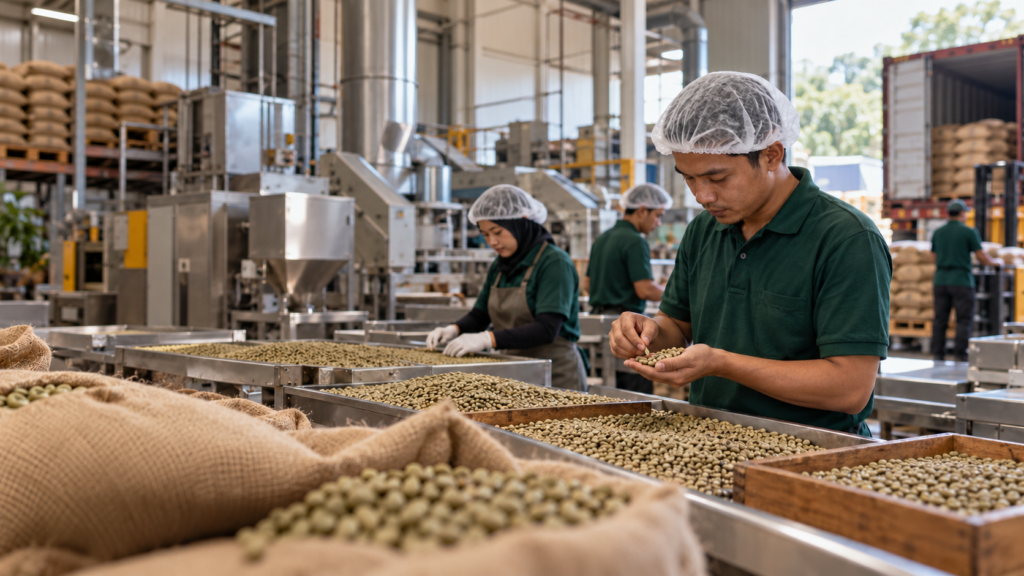
As an Indonesian coffee exporter, EFBA Agro International presents a sourcing approach that emphasizes coordination with producers and processing partners, clear product specifications, quality evaluation, packaging, and export preparation.
Furthermore, the company’s published quotation process encourages international buyers to define their required quantities, coffee grades, packaging preferences, shipping destinations, Incoterms, and documentation requirements before entering commercial discussions.
This structured approach helps buyers communicate technical expectations and allows both parties to evaluate whether the proposed supply arrangement meets their procurement needs.
Gayo Arabica Sourcing and Product Selection
EFBA Agro International offers published information about Gayo Arabica coffee for international wholesale buyers. As a potential Indonesian coffee exporter for Gayo sourcing, the company provides reference specifications that procurement teams can review before requesting commercial quotations.
Its coffee offering identifies essential parameters, including growing origin, processing method, physical grading, moisture content, bulk packaging, loading port, and minimum order quantity.
Furthermore, these specifications help importers prepare detailed inquiries rather than requesting products based only on Indonesian origin or general quality descriptions.
For example, a specialty coffee roaster may prioritize cup profile, defect classification, processing characteristics, and sample evaluation. Meanwhile, wholesale distributors may focus on repeatable physical quality, packaging consistency, available quantities, and shipment arrangements.
Therefore, buyers should define their intended application before selecting a specific Gayo Arabica offering.
For additional information about origin characteristics and procurement considerations, review EFBA Agro’s Indonesian Arabica Coffee Supplier article.
Procurement and Export Coordination
EFBA Agro’s published sourcing approach includes identifying buyer requirements, confirming commodity specifications, arranging sample evaluations, obtaining buyer approval, and progressing toward commercial discussions.
This process allows international buyers to clarify technical requirements before committing to larger purchase volumes. Moreover, it provides an opportunity to address quality expectations and potential sourcing limitations early in the procurement process.
When selecting an Indonesian coffee exporter, importers should also clarify responsibility for documentation, inspection, freight coordination, and delivery arrangements.
For this reason, EFBA Agro and prospective buyers should confirm the applicable export documents, quality inspection procedures, Incoterms, and shipment schedules separately for each transaction.
Additionally, written agreements should identify the relevant product specifications and procedures for handling quality differences.
Consequently, both parties can establish clearer expectations and reduce uncertainty during international procurement.
EFBA Group and Coffeenesia Support
EFBA Agro operates within the broader EFBA business ecosystem, which publishes information about business development, agricultural commodities, and international trade-related activities.
Furthermore, buyers researching Indonesian specialty coffee can explore Coffeenesia, which presents Gayo coffee beans and cascara for international wholesale markets.
Coffeenesia publishes sourcing information covering Gayo single-origin coffee, processing options, bulk quantities, and packaging considerations.
For example, international roasters and distributors interested in Indonesian coffee products can review its Indonesian Coffee Beans for Bulk Buyers resource.
These sourcing materials provide additional information for buyers comparing product characteristics and purchasing requirements.
However, buyers should not automatically assume that different businesses within the EFBA ecosystem offer identical specifications, certifications, inventory, or commercial conditions.
Instead, importers should confirm the contracting legal entity, available products, documentation, and final transaction terms with the relevant supplier.
By following this approach, international buyers can compare sourcing options more effectively while maintaining clear procurement responsibilities.
How to Import Indonesian Coffee Through an Indonesian Coffee Exporter
Importing coffee from Indonesia requires clear communication between the international buyer and the supplier. Therefore, businesses should begin by preparing a detailed request for quotation (RFQ) rather than asking only for general coffee prices.
A complete sourcing brief helps an Indonesian coffee exporter understand the buyer’s intended application, technical expectations, purchasing volume, and shipping requirements.
Moreover, an organized procurement process helps buyers compare supplier quotations using consistent criteria.
The following four steps provide a practical framework for requesting Indonesian coffee through EFBA Agro International.
1. Define Your Coffee Requirements
Begin by identifying whether your business requires green coffee beans, roasted coffee, or another coffee-related product.
Next, specify the intended market application, preferred origin, processing method, quality grade, purchasing quantity, and expected procurement schedule.
For instance, specialty roasters may require Gayo Arabica with particular sensory characteristics. Meanwhile, coffee manufacturers may prioritize consistency, production suitability, and predictable supply quantities.
Additionally, buyers should identify any destination-specific testing, traceability, food-safety, or documentation requirements before contacting the supplier.
By preparing this information, importers can help their Indonesian coffee exporter assess product suitability and commercial feasibility more efficiently.
2. Request Technical Information and Samples
After defining your requirements, request the available coffee specifications and supporting technical information from EFBA Agro.
Depending on availability, relevant information may include origin details, processing method, moisture content, defect classification, screen size, packaging, and lot-specific inspection records.
Furthermore, buyers should discuss sample arrangements and confirm whether any associated sampling or shipping costs apply.
Before making a bulk purchasing commitment, evaluate representative samples according to your roasting, cupping, and quality requirements.
For example, specialty roasters may conduct sample roasting and sensory evaluation. In contrast, larger commercial buyers may emphasize physical specifications and consistency across the proposed shipment lot.
Therefore, an Indonesian coffee exporter and its buyer should establish clear sample approval criteria before proceeding to commercial confirmation.
3. Confirm Commercial and Shipping Terms
Once the buyer approves the technical requirements, both parties should discuss the commercial aspects of the transaction.
These details may include product pricing, quotation currency, MOQ, packaging, Incoterms, loading port, destination, payment arrangements, and estimated shipment timing.
However, buyers should not compare supplier quotations based solely on the stated coffee price. Instead, they should evaluate which costs and responsibilities each quotation includes.
For instance, the total procurement cost may vary depending on freight, insurance, handling, customs, and import-related expenses.
Therefore, when negotiating with an Indonesian coffee exporter, importers should request a quotation that clearly identifies the price basis and the responsibilities of each party.
Additionally, buyers should confirm payment conditions and delivery arrangements before entering a binding commercial agreement.
4. Agree on Quality and Shipment Procedures
Before shipment, the buyer and supplier should confirm the technical specifications, inspection arrangements, acceptance criteria, and required documentation.
Furthermore, both parties should establish procedures for addressing quality differences, shipment discrepancies, or delivery-related issues.
For example, the purchase agreement may identify how inspectors will compare delivered coffee against the accepted reference sample.
The agreement may also specify documentation responsibilities and procedures for communicating potential quality deviations.
Consequently, buyers can establish clearer expectations and reduce uncertainty during receiving inspections.
The recommended procurement process is:
Buyer Requirements → Technical Specifications → Sample Approval → Commercial Agreement → Pre-Shipment Verification → Export Documentation → Shipment → Receiving Inspection
This structured sequence allows importers and their Indonesian coffee exporter to establish repeatable purchasing procedures.
Moreover, consistent documentation and quality criteria can support future orders without requiring both parties to renegotiate every technical requirement from the beginning.
FAQ About Indonesian Coffee Exporters
1. What does an Indonesian coffee exporter supply?
An Indonesian coffee exporter may supply green coffee beans, roasted coffee, or other coffee-related products depending on its commercial portfolio. Services can include sourcing, quality coordination, packaging, export documentation, and international shipment arrangements.
However, buyers should confirm the supplier’s actual capabilities, available coffee formats, minimum order quantities, and delivery responsibilities before ordering.
2. Does EFBA Agro export Indonesian coffee beans?
EFBA Agro International presents Gayo Arabica coffee as part of its agricultural export portfolio. Its published product information includes green and roasted coffee offerings, technical specifications, packaging options, and a minimum wholesale purchasing quantity.
International buyers can contact EFBA Agro to confirm current availability, lot specifications, and commercial export arrangements.
3. What is the minimum order quantity for EFBA Agro coffee?
EFBA Agro’s published Gayo Arabica coffee product page lists a minimum order quantity of 5 metric tons.
However, buyers should verify whether this MOQ applies to their preferred coffee lot, packaging format, available inventory, and transaction conditions.
Additionally, prospective importers should confirm any applicable sample purchasing arrangements before placing commercial orders.
4. What quality parameters should buyers check?
When choosing an Indonesian coffee exporter, buyers should evaluate origin, processing method, moisture content, defect classification, screen size, sensory profile, storage conditions, packaging, and available inspection records.
Furthermore, the purchasing agreement should identify measurable acceptance criteria that match the intended commercial application.
For example, specialty roasters may require detailed sensory evaluation, while industrial buyers may emphasize consistent physical grading and supply volumes.
5. Can international buyers request coffee samples?
EFBA Agro publishes a sourcing process that includes sample evaluation and buyer approval. Therefore, interested buyers can contact the company to discuss representative samples and applicable arrangements.
However, sample availability, pricing, shipping costs, and additional testing requirements may vary according to the specific coffee lot and procurement request.
For this reason, buyers should confirm sampling terms before proceeding with commercial evaluations.
6. Which Indonesian coffee is suitable for specialty roasting?
Gayo Arabica is one Indonesian origin that international specialty roasters may consider. Depending on the particular lot, it can offer sensory characteristics suitable for different roasting approaches and coffee applications.
However, suitability depends on moisture content, defects, cup profile, processing characteristics, roast performance, and the buyer’s intended product.
Consequently, roasters should evaluate representative samples rather than selecting coffee based solely on geographic origin.
7. What documents are needed to import coffee from Indonesia?
Documentation requirements depend on the destination country, coffee format, applicable regulations, and shipment arrangements.
Common documents may include a commercial invoice, packing list, export customs documents, transport documents, and certificates or inspection records when applicable.
Furthermore, buyers should confirm destination-specific food-safety, traceability, phytosanitary, and customs requirements.
An Indonesian coffee exporter can coordinate the export documentation within its agreed responsibilities, while importers remain responsible for confirming their applicable import obligations.
8. Does EFBA Agro support bulk coffee exports?
EFBA Agro publishes bulk agricultural export services and commercial specifications for Gayo Arabica coffee.
Prospective buyers can submit inquiries covering purchasing quantity, coffee grade, packaging requirements, destination port, preferred Incoterms, and shipment expectations.
Moreover, providing a detailed sourcing brief helps EFBA Agro evaluate whether its available coffee offerings match the buyer’s technical and commercial requirements.
Source Indonesian Coffee for Wholesale with EFBA Agro
Choosing a reliable Indonesian coffee exporter requires careful evaluation of coffee origin, quality specifications, supply arrangements, documentation, and commercial terms. International importers, roasters, and distributors should prioritize measurable quality criteria and representative sample evaluation rather than relying exclusively on price or origin reputation.
Furthermore, buyers should confirm available inventory, packaging arrangements, shipment responsibilities, and destination-market requirements before making commercial commitments.
EFBA Agro International provides a sourcing contact for global buyers interested in Indonesian agricultural commodities, including Gayo Arabica coffee.
Through its published product information, the company offers initial reference specifications that can help importers prepare more detailed procurement inquiries.
Therefore, international buyers seeking an Indonesian coffee exporter can contact EFBA Agro to discuss their intended coffee application, quality grade, purchasing volume, packaging preferences, and destination requirements.
For an effective initial inquiry, include your company information, target coffee specifications, estimated order quantity, destination port, preferred Incoterm, and expected purchasing schedule.
Explore EFBA Agro International to discuss Indonesian coffee sourcing and wholesale export requirements.

Looking for an Indonesian coffee exporter for your next wholesale order? Contact EFBA Agro International to discuss Gayo Arabica specifications, bulk quantities, samples, packaging, export arrangements, and a commercial quotation.
You can also explore Coffeenesia for additional Gayo coffee and cascara sourcing information.
Coffee Origin → Quality Specification → Sample Evaluation → Commercial Approval → Export Preparation → Global Delivery