Indonesia is an important cassava producer, supplying raw materials for tapioca starch, cassava flour, modified cassava flour (MOCAF), and other agricultural products. However, maintaining a reliable supply requires more than sufficient agricultural output. Harvest schedules, root quality, processing capacity, transportation, and storage conditions all influence product availability.
Understanding cassava supply chain Indonesia operations helps international buyers evaluate production reliability, sourcing opportunities, and potential delivery risks. Fresh cassava roots deteriorate rapidly after harvesting, making coordination between farmers, collectors, transporters, and processors particularly important.
Furthermore, seasonal production, extreme weather, inconsistent raw-material specifications, and infrastructure disruptions can create additional challenges. Therefore, effective supply management should connect production planning, quality control, logistics, and procurement to improve delivery predictability.
What Is the Cassava Supply Chain in Indonesia?
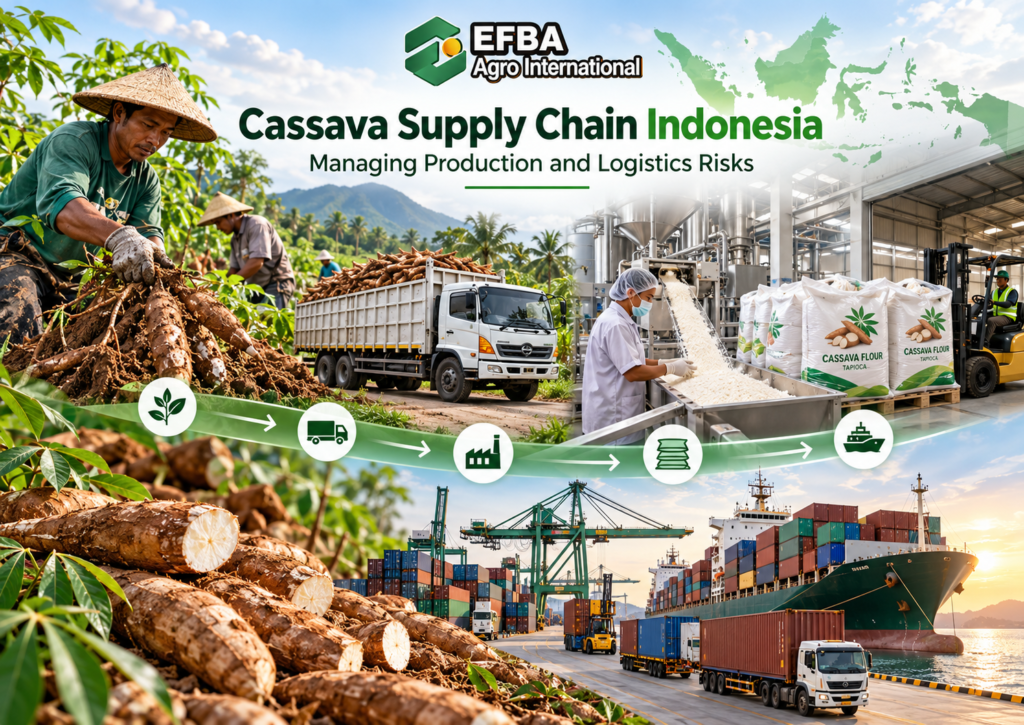
The cassava supply chain in Indonesia connects farmers, collectors, transport providers, processors, warehouses, and distributors that move cassava from agricultural production to domestic manufacturers and international buyers.
The process includes cultivation, harvesting, raw-material collection, transportation, processing, quality inspection, packaging, storage, and distribution. Each stage requires coordination because delays or quality problems can affect the availability of finished cassava-based commodities.
The main process follows:
Cassava Farming → Harvesting → Collection → Transportation → Processing → Quality Control → Packaging → Storage → Distribution / Export
For international buyers, managing the cassava supply chain Indonesia requires evaluating both agricultural origin and commercial readiness. Therefore, reliable procurement should consider supplier capability, technical specifications, available volume, processing schedules, and delivery commitments.
How Does Cassava Production and Supply Management Work in Indonesia?
Cassava production involves several interconnected activities, from preparing agricultural land to delivering finished products to industrial buyers. Although farming conditions vary across Indonesia, effective management follows one principle: match available production with processing capacity and customer requirements.
Understanding these stages helps buyers manage cassava supply chain Indonesia operations, identify potential disruptions, and establish more realistic procurement schedules.
1. Cassava Farming and Production Planning
The first stage involves selecting appropriate cultivation areas, cassava varieties, soil management practices, and harvest schedules. Farmers must consider rainfall, planting materials, productivity, and the requirements of the intended processing industry.
For processors, production planning should begin before harvesting. Estimating incoming root volumes helps factories coordinate labor, transportation, processing capacity, and raw-material purchasing.
Cassava sourcing also benefits from evaluating different production regions rather than depending exclusively on one area. However, buyers should verify supplier quality, available quantities, processing access, and commercial conditions before including alternative sources in procurement plans.
2. Harvesting and Raw Material Collection
Harvesting schedules influence cassava quality and raw-material availability. Early harvesting may affect starch yield, while delays can interrupt supply commitments and processing operations.
After harvesting, farmers and collectors should minimize mechanical damage and arrange prompt transportation to processing facilities. Fresh cassava roots deteriorate quickly, making timely collection particularly important for starch manufacturers.
The Food and Agriculture Organization (FAO) explains that physiological deterioration in fresh cassava roots can begin within 24 hours after harvesting. Therefore, efficient collection schedules help reduce postharvest losses and maintain raw-material quality.
3. Transportation from Farms to Processing Facilities
Transportation connects agricultural production with industrial processing. Trucks commonly transport harvested cassava roots from farms or collection points to manufacturing facilities, where processors inspect the raw materials before production.
However, poor roads, heavy rainfall, vehicle shortages, and long transport distances can extend delivery times. These disruptions become especially important when factories depend on fresh roots with limited storage flexibility.
Consequently, cassava supply chain Indonesia planning should evaluate transport capacity, road accessibility, collection schedules, and alternative logistics arrangements. Effective coordination can help processors reduce avoidable delays and manage production commitments.
4. Cassava Processing and Value Addition
Processing converts fresh cassava roots into products that manufacturers can use in food and industrial applications. Depending on the intended commodity, operations may involve washing, peeling, grating, starch extraction, fermentation, drying, milling, and packaging.
However, different cassava derivatives require different production methods. Tapioca starch primarily comes from starch extraction, while modified cassava flour (MOCAF) involves different processing techniques, commonly including controlled fermentation.
For procurement teams, understanding these differences helps ensure that purchased products meet the intended manufacturing application. It also prevents buyers from treating tapioca starch and MOCAF as interchangeable ingredients.
5. Quality Control and Product Specification Management
Quality control connects agricultural output with customer requirements. Raw-material characteristics, processing conditions, moisture levels, particle properties, and contamination prevention can influence finished-product performance.
Before confirming orders, buyers should request technical specifications that match their industrial requirements. For tapioca starch, relevant parameters may include moisture, whiteness, ash content, starch content, acidity, and viscosity.
EFBA Agro publishes technical information about Tapioca Flour (Food Grade), which buyers can use as an initial commercial reference. However, each purchasing agreement should confirm current specifications, testing requirements, and batch conformity.
6. Packaging, Storage, and Inventory Management
Processed cassava products require appropriate packaging and warehouse conditions to maintain their characteristics. Finished tapioca starch and cassava flour generally offer greater storage flexibility than fresh roots, but moisture exposure, pests, contamination, and unsuitable storage conditions can still affect quality.
Therefore, suppliers should monitor packaging integrity, warehouse cleanliness, inventory rotation, and batch traceability. Buyers should also confirm that packaging meets transportation, handling, and storage requirements.
Within the cassava supply chain Indonesia, proper inventory planning helps companies manage procurement uncertainty and fluctuations in replenishment lead times. However, safety stock levels should reflect actual demand, available storage capacity, product characteristics, and working-capital requirements.
7. Export Logistics and International Delivery
Export logistics connect Indonesian cassava processors with international buyers. The process involves confirming product availability, packaging, commercial documents, transportation to loading ports, customs requirements, and shipment schedules.
Before dispatch, buyers and suppliers should agree on product quantities, specifications, inspection requirements, Incoterms, and shipping documents. Procurement teams must also consider applicable import regulations and food-safety requirements in destination markets.
Effective coordination helps reduce uncertainty between purchasing, processing, packaging, and delivery. Nevertheless, actual shipment timelines depend on production readiness, transport conditions, port schedules, and regulatory requirements.
Cassava Supply Chain Indonesia: Main Production and Logistics Risks
The cassava supply chain Indonesia faces risks across agricultural production, processing, transportation, and international distribution. Some originate during cultivation, while others emerge through commercial coordination, inventory management, or logistics operations.
Understanding these risks helps buyers assess supplier reliability and develop procurement strategies that support consistent product quality and delivery performance.
| Risk category | Potential impact | Recommended management |
|---|---|---|
| Seasonal production | Uneven raw-material availability | Harvest forecasting and supplier planning |
| Extreme weather | Field damage and transport disruption | Regional risk monitoring |
| Root deterioration | Lower usable raw-material quality | Faster collection and processing |
| Quality inconsistency | Variation in product specifications | Quality inspection and supplier verification |
| Processing interruption | Reduced output or delayed orders | Capacity planning and contingency arrangements |
| Logistics disruption | Higher transport costs and late delivery | Alternative route assessment |
| Inventory shortages | Difficulty fulfilling orders | Demand forecasting and safety stock |
| Export documentation | Customs or shipping delays | Document verification before dispatch |
Managing these risks requires cooperation between farmers, collectors, processors, suppliers, and logistics providers. However, buyers should recognize that published production capacity or historical delivery performance does not guarantee immediate availability for every new order.
Official Data: Indonesian Cassava Production and Supply Conditions
Indonesia’s Ministry of Agriculture provides agricultural production statistics through its annual reports and the Satu Data Pertanian platform. These publications help international buyers identify production trends, major sourcing regions, and potential supply concentration risks.
According to the Ministry of Agriculture’s 2025 Annual Performance Report, citing BPS final production figures, Indonesia produced approximately 14.65 million metric tonnes of cassava in 2025, compared with 15.18 million metric tonnes in 2024. This represents a decline of approximately 3.5%.
Indonesian Cassava Production: Official Historical Indicators
| Production year | National cassava production |
|---|---|
| 2024 | Approximately 15.18 million tonnes |
| 2025 | Approximately 14.65 million tonnes |
| Year-on-year change | Approximately −3.5% |
Source: Indonesian Ministry of Agriculture, 2025 Annual Performance Report, citing BPS final figures.
The Ministry’s separate 2025 Cassava Trade Performance Analysis identifies Lampung as a major production center, representing approximately 47.32% of national cassava output in its 2024 regional dataset. Other producing provinces include Central Java, East Java, West Java, North Sumatra, Yogyakarta, and East Nusa Tenggara.
However, the publications use statistical series that produce different historical totals. Therefore, buyers should examine the underlying methodology before combining regional production percentages with national figures from another report.
For international procurement, these figures demonstrate why cassava supply chain Indonesia analysis should consider both national production trends and regional supplier concentration.
What Do These Statistics Mean for International Buyers?
Changes in national cassava production can influence the broader procurement environment, but they do not directly indicate export-grade tapioca starch or cassava flour availability.
Finished-product supply also depends on starch recovery, processing capacity, domestic industrial demand, inventories, and commercial arrangements. Therefore, procurement teams should request supplier-specific information before confirming purchasing commitments.
The Ministry’s 2025 research performance report also identifies seasonal raw-material availability, starch quality challenges, and weaknesses in farmer–processor purchasing arrangements. These findings emphasize the importance of production coordination, quality control, and transparent procurement.
Why Is Cassava Logistics More Time-Sensitive Than Other Agricultural Commodities?
Fresh cassava roots deteriorate more rapidly than many dried agricultural commodities. The FAO explains that physiological deterioration can begin within 24 hours after harvesting, while substantial quality losses may develop within several days without suitable handling.
This characteristic creates an important operational distinction between transporting fresh roots and distributing processed cassava products. Fresh cassava requires close coordination between harvesting and factory intake, whereas dried tapioca starch or cassava flour offers greater storage flexibility under suitable conditions.
Consequently, cassava supply chain Indonesia logistics management should account for the different handling requirements of each commodity.
| Supply stage | Fresh cassava roots | Tapioca starch / MOCAF |
|---|---|---|
| Main priority | Rapid movement to processing | Moisture and contamination control |
| Storage flexibility | Limited | Generally greater under suitable conditions |
| Key quality concern | Physiological deterioration | Specification and storage stability |
| Transport planning | Harvest-to-factory coordination | Warehouse-to-port coordination |
| Inventory planning | Minimize prolonged holding | Manage stock rotation and storage |
International buyers should avoid applying identical procurement assumptions to fresh cassava roots, tapioca starch, and MOCAF. Each commodity requires appropriate specifications, handling procedures, storage conditions, and delivery schedules.
6 Strategies for Managing Cassava Supply Chain Risks
Reliable procurement strategies should balance product availability, quality, cost, and delivery performance. For international buyers, effective cassava supply chain Indonesia management requires evaluating both agricultural conditions and commercial logistics arrangements.
The following strategies help procurement teams reduce avoidable risks without assuming that agricultural supply chains can remain completely unaffected by disruptions.
1. Diversify Raw Material Sourcing
Depending on one agricultural production region can increase exposure to extreme weather, harvest disruptions, and transportation problems. Therefore, buyers should evaluate qualified suppliers across different Indonesian cassava-producing regions.
However, diversification should involve more than geographic distance. Procurement teams must also assess processing access, available volume, product specifications, documentation, and logistics costs before approving alternative suppliers.
A diversified sourcing strategy can improve procurement flexibility when disruptions affect a particular location. Nevertheless, buyers should verify alternative supplier readiness before relying on additional sourcing arrangements.
2. Match Harvest Forecasts with Processing Capacity
Effective production planning is essential for maintaining reliable cassava supply chain Indonesia operations. Cassava processors need predictable raw-material arrivals to manage factory utilization, processing schedules, and purchasing commitments. Therefore, suppliers should compare expected harvest volumes with collection capacity, available labor, and production requirements.
When raw-material availability changes, early communication helps processors adjust schedules and inform buyers about potential delays. This coordination becomes especially important during seasonal fluctuations or unexpected disruptions. By aligning agricultural output with manufacturing capacity, suppliers can reduce avoidable interruptions and improve procurement planning.
3. Implement Quality Verification at Critical Stages
Quality verification helps maintain consistency throughout the cassava supply chain. Suppliers should begin quality management with raw-material selection and continue through processing, storage, packaging, and dispatch. Depending on the commodity, buyers may require sampling, batch identification, laboratory analysis, and inspection records.
For example, tapioca buyers should establish acceptable limits for moisture, starch characteristics, and other application-specific parameters. These requirements help procurement teams evaluate product suitability before shipment. However, buyers and suppliers should agree on testing methods and acceptance criteria according to the purchase contract and destination-market requirements.
For international manufacturers, quality verification is an important component of cassava supply chain Indonesia management because product consistency directly influences procurement decisions and manufacturing performance.
4. Optimize Transport Routes and Delivery Scheduling
Transportation plays an important role in connecting agricultural production with processing facilities and international markets. Therefore, suppliers should evaluate farm-to-factory collection routes, warehouse access, inland transportation, and port connectivity. When practical, alternative routes and logistics providers can reduce reliance on a single transportation arrangement.
However, changing routes may increase operational expenses or introduce additional constraints. Procurement teams should compare transportation costs, delivery times, cargo suitability, and commercial feasibility before making adjustments.
Effective cassava supply chain Indonesia logistics also requires coordination between suppliers, warehouses, freight providers, and buyers. Clear delivery schedules help reduce uncertainty and improve shipment planning, particularly when seasonal weather affects transportation infrastructure.
5. Maintain Appropriate Processed-Product Inventory
Inventory management helps manufacturers respond to changes in cassava availability and replenishment lead times. Safety stock may provide additional flexibility when suppliers experience temporary production or transportation disruptions. However, inventory levels should reflect actual demand, storage conditions, product shelf life, and working-capital requirements.
Processed cassava products such as tapioca starch and MOCAF generally provide greater storage flexibility than fresh roots under suitable conditions. Nevertheless, suppliers must maintain appropriate packaging, warehouse cleanliness, batch traceability, and inventory rotation.
Within the cassava supply chain Indonesia, effective stock management supports more predictable procurement and delivery arrangements. Buyers should still verify finished-product availability and batch quality before confirming commercial shipments.
6. Strengthen Contracts and Supplier Communication
Clear procurement agreements help buyers and suppliers manage product specifications, quantities, pricing, delivery windows, inspections, and logistics responsibilities. Both parties should also establish communication procedures and contingency arrangements for unexpected supply disruptions.
For international orders, clearly defined Incoterms and documentation responsibilities are particularly important. Suppliers should provide updates on production status, available inventory, quality requirements, and shipment readiness. These updates help buyers make informed decisions before operational problems affect delivery commitments.
A reliable cassava supply chain Indonesia strategy should therefore connect supplier verification, inventory planning, logistics coordination, and transparent commercial communication.
The recommended framework is:
Supply Forecast → Supplier Verification → Quality Control → Production Planning → Inventory Management → Logistics Confirmation → Delivery Monitoring
Practical Example: Managing a 20-Metric-Tonne Tapioca Order
Consider an international buyer planning to purchase 20 metric tonnes of food-grade tapioca starch from Indonesia. The buyer requires consistent technical specifications, suitable packaging, and delivery within an agreed commercial schedule.
This example illustrates how cassava supply chain Indonesia management connects product availability, quality verification, inventory planning, and export logistics. Rather than confirming shipment solely from a supplier quotation, procurement teams should evaluate the following requirements.
| Procurement stage | Buyer verification |
|---|---|
| Product requirement | Food-grade tapioca specifications |
| Quantity | 20 metric tonnes |
| Packaging | 25 kg or 50 kg bags |
| Quality | Product specifications and inspection documents |
| Inventory | Finished-product availability |
| Transport | Inland transportation and container booking |
| Commercial terms | Confirmed Incoterm and shipment window |
| Delivery | Documentation and dispatch monitoring |
For 20 metric tonnes, buyers would require approximately 800 bags of 25 kg or 400 bags of 50 kg. However, actual loading feasibility also depends on packaging dimensions, container payload limits, transportation restrictions, and destination requirements.
EFBA Agro’s published Tapioca Flour (Food Grade) page provides commercial information about packaging and shipment configurations. The page lists an indicative loading capacity of approximately 20 metric tonnes per 20-foot container and identifies Tanjung Priok as the stated loading port.
These details provide a reference for procurement planning, but they do not confirm immediate product availability or a specific shipment booking.
What If Raw Material Supply Is Delayed?
Raw-material shortages can affect cassava processors when farmers cannot deliver the expected harvest volume. In such situations, suppliers should first evaluate whether existing finished-product inventory can fulfill the contracted quantity.
If available stock cannot meet demand, procurement teams may need to assess alternative qualified suppliers, revised production schedules, or adjusted shipment arrangements. Buyers should also consider whether substitute sourcing options meet the same technical and commercial requirements.
This process demonstrates why effective cassava supply chain Indonesia planning requires contingency arrangements and timely communication. Suppliers should confirm operational conditions before making new delivery commitments, helping buyers evaluate alternatives against their manufacturing schedules.
This scenario is illustrative and does not describe an actual EFBA Agro customer transaction.
EFBA Agro International’s Experience in Cassava Commodity Sourcing
EFBA Agro International publishes information about Indonesian agricultural commodity sourcing and export services. Its official website presents products such as cassava derivatives, coffee, spices, and other agricultural commodities for commercial and industrial buyers.
The company also describes sourcing activities involving agricultural producers, product specifications, packaging arrangements, quality requirements, and export coordination. These capabilities are relevant to companies evaluating cassava supply chain Indonesia sourcing opportunities.
For cassava-based commodities, EFBA Agro’s published portfolio includes food-grade tapioca flour, modified cassava flour (MOCAF), and related agricultural products. These offerings provide initial reference information for food manufacturers, wholesalers, importers, and procurement managers seeking Indonesian agricultural ingredients.
Tapioca Flour Sourcing and Product Specifications
EFBA Agro’s official Tapioca Flour (Food Grade) page provides technical information that buyers can review before requesting quotations.
| Parameter | Published reference specification |
|---|---|
| Appearance | Fine white powder |
| Starch content | Minimum 85% |
| Moisture | Maximum 13% |
| Ash content | Maximum 0.2% |
| Whiteness | Minimum 92% |
| Viscosity | Minimum 700 BU |
| Packaging | 25 kg / 50 kg bags; 500 kg on request |
These specifications provide a useful commercial starting point for international procurement. However, buyers should confirm current technical documentation, applicable testing methods, batch conformity, and purchasing terms before finalizing orders.
Technical verification also supports cassava supply chain Indonesia quality management by helping buyers assess whether finished products meet their manufacturing requirements.
MOCAF and Cassava-Based Product Development
EFBA Agro also publishes information about Modified Cassava Flour (MOCAF) as part of its agricultural commodity portfolio. The company’s product information describes potential applications in food manufacturing, including bread, pastries, noodles, and gluten-free formulations.
MOCAF and tapioca starch have different processing characteristics and functional properties. Therefore, buyers should confirm product specifications, intended applications, and technical requirements before selecting a commodity.
Understanding these differences helps manufacturers make appropriate sourcing decisions. It also supports the broader cassava supply chain by connecting raw-material processing with industrial product requirements.
Procurement Coordination and Export Logistics
EFBA Agro describes its involvement in agricultural sourcing, quality-related requirements, packaging, and international shipment preparation. Its published articles also discuss the importance of connecting farmers, processors, suppliers, and international buyers within Indonesian commodity trade.
For international procurement teams, these activities relate directly to cassava supply chain Indonesia logistics and sourcing management. Buyers need accurate information about product availability, finished-product specifications, commercial documentation, and shipment arrangements.
However, published services do not automatically guarantee capacity or availability for every order. Therefore, companies should request current confirmation of product quantities, quality documentation, packaging options, and delivery schedules before purchasing.
How EFBA’s Business Partnership Ecosystem Supports Supply Chain Development
PT EFBA Digital Mulia publishes information about strategic partnerships, business development, market access, distribution, and logistics-related capabilities. Through its Business Partnership page, the company explains how cooperation can connect complementary business capabilities.
This ecosystem may offer relevant opportunities for agricultural companies seeking to strengthen supplier coordination, commercial relationships, and procurement planning. However, businesses should verify the availability and scope of any specific service or partnership before entering an agreement.
For companies evaluating the cassava supply chain Indonesia, partnership coordination can support more informed decisions about supplier capabilities, product quality, commercial terms, and delivery arrangements. The objective is to improve procurement transparency while maintaining clear responsibilities throughout the transaction.
Cassava Supply Chain Indonesia: Procurement Checklist for International Buyers
Before purchasing cassava-derived agricultural commodities, international buyers should evaluate production readiness, supplier reliability, product specifications, and logistics requirements.
The following checklist helps procurement teams identify essential purchasing considerations and potential cassava supply chain Indonesia risks.
- Confirm the required cassava product and its industrial application.
- Verify the sourcing region and available production volume.
- Review supplier processing capacity and production schedules.
- Request technical specifications and relevant quality documents.
- Confirm packaging, inventory, and storage arrangements.
- Check transportation routes and export documentation.
- Agree on Incoterms, shipment schedules, and contingency procedures.
This checklist supports procurement evaluation but does not replace contractual review, quality inspection, or compliance with destination-country import requirements. Buyers should confirm the conditions of each transaction directly with the relevant supplier.
Frequently Asked Questions About Cassava Supply Chain Indonesia
How does the cassava supply chain work in Indonesia?
The cassava supply chain connects farmers, collectors, transporters, processors, warehouses, and buyers. Farmers cultivate and harvest cassava roots, while transporters deliver raw materials to processing facilities. Manufacturers then produce tapioca starch, cassava flour, MOCAF, or other derivatives before domestic distribution or export.
What are the biggest risks in Indonesia’s cassava supply chain?
Major risks include seasonal raw-material availability, rapid postharvest deterioration, inconsistent product quality, extreme weather, processing interruptions, and transportation delays. Managing cassava supply chain Indonesia risks requires buyers to evaluate production regions, supplier capabilities, product specifications, and logistics arrangements.
Why must fresh cassava be processed quickly?
Fresh cassava roots deteriorate rapidly after harvesting. Physiological deterioration can begin within 24 hours and affect usable raw-material quality if farmers and processors delay handling. Therefore, reliable harvesting schedules, transportation, and timely processing help minimize postharvest losses.
Which regions produce cassava in Indonesia?
Lampung is one of Indonesia’s major cassava-producing provinces. Other important production areas include Central Java, East Java, West Java, North Sumatra, Yogyakarta, and East Nusa Tenggara. However, commercial availability depends on agricultural seasons, processing capacity, and supplier arrangements.
How can international buyers reduce cassava supply risks?
International buyers can diversify qualified suppliers, monitor production schedules, verify specifications, maintain appropriate inventories, and coordinate logistics before shipment. Clear procurement agreements and supplier communication also improve preparedness for unexpected disruptions.
For companies developing a cassava supply chain Indonesia procurement strategy, these measures help balance product availability, quality, cost, and delivery requirements.
What is the difference between tapioca starch and MOCAF?
Tapioca starch primarily comes from starch extraction, while MOCAF is modified cassava flour produced through different processing methods, commonly involving fermentation. Their characteristics and industrial applications differ, so buyers should verify technical specifications before purchasing.
Does EFBA Agro International supply cassava-based products?
EFBA Agro International publishes sourcing and export information for tapioca flour, MOCAF, and related cassava commodities. International buyers can contact the company to confirm current products, technical specifications, available quantities, packaging options, commercial prices, and shipment arrangements.
Build a More Reliable Cassava Supply Chain with EFBA Agro International
Managing the cassava supply chain Indonesia requires coordination across agricultural production, harvesting, transportation, processing, quality control, inventory, and export logistics. Reliable procurement depends on evaluating these stages together rather than focusing exclusively on price or production volume.
For manufacturers and importers, successful purchasing begins with clearly defined product requirements, qualified suppliers, quality verification, and realistic delivery planning. Therefore, consistent communication and logistics coordination should remain essential components of procurement decisions.
The recommended process follows:
Production Planning → Quality Verification → Inventory Control → Logistics Coordination → Reliable Procurement
EFBA Agro International provides information about Indonesian agricultural commodities through its official website. Buyers can explore its Tapioca Flour (Food Grade) and Modified Cassava Flour (MOCAF) pages to review published product information.
For companies seeking Indonesian tapioca flour or related cassava commodities, EFBA Agro can serve as an initial contact for discussing product requirements, current availability, packaging, quotations, and export arrangements.
Reliable cassava supply chain Indonesia sourcing begins with verified specifications, transparent supplier communication, and realistic procurement planning. These practices help international buyers manage agricultural sourcing risks and make better purchasing decisions.
EFBA Agro International provides information on Indonesian tapioca flour, MOCAF, and other agricultural commodities through its official website. Buyers can review the company’s Tapioca Flour (Food Grade) and Modified Cassava Flour offerings before requesting current quotations.
Contact EFBA Agro International to discuss cassava-derived commodity requirements, technical specifications, packaging options, available volumes, and export arrangements.