Indonesian Arabica Coffee Supplier

Indonesia is one of the world’s most recognized coffee origins, offering diverse flavor profiles shaped by altitude, volcanic soil, microclimates, processing methods, and local farming traditions.
For international roasters, distributors, café chains, and importers, finding the right Indonesian Arabica coffee supplier is not only about buying coffee beans. It is about securing consistent quality, clear specifications, reliable sourcing, traceability, proper post-harvest handling, and dependable export support.
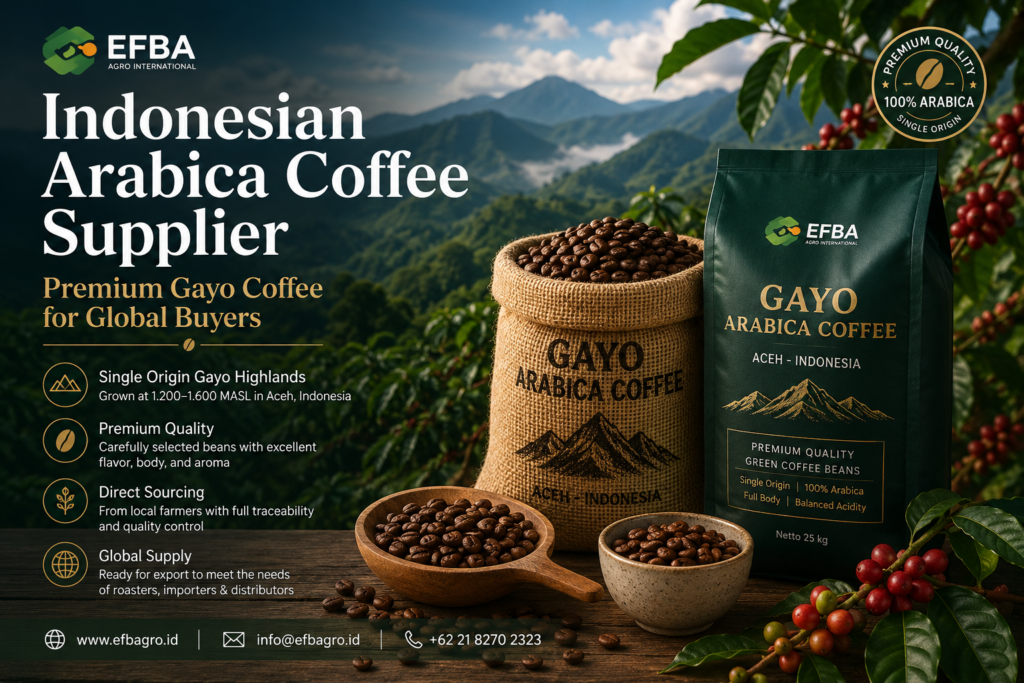
EFBA Agro International provides Indonesian agricultural commodities for wholesale and export markets, including Gayo Arabica coffee from the highlands of Aceh. The company positions Gayo Arabica as a premium specialty coffee known for its full body and complex flavor profile.
For buyers who want to explore Indonesian specialty coffee more deeply, EFBA Agro is also connected with Coffeenesia , a specialized Indonesian coffee and cascara sourcing platform focused on direct sourcing from the Gayo Highlands.
What Is an Indonesian Arabica Coffee Supplier?
An Indonesian Arabica coffee supplier is a business that sources, prepares, supplies, or exports Arabica coffee beans from Indonesian growing regions to buyers such as:
- coffee importers;
- specialty roasters;
- distributors;
- café chains;
- private-label coffee businesses;
- beverage manufacturers;
- wholesale buyers.
A professional Indonesian Arabica coffee supplier should do more than simply offer beans. International buyers generally need clarity regarding:
Origin → Variety → Processing Method → Grade → Moisture → Defect Level → Packaging → Volume → Export Documentation → Shipping Arrangement
The quality of the sourcing relationship can directly affect consistency in roasting, product positioning, customer experience, and long-term supply planning.
Why Source Arabica Coffee from Indonesia?
Indonesia offers a wide range of coffee-growing environments. Arabica coffee is produced in several well-known regions, including:
- Aceh;
- North Sumatra;
- Java;
- Bali;
- Flores;
- Sulawesi.
Each origin can offer a different sensory profile because of differences in altitude, soil, rainfall, temperature, coffee variety, post-harvest process, and farming practices.
This regional diversity allows international buyers to select Indonesian Arabica coffee according to their product positioning and target market.
1. Specialty Single-Origin
Coffee with a strong regional identity and distinctive sensory characteristics.
2. Espresso Blend
Coffee selected for body, sweetness, balance, and structure.
3. Filter Coffee
Coffee selected for clarity, aroma, acidity, and flavor complexity.
4. Commercial Roasting
Coffee sourced for consistency and scalable supply.
Therefore, Indonesia can serve both specialty and commercial coffee markets.
Gayo Arabica Coffee from Aceh
One of the important origins within the EFBA Agro coffee portfolio is Gayo Arabica.
EFBA Agro describes its Gayo coffee as originating from the highlands of Aceh and grown at approximately 1,200–1,600 meters above sea level. The coffee is presented as having medium-to-full body, balanced acidity, and distinctive floral and herbal aromas.
The Gayo Highlands are especially relevant for buyers seeking:
- single-origin Arabica;
- specialty coffee;
- traceable sourcing;
- distinctive Indonesian character;
- premium coffee products.
Buyers who want detailed information about Gayo sourcing can also explore Coffeenesia , which specializes in single-origin Indonesian coffee sourced from the Gayo Highlands.
What Makes Gayo Arabica Different?
Coffee quality cannot be summarized with one flavor description. However, Gayo Arabica is commonly valued for a combination of:
- substantial body;
- balanced acidity;
- aromatic complexity;
- herbal characteristics;
- floral notes;
- sweetness;
- long finish.
Processing method also influences the final profile.
Natural Process
- fruit-forward characteristics;
- sweetness;
- heavier body;
- fermentation character.
Washed Process
- cleaner profiles;
- brighter acidity;
- clearer flavor separation.
Wet-Hulled Process
A traditional Indonesian processing method often associated with deeper body and characteristic Indonesian cup profiles.
Buyers should therefore select a processing method according to their desired roasting profile and target market.
Why Direct Sourcing Matters for an Indonesian Arabica Coffee Supplier
One major challenge in global coffee sourcing is the distance between the buyer and the farm.
A longer supply chain may look like:
Farmer → Collector → Processor → Trader → Exporter → Importer → Roaster
The longer this chain becomes, the more difficult it may be to understand exactly where the coffee originated and how it was handled.
Coffeenesia emphasizes a more direct approach. Its website states that the company established farm presence in the Gayo Highlands, Aceh, and oversees coffee and cascara production.
For buyers, direct sourcing can provide:
- clearer origin information;
- greater traceability;
- stronger communication;
- better quality feedback;
- closer supplier relationships;
- potentially more consistent repeat orders.
Traceability Is Important for International Buyers
Traceability allows buyers to understand the origin and production history of a coffee lot.
Depending on the supplier, information may include:
- region;
- farm or cooperative;
- altitude;
- variety;
- processing method;
- harvest period;
- drying method;
- lot information.
Coffeenesia states that it provides transparency regarding origin, variety, and processing methods for its coffee and cascara products.
Quality Control
Roasters can compare different lots and monitor consistency.
Brand Storytelling
Coffee companies can communicate origin more clearly to customers.
Procurement
Buyers can maintain purchasing specifications for future orders.
Supplier Evaluation
Importers can better understand consistency between shipments.
For premium coffee, traceability can support both quality management and brand positioning.
Quality Control in Indonesian Arabica Coffee
An Indonesian Arabica coffee supplier should have clear quality control procedures.
Coffee quality can be affected at several stages:
Harvest → Cherry Selection → Processing → Drying → Sorting → Storage → Packaging → Transport
Coffeenesia describes its production process as beginning with selective harvesting of ripe red cherries, followed by hygienic processing and slow drying on raised beds for even air circulation.
These steps matter because poor handling can contribute to:
- mold;
- unwanted fermentation;
- inconsistent moisture;
- off-flavors;
- physical defects;
- reduced storage stability.
Moisture Control and Coffee Storage
Moisture is particularly important for green coffee. Coffee stored with excessive moisture may become more vulnerable to quality deterioration and storage instability.
EFBA Agro’s existing Indonesian coffee content describes post-harvest drying targets around 10–12% moisture before storage and export preparation.
Buyers should discuss moisture together with:
- water activity where applicable;
- storage conditions;
- packaging;
- shipping duration;
- destination climate.
Actual product specifications should always be requested for the specific lot being purchased.
Green Coffee Beans vs Roasted Coffee Beans
International buyers should first determine whether they require green coffee beans or roasted coffee.
Green Coffee Beans
Suitable for:
- coffee roasters;
- importers;
- distributors;
- private-label manufacturers.
Advantages include:
- greater control over roast profile;
- procurement flexibility;
- product differentiation.
Roasted Coffee
Suitable for:
- retailers;
- cafés;
- hospitality businesses;
- private-label brands;
- distributors without roasting facilities.
The appropriate format depends on the buyer’s business model.
What Should Buyers Ask an Indonesian Arabica Coffee Supplier?
Before placing an order, buyers should request detailed product information from an Indonesian Arabica coffee supplier.
Origin
Where is the coffee grown?
Variety
Which Arabica variety or varieties are supplied?
Processing
Is the coffee natural, washed, wet-hulled, honey, or another process?
Grade
What grading system is used?
Moisture
What is the target moisture range?
Defect Specifications
What defect tolerance applies?
Cup Profile
What sensory characteristics can buyers expect?
Harvest
Which harvest period does the lot come from?
Packaging
What export packaging options are available?
MOQ
What is the minimum order quantity?
Export Documentation
Which documents can the supplier provide?
Lead Time
How long does preparation and shipment typically require?
The more specific the purchasing specification, the easier it becomes to compare suppliers accurately.
MOQ for Indonesian Arabica Coffee
Minimum order quantity is important for different types of buyers. A small specialty roaster may not require the same volume as an international distributor.
Coffeenesia currently publishes three partnership tiers:
- Merchant Tier: 25 kg
- Wholesale Tier: 100 kg
- Distributor Tier: above 250 kg
This structure can be useful for buyers who want to begin with a smaller commercial quantity before increasing order volume. However, availability and specifications should always be confirmed directly before purchase.
Example: Coffee Sourcing for an International Roaster
Imagine a specialty coffee roaster in Singapore is looking for a new Indonesian single-origin product.
Product Requirement
- Origin: Indonesia
- Coffee: Arabica
- Target: Single Origin
- Preferred Region: Gayo
- Initial Volume: 100 kg
Step 1 — Define Product Requirement
Determine the desired flavor profile, roast style, and target retail price.
Step 2 — Review Supplier Information
Check origin, processing, MOQ, specifications, and traceability.
Step 3 — Request Samples
Evaluate:
- aroma;
- acidity;
- sweetness;
- body;
- balance;
- aftertaste.
Step 4 — Trial Roast
Determine how the coffee responds to the intended roasting profile.
Step 5 — Commercial Evaluation
Calculate bean cost, freight, import cost, roasting cost, packaging, distribution, and final product cost.
Step 6 — Initial Order
For example, the roaster may begin with a 100 kg commercial order.
Step 7 — Repeat Purchase
If quality and customer response remain consistent, procurement volume can gradually increase.
Coffee Quality Should Be Evaluated Through Samples
A product description cannot replace physical evaluation. Terms such as premium, specialty, full body, fruity, floral, and complex remain subjective unless buyers test the coffee.
Professional buyers should evaluate samples through:
- visual green bean inspection;
- sample roasting;
- cupping;
- moisture analysis;
- defect assessment;
- consistency comparison.
This approach helps reduce procurement risk. For large-volume orders, buyers may also require pre-shipment inspection or agreed specification documents.
Indonesian Arabica Coffee for Specialty Roasters
Specialty roasters often require more than commodity-level supply. They may need:
- single origin;
- farm or cooperative information;
- processing details;
- harvest information;
- cup notes;
- traceability;
- consistent lots;
- origin storytelling material.
This is where Coffeenesia becomes particularly relevant.
Coffeenesia focuses on single-origin specialty coffee and cascara from Gayo, positioning itself as a direct connection between the highlands and international buyers.
Buyers interested in green coffee sourcing can also explore:
Indonesian Coffee Beans for Bulk Buyers
Not every buyer operates in the micro-lot specialty market. Larger companies may require:
- bulk coffee;
- standardized specifications;
- repeatable supply;
- efficient packaging;
- export documentation;
- scalable logistics.
EFBA Agro International is positioned as a wholesale agricultural commodity sourcing and export company. Its business model includes coffee beans and cascara alongside other Indonesian agricultural commodities.
This makes EFBA Agro relevant to buyers that prefer to work with a broader Indonesian commodity procurement partner.
Meanwhile, Coffeenesia provides a more specialized coffee-focused sourcing channel.
EFBA Agro International → Broad Indonesian Agricultural Commodity Sourcing
Coffeenesia → Specialized Gayo Coffee & Cascara Sourcing
Coffeenesia: Direct Source for Gayo Coffee
Coffeenesia’s sourcing model is built around several key principles.
1. Direct Sourcing
Coffee originates from the Gayo Highlands.
2. Quality Control
The company states that it oversees production stages to maintain consistency.
3. Full Traceability
Origin, variety, and processing information are provided.
4. Sustainable Production
The company highlights reduced waste and the use of coffee pulp for compost.
5. Flexible Packaging
Available formats range from smaller packaging to bulk bags.
6. Flexible MOQ
Published starting tiers begin at 25 kg.
These characteristics make Coffeenesia relevant for:
- specialty roasters;
- coffee importers;
- café chains;
- distributors;
- beverage brands.
Coffee and Cascara: More Value from One Coffee Cherry
Another interesting aspect of the Coffeenesia ecosystem is cascara.
Cascara is the dried outer fruit of the coffee cherry. Instead of treating it only as agricultural waste, it can be processed into a tea-like beverage ingredient.
Coffeenesia describes its cascara as produced from ripe Arabica cherries and slowly sun-dried.
For beverage brands, this creates opportunities beyond traditional roasted coffee.
- cascara tea;
- cold beverages;
- tea blends;
- specialty drinks;
- café menu innovation;
- beverage product development.
Sustainability in Indonesian Coffee Sourcing
Sustainability is becoming increasingly important in international procurement. However, buyers should look beyond broad sustainability claims.
Useful questions include:
- How are farmers involved?
- Is origin traceable?
- How is coffee waste handled?
- What farming methods are used?
- How does the supplier manage water?
- How are farmers compensated?
- Can the supplier document sourcing practices?
Coffeenesia states that it works as part of the Gayo coffee community and highlights farmer support and environmental preservation activities.
Such sourcing practices can create additional value for brands that want to communicate provenance and responsible sourcing.
How EFBA Agro Supports International Coffee Buyers
EFBA Agro International describes itself as a direct source and exporter of Indonesian agricultural commodities.
Its export process can be summarized as:
Need & Demand Analysis → Procurement & Quality Control → Packaging & Documentation → Shipping & Logistics
For international buyers looking for an Indonesian Arabica coffee supplier, this approach can support the commercial side of procurement.
Before requesting a quotation, communicate:
- coffee type;
- origin;
- green or roasted;
- processing method;
- grade;
- volume;
- packaging;
- destination country;
- desired shipment schedule.
The clearer the requirement, the more accurate the sourcing process can become.
How to Choose the Right Indonesian Arabica Coffee Supplier
Use this checklist before committing to a long-term sourcing relationship with an Indonesian Arabica coffee supplier.
1. Check Origin Transparency
Does the supplier clearly identify where the coffee comes from?
2. Ask for Specifications
Avoid making purchasing decisions based only on marketing descriptions.
3. Request Samples
Always evaluate the coffee before major orders.
4. Evaluate Traceability
This is particularly important for specialty coffee.
5. Review Quality Control
Understand how cherries and beans are processed.
6. Ask About MOQ
Ensure the volume fits your business requirements.
7. Discuss Packaging
Packaging should protect coffee quality during transportation.
8. Verify Export Capability
International orders require appropriate documentation and logistics coordination.
9. Assess Communication
A reliable supplier should respond clearly to technical and commercial questions.
10. Test Repeat Consistency
One good sample does not automatically guarantee long-term consistency.
The goal is not simply finding the cheapest supplier. Instead, look for:
Quality + Consistency + Traceability + Reliability + Commercial Fit
FAQ — Indonesian Arabica Coffee Supplier
Below are common questions international buyers ask when looking for an Indonesian Arabica coffee supplier.
What is an Indonesian Arabica coffee supplier?
An Indonesian Arabica coffee supplier sources and supplies Arabica coffee from Indonesian origins to roasters, importers, distributors, cafés, or other commercial buyers.
Where does Gayo Arabica coffee come from?
Gayo Arabica coffee comes from the Gayo Highlands of Aceh, Sumatra, Indonesia.
Does EFBA Agro supply Gayo Arabica coffee?
Yes. EFBA Agro International lists Gayo Arabica among its agricultural commodities and describes it as coffee originating from the highlands of Aceh.
What is Coffeenesia?
Coffeenesia is a coffee-focused platform specializing in single-origin Indonesian coffee and cascara sourced from the Gayo Highlands.
Can I buy green coffee beans from Indonesia?
Yes. Green coffee beans can be sourced for roasters, importers, distributors, and private-label coffee businesses.
What is the minimum order quantity?
MOQ depends on the supplier and product. Coffeenesia publishes tiers beginning at 25 kg, followed by 100 kg wholesale and quantities above 250 kg for distributors.
What should I check before importing Arabica coffee?
Review origin, variety, grade, processing method, moisture, defects, cup profile, packaging, MOQ, export documentation, lead time, and product samples.
Should I request samples before placing a bulk order?
Yes. Samples allow buyers to evaluate green bean quality, perform trial roasting and cupping, and compare the coffee with purchasing specifications before making a larger commitment.
Can Indonesian Arabica coffee be used for espresso?
Yes. The suitability depends on origin, processing method, roast profile, and desired flavor characteristics.
What is the difference between green beans and roasted coffee?
Green beans are unroasted coffee commonly purchased by roasters and importers. Roasted coffee has already undergone roasting and can be more suitable for cafés, retailers, or businesses without roasting facilities.
Does Coffeenesia also supply cascara?
Yes. Coffeenesia supplies Gayo cascara made from dried Arabica coffee cherry fruit.
Looking for an Indonesian Arabica Coffee Supplier?
The right coffee sourcing decision should not be based only on price. International buyers should evaluate:
Origin → Quality → Processing → Traceability → Specifications → MOQ → Packaging → Export Capability → Consistency
EFBA Agro International supplies Indonesian agricultural commodities for global wholesale markets, including premium Gayo Arabica coffee from Aceh.
For buyers specifically looking for a direct and specialized Gayo coffee source, explore:
Coffeenesia — Premium Indonesian Coffee & Cascara
Coffeenesia provides single-origin coffee sourcing from the Gayo Highlands with direct sourcing, quality control, traceability, flexible packaging, and commercial MOQ options.
For broader Indonesian agricultural procurement, visit:
EFBA Agro International
Source Indonesian Arabica coffee with a focus on quality, traceability, consistency, and long-term supply—not just price.