Finding a reliable tapioca flour wholesale supplier requires more than comparing prices. Global buyers must evaluate product specifications, quality consistency, production capacity, packaging, documentation, logistics, and the supplier’s ability to maintain a stable long-term supply.
Tapioca flour is derived from cassava and is widely used in noodles, snacks, bakery products, sauces, and other food applications. Its neutral taste, white appearance, and functional thickening properties make it a versatile ingredient for international food manufacturers. For businesses purchasing large quantities, selecting the right supplier is essential to maintaining consistent manufacturing operations.
As demand for reliable agricultural ingredients continues across international markets, tapioca flour wholesale sourcing requires careful coordination between product specifications, commercial requirements, and export logistics. Buyers should understand these factors before committing to recurring procurement arrangements.
For importers, distributors, and food manufacturers, this guide explains the key factors to consider before placing a bulk order, including supplier selection, quality standards, packaging, export documentation, and long-term procurement planning.
Table of Contents
ToggleWhat Are Global Buyers Looking for in Tapioca Flour Wholesale?
Buyers searching for tapioca flour wholesale usually have strong sourcing intent. They are not simply asking what tapioca flour is. Instead, they want to understand specifications, MOQ, packaging, supplier reliability, export documentation, pricing, shipping, and quality assurance.
For international food manufacturers, purchasing decisions often depend on whether the supplied flour meets specific production requirements. Consistency in starch content, moisture, viscosity, and physical characteristics can influence manufacturing efficiency and final product quality.
Therefore, the sourcing process should follow a structured flow:
Product Requirement → Supplier Verification → Specification → Sample → Commercial Terms → Documentation → Shipment → Quality Evaluation → Repeat Order
This process reduces procurement risk and helps buyers establish a more reliable supply chain.
In addition, a structured purchasing approach allows importers to compare suppliers using consistent evaluation criteria. Instead of focusing exclusively on quotation prices, procurement teams can assess product suitability, shipment reliability, and overall commercial value.
How to Source Tapioca Flour Wholesale
To source tapioca flour in bulk, buyers should first define their required specifications and intended applications. Next, evaluate potential suppliers based on product consistency, quality control, production capacity, export readiness, packaging options, documentation, and logistics capability.
Before confirming a large purchase order, request a technical specification sheet, quotation, available certifications or supporting documents, packaging details, MOQ, lead time, Incoterms, and product sample where appropriate.
Price matters, but the lowest price does not always represent the lowest procurement cost.
A supplier that consistently delivers the correct specifications can help prevent production disruption, rejected materials, delays, and costly supply-chain problems.
For companies developing long-term tapioca flour wholesale purchasing arrangements, supplier evaluation should also consider the ability to maintain product availability across multiple orders. This becomes particularly important when tapioca flour is a critical ingredient in continuous food manufacturing.
1. Define Your Tapioca Flour Specifications
The first step is determining exactly what your production process requires.
Depending on the application, buyers may evaluate parameters such as:
Starch content, moisture, ash, pH, whiteness, viscosity, crude fiber, SO₂ level, particle characteristics, and microbiological requirements.
For example, EFBA Agro’s Tapioca Flour (Food Grade) specification lists a general specification of minimum 85% starch, maximum 13% moisture, maximum 0.2% ash, pH 5.0–7.0, minimum 92% whiteness, and minimum 700 BU viscosity.
These figures should not automatically become every buyer’s purchasing specification. Instead, buyers should establish requirements according to their finished product, manufacturing process, destination-market regulations, and internal quality standards.
When evaluating tapioca flour wholesale offers, procurement teams should request supporting technical documents to verify whether the proposed product matches their requirements. Clear specifications also help reduce misunderstandings between buyers and suppliers before commercial agreements are finalized.
2. Match the Flour with Its Final Application
Not every buyer needs identical tapioca characteristics.
A noodle manufacturer may prioritize texture and consistency. Snack manufacturers may focus on crispness and processing performance. Sauce producers may pay closer attention to viscosity and thickening behavior.
Tapioca starch is also useful across applications such as sauces and processed foods because of its thickening properties. Additional information about Indonesian agricultural export products can be found through the Directorate General of National Export Development.
Therefore, when contacting a tapioca flour wholesale supplier, explain the final application.
Instead of simply asking:
“Please send your tapioca flour price.”
A more effective inquiry would specify:
“We require food-grade tapioca flour for snack manufacturing and need technical specifications, MOQ, packaging options, FOB/CIF quotation, lead time, and available quality documentation.”
A detailed RFQ helps suppliers provide a more accurate offer.
Moreover, sharing information about the manufacturing process can help suppliers identify suitable product specifications. This is particularly relevant for food processors that require consistent texture, thickening performance, or processing behavior.
3. Check Quality Consistency, Not Only One Sample
A good sample does not automatically guarantee a good long-term supply.
For industrial buyers, the critical question is:
Can the supplier reproduce similar specifications across multiple batches?
Quality inconsistency can affect texture, viscosity, appearance, processing efficiency, and finished-product quality.
Therefore, buyers should discuss the supplier’s raw-material sourcing, processing controls, batch inspection, traceability, storage, and quality documentation.
Indonesia’s Ministry of Trade has also emphasized that agricultural exports need to satisfy increasingly demanding quality requirements in destination markets. Related research and publications can be accessed through Jurnal Kementerian Perdagangan.
For food applications, buyers should additionally verify which food-safety certifications, laboratory tests, and regulatory requirements apply to their specific destination market.
In international tapioca flour wholesale procurement, consistent quality supports more predictable production planning. Buyers establishing recurring contracts should therefore discuss quality acceptance criteria and documentation requirements before confirming future shipments.
4. Evaluate Packaging and Container Capacity
Packaging becomes increasingly important when purchasing tapioca flour internationally.
It must protect the flour against moisture, contamination, handling damage, and deterioration during transportation and storage.
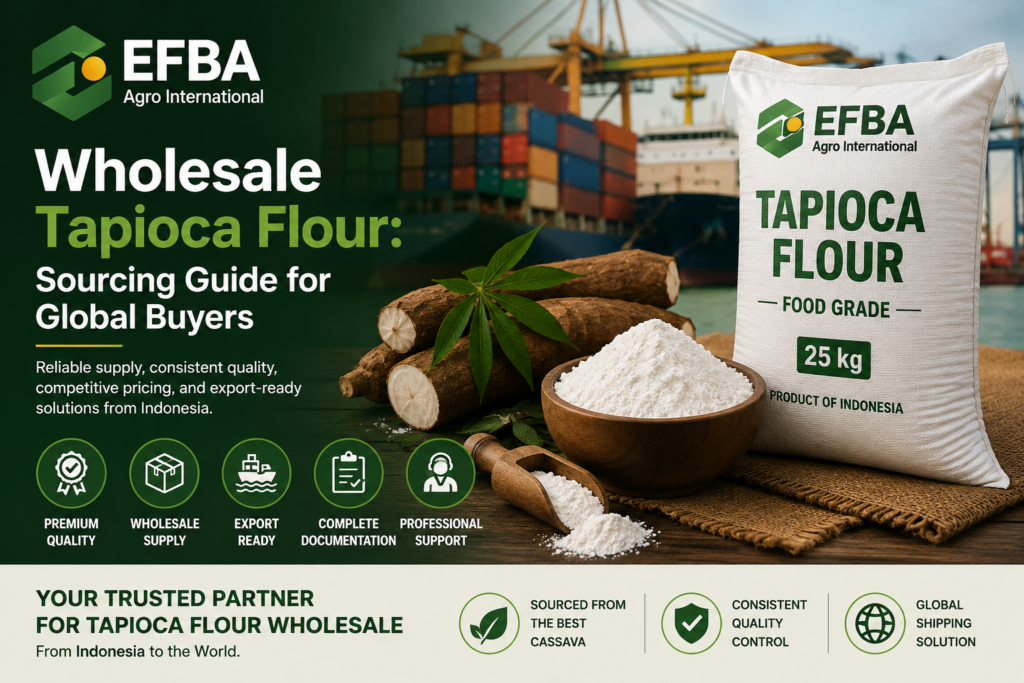
EFBA Agro lists 25 kg and 50 kg PP sacks with PE inner lining, with 500 kg jumbo bags available upon request. Its published product information also indicates an approximate loading capacity of 20 metric tons per 20-foot FCL.
For buyers specifically considering wholesale packaging, see Tapioca Flour Wholesale 25 kg & 50 kg Bags, which discusses bulk supply for food producers, distributors, and international buyers.
Before ordering, confirm:
Net weight → Bag material → Inner liner → Palletization → Labeling → Container loading → Storage requirement
These details can materially affect total landed cost and warehouse handling.
For large-volume orders, packaging decisions should balance product protection, handling efficiency, available warehouse facilities, and transportation costs. Importers should also verify whether specific labeling or packaging requirements apply in their destination markets.
5. Understand MOQ, Price, and Incoterms
Wholesale purchasing is not simply about finding the lowest price per kilogram.
Buyers should compare the total landed cost.
A simplified calculation is:
Product Cost + Packaging + Inland Transportation + Export Handling + Freight + Insurance + Import Duties/Taxes + Destination Charges = Landed Cost
The applicable costs depend on the agreed Incoterm and destination, and the calculation should avoid double-counting expenses already included in the quoted price.
EFBA Agro’s published food-grade tapioca flour information lists an MOQ of 1 × 20′ FCL and invites buyers to request FOB or CIF quotations.
When comparing quotations, make sure suppliers are quoting on comparable terms. A low EXW or FOB offer cannot be fairly compared with a CIF quotation without calculating the remaining logistics costs.
For international companies managing tapioca flour wholesale purchases, understanding Incoterms helps clarify which party is responsible for transportation, insurance arrangements, export procedures, and specific delivery-related risks.
Commercial negotiations should also consider payment terms, lead times, shipment schedules, and potential price changes. These factors can influence working capital requirements and procurement planning.
6. Verify Export Documentation and Compliance
International food procurement requires proper documentation.
Depending on the product and destination country, buyers may need documents such as a commercial invoice, packing list, certificate of origin, bill of lading, quality documentation, health-related documents, or other certificates required by local authorities.
Requirements vary by destination, so buyers should confirm them with their importer, customs broker, and competent authority before shipment.
Indonesia’s Directorate General of National Export Development advises exporters to understand procedures, market requirements, standards, and product requirements in the destination country. It also provides export-related information through its official resources.
For broader information about Indonesian export requirements, buyers and suppliers can refer to the Directorate General of National Export Development, Ministry of Trade of Indonesia.
Reliable documentation is particularly important in tapioca flour wholesale transactions involving international food manufacturers and distributors. Proper preparation can help reduce customs-related delays and improve coordination between suppliers, freight forwarders, and importing companies.
7. Choose a Supplier for Long-Term Supply, Not One Shipment
For global manufacturers, supply continuity can be more valuable than obtaining a slightly cheaper first order.
Evaluate whether your supplier can support:
Stable sourcing → Consistent processing → Quality control → Export packaging → Documentation → Logistics → Repeat orders
A supplier with strong procurement and export capabilities reduces the number of parties that buyers need to coordinate with.
EFBA Agro states that its model connects agricultural sourcing with quality services and end-to-end export logistics, including packaging, documentation, and international delivery coordination.
This is particularly important for manufacturers that require predictable material availability throughout the year.
For businesses establishing long-term tapioca flour wholesale partnerships, supplier performance should be evaluated across multiple transactions. Quality consistency, communication, documentation accuracy, and shipment coordination all contribute to a more dependable procurement relationship.
Comparing Wholesale Suppliers: Price vs Long-Term Value
Consider a food manufacturer sourcing 20 metric tons of tapioca flour.
Supplier A offers USD 15 less per metric ton than Supplier B.
The apparent saving is:
20 MT × USD 15 = USD 300
However, Supplier A has inconsistent moisture levels and unpredictable shipment schedules. One delayed container disrupts production for several days.
The original USD 300 saving can quickly become insignificant compared with production downtime, emergency sourcing, additional freight, or rejected raw materials.
This example illustrates an important procurement principle:
Lowest Purchase Price ≠ Lowest Total Procurement Cost
Global buyers should evaluate price + quality + consistency + logistics + risk together.
The same principle applies when comparing tapioca flour wholesale quotations from multiple suppliers. A competitive unit price should be assessed alongside technical specifications, supplier performance, and expected operational costs.
By considering these factors, procurement teams can make purchasing decisions that support manufacturing continuity rather than focusing exclusively on short-term savings.
Build a Strong Tapioca Flour Procurement System
Professional procurement should move beyond transactional buying.
A stronger sourcing framework looks like:
Supplier Screening → Specification Alignment → Sample Evaluation → Documentation Check → Commercial Negotiation → Trial Order → Incoming QC → Supplier Performance Review
After receiving the shipment, evaluate the supplier using measurable indicators such as:
Specification conformity, rejection rate, on-time delivery, documentation accuracy, responsiveness, lead-time consistency, and total landed cost.
Over several shipments, this creates a supplier scorecard.
Buyers can then make purchasing decisions based on actual performance instead of promises.
FAQ
What is tapioca flour wholesale?
Tapioca flour wholesale refers to purchasing tapioca flour in commercial or industrial quantities, generally for food manufacturing, distribution, repacking, food service, or international trade.
What should I check before buying tapioca flour in bulk?
Check technical specifications, intended application, batch consistency, packaging, MOQ, available certifications and test documentation, production capacity, lead time, Incoterms, and logistics arrangements.
What packaging is available for wholesale tapioca flour?
Packaging depends on the supplier. EFBA Agro currently lists 25 kg and 50 kg PP sacks with PE inner lining, while 500 kg jumbo bags are available upon request. (Efba Agro International)
What is the MOQ for EFBA Agro tapioca flour?
Its current product page lists a minimum order quantity of one 20-foot FCL, with approximately 20 metric tons of loading capacity per container. Buyers should reconfirm current availability and commercial terms when requesting a quotation. (Efba Agro International)
Is tapioca flour gluten-free?
Tapioca comes from cassava rather than wheat and is naturally gluten-free. However, manufacturers making a gluten-free claim should still verify processing controls and potential cross-contact throughout their own supply chain. Indonesia’s Ministry of Trade publication likewise describes tapioca flour as gluten-free. (Directorate General of National Export)
How do I compare tapioca flour suppliers?
Do not compare price alone. Evaluate specifications, consistency, documentation, packaging, production capacity, responsiveness, delivery reliability, and total landed cost.
Should buyers request samples before bulk orders?
For manufacturing applications, sample evaluation or a trial order is highly recommended whenever practical. It allows the buyer to test whether the material performs correctly in the intended formulation before committing to recurring volumes.
Source Tapioca Flour from Indonesia
Successful tapioca flour wholesale sourcing depends on more than finding an attractive quotation. Global buyers need the right combination of consistent specifications, reliable supply, export-ready packaging, documentation, competitive commercial terms, and professional logistics support.
EFBA Agro International supplies food-grade tapioca flour from Indonesia for international food manufacturers, importers, distributors, and wholesale buyers. Its current product specification includes bulk packaging options and container-scale ordering for export markets. (Efba Agro International)
For sourcing inquiries, technical specifications, samples, current availability, and FOB/CIF quotations, visit EFBA Agro International and discuss your required volume, destination, application, packaging, and quality specifications with the team.