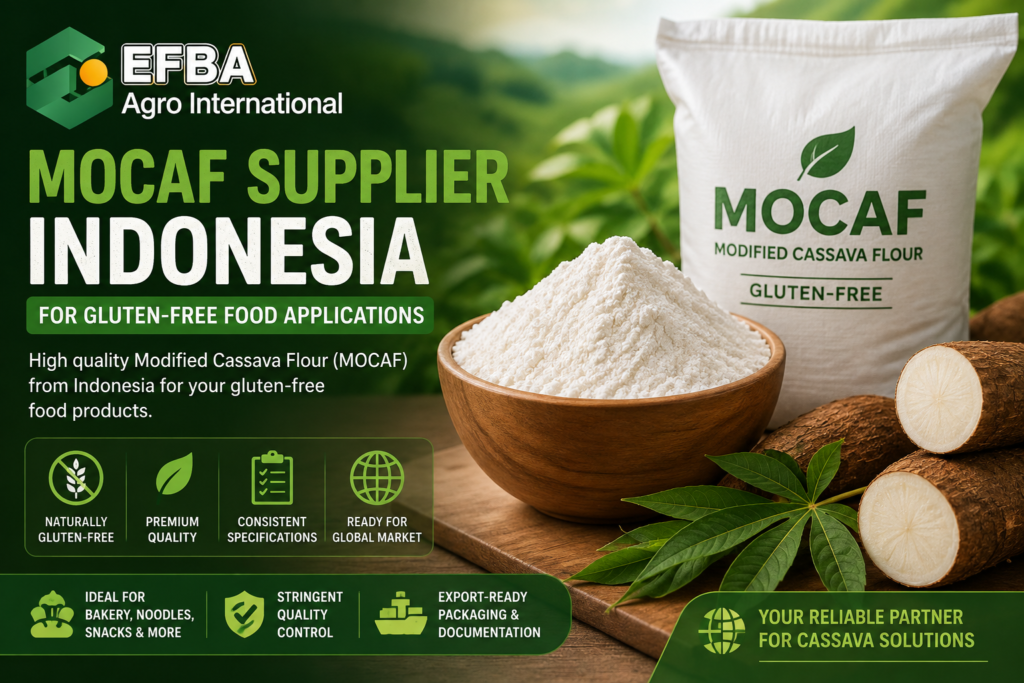
Finding a reliable MOCAF supplier Indonesia is essential for food manufacturers, importers, and distributors that need consistent Modified Cassava Flour for commercial food production. As one of the world’s cassava-producing countries, Indonesia offers strong potential as a sourcing destination for cassava-based food ingredients.
MOCAF, or Modified Cassava Flour, provides a naturally gluten-free alternative to wheat flour and offers versatile applications across bakery products, noodles, snacks, premixes, and other processed foods.
As a MOCAF supplier Indonesia, EFBA Agro International supplies export-ready Modified Cassava Flour for global food manufacturers, importers, and distributors. We support bulk procurement through clear product specifications, export packaging, quality control, documentation, and international logistics arrangements.
Table of Contents
ToggleMOCAF Supplier Indonesia: Quick Supply Overview
International buyers need more than competitive pricing when choosing a supplier. Product specifications, packaging, minimum order quantity, supply consistency, and export capability also play an important role in procurement decisions.
Here is a quick overview of MOCAF supplied by EFBA Agro International:
| Specification | Details |
|---|---|
| Product | Modified Cassava Flour (MOCAF) |
| Origin | Indonesia |
| Appearance | Fine, white powder |
| Moisture | Max. 12% |
| Ash Content | Max. 1.0% |
| Protein | Min. 1.5% |
| Whiteness | Min. 85% |
| pH | 4.5–6.5 |
| HCN | Below 10 ppm |
| Packaging | 25 kg / 50 kg PP sacks with PE lining |
| Jumbo Bag | 500 kg upon request |
| MOQ | 1 × 20-foot FCL |
| Approx. Load | 20 metric tons / 20-foot FCL |
| Loading Port | Tanjung Priok, Jakarta |
| Applications | Bakery, noodles, snacks, premixes, gluten-free foods |
Buyers should confirm final specifications, packaging availability, production capacity, and commercial terms before placing an order.
What Is MOCAF?
MOCAF, or Modified Cassava Flour, is a cassava-based flour produced through a fermentation process. This process modifies some characteristics of conventional cassava flour and can produce a lighter aroma and functional properties suitable for various food formulations.
Because manufacturers produce MOCAF from cassava rather than wheat, the flour is naturally gluten-free. Therefore, food manufacturers can consider MOCAF when developing gluten-free or wheat-reduced products.
Its versatility makes MOCAF relevant for bakery products, noodles, snacks, cakes, premixes, and various processed foods.
International buyers can review EFBA Agro’s Modified Cassava Flour (MOCAF) product specifications before discussing bulk procurement requirements.
Why Source MOCAF from Indonesia?
Indonesia has an established cassava production base and a growing processing industry for cassava-derived ingredients. Consequently, international food manufacturers can consider Indonesia when sourcing MOCAF and other cassava-based products.
Working with an experienced MOCAF supplier Indonesia can also simplify international procurement. Instead of managing sourcing, packaging, documentation, and shipment separately, buyers can coordinate these requirements through one supply partner.
EFBA Agro International supports this process by coordinating product sourcing, quality control, export packaging, documentation, and shipment arrangements.
As a result, importers and food manufacturers can focus on their commercial requirements while maintaining clearer communication throughout the procurement process.
MOCAF Applications in Food Manufacturing
Food manufacturers can use MOCAF across various product categories. However, each formulation may require a different substitution ratio depending on the desired texture, moisture, elasticity, flavor, and production process.
Common MOCAF applications include:
- Bread and bakery products
- Cakes and pastries
- Cookies and biscuits
- Noodles
- Crackers and snacks
- Flour premixes
- Gluten-free products
- Wheat-reduced food formulations
Because every formulation behaves differently, manufacturers should conduct product trials before implementing MOCAF at commercial production scale.
For additional information about potential applications, read 7 Reasons MOCAF Is the Future of Gluten-Free Flour.
Benefits of MOCAF for Food Manufacturers
MOCAF provides several characteristics that make it relevant for food manufacturers exploring cassava-based alternatives.
1. Naturally Gluten-Free Raw Material
Cassava naturally contains no gluten. Therefore, MOCAF can support formulations designed around gluten-free ingredients.
However, manufacturers that plan to make regulated gluten-free claims should verify supplier documentation and manage cross-contact according to regulations in their destination market.
2. Versatile Food Applications
Manufacturers can evaluate MOCAF for bakery products, noodles, snacks, premixes, and various processed foods.
This versatility allows product developers to explore different formulations using one cassava-based ingredient.
3. Alternative to Wheat Flour
MOCAF can partially or, in some formulations, more substantially replace wheat flour.
Nevertheless, manufacturers should determine the appropriate substitution ratio through formulation trials because wheat and MOCAF have different functional properties.
4. Neutral Characteristics
The modification process can give MOCAF characteristics that make it suitable for various food formulations.
This allows product developers to explore MOCAF without significantly limiting the types of finished products they can create.
5. Cassava-Based Ingredient from Indonesia
Indonesia provides access to cassava and cassava-derived agricultural products. Therefore, global buyers looking to diversify their ingredient sourcing can consider Indonesian MOCAF as part of their procurement strategy.
MOCAF Specifications from EFBA Agro
Technical specifications are a critical consideration when evaluating a MOCAF supplier Indonesia.
EFBA Agro International lists general MOCAF specifications that include:
- Fine, white, odorless powder
- Maximum moisture: 12%
- Maximum ash content: 1.0%
- Minimum protein: 1.5%
- Minimum whiteness: 85%
- pH: 4.5–6.5
- HCN: below 10 ppm
These parameters provide importers, distributors, and manufacturers with an initial reference when evaluating the product.
However, buyers should confirm final specifications and supporting documentation for each commercial order, especially when their manufacturing process requires specific technical parameters.
MOCAF vs Tapioca Flour: What Is the Difference?
Although manufacturers produce both ingredients from cassava, MOCAF and tapioca flour have different characteristics and applications.
MOCAF is modified cassava flour produced through a fermentation process. Manufacturers commonly evaluate it for wheat-flour substitution, bakery products, noodles, snacks, and gluten-free formulations.
Meanwhile, tapioca primarily consists of starch extracted from cassava. Food manufacturers often use tapioca when they need thickening, viscosity, binding, smooth texture, or specific starch functionality.
Therefore, choosing between MOCAF and tapioca depends on the intended food application and required functional characteristics.
Buyers looking for starch-based ingredients can also review EFBA Agro’s Food Grade Tapioca Flour as another cassava-derived ingredient.
Packaging and MOQ for Bulk MOCAF
Packaging and order volume are important considerations for importers purchasing MOCAF at commercial scale.
EFBA Agro International lists the following bulk packaging options:
- 25 kg PP sacks with PE lining
- 50 kg PP sacks with PE lining
- 500 kg jumbo bags upon request
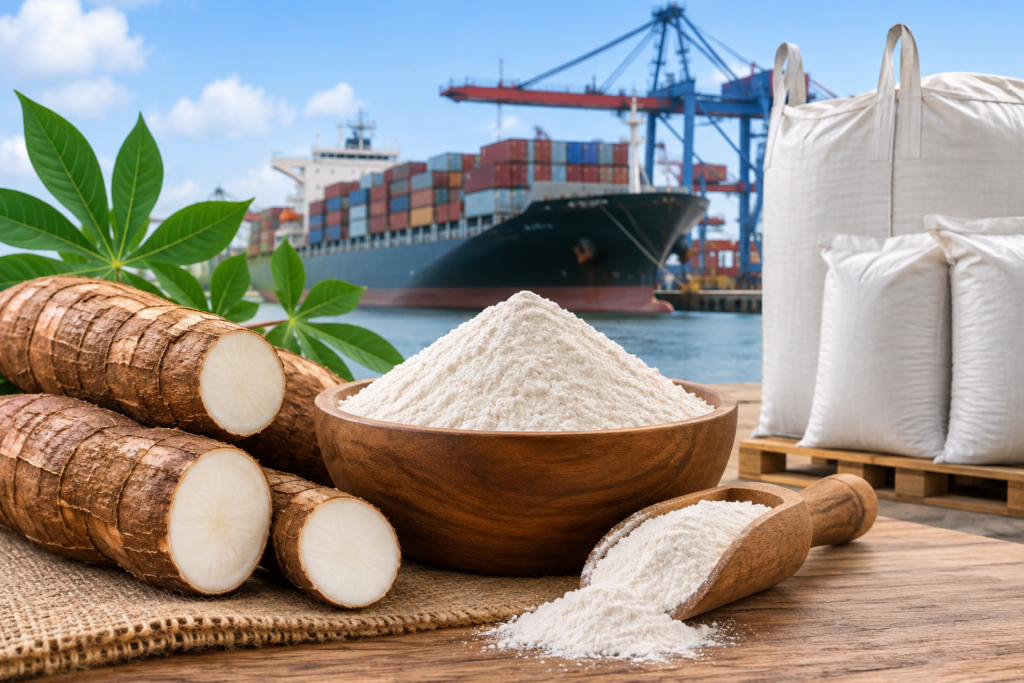
The listed minimum order quantity is 1 × 20-foot FCL, with an approximate loading capacity of 20 metric tons per 20-foot container.
The listed loading port is Tanjung Priok, Jakarta, Indonesia.
Before confirming an order, buyers should discuss current packaging availability, production capacity, lead time, destination port, freight arrangements, and commercial terms with EFBA Agro.
Quality Control and Export Support
International procurement involves more than sourcing the product itself. Buyers also need consistent specifications, appropriate packaging, documentation, and reliable shipment coordination.
EFBA Agro International coordinates quality-control procedures before export and prepares the required packaging and documentation according to the agreed commercial requirements.
International buyers should communicate any specific quality parameters or documentation requirements during the initial inquiry. Early communication helps both parties determine whether the available product and export arrangements meet the buyer’s requirements.
What Should International Buyers Check Before Ordering?
Before choosing a MOCAF supplier Indonesia, buyers should evaluate several procurement factors.
These include:
- Required technical specifications
- Estimated purchasing volume
- Packaging requirements
- Destination country and port
- Quality requirements
- Required export documentation
- Preferred Incoterms
- Expected shipment schedule
- Product sampling requirements
- Commercial terms
For food manufacturers, product trials can also play an important role before commercial-scale purchasing.
Trials allow manufacturers to evaluate texture, flavor, moisture behavior, processing characteristics, and the appropriate substitution ratio for their existing formulations.
How to Order MOCAF from Indonesia
International buyers can begin the procurement process by providing EFBA Agro International with their sourcing requirements.
First, buyers should specify the required MOCAF specifications and estimated purchasing volume. Next, they should provide their preferred packaging, destination country, destination port, and required shipping terms.
EFBA Agro can then evaluate product availability, packaging requirements, quality parameters, export documentation, and logistics arrangements.
A typical procurement process may include:
- Buyer inquiry and requirement identification
- Specification and volume confirmation
- Product sourcing and quality control
- Packaging preparation
- Export documentation
- Shipping and logistics coordination
Clear information at the inquiry stage helps streamline communication and allows EFBA Agro to prepare a more relevant commercial offer.
Why Choose EFBA Agro as Your MOCAF Supplier Indonesia?
Choosing the right supply partner requires more than finding a company that can provide the product. International buyers also need clear specifications, dependable communication, suitable packaging, and export coordination.
EFBA Agro International focuses on sourcing, processing, and wholesale export of Indonesian agricultural commodities, including cassava and its derivatives.
For buyers sourcing MOCAF, EFBA Agro supports several important procurement requirements, including:
- Indonesian MOCAF sourcing
- Product specification coordination
- Quality-control procedures
- Bulk packaging
- Export documentation
- International shipment arrangements
- Communication for commercial requirements
Beyond MOCAF, EFBA Agro also supplies tapioca flour and other Indonesian agricultural commodities. Therefore, importers, distributors, and food manufacturers may consolidate selected sourcing requirements through one Indonesian agricultural supply partner.
Companies exploring broader sourcing and commercial opportunities in Indonesia can also review business and investment insights in Indonesia from EFBA.
FAQ About MOCAF Supplier Indonesia
Is MOCAF gluten-free?
Yes. Manufacturers produce MOCAF from cassava rather than wheat, making cassava naturally gluten-free. However, manufacturers making regulated gluten-free claims should verify supplier documentation and manage potential cross-contact according to applicable regulations.
Can MOCAF completely replace wheat flour?
The appropriate replacement ratio depends on the formulation. Manufacturers can use MOCAF as a wheat-flour alternative in various applications, but they should adjust the percentage according to the required texture, elasticity, moisture, and processing characteristics.
What products can manufacturers make with MOCAF?
Manufacturers can evaluate MOCAF for bread, cakes, pastries, cookies, noodles, snacks, premixes, and various gluten-free or wheat-reduced food formulations.
Where can I buy MOCAF in bulk from Indonesia?
International manufacturers, importers, and distributors can source bulk Indonesian MOCAF through suppliers such as EFBA Agro International. Buyers should provide their required specifications, order volume, packaging, and destination port when requesting a quotation.
What is the MOQ for MOCAF from EFBA Agro?
EFBA Agro currently lists a minimum order quantity of 1 × 20-foot FCL, with an approximate loading capacity of 20 metric tons.
What MOCAF packaging is available?
EFBA Agro lists 25 kg and 50 kg PP sacks with PE lining. Buyers can also request 500 kg jumbo bags, subject to availability and commercial requirements.
Can EFBA Agro handle international MOCAF shipments?
Yes. EFBA Agro coordinates product sourcing, quality control, packaging, export documentation, and international shipment arrangements for bulk orders.
What information should I provide when requesting a MOCAF quotation?
Buyers should provide the required specification, estimated volume, packaging preference, destination country and port, required Incoterm, documentation requirements, and expected shipment schedule.
Source MOCAF from Indonesia with EFBA Agro
Choosing a reliable MOCAF supplier Indonesia requires more than comparing product prices. International buyers should also evaluate product specifications, supply consistency, packaging, minimum order quantity, quality control, export documentation, and logistics capability.
EFBA Agro International supplies export-ready Indonesian Modified Cassava Flour for food manufacturers, importers, and distributors serving international markets.
Whether you need MOCAF for bakery products, noodles, snacks, premixes, gluten-free products, or other food-processing applications, EFBA Agro can discuss your bulk sourcing requirements.
Contact EFBA Agro International to request a quotation and discuss MOCAF specifications, required volume, packaging, destination port, and shipping requirements.