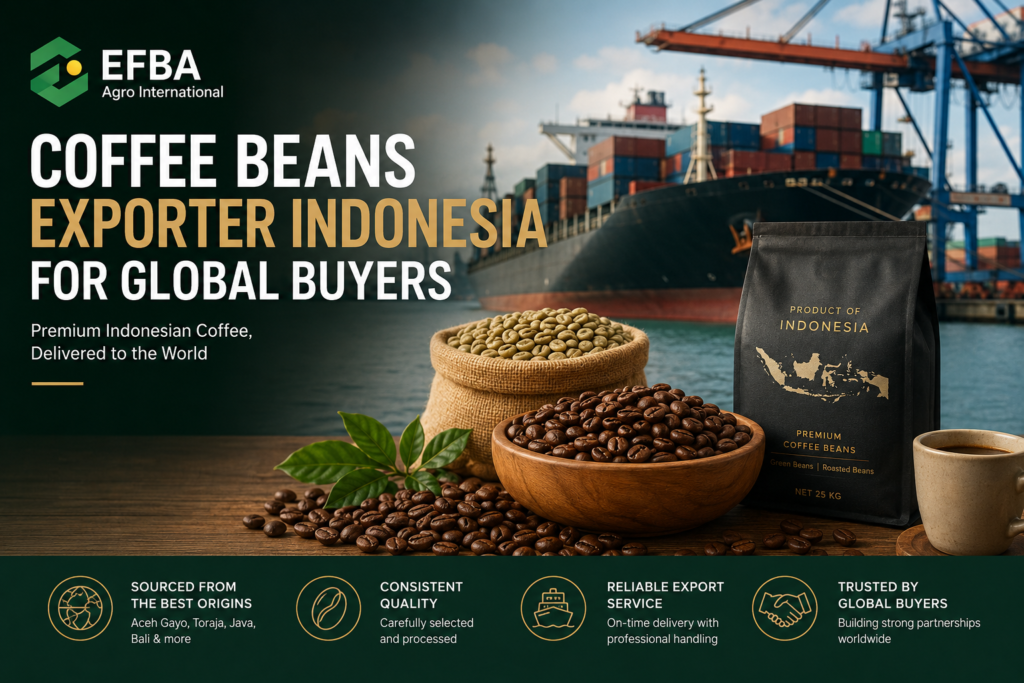
Green coffee beans Indonesia are widely sourced by international roasters, coffee importers, distributors, and private-label businesses looking for distinctive origins, diverse flavor profiles, and flexible sourcing opportunities. Indonesia produces coffee across multiple regions, including Sumatra, Java, Sulawesi, Bali, and Flores, giving global buyers access to different varieties, processing methods, and cup characteristics within one producing country.
For buyers, however, selecting Indonesian green coffee is not only about choosing an origin. Quality consistency, processing method, moisture condition, grading, traceability, shipment preparation, and supplier reliability are equally important. Understanding these factors helps buyers select coffee that matches their roasting profile, target market, and commercial requirements.
This guide explains what global buyers should evaluate when sourcing green coffee beans Indonesia, from origin and processing to quality control and supplier selection.
Table of Contents
ToggleWhat Are Green Coffee Beans Indonesia?
Green coffee beans Indonesia are unroasted coffee beans produced and processed in Indonesian coffee-growing regions before being supplied to roasters, importers, distributors, and other international buyers.
Unlike roasted coffee, green beans have not undergone the roasting process that develops the final aroma, color, and flavor characteristics associated with brewed coffee. This allows professional roasters to create roasting profiles according to their preferred flavor development and target consumers.
Indonesia produces both Arabica and Robusta coffee. Arabica is commonly associated with higher-altitude producing regions and specialty coffee markets, while Robusta plays an important role in commercial blends, instant coffee, espresso blends, and other large-volume applications.
For international sourcing, buyers can select coffee according to origin, species, processing method, quality specification, intended application, and available harvest.
Why Do Global Buyers Source Green Coffee Beans from Indonesia?
One of the main reasons global buyers source green coffee beans Indonesia is the diversity of origins, processing methods, and flavor profiles available across the country.
Coffee is produced across different islands, elevations, climates, soil conditions, and local processing traditions. As a result, Indonesian coffee cannot be represented by a single flavor profile.
Sumatra, for example, is internationally recognized for coffees that can present deep body and earthy, herbal, spicy, chocolate, or complex characteristics depending on origin and processing. Other regions can offer cleaner acidity, sweetness, fruit characteristics, floral notes, or different body profiles.
This diversity gives roasters more flexibility when developing products for different market segments.
A buyer may source one Indonesian coffee for a single-origin product and another for an espresso or house blend. Therefore, origin selection should always be connected to the intended final product rather than based only on the reputation of a producing region.
Main Indonesian Coffee Origins Global Buyers Should Know
When sourcing green coffee beans Indonesia, understanding origin is one of the first steps in building an effective procurement strategy.
Sumatra
Sumatra is one of Indonesia’s most recognized coffee-producing islands. Areas such as Aceh Gayo and North Sumatra are particularly familiar to international specialty coffee buyers.
Gayo Arabica is grown in the highlands of Aceh and is frequently selected for specialty and premium coffee applications. Depending on variety, processing, lot, and roast development, the coffee can present substantial body, sweetness, spice, chocolate, herbal, or fruit characteristics.
For buyers interested specifically in Aceh-origin coffee, EFBA Agro’s Gayo Arabica Coffee information can provide additional sourcing context.
Java
Java has a long history within Indonesia’s coffee industry and produces both Arabica and Robusta.
Java coffees can vary significantly according to location and processing. For buyers, this means the word “Java” alone should not be considered a complete quality specification. Specific origin, processing, crop information, and physical or sensory requirements should still be confirmed with the supplier.
Sulawesi
Sulawesi, particularly Toraja, is another Indonesian origin known within international specialty coffee markets.
Coffee from this region can offer substantial body and complex flavor characteristics. As with other Indonesian origins, sensory results depend on growing area, cultivar, processing, sorting, storage, and roast profile.
Bali and Flores
Bali and Flores provide additional options for buyers seeking differentiated Indonesian origins.
These coffees may be particularly interesting for roasters building diverse single-origin portfolios or looking for Indonesian coffees with characteristics different from better-known Sumatran profiles.
Rather than selecting an origin solely by name, professional buyers should request samples and evaluate the actual lot before committing to commercial volumes.
Arabica vs Robusta: Which Green Coffee Should Buyers Choose?
The answer depends on the buyer’s market and product.
When sourcing green coffee beans Indonesia, buyers can choose between Arabica and Robusta according to their target product, quality requirements, roast profile, and commercial positioning.
Arabica is commonly selected by specialty roasters, premium coffee brands, cafés, and businesses seeking more differentiated sensory profiles.
Robusta, meanwhile, can provide stronger body, higher caffeine content, and commercial advantages for certain applications. It is widely used in espresso blends, instant coffee, ready-to-drink applications, and mass-market coffee products.
Therefore, the sourcing decision should begin with the final product.
A specialty roaster developing premium single-origin coffee may prioritize high-altitude Arabica with clear traceability and specific sensory characteristics. A manufacturer developing an espresso blend may require a different combination of body, intensity, price, and volume.
In other words:
Target Product → Required Profile → Coffee Type → Origin → Specification → Sample Evaluation → Purchase
This approach is more reliable than choosing coffee based only on price.
Understanding Indonesian Green Coffee Processing Methods
Processing has a major influence on the physical and sensory characteristics of green coffee beans Indonesia, making processing method an important consideration for international buyers.
One method strongly associated with Indonesia is wet-hulled processing, commonly known locally as giling basah. The process differs from conventional fully washed processing and has contributed to some of the flavor and physical characteristics associated with Indonesian coffee.
However, Indonesian producers also use washed, natural, honey, and other processing approaches depending on region and producer.
For global buyers, the important point is to specify the processing method when requesting quotations or samples.
Instead of asking only for:
“Indonesian Arabica”
a stronger sourcing inquiry would include information such as:
“Indonesian Arabica, Gayo origin, required processing method, target grade, moisture specification, quantity, packaging requirement, and destination port.”
The more precise the inquiry, the easier it is for suppliers to identify a suitable lot.
What Specifications Should Buyers Check?
Before purchasing green coffee beans Indonesia, global buyers should define measurable product requirements.
Moisture condition is one important parameter because improper moisture levels or storage conditions can affect stability during transportation and storage. Buyers may also evaluate bean size or screen specification, defect count, foreign matter, physical appearance, density, water activity where required, and other quality parameters relevant to their purchasing standard.
Sensory evaluation is equally important for coffee intended for specialty or profile-specific applications.
Buyers can request samples for roasting and cupping before confirming larger orders. This allows the purchasing team or roaster to evaluate whether the coffee meets the desired aroma, acidity, sweetness, body, aftertaste, balance, and overall cup profile.
However, acceptable specifications should always be agreed between buyer and supplier before shipment rather than assumed from general descriptions of Indonesian coffee.
Green Coffee Grading and Quality Control
Quality consistency is one of the most important considerations when sourcing green coffee beans Indonesia for international markets.
A professional supplier should have procedures for receiving, sorting, inspecting, storing, preparing, and releasing coffee for shipment. Depending on the product and buyer requirements, quality evaluation may include physical inspection, defect assessment, moisture measurement, sample roasting, and cupping.
For B2B buyers, quality control should occur before commercial shipment.
A practical workflow can be:
Sourcing → Processing → Sorting → Physical Inspection → Sample Evaluation → Approval → Packing → Shipment
This process reduces the risk of discovering quality differences only after the coffee reaches the destination market.
Buyers purchasing multiple containers or establishing long-term supply arrangements should also discuss how quality consistency will be managed between different lots and harvest periods.
Traceability Matters in Coffee Sourcing
International buyers increasingly need to understand where agricultural products originate and how they move through the supply chain.
For coffee, traceability can include information about country, producing region, producer or cooperative where applicable, processing method, crop or harvest period, lot identification, and supply-chain documentation.
The required level of traceability depends on the buyer, destination market, customer requirements, and applicable regulations.
This makes supplier documentation an important part of sourcing.
Traceability is particularly valuable for specialty coffee brands because origin information can also support product positioning and communication with consumers.
Example: How a Global Buyer Can Source Indonesian Green Coffee
Consider a European coffee roaster looking for Indonesian Arabica for a premium product.
Instead of requesting “the best Indonesian coffee,” the buyer first defines the commercial requirements.
The company needs Arabica from Indonesia, a profile suitable for medium roasting, a particular quantity, export packaging, traceability information, and shipment to its destination market.
The sourcing process can then follow:
Requirement → Supplier Inquiry → Product Specification → Sample → Cupping → Commercial Evaluation → Agreement → Quality Confirmation → Shipment
The buyer receives a representative sample and conducts a test roast.
If the coffee matches the required profile, the next step is to confirm commercial terms and shipment specifications. If it does not, the supplier can propose another available lot or origin.
This approach is more efficient because purchasing decisions are based on measurable requirements rather than general descriptions.
How to Evaluate a Green Coffee Supplier in Indonesia
Choosing the right supplier of green coffee beans Indonesia is just as important as selecting the coffee origin, grade, processing method, and quality specification.
International buyers should evaluate whether a supplier can communicate product specifications clearly, provide representative samples, explain origin and processing, manage quality control, prepare export documentation, and coordinate international shipments.
Responsiveness also matters.
Export transactions involve multiple stages and parties. Delays in documentation, product confirmation, packing, or logistics communication can create additional costs for buyers.
Therefore, buyers should evaluate suppliers based on both:
Product Quality + Supply Reliability
A coffee with an excellent sample is not enough if the supplier cannot maintain specifications or manage commercial shipments consistently.
Price Should Not Be the Only Purchasing Factor
Price is naturally important in B2B sourcing, but the lowest quotation is not always the lowest total cost.
Suppose Supplier A offers coffee at a lower price but delivers inconsistent quality. Supplier B is slightly more expensive but provides better sorting, traceability, communication, and lot consistency.
The real purchasing cost should consider more than the initial unit price.
Buyers should consider:
Coffee Price + Quality Risk + Sorting Loss + Logistics + Rejection Risk + Consistency + Supply Reliability
For roasters, inconsistent green coffee can also require repeated roast-profile adjustments and make final product consistency more difficult.
Therefore, purchasing teams should evaluate overall value rather than comparing quotations only on price per kilogram or metric ton.
Packaging and Storage for Green Coffee Beans
Proper packaging and storage help maintain the condition and consistency of green coffee beans Indonesia throughout the international supply chain.
Traditional coffee exports commonly use bags suitable for bulk handling, while additional protective packaging or liners may be considered depending on quality level, buyer requirements, shipment duration, and environmental conditions.
Storage before shipment should also protect coffee from excessive humidity, contamination, strong odors, and other factors that may affect quality.
Buyers should discuss packaging specifications before issuing a purchase order because different market segments may require different solutions.
Specialty coffee buyers, commercial roasters, and industrial manufacturers may have different priorities regarding packaging cost, protection, unit size, and handling efficiency.
Indonesian Green Coffee for Specialty and Commercial Markets
Green coffee beans Indonesia can serve both specialty and commercial coffee markets, depending on origin, grade, processing method, volume, and buyer requirements.
For specialty applications, buyers may focus heavily on origin, processing, traceability, cup profile, lot separation, and consistency.
Commercial buyers may place greater emphasis on volume availability, price stability, physical specification, supply continuity, and suitability for blending or industrial processing.
Neither approach is inherently better. The correct specification depends on the final application.
This is why a capable supplier should first understand the buyer’s requirement before recommending a product.
Expertise: Building a More Reliable Indonesian Coffee Supply Chain
Reliable agricultural sourcing requires coordination from origin to shipment.
For coffee, this means connecting producers and processing partners with quality control, storage, documentation, packing, and logistics.
EFBA Agro approaches agricultural sourcing from this supply-chain perspective. Rather than treating export as simply selling a commodity, the objective is to align product specifications with the requirements of international buyers.
For businesses exploring other Indonesian agricultural commodities, visit EFBA Agro to review available products and sourcing information.
EFBA’s broader business ecosystem also focuses on business development and structured commercial solutions. More information about the group can be found through EFBA.
What Information Should Buyers Include in an RFQ?
A detailed Request for Quotation helps suppliers respond faster and reduces unnecessary back-and-forth communication.
For green coffee beans Indonesia, buyers should ideally provide the required coffee type, preferred origin, processing method, quality or grade requirements, expected quantity, packaging requirements, destination country or port, and purchasing timeline.
If a specific cup profile is required, include it in the inquiry.
For example, saying “We need Indonesian Arabica” is very broad.
A more useful request would specify the preferred region, expected volume, physical specifications, desired sensory profile, packaging, destination, and shipment period.
This enables the supplier to determine whether an existing lot matches the requirement or whether another sourcing option is needed.
FAQ About Green Coffee Beans Indonesia
Where can global buyers source green coffee beans in Indonesia?
Green coffee can be sourced from producing regions across Sumatra, Java, Sulawesi, Bali, Flores, and other Indonesian origins. The best origin depends on the required species, processing method, sensory profile, volume, and commercial application.
Does Indonesia produce Arabica and Robusta green coffee?
Yes. Indonesia is an important producer of both Arabica and Robusta. Arabica is widely used for specialty and premium applications, while Robusta is important for blends, instant coffee, and other commercial applications.
What should I check before buying Indonesian green coffee beans?
Buyers should check origin, processing method, physical specifications, moisture condition, defects, sensory profile where applicable, traceability, packaging, available quantity, shipment requirements, and supplier reliability.
Can buyers request green coffee samples before placing an order?
Sample evaluation is highly recommended, especially when cup profile and quality consistency are important. Buyers can roast and cup representative samples before confirming commercial volumes.
What is the best Indonesian coffee origin?
There is no single best origin for every buyer. Gayo, Java, Toraja, Bali, Flores, and other origins have different characteristics. The right choice depends on the desired flavor profile, roasting application, target market, specification, and budget.
How should I choose an Indonesian green coffee supplier?
Evaluate the supplier’s product specifications, quality-control process, traceability, sample availability, communication, export capability, documentation, packaging, and ability to maintain consistency across commercial orders.
Source Green Coffee Beans from Indonesia
Sourcing green coffee beans Indonesia successfully requires more than finding a producer with an attractive price. International buyers need to align origin, processing, physical quality, sensory profile, traceability, packaging, logistics, and commercial terms with their target product.
A structured sourcing process makes that easier:
Define Requirements → Select Origin → Review Specifications → Request Sample → Evaluate Quality → Confirm Commercial Terms → Prepare Shipment
For importers, distributors, roasters, and coffee businesses looking for Indonesian coffee, EFBA Agro can help identify sourcing options based on product specifications, quantity, destination, and commercial requirements.
Looking for green coffee beans from Indonesia? Contact EFBA Agro with your required origin, specification, quantity, packaging, and destination to discuss available sourcing options.