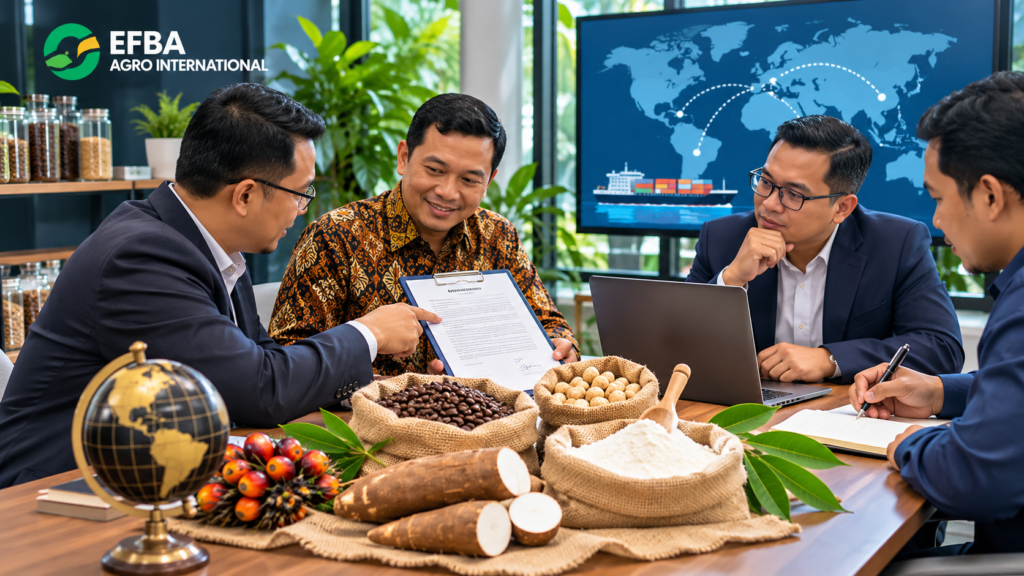
Commodity trading involves buying and selling agricultural products such as coffee, cassava derivatives, candlenut, and palm-based commodities through commercial transactions. For international buyers, agricultural supply contracts establish the agreed product specifications, purchasing quantities, pricing, payment conditions, and delivery responsibilities before goods change hands.
Agricultural commodity trading typically begins with a buyer’s sourcing requirements, followed by supplier evaluation, sample approval, price negotiation, and a written supply agreement. The supplier then coordinates product preparation, quality verification, documentation, and shipment according to the agreed terms. Clear contracts help manufacturers, importers, and distributors reduce procurement uncertainty and maintain more predictable agricultural supply arrangements.
What Is Commodity Trading in Agriculture?
Commodity trading is the commercial exchange of raw or processed agricultural products between producers, suppliers, traders, manufacturers, and international buyers. These products often serve food manufacturing, beverage production, wholesale distribution, and other industrial applications.
In agricultural markets, trading activities may involve physical commodities such as tapioca starch, coffee beans, Modified Cassava Flour (MOCAF), candlenut, or palm sugar. Buyers typically evaluate product quality, purchasing volume, origin, available stock, delivery schedules, and prevailing market conditions before completing transactions.
Unlike financial commodity trading, which can involve derivatives and speculative positions, physical agricultural trading focuses on the actual supply and delivery of goods. Businesses must therefore manage sourcing, quality control, logistics, documentation, and contractual obligations to complete transactions successfully.
How Do Agricultural Supply Contracts Work?
An agricultural supply contract is a commercial agreement defining the conditions under which a supplier sells agricultural products to a buyer. The agreement generally identifies the product, quantity, specifications, price, delivery schedule, payment arrangements, and responsibilities of each party.
The Food and Agriculture Organization of the United Nations (FAO) explains that agricultural contracting arrangements should clearly establish product quality, quantity, delivery, payment, and procedures for handling disputes. Although FAO’s contract-farming guidance focuses on agreements between producers and buyers, these principles also provide useful references for developing commercial agricultural supply agreements.
1. Buyer Defines Product Requirements
The process begins when a manufacturer, importer, or distributor identifies its required commodity and purchasing volume. Buyers should provide information about the intended application, technical specifications, destination market, packaging preferences, and estimated delivery schedule.
For example, a food manufacturer sourcing tapioca starch may request particular moisture limits, starch content, viscosity characteristics, and bulk packaging. Clear requirements help suppliers evaluate product suitability and available sourcing options before presenting a quotation.
2. Supplier Confirms Availability and Specifications
The supplier reviews product availability, technical requirements, sourcing capacity, and potential delivery arrangements. Depending on the commodity, evaluation may involve farmers, processors, warehouses, quality-control providers, and logistics partners.
International buyers should request relevant technical specifications, representative samples, and supporting documents when available. Product descriptions alone cannot guarantee that a shipment will meet manufacturing requirements, so both parties should establish measurable acceptance criteria.
3. Both Parties Negotiate Price and Quantity
After confirming technical suitability, the buyer and supplier negotiate commercial conditions. Discussions generally cover unit price, total purchasing volume, quotation currency, packaging, shipment schedule, and payment arrangements.
Agricultural prices may change due to seasonal availability, production conditions, transportation costs, and market demand. Therefore, supply agreements should clearly state whether the price remains fixed or follows an agreed adjustment mechanism.
4. Buyer and Supplier Finalize the Contract
Once both parties agree on the requirements, they prepare a written purchase agreement or supply contract. The document should identify the contracting entities, product specifications, quantity, pricing method, delivery terms, payment conditions, and procedures for resolving disagreements.
For international transactions, contracts should also specify the applicable Incoterms rule and named delivery location. However, Incoterms do not replace a complete sales contract because they do not independently determine payment obligations, product quality, or dispute-resolution procedures.
5. Supplier Prepares and Verifies the Shipment
The supplier coordinates product procurement, processing where applicable, packaging, and shipment preparation. Buyers may require inspections, sampling, laboratory results, or other verification procedures based on the agreed product specifications.
For food-grade ingredients, quality checks may include moisture, purity, physical characteristics, microbiological requirements, and contaminant limits where relevant. Inspection procedures should identify who conducts testing, which methods apply, and how both parties handle deviations.
6. Goods Are Delivered and Payment Is Completed
Once the shipment satisfies the agreed requirements, the supplier arranges delivery under the specified contractual terms. International transactions may require commercial invoices, packing lists, transport documents, customs records, and product-specific certificates.
The buyer completes payment according to the contract, such as an advance payment, letter of credit, or another agreed arrangement. Both parties should retain transaction records and evaluate supplier performance before arranging additional orders.
Agricultural commodity trading process:
Buyer Requirements → Supplier Evaluation → Sample Approval → Quotation → Supply Contract → Quality Verification → Shipment → Payment and Performance Review
What Types of Contracts Are Used in Commodity Trading?
Agricultural businesses use different contract structures depending on purchasing frequency, commodity characteristics, market conditions, and delivery requirements.
| Contract Type | How It Works | Typical Application |
| Spot Contract | Buyer purchases goods for prompt delivery under agreed conditions | Available agricultural stock |
| Forward Supply Contract | Parties agree on delivery at a future date and establish commercial terms in advance | Planned seasonal procurement |
| Long-Term Supply Agreement | Buyer and supplier establish recurring purchasing arrangements | Manufacturing and wholesale supply |
| Contract Farming Agreement | Farmer or producer agrees to produce and deliver agricultural goods under specified conditions | Agricultural production sourcing |
A forward supply contract between commercial parties should not automatically be confused with an exchange-traded futures contract. Futures contracts use standardized terms and trading mechanisms, while privately negotiated physical supply contracts can reflect specific product grades, quantities, and delivery locations.
For manufacturers requiring consistent raw materials, recurring supply agreements can support procurement planning. However, buyers should verify whether suppliers can maintain the agreed specifications and quantities throughout the contract period.
What Should an Agricultural Commodity Supply Contract Include?
A well-structured agreement reduces ambiguity by defining the responsibilities of buyers and suppliers. The FAO recommends written agricultural agreements that explain core obligations, pricing, delivery, payment, and dispute-resolution arrangements.
| Contract Element | Information to Confirm |
| Contracting parties | Legal names, addresses, and authorized representatives |
| Product description | Commodity type, grade, origin, and applicable specifications |
| Quantity | Weight, tolerance, units, and shipment schedule |
| Quality requirements | Testing methods, acceptable limits, and inspection procedures |
| Pricing | Currency, unit price, adjustment method, and taxes where applicable |
| Payment | Deposit, payment deadline, payment method, and required documents |
| Delivery | Location, schedule, packaging, and applicable Incoterm |
| Claims | Nonconforming goods, notification deadlines, and remedies |
| Contract protection | Force majeure, termination, governing law, and dispute resolution |
For example, a bulk tapioca starch agreement may require a specified maximum moisture level and an agreed packaging format. The contract should also explain how both parties will verify those requirements before shipment or upon receipt.
These clauses represent general procurement considerations rather than a standardized contract suitable for every transaction. Businesses should obtain appropriate legal and trade advice before finalizing substantial international purchasing commitments.
How Are Agricultural Commodity Trading Prices Determined?
Agricultural commodity prices reflect several commercial factors, including seasonal supply, demand, quality, processing costs, packaging, transportation, and international market conditions. The final quotation also depends on purchasing volume, payment conditions, and shipment responsibilities.

1. Fixed-Price Agreements
A fixed-price contract establishes the agreed unit price for a specified quantity and period. This arrangement can help buyers plan procurement costs, but both parties remain exposed to changes in market prices during the contract.
For example, a manufacturer may agree to purchase a defined volume of tapioca starch at a fixed price for a future shipment. The contract should identify the price validity period, delivery schedule, and conditions under which changes may be permitted.
2. Market-Linked Pricing
Some agreements calculate prices using a published market reference, agreed index, or negotiated formula. Such contracts should clearly explain the reference source, pricing date, currency, quality adjustments, and any applicable premiums or discounts.
This structure can help parties respond to market movements while maintaining a transparent pricing method. However, not all agricultural products have a suitable public benchmark, especially when quality grades and local market conditions vary.
3. Delivered Cost and Incoterms
International buyers should distinguish the commodity price from the total landed cost. Freight, insurance, customs, handling, storage, duties, and other applicable expenses can affect the final purchasing cost.
For instance, comparing FOB and CIF quotations requires understanding which transportation and insurance responsibilities fall on each party. The contract must identify the appropriate named port and the applicable Incoterms version.
How Do Incoterms Work in Agricultural Commodity Trading?
The International Chamber of Commerce (ICC) developed Incoterms rules to clarify delivery responsibilities, transportation costs, and the transfer of risk between buyers and sellers.
Incoterms 2020 remains the latest ICC edition as of November 2026, containing 11 standardized trade rules. Agricultural exporters and importers should select the rule that matches the actual transportation method and commercial agreement.
| Incoterm | General Commercial Meaning |
| EXW | Seller makes goods available at the agreed location |
| FCA | Seller delivers goods to a designated carrier or party |
| FOB | Seller delivers goods on board a vessel at the named shipment port |
| CFR | Seller pays freight to the destination port under the agreed rule |
| CIF | Seller pays cost, freight, and required insurance to the destination port |
| DAP | Seller delivers goods to the named destination, ready for unloading |
FOB, CFR, and CIF apply to sea and inland waterway transport. For containerized cargo, FCA or another suitable rule may better reflect the actual handover to the carrier, depending on the transaction.
Importantly, Incoterms do not determine when ownership transfers, how payment must occur, or which law governs the contract. Buyers should address those matters separately in their commercial agreements.
Official reference: ICC – Incoterms 2020.
What Are the Main Risks in Agricultural Commodity Trading?
Agricultural supply contracts help clarify obligations, but they cannot eliminate production, quality, price, or transportation risks. Buyers and suppliers should establish practical measures to manage potential disruptions.
1. Seasonal Supply and Production Changes
Agricultural output may fluctuate because of weather, harvesting conditions, crop disease, and processing capacity. These changes can affect available quantities and delivery schedules, particularly for recurring purchases.
Buyers can reduce uncertainty by confirming realistic lead times, monitoring seasonal availability, and evaluating alternative qualified sourcing arrangements when necessary.
2. Quality Differences Between Shipments
Agricultural products may differ in moisture, physical characteristics, processing performance, or other quality parameters. This becomes particularly important when manufacturers depend on consistent ingredients for standardized production.
Procurement teams should establish agreed specifications, sampling procedures, inspection responsibilities, and acceptance criteria before confirming bulk orders.
3. Price and Currency Fluctuations
Market movements and exchange-rate changes can influence purchasing costs and supplier margins. Therefore, contracts should identify the quotation currency, pricing method, validity period, and procedures for handling agreed price adjustments.
Businesses should also distinguish commodity purchasing risk from financial speculation. Risk-management measures should match actual procurement requirements and the company’s financial capabilities.
4. Logistics and Documentation Delays
International shipments can experience delays involving transportation, customs clearance, port operations, or missing documentation. Such problems may interrupt manufacturing schedules and increase costs.
Buyers should verify shipment responsibilities, destination-market requirements, documentation, and realistic timelines before goods leave the supplier’s facilities.
For additional procurement guidance, read Agricultural Supply Chain Resilience: 7 Strategies for Global Commodity Buyers.
What Do Official Sources Say About Agricultural Supply Contracts?
The Food and Agriculture Organization of the United Nations (FAO) identifies price, quantity, quality standards, delivery schedules, and payment methods as central elements of agricultural production agreements. FAO also highlights the importance of clear responsibilities, contractual remedies, and dispute-resolution mechanisms.
Through its Contract Farming Analysis Toolkit, FAO explains that effective agreements should define product requirements, delivery procedures, pricing, and the consequences of non-performance. Although these resources principally concern producer-buyer arrangements, the underlying principles remain relevant when reviewing agricultural sourcing contracts.
The ICC, meanwhile, confirms that Incoterms 2020 establishes 11 trade rules for allocating delivery tasks, costs, and risks. These rules provide a recognized framework for international agricultural shipments, but businesses still need complete agreements covering product specifications, payment, and contractual remedies.
Together, FAO and ICC guidance reinforces the importance of written agreements with measurable specifications and clearly assigned responsibilities. Buyers should use these principles alongside the applicable laws and importing-country requirements.
EFBA Agro International’s Expertise in Agricultural Commodity Sourcing
EFBA Agro International presents itself as an Indonesian agricultural commodity supplier and export sourcing partner. Its published portfolio includes tapioca flour, Modified Cassava Flour (MOCAF), Gayo Arabica coffee, cascara, candlenut, crude palm oil, RBD palm olein, and arenga palm sugar.
The company’s published sourcing approach includes product matching, procurement coordination, technical specifications, sample evaluation, quality considerations, packaging, export documentation, and logistics coordination. These activities directly relate to the practical requirements of physical agricultural commodity trading.
Agricultural Commodity Procurement and Product Matching
EFBA Agro helps prospective buyers explore Indonesian agricultural commodities based on purchasing requirements. International manufacturers can discuss intended applications, technical specifications, order quantities, packaging preferences, and destination markets.
For example, buyers evaluating Tapioca Flour Supplier Indonesia can review the published food-grade tapioca starch specifications before preparing a procurement inquiry. However, current batch quality, available volumes, and transaction terms still require direct confirmation.
Similarly, buyers interested in cassava derivatives can review Modified Cassava Flour (MOCAF) and compare product suitability against their manufacturing requirements.
Quality Specifications and Sample Evaluation
Product specifications are essential in agricultural commodity supply contracts because buyers must identify measurable acceptance requirements. EFBA Agro publishes technical reference information for selected products and describes sample evaluation as part of its sourcing process.
For instance, its tapioca flour materials provide reference parameters such as starch content, moisture, whiteness, viscosity, and packaging options. Buyers should verify relevant testing methods and request lot-specific documentation when available.
The company’s website also discusses sample evaluation and quality considerations for agricultural sourcing. However, published product descriptions should not replace independent verification or contractual acceptance procedures when required by the buyer.
Agricultural Export Coordination
EFBA Agro describes wholesale sourcing and export coordination for importers, distributors, and manufacturers. These services relate to matching buyer requirements with potential supply arrangements and discussing documentation, packaging, and shipment planning.
For selected tapioca flour products, EFBA Agro publishes commercial references involving bulk packaging, container quantities, and potential FOB or CIF quotations. Actual product availability and final commercial conditions depend on the individual inquiry.
Consequently, international buyers should confirm the contracting legal entity, product specifications, current availability, quantities, and applicable export documents before entering into supply agreements.
EFBA Agro’s published information supports preliminary sourcing discussions, but it does not establish guaranteed fulfillment capacity or previously completed volumes for every commodity.
Why Work With an Indonesian Agricultural Commodity Supplier?
Indonesia offers a diverse agricultural product base relevant to food manufacturing, beverage production, wholesale distribution, and international ingredient procurement. Buyers can explore commodities such as cassava-based flour, coffee, candlenut, and palm-derived products through suitable local sourcing partners.
Working with an Indonesian supplier may simplify initial product inquiries, specification discussions, and export coordination. Nevertheless, buyers should evaluate each supplier individually rather than assuming that geographic origin guarantees product availability or quality.
EFBA Agro International provides published information about Indonesian agricultural commodities and sourcing arrangements for prospective global buyers. Through its website, procurement teams can explore available product categories and prepare detailed requests for quotation.
Within the broader PT EFBA Digital Mulia business ecosystem, EFBA Agro focuses on agricultural commodity sourcing and export-related commercial discussions. Buyers should still verify the legal entity responsible for each transaction before signing an agreement.
How to Start a Commodity Trading Agreement With EFBA Agro
International buyers interested in Indonesian agricultural commodities should prepare a structured procurement inquiry before requesting a quotation. A complete inquiry helps identify product suitability and clarifies commercial expectations early in the process.
1. Identify the Required Agricultural Commodity
Specify whether the inquiry concerns tapioca flour, MOCAF, coffee beans, candlenut, palm products, or another commodity listed in EFBA Agro’s portfolio. Include the intended application so the supplier can evaluate suitable sourcing options.
2. Provide Technical Specifications and Purchasing Volume
Share the required product grade, moisture limits, processing characteristics, packaging, estimated order quantity, and quality documentation needs. Buyers should distinguish essential requirements from optional preferences to make product matching more effective.
3. Confirm Samples and Commercial Terms
Discuss available samples, inspection requirements, quotation currency, payment arrangements, delivery schedule, and shipment responsibilities. If the transaction involves international transport, identify the proposed Incoterm and named location.
4. Review the Contract Before Purchasing
Confirm product descriptions, quantity tolerances, delivery dates, quality acceptance procedures, payment conditions, and dispute-resolution arrangements in writing. Buyers should also verify applicable import regulations and seek professional review when appropriate.
This process helps establish clearer expectations before committing to large or recurring agricultural purchases.
FAQ About Commodity Trading and Agricultural Supply Contracts
1. What is commodity trading in agriculture?
Commodity trading involves buying and selling raw or processed agricultural products through commercial transactions. Physical trading focuses on products such as coffee, tapioca starch, candlenut, and palm-based commodities that buyers purchase for manufacturing, distribution, or processing. Transactions commonly require clear agreements on quality, quantity, price, and delivery.
2. How does an agricultural supply contract work?
An agricultural supply contract defines the products a supplier must deliver and the obligations a buyer must fulfill. It typically covers specifications, purchasing volume, pricing, payment, delivery schedules, and quality acceptance. A written agreement helps both parties manage expectations and resolve commercial disagreements.
3. What is the difference between spot and forward commodity trading?
Spot trading involves purchasing commodities for prompt delivery under agreed conditions. Forward trading involves a privately negotiated agreement for delivery at a future date. The parties may establish pricing and delivery terms in advance, but a forward supply contract differs from a standardized exchange-traded futures contract.
4. What determines agricultural commodity prices?
Commodity prices depend on supply and demand, seasonal production, product grades, processing costs, transportation, and market conditions. Final quotations also reflect purchasing quantities, currency, packaging, payment conditions, and agreed delivery responsibilities. Buyers should compare offers using equivalent specifications and commercial terms.
5. What should buyers check before signing a supply contract?
Buyers should verify the supplier’s identity, product specifications, available quantity, price, payment terms, delivery schedule, inspection procedures, and contractual remedies. International buyers must also confirm applicable Incoterms, destination-market requirements, and documentation responsibilities. Clear agreements help reduce procurement disputes.
6. What are Incoterms in commodity trading?
Incoterms are standardized commercial rules published by the International Chamber of Commerce. They explain how buyers and sellers allocate certain delivery tasks, costs, and transportation risks. Incoterms 2020 contains 11 rules, but these rules do not replace a complete sales contract or determine all payment and legal obligations.
7. How can buyers reduce agricultural supply contract risks?
Buyers can reduce risks by evaluating suppliers, checking product specifications, approving representative samples, establishing realistic delivery schedules, and documenting payment conditions. They should also prepare alternatives for supply disruptions and clarify how both parties will handle nonconforming products.
8. What documents are commonly required for agricultural commodity exports?
International agricultural shipments commonly involve commercial invoices, packing lists, transport documents, and relevant customs records. Certificates of origin, phytosanitary documents, quality certificates, or other permits may also apply depending on the commodity and importing country. Buyers should confirm the exact requirements before shipment.
9. Does EFBA Agro International supply Indonesian agricultural commodities?
EFBA Agro International publishes wholesale sourcing information for tapioca flour, MOCAF, Gayo Arabica coffee, cascara, candlenut, palm products, and arenga palm sugar. Its website describes sourcing coordination, technical specifications, sample evaluation, and export preparation. Buyers should confirm actual availability and commercial conditions directly.
10. How can international buyers request a quotation from EFBA Agro?
Buyers can contact EFBA Agro International with their required commodity, technical specifications, estimated purchasing volume, preferred packaging, destination country, and expected delivery schedule. Including these details helps the company assess sourcing options and discuss suitable commercial arrangements before a formal agreement.
Source Indonesian Agricultural Commodities With EFBA Agro International
Successful commodity trading requires more than competitive purchasing prices. International manufacturers, importers, and distributors need clear product specifications, reliable procurement communication, appropriate delivery arrangements, and written agreements that establish commercial responsibilities.
Agricultural supply contracts provide a framework for managing quality, quantity, price, payment, and shipment expectations. However, buyers should still evaluate actual supplier capabilities, technical documentation, applicable regulations, and order-specific availability before making purchasing commitments.
EFBA Agro International offers an Indonesian agricultural commodity sourcing portfolio covering tapioca flour, MOCAF, coffee beans, cascara, candlenut, and selected palm-derived products. Through its published sourcing approach, international buyers can explore product requirements, technical information, sample arrangements, and potential export coordination.
Looking for an Indonesian agricultural commodity supplier for your next wholesale or manufacturing order?

Contact EFBA Agro International to discuss commodity specifications, purchasing quantities, available sourcing options, quotations, and shipment requirements.
Prepare your product specifications, estimated purchasing volume, preferred packaging, destination port, and expected delivery timeline to support a more effective sourcing discussion.
Build a more structured agricultural supply partnership with EFBA Agro International through clear specifications, transparent commercial agreements, and coordinated sourcing from Indonesia.