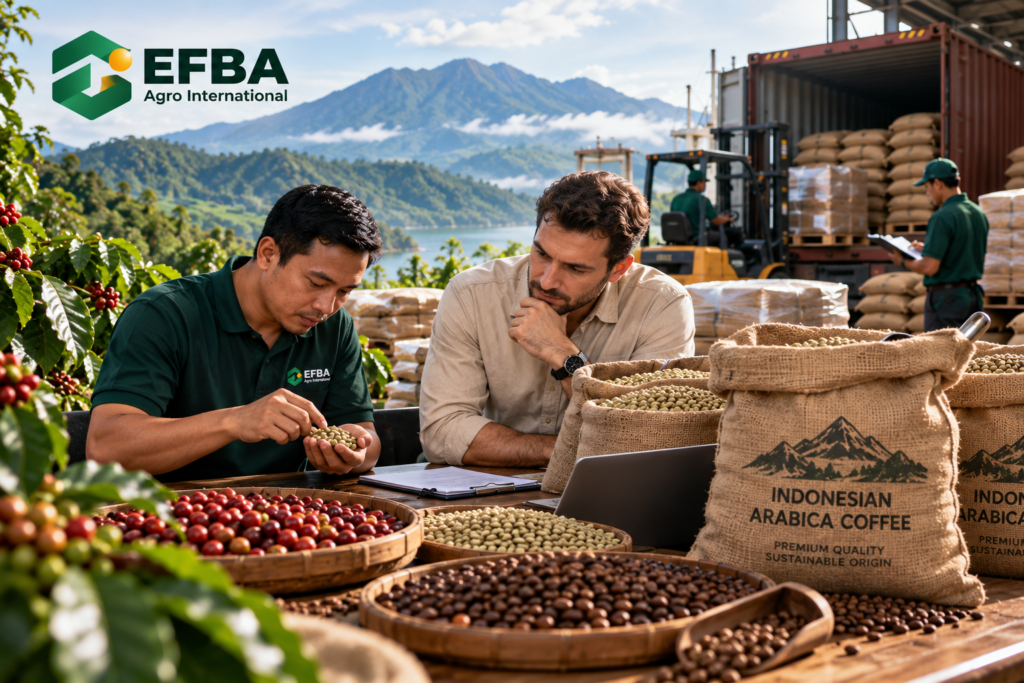
Indonesia has a long-established position in the global coffee market, with coffee-growing regions spread across Sumatra, Java, Sulawesi, Bali, Flores, and other producing areas. Within this landscape, Indonesian Arabica coffee attracts international roasters, importers, distributors, and specialty coffee businesses because different origins can deliver distinctive sensory characteristics shaped by altitude, climate, soil, varieties, and post-harvest processing.
However, origin alone does not determine whether a coffee is suitable for a buyer. Professional sourcing also requires attention to processing method, physical quality, moisture, defects, cup profile, traceability, packaging, volume, and consistency between lots.
For international buyers, EFBA Agro International supplies Indonesian agricultural commodities for wholesale and export markets. Its published coffee portfolio includes Gayo Arabica from Aceh, while its sourcing process covers product requirements, product matching, samples, sample testing, client confirmation, and commercial cooperation.
What Is Indonesian Arabica Coffee?
Indonesian Arabica coffee is Coffea arabica grown in Indonesia’s suitable coffee-producing regions, particularly higher-altitude areas where environmental conditions support Arabica cultivation. Its characteristics vary considerably by origin and processing, so there is no single flavor profile that represents every Indonesian Arabica.
Gayo Arabica from Aceh, for example, is one of the origins presented by EFBA Agro. The company describes its Gayo coffee as grown at approximately 1,200–1,600 meters above sea level, with medium-to-full body, balanced acidity, and floral and herbal aromatic characteristics.
For international buyers, a practical sourcing framework is:
Origin → Variety → Processing → Physical Quality → Cup Profile → Sample → Commercial Specification → Supply
This approach is more reliable than selecting coffee based only on country of origin or generic descriptions such as “premium Arabica.”
Indonesian Arabica Coffee in the Global Market
The latest Indonesian Permanent Estate Crops Statistics 2025 from BPS-Statistics Indonesia was released on August 31, 2026 and revised on September 16, 2026. The publication covers coffee area and production by province as well as export and import data by HS Code and destination country. BPS compiles these statistics from estate surveys, smallholder data from the Directorate General of Estate Crops, and customs documents.
For additional global context, the USDA’s December 2025 coffee outlook placed Indonesia’s 2025/26 Arabica production at approximately 1.45 million 60-kg bags. The same USDA dataset placed total Indonesian green coffee bean exports at approximately 7.8 million bags for 2025/26, although that export figure combines coffee types rather than Arabica alone.
Therefore, buyers should distinguish three different metrics:
Indonesian Coffee Production ≠ Indonesian Arabica Production ≠ Arabica Export Volume
This distinction matters because Indonesia produces substantial Robusta alongside Arabica. Broad national coffee statistics should not automatically be presented as Arabica-specific demand.
1. Indonesian Arabica Coffee Comes from Diverse Origins
One reason Indonesian coffee attracts international buyers is geographic diversity. Growing conditions differ significantly between islands, provinces, mountains, and even neighboring production areas.
For buyers working with EFBA Agro, one documented Arabica origin is Gayo in the highlands of Aceh, Sumatra. EFBA Agro lists Gayo Arabica among its commodities and positions it for wholesale and international sourcing.
This geographic identity matters for specialty coffee because origin can influence product positioning and sensory expectations. Nevertheless, buyers should evaluate individual lots rather than assuming every coffee from one region will deliver identical characteristics.
2. What Does Indonesian Arabica Coffee Taste Like?
There is no universal Indonesian Arabica flavor profile. Altitude, variety, soil, rainfall, processing, drying, storage, roast development, and brewing method can all influence what eventually appears in the cup.
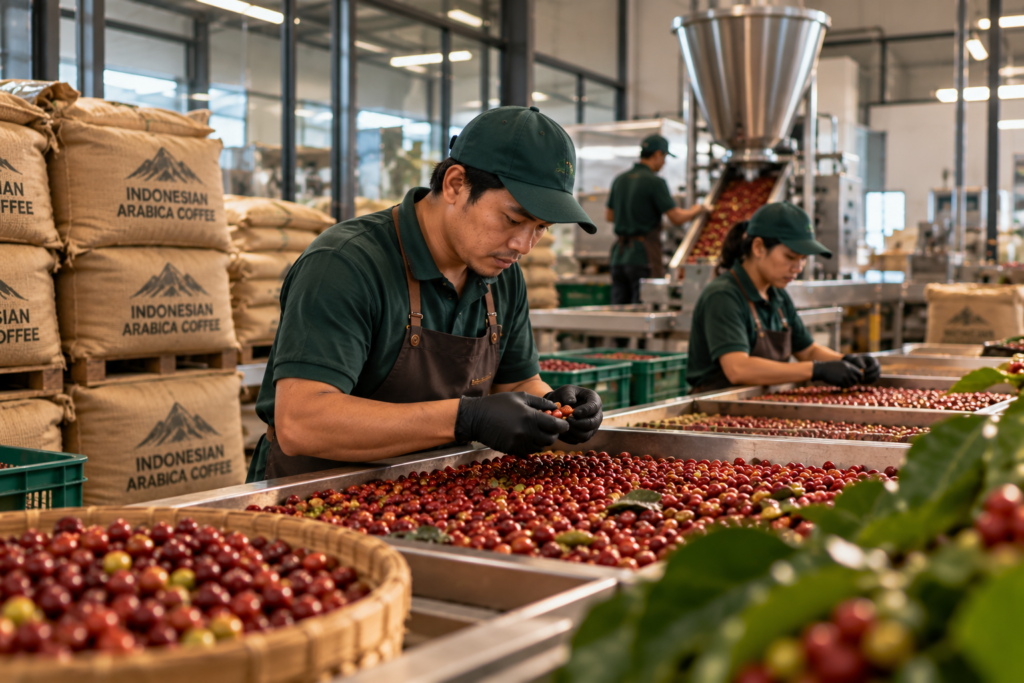
EFBA Agro describes its Gayo Arabica as having medium-to-full body, balanced acidity, and distinctive floral and herbal aromas. These characteristics make Gayo relevant to buyers looking for an Indonesian coffee with substantial body and a recognizable origin profile.
However, commercial buyers should treat tasting descriptions as an initial reference. Sample roasting and cupping remain important before confirming larger orders because actual lot characteristics may differ.
3. Altitude Can Influence Arabica Development
Arabica generally performs in cooler highland environments, but altitude should not become a stand-alone quality guarantee. It works together with temperature, rainfall, soil, variety, farming practices, cherry maturity, and post-harvest handling.
EFBA Agro states that the Gayo Arabica in its published sourcing information is grown at approximately 1,200–1,600 meters above sea level.
For professional procurement, altitude should therefore form part of a larger specification rather than act as the only quality indicator.
Origin + Altitude + Processing + Physical Quality + Cup Evaluation = Better Sourcing Context
4. Processing Method Changes Coffee Characteristics
Processing strongly influences the sensory expression of coffee. EFBA Agro’s published buyer guidance discusses washed, natural, and wet-hulled processing when explaining Indonesian Arabica sourcing.
Washed coffees can offer cleaner flavor separation, while natural processing may emphasize fruit character and sweetness. Wet-hulled processing has a particularly strong association with Indonesian coffee production and can contribute to the heavier body and distinctive character buyers often associate with some Sumatran coffees.
Therefore, buyers searching for Indonesian Arabica coffee should specify the processing method they need rather than requesting Arabica beans without further qualification.
5. Physical Quality Matters as Much as Origin
A well-known origin does not remove the need for quality control. International buyers need specifications that make quality measurable and easier to communicate between supplier and buyer.
EFBA Agro’s published Arabica sourcing guidance identifies several factors that buyers should discuss, including origin, variety, processing method, grade, moisture, defect level, packaging, volume, export documentation, and shipping arrangements.
This turns a vague request such as “We need premium Indonesian Arabica” into a more useful commercial requirement. Clear specifications also make sample evaluation and repeat procurement more objective.
6. Why Should Buyers Request Coffee Samples?
A sample gives buyers the opportunity to evaluate whether the actual coffee matches their requirements before committing to a larger commercial quantity.
EFBA Agro publishes a cooperation process in which clients first communicate the required product, specifications, and quantity. The team then matches those requirements with available products and its producer network, prepares a sample, allows the client to test it, receives confirmation, and proceeds toward cooperation.
For coffee buyers, sample evaluation can include physical inspection, moisture assessment, sample roasting, cupping, aroma, acidity, sweetness, body, balance, aftertaste, and comparison against the intended purchasing specification.
The process can be summarized as:
Requirement → Product Matching → Sample → Testing → Feedback → Confirmation → Commercial Cooperation
7. Why Is Traceability Important for International Buyers?
Traceability helps buyers understand the relationship between the coffee they purchase and its origin. Depending on the sourcing model, relevant information may include region, producer or cooperative, altitude, variety, processing method, harvest period, drying method, and lot identification.
For specialty roasters, this information can support product storytelling and quality management. For importers and distributors, traceability can also improve purchasing records and make repeat sourcing more structured.
Buyers specifically interested in Gayo coffee can also explore Coffeenesia, which focuses on Indonesian coffee and cascara sourced from the Gayo Highlands.
8. Why Does Indonesian Arabica Attract Global Buyers?
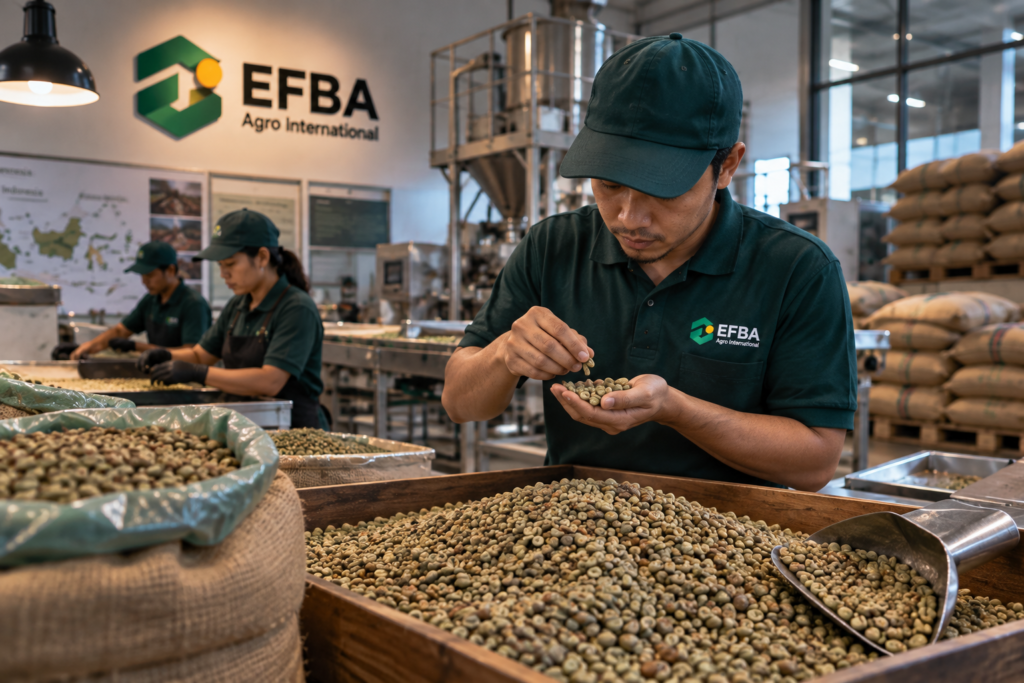
Global demand should not be reduced to a single number because international buyers purchase Indonesian coffee for different reasons. Some seek distinctive single origins, while others need green coffee for roasting, distribution, blending, private-label products, or specialty programs.
Current USDA data provide useful market context. Its December 2025 outlook estimated Indonesian Arabica production at approximately 1.45 million 60-kg bags for 2025/26, compared with 1.40 million bags in 2024/25. Meanwhile, Indonesia’s overall green coffee bean exports were estimated at 7.8 million bags for 2025/26.
These figures indicate Indonesia’s continuing relevance to global coffee supply, but buyers should remember that total export numbers include Robusta. Arabica procurement decisions require origin- and product-specific evaluation.
9. What Should International Buyers Check Before Ordering?
Price per kilogram is only one part of coffee procurement. A lower quotation can become less attractive if the coffee does not meet quality specifications, packaging requirements, consistency expectations, or the buyer’s target market.
Before requesting a final quotation, buyers should communicate the coffee type, origin, green or roasted format, processing method, quality requirements, volume, packaging, destination country, and desired shipment schedule. EFBA Agro specifically recommends providing these details to improve sourcing accuracy.
A professional buying decision should therefore follow:
Quality → Specification → Sample → Commercial Fit → Logistics → Repeat Supply
This framework helps buyers evaluate both the coffee and the commercial relationship around it.
10. Choose a Supplier Based on Long-Term Supply Requirements
International coffee sourcing should consider what happens after the first shipment. Buyers planning repeat procurement need clear communication, agreed specifications, quality evaluation, packaging arrangements, documentation, and dependable sourcing.
EFBA Agro describes its business as procurement, processing, and wholesale export of Indonesian agricultural commodities. Its website states that the company works with producers and processing partners to maintain product consistency from origin to destination and supports bulk requirements for international buyers.
For coffee specifically, this means buyers can begin by communicating requirements and evaluating samples rather than moving directly from an online description to a larger commercial commitment.
Indonesian Arabica Coffee Sourcing Process
For international buyers, the complete process can be simplified into:
Buyer Requirement → Origin → Processing → Specification → Product Matching → Sample → Quality Evaluation → Commercial Review → Packaging → Order → Shipping → Repeat Evaluation
The process does not always move in a perfectly linear sequence. Logistics discussions may begin while samples are being tested, while packaging and commercial requirements can develop alongside product evaluation.
However, every decision should return to three questions:
1. Does the coffee meet the required quality and origin specifications?
2. Does the sample perform as expected during roasting and cupping?
3. Can the supplier support the buyer’s commercial and repeat-supply requirements?
These questions help buyers move from general interest in Indonesian coffee toward a more disciplined procurement decision.
Expertise of EFBA Agro in Indonesian Arabica Coffee Supply
EFBA Agro International focuses on procurement, processing, and wholesale export of Indonesian agricultural commodities. Its official website lists coffee beans and cascara among its commodity categories and specifically presents Gayo Arabica Coffee from Aceh within its product portfolio.
For coffee buyers, EFBA Agro has also published dedicated sourcing guidance covering origin, processing, quality specifications, moisture, defects, traceability, packaging, volume, export documentation, and shipping arrangements. The company positions its coffee sourcing activities toward international roasters, importers, distributors, café chains, private-label businesses, and wholesale buyers.
Its documented cooperation process provides another relevant experience signal. EFBA Agro asks clients to communicate their required product, specification, and quantity before product matching, sampling, testing, confirmation, and commercial cooperation.
For buyers focusing specifically on Gayo coffee and cascara, Coffeenesia provides a specialized sourcing channel within the broader coffee ecosystem. Information about the wider EFBA business group is available through EFBA Digital Mulia.
FAQ About Indonesian Arabica Coffee
What is Indonesian Arabica coffee?
Indonesian Arabica coffee is Coffea arabica grown in suitable coffee-producing regions across Indonesia. Characteristics vary according to origin, altitude, variety, climate, processing, drying, storage, and individual lot conditions, so Indonesian Arabica should not be treated as one uniform flavor profile.
What does Indonesian Arabica coffee taste like?
There is no single flavor profile for all Indonesian Arabica. EFBA Agro describes its Gayo Arabica from Aceh as having medium-to-full body, balanced acidity, and floral and herbal aromas. Other origins and processing methods can produce different sensory characteristics.
How much Arabica coffee does Indonesia produce?
The USDA’s December 2025 outlook placed Indonesian Arabica production at approximately 1.45 million 60-kg bags for the 2025/26 marketing year. This figure represents Arabica production rather than Indonesia’s total coffee production.
Is Indonesian coffee only Arabica?
No. Indonesia produces both Arabica and Robusta, among other coffee categories reflected in international statistics. USDA data show that Robusta represents a substantially larger portion of Indonesia’s overall coffee output, which is why buyers should not treat total Indonesian coffee statistics as Arabica-specific data.
Where does Gayo Arabica coffee come from?
Gayo Arabica comes from the highlands of Aceh in Sumatra, Indonesia. EFBA Agro lists Gayo Arabica among its agricultural commodities and describes its sourcing origin as Aceh’s highlands.
Should international buyers request samples before ordering?
Yes. Samples allow buyers to inspect and test the actual coffee before larger procurement. EFBA Agro’s published cooperation process includes product matching, sample preparation, client testing, confirmation, and subsequent commercial cooperation.
What should buyers tell an Indonesian Arabica coffee supplier?
Buyers should communicate the required origin, coffee format, processing method, grade or quality specification, expected volume, packaging, destination country, and shipment requirements. More precise requirements allow suppliers to evaluate product and commercial suitability more effectively.
Does EFBA Agro supply Indonesian Arabica coffee?
Yes. EFBA Agro officially lists Gayo Arabica from Aceh within its commodity portfolio and publishes dedicated information for international buyers sourcing Indonesian Arabica coffee.
Looking for Indonesian Arabica Coffee for International Sourcing?
International buyers should evaluate Indonesian Arabica coffee through origin, processing, physical specifications, cup profile, samples, traceability, commercial requirements, and supply consistency. Indonesia offers diverse Arabica origins, but the right coffee depends on the buyer’s roasting application, customer segment, product positioning, and procurement requirements.
EFBA Agro International supports agricultural commodity procurement for wholesale and international markets and lists Gayo Arabica Coffee among its products. Its documented process moves from buyer requirements and product matching to samples, testing, confirmation, and commercial cooperation.
For broader Indonesian agricultural procurement, visit EFBA Agro International. Buyers seeking a specialized Gayo coffee and cascara source can explore Coffeenesia.
Source Indonesian Arabica based on verified specifications, sample evaluation, commercial fit, and long-term supply requirements—not origin or price alone.