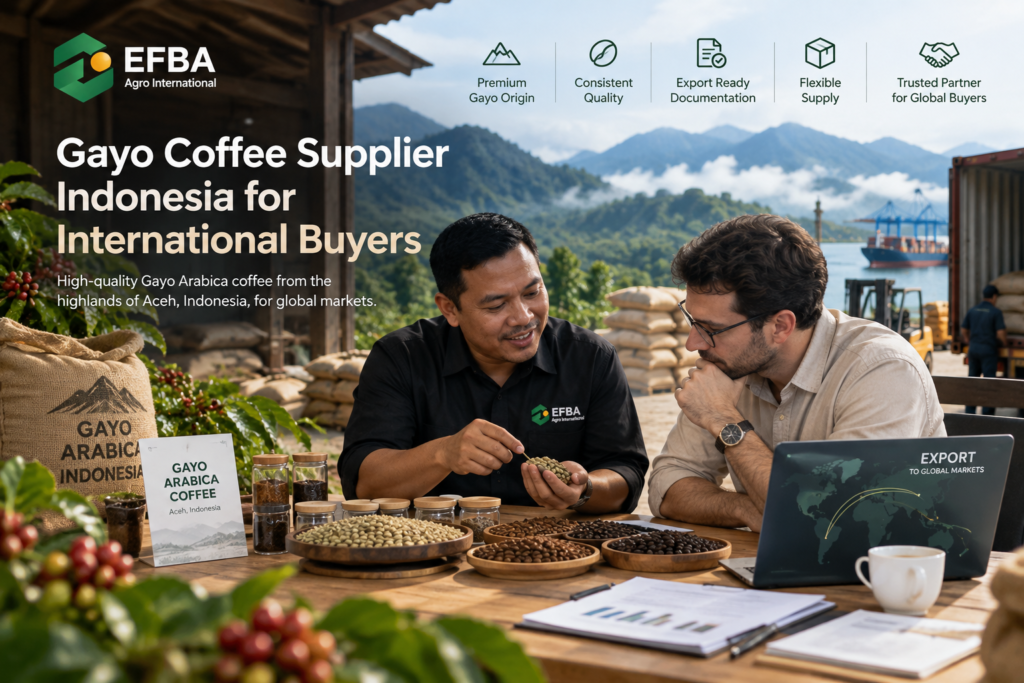
International buyers looking for a reliable Gayo coffee supplier need more than a company that can simply provide coffee beans. Importers, specialty roasters, distributors, café groups, and coffee brands need clear information about origin, processing, quality specifications, samples, traceability, packaging, volume, and supply arrangements.
EFBA Agro International supplies Indonesian agricultural commodities for wholesale and international markets, including Gayo Arabica coffee from the highlands of Aceh. As a Gayo coffee supplier serving international sourcing requirements, EFBA Agro describes its Gayo coffee as a premium Indonesian Arabica with a full body and complex flavor profile.
For international buyers, choosing a Gayo coffee supplier should therefore involve more than comparing prices. Buyers need to evaluate whether the coffee matches their quality requirements, target market, roasting application, purchasing volume, and long-term procurement plan.
A professional sourcing decision should connect product requirements with actual supply capability:
Buyer Requirement → Coffee Origin → Specification → Sample → Quality Evaluation → Commercial Terms → Supply
Is EFBA Agro a Gayo Coffee Supplier in Indonesia?
Yes. EFBA Agro International lists Gayo Arabica coffee among its agricultural commodities and identifies its origin as the highlands of Aceh, Indonesia. For buyers searching for a Gayo coffee supplier in Indonesia, this provides a starting point for evaluating origin, product characteristics, and sourcing requirements.
EFBA Agro’s published coffee sourcing material describes Gayo Arabica grown at approximately 1,200–1,600 meters above sea level, with medium-to-full body, balanced acidity, and floral and herbal aromatic characteristics.
EFBA Agro also publishes a procurement process that allows buyers to identify the required product, receive a sample, test it, confirm its suitability, and proceed to commercial cooperation. This process matters when selecting a Gayo coffee supplier because descriptions such as “premium,” “full body,” or “complex” should not replace actual product evaluation.
For international procurement, the process can be summarized as:
Buyer Requirement → Origin → Specification → Sample → Testing → Confirmation → Commercial Order → Supply Evaluation
This approach helps buyers evaluate Gayo coffee based on their actual requirements instead of relying only on marketing descriptions. It also creates a clearer communication framework between the buyer and the Gayo coffee supplier before a larger commercial order begins.
Official Data: Why Indonesia Matters in Global Coffee Sourcing
Indonesia has an established coffee production and export base. The latest Indonesian Permanent Estate Crops Statistics 2025, released by BPS-Statistics Indonesia on August 31, 2026 and revised on September 16, 2026, provides coffee production data by province as well as export and import data by HS Code and destination country.
BPS also maintains dedicated statistics on Indonesian coffee exports by major destination country through 2025. This confirms that coffee remains part of Indonesia’s documented international commodity trade.
More broadly, Indonesia recorded US$167.03 billion in exports from January to July 2026, an increase of 4.43% compared with the same period in 2025. Non-oil and gas exports reached US$160.01 billion. These figures represent national trade data rather than coffee-specific performance, but they provide useful context for buyers evaluating Indonesia as an international sourcing origin.
Gayo Arabica also has formal recognition connected to its origin. Indonesia’s Directorate General of Intellectual Property lists Kopi Arabika Gayo as a registered Geographical Indication from Aceh.
For an international buyer evaluating a Gayo coffee supplier, these references reinforce an important principle:
Origin → Product Specification → Quality Verification → Commercial Fit → Supply
Origin creates value, but professional procurement still requires buyers to verify the actual coffee, specifications, sample, and commercial suitability before confirming an order.
1. Start with Gayo Coffee Origin
Gayo Arabica comes from the Gayo Highlands in Aceh, Sumatra. The origin has an established identity within Indonesian coffee and is officially listed as a registered Geographical Indication by Indonesia’s Directorate General of Intellectual Property.
A professional Gayo coffee supplier should therefore provide clear information about the origin of the coffee being offered. Origin information gives buyers an important starting point, but they should continue the evaluation through product specifications and samples.
EFBA Agro identifies Gayo Arabica as one of the important origins in its coffee portfolio. Its published sourcing material describes coffee grown at approximately 1,200–1,600 meters above sea level and associates the product with medium-to-full body, balanced acidity, floral aromas, and herbal characteristics.
However, international buyers should not assume that every Gayo lot will taste identical. Altitude, variety, harvest conditions, processing, drying, sorting, storage, and individual lot characteristics can influence the final cup.
For this reason, buyers should use origin as the beginning of the sourcing process rather than the final quality conclusion. When comparing a Gayo coffee supplier, buyers should continue from origin information to specifications, samples, testing, and commercial evaluation.
2. Define Specifications Before Asking a Gayo Coffee Supplier for Price
One of the first questions buyers often ask a Gayo coffee supplier is: “What is your price per kilogram?” Price matters, but the quotation has limited value if the buyer and supplier are discussing different specifications.
Professional buyers should first define the product format, expected volume, origin requirements, processing method, quality parameters, packaging, destination, and intended application.
EFBA Agro’s own sourcing guidance recommends reviewing factors including origin, variety, processing, grade, moisture, defect specifications, cup profile, harvest, packaging, MOQ, export documentation, and lead time.
A buyer can use the following sourcing sequence:
Product → Origin → Process → Quality → Specification → Volume → Packaging → Destination → Commercial Offer
This structure helps the buyer and Gayo coffee supplier understand exactly what the quotation covers. It also reduces misunderstandings when discussing quality, volume, packaging, pricing, and international supply requirements.
For example, two Gayo coffee offers may come from the same general origin but differ in processing method, moisture level, defect tolerance, cup characteristics, packaging, or lot size. Comparing price without comparing these variables can produce an inaccurate purchasing decision.
3. Request a Sample from the Gayo Coffee Supplier Before a Larger Order
Samples are essential when evaluating coffee. A website description can introduce the product, but it cannot tell a roaster exactly how a specific lot will perform during roasting and cupping.
For that reason, buyers should request a sample from the Gayo coffee supplier before moving directly into a larger commercial order. The sample allows the buyer to evaluate whether the coffee matches the intended roasting profile, product positioning, customer preference, and quality expectations.
EFBA Agro publishes a sourcing process where the company prepares a sample after identifying an appropriate product. The buyer can test the sample and provide confirmation before commercial cooperation begins.
A practical evaluation process can follow this sequence:
Requirement → Sample Request → Sample Evaluation → Roasting Test → Cupping → Feedback → Specification Confirmation → Commercial Discussion
The sample stage also gives buyers an opportunity to communicate more precisely with the Gayo coffee supplier. Instead of discussing coffee only through general descriptions, both parties can refer to actual evaluation results.
For specialty roasters and coffee brands, this step becomes particularly important because the intended cup profile may influence purchasing decisions. Distributors and wholesale buyers may also use samples to evaluate whether the product fits the quality level and price segment of their target market.
Therefore, sample evaluation should form part of the supplier-selection process rather than becoming an optional step after commercial negotiations.
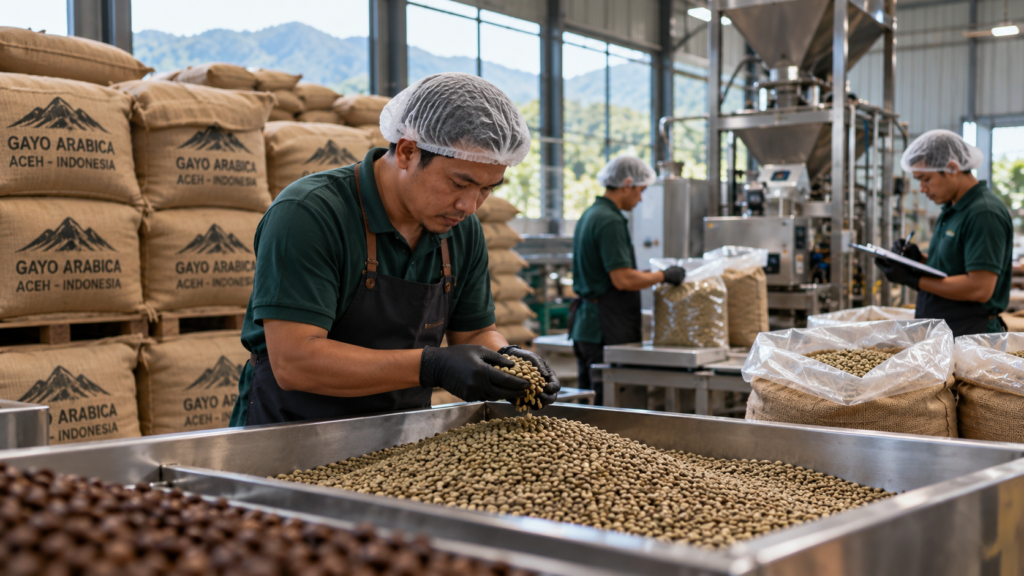
For coffee procurement, buyers can use samples to evaluate green bean appearance, aroma, roasting response, acidity, sweetness, body, balance, aftertaste, moisture, defects, and overall suitability. EFBA Agro’s coffee sourcing material specifically recommends physical sample evaluation rather than relying solely on descriptive terms.
The process becomes:
Specification → Sample → Test → Feedback → Confirmation → Order
This is especially important for buyers planning repeat or larger-volume procurement.
4. Understand Processing and Cup Profile
Processing can influence how Gayo coffee presents itself in the cup. EFBA Agro’s published coffee guide discusses natural, washed, and wet-hulled processing and explains that each can create different sensory characteristics.
Natural processing can emphasize fruit character, sweetness, and heavier body. Washed coffee may provide a cleaner profile and clearer flavor separation, while wet-hulled processing is closely associated with Indonesian coffee production and can produce deeper body and characteristic Indonesian profiles.
Therefore, buyers should not ask only whether a supplier has “Gayo coffee.” A more useful question is whether the available coffee matches the buyer’s intended roast profile, brewing application, customer preference, and product positioning.
5. Evaluate Traceability for Professional Sourcing
Traceability helps international buyers understand where coffee comes from and how a particular lot has been handled. Depending on the sourcing arrangement, useful information can include region, farm or cooperative, altitude, variety, processing method, harvest period, drying method, and lot identification.
This information can support quality control, repeat procurement, supplier evaluation, and origin storytelling. A specialty roaster, for example, may need detailed origin information for its customers, while an importer may prioritize consistency between one shipment and the next.
For buyers seeking more specialized information about Gayo coffee, Coffeenesia focuses specifically on single-origin Indonesian coffee and cascara from the Gayo Highlands. Its published information includes origin, packaging options, wholesale tiers, and coffee sourcing activities.
6. Match the Coffee with the Intended Market
Good coffee is not automatically the right coffee for every buyer. A specialty roaster, distributor, café group, and private-label coffee business can have very different requirements.
A specialty roaster may prioritize origin identity, cup complexity, processing, and traceability. A distributor may place more emphasis on commercial volume, repeat supply, packaging, and product consistency. Meanwhile, a café operator may need coffee that performs reliably within a specific espresso or filter menu.
The decision should connect:
Coffee Quality → Roast Application → Customer Segment → Price Positioning → Commercial Fit
This prevents buyers from purchasing coffee only because the Gayo name is well known. The actual product still needs to fit the intended market.
7. Review Packaging, Volume, and Supply Requirements
Coffee procurement does not end when a buyer approves the flavor. Packaging, storage, shipment volume, delivery expectations, and supply planning also affect commercial feasibility.
International buyers should communicate their expected volume and packaging requirements early. This allows the supplier to evaluate whether the available product and sourcing arrangement match the project.
For specialized Gayo coffee sourcing, Coffeenesia currently publishes commercial tiers starting at 25 kg for Merchant Tier, 100 kg for Wholesale Tier, and above 250 kg for Distributor Tier. These are Coffeenesia’s published tiers and should not automatically be interpreted as EFBA Agro’s MOQ.
EFBA Agro, meanwhile, invites international buyers to communicate their procurement requirements so its team can prepare an offer based on the requested commodity and project.
8. Check Quality Consistency, Not Only the First Sample
A strong first sample is important, but long-term procurement requires consistency. Coffee is an agricultural product, so buyers need to understand how quality may vary between harvests and lots.
EFBA Agro’s coffee sourcing guidance identifies several stages that can influence quality:
Harvest → Cherry Selection → Processing → Drying → Sorting → Storage → Packaging → Transport
For repeat orders, buyers should maintain clear purchasing specifications and compare subsequent lots with previously approved coffee. Feedback between buyer and supplier also becomes important because it creates a clearer reference for future procurement.
The objective is not to assume that agricultural products never vary. Instead, buyers need a process for identifying, communicating, and managing that variation.
9. Consider Commercial Fit Before Scaling Orders
International sourcing needs to make sense commercially. Buyers should calculate not only the coffee price but also freight, import costs, roasting, packaging, storage, distribution, and other costs relevant to their business model.
For this reason, a buyer may begin with sample evaluation and a manageable commercial quantity before increasing procurement volume. EFBA Agro’s published coffee sourcing example similarly describes a process moving from product requirements and samples through trial roasting, commercial evaluation, initial orders, and repeat purchasing.
A practical approach is:
Sample → Trial → Commercial Evaluation → Initial Order → Market Response → Repeat Order → Scale
This allows buyers to validate both coffee quality and commercial performance before making a larger commitment.
10. Choose a Gayo Coffee Supplier for Long-Term Procurement
The cheapest quotation does not automatically create the lowest procurement risk. Professional buyers need to consider communication, specifications, sample availability, product consistency, traceability, packaging, and the supplier’s ability to respond to repeat requirements.
A useful supplier evaluation framework is:
Quality + Consistency + Traceability + Communication + Commercial Fit + Supply Reliability
EFBA Agro positions itself as a long-term procurement partner for Indonesian agricultural commodities and invites buyers to provide their requirements so the team can prepare a comprehensive offer. Its website also shows a procurement process covering product selection, samples, sample testing, client confirmation, and commercial cooperation.
This documented process is particularly relevant to international coffee buyers who want to evaluate the product before moving toward larger commercial procurement.
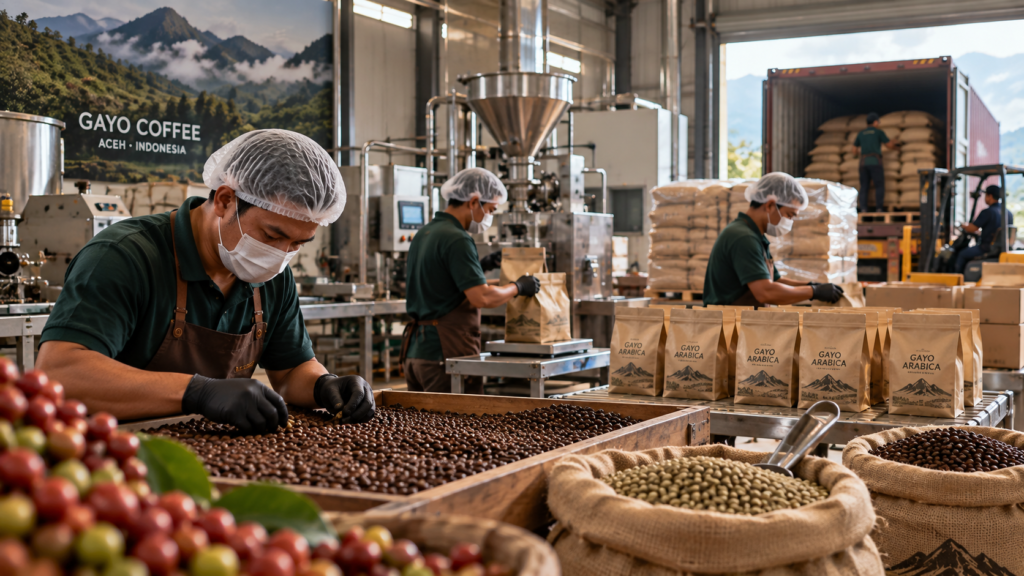
How Should International Buyers Source Gayo Coffee?
A structured sourcing process can be summarized as follows:
Buyer Requirement → Gayo Origin → Product Specification → Processing → Sample → Quality Evaluation → Commercial Evaluation → Confirmation → Order → Supply → Repeat Evaluation
The process does not need to be completely linear. Packaging discussions can take place while samples are being evaluated, while commercial and logistics requirements can be reviewed before final confirmation.
However, buyers should return to four key questions:
1. Does the coffee match the required origin and specifications?
2. Does the sample meet the buyer’s quality and sensory requirements?
3. Can the commercial terms support the buyer’s target market?
4. Can the sourcing relationship support future orders and quality evaluation?
These questions make supplier selection more objective and help international buyers move beyond price-based sourcing.
Expertise of EFBA Agro in Gayo Coffee Sourcing
EFBA Agro International focuses on Indonesian agricultural commodities for wholesale and international markets. Its official website lists Gayo Arabica Coffee alongside other Indonesian commodities and describes the coffee as originating from Aceh’s highlands.
More importantly for international buyers, EFBA Agro publicly documents a procurement process. After identifying an appropriate product, EFBA Agro prepares a sample, allows the client to test it, receives confirmation, and then proceeds toward commercial cooperation.
EFBA Agro has also published dedicated guidance for international Arabica coffee buyers. The material covers Gayo origin, processing, traceability, quality control, moisture and storage, specifications, MOQ considerations, samples, commercial evaluation, and supplier selection.
Within the wider EFBA ecosystem, Coffeenesia provides a more specialized focus on Gayo coffee and cascara. Its official website publishes information about single-origin Indonesian coffee, packaging, wholesale quantities, and sourcing from the Gayo Highlands.
For international buyers, this creates a clear connection:
EFBA Agro → Indonesian Agricultural Procurement
Coffeenesia → Specialized Gayo Coffee & Cascara Sourcing
For broader information about the EFBA business ecosystem, buyers can also visit EFBA Digital Mulia.
FAQ About Gayo Coffee Supplier Indonesia
What is a Gayo coffee supplier?
A Gayo coffee supplier sources and supplies coffee originating from the Gayo Highlands of Aceh, Indonesia. Depending on the business model, the supplier may support product specifications, samples, packaging, wholesale procurement, and international supply arrangements. Buyers should verify the actual origin and specifications of the coffee offered.
Does EFBA Agro supply Gayo Arabica coffee?
Yes. EFBA Agro International officially lists Gayo Arabica coffee among its agricultural commodities and describes it as originating from the highlands of Aceh. EFBA Agro also publishes a sample-based procurement process for clients before commercial cooperation begins.
Where does Gayo coffee come from?
Gayo coffee originates from the Gayo Highlands in Aceh, Sumatra, Indonesia. Indonesia’s Directorate General of Intellectual Property officially lists Kopi Arabika Gayo as a registered Geographical Indication associated with Aceh.
What should international buyers ask a Gayo coffee supplier?
Buyers should ask about origin, variety, processing method, grade or quality specifications, moisture, defects, cup profile, harvest information, packaging, volume, samples, documentation, and lead time. The exact requirements should follow the buyer’s intended market and application.
Should buyers request samples before ordering Gayo coffee?
Yes. Samples help buyers inspect the green coffee, conduct sample roasting and cupping, evaluate sensory characteristics, and compare the coffee with purchasing specifications. EFBA Agro’s published procurement process specifically includes sample preparation and client testing before confirmation.
Is all Gayo coffee the same?
No. Gayo identifies an origin, but individual coffees can differ according to altitude, variety, processing, harvest conditions, drying, sorting, storage, and lot characteristics. Buyers should therefore evaluate each offered lot against their requirements.
Does EFBA Agro work with international buyers?
EFBA Agro positions its business toward international agricultural commodity procurement and invites buyers to discuss requirements for a comprehensive offer. Its dedicated Arabica coffee material is specifically written for international roasters, distributors, café chains, importers, and wholesale buyers.
Where can buyers find more specialized Gayo coffee information?
Buyers can explore Coffeenesia for a specialized focus on single-origin Indonesian coffee and cascara from the Gayo Highlands. Coffeenesia publishes information about sourcing, packaging, commercial quantities, and its Gayo coffee ecosystem.
Looking for a Gayo Coffee Supplier in Indonesia?
Choosing a Gayo coffee supplier should not begin and end with price. International buyers need to evaluate origin, specifications, processing, samples, quality, traceability, packaging, commercial requirements, and the potential for repeat supply.
EFBA Agro International provides Gayo Arabica within its Indonesian agricultural commodity portfolio and uses a procurement process that includes product identification, sample preparation, testing, confirmation, and commercial cooperation.
If your company is an importer, specialty roaster, distributor, café group, or wholesale buyer, start by defining the coffee specifications and volume you need. Then evaluate the sample before moving toward commercial procurement.
Discuss Gayo Coffee Sourcing with EFBA Agro International
For specialized Gayo coffee and cascara sourcing, explore Coffeenesia. For information about the broader business ecosystem, visit EFBA Digital Mulia.
Source Gayo coffee based on origin, verified specifications, quality evaluation, and long-term commercial fit—not price alone.