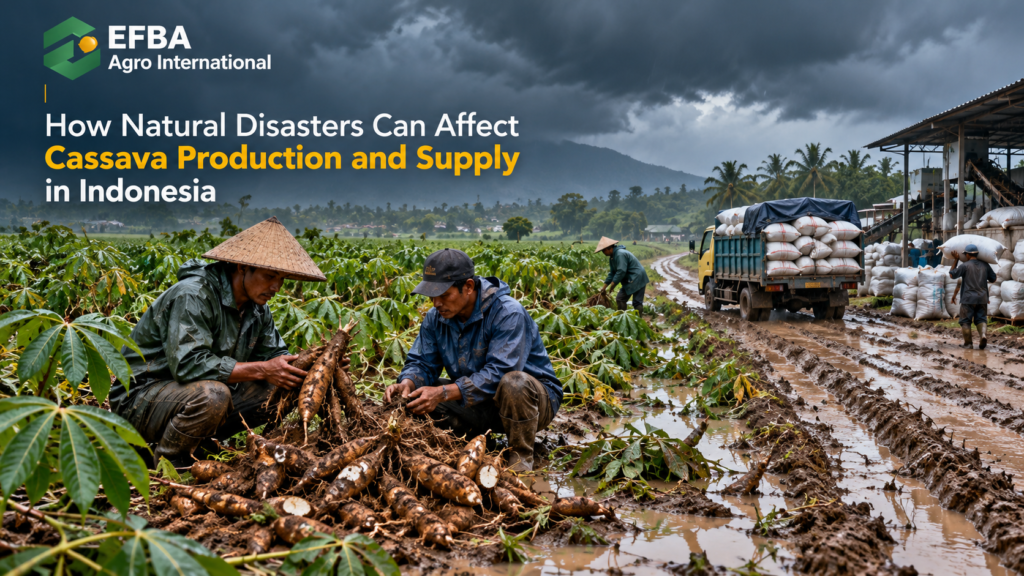
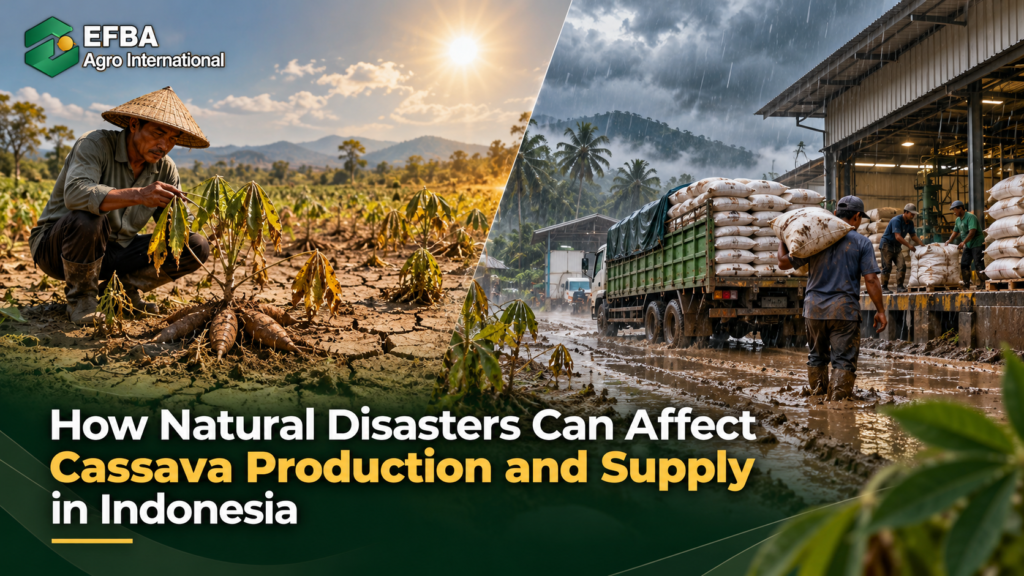
Natural disasters can disrupt cassava production in Indonesia by damaging agricultural land, affecting root development, delaying harvests, and interrupting transportation. Understanding natural disaster cassava production risks is therefore essential for farmers, processors, and international commodity buyers who depend on consistent raw-material availability.
Floods, prolonged droughts, landslides, and extreme rainfall can also influence the quality of raw materials used to manufacture tapioca starch and cassava flour. Although cassava tolerates relatively dry conditions, successful production still requires suitable soil conditions, healthy planting materials, and reliable harvesting operations.
Furthermore, damaged roads and interrupted processing activities can delay deliveries even when farms remain productive. Consequently, buyers should evaluate regional production, transportation, processing capacity, product quality, and shipment schedules when managing cassava sourcing risks.
How Do Natural Disasters Affect Cassava Production in Indonesia?
Natural disasters affect cassava production by reducing harvest yields, damaging roots, delaying agricultural operations, increasing transportation costs, and disrupting the supply of tapioca starch and cassava flour.
The severity depends on the type of disaster, crop growth stage, soil conditions, geographic location, and availability of alternative sourcing regions. Therefore, natural disaster cassava production impacts may differ significantly between provinces and individual farming areas.
Not every extreme weather event creates a nationwide cassava shortage. However, regional disruptions can still affect manufacturers and international buyers that depend on particular production locations.
The supply chain impact follows this process:
Natural Disaster → Farm Disruption → Harvest Delay → Raw Material Shortage → Processing Disruption → Supply Risk
For this reason, procurement teams should monitor agricultural production alongside transportation, processing availability, inventory, and delivery commitments.
5 Major Natural Disaster Risks to Cassava Production in Indonesia
Natural disasters influence cassava cultivation through different mechanisms. Some events directly damage plants and roots, while others interrupt harvesting, processing, and transportation without necessarily reducing national crop yields.
Understanding these natural disaster cassava production risks helps buyers identify vulnerable sourcing areas and prepare appropriate procurement strategies.
1. Flooding and Excessive Rainfall
Heavy rainfall can saturate agricultural soils and create waterlogged conditions that restrict oxygen availability around cassava roots. Prolonged flooding can damage root systems, increase root rot risks, and reduce the quantity of commercially usable cassava.
Furthermore, excessive rainfall may prevent farmers from harvesting on schedule because waterlogged fields become difficult to access. Muddy roads and damaged transport routes can also delay harvested roots from reaching processing facilities.
For tapioca manufacturers, these disruptions are particularly important because fresh cassava roots deteriorate relatively quickly after harvesting. Consequently, delays between harvesting and processing can reduce usable raw-material quality and increase operational losses.
2. Prolonged Drought and Water Shortages
Cassava tolerates relatively dry conditions better than many agricultural crops. However, prolonged water shortages can still slow plant growth, limit root development, and reduce yields depending on drought severity and crop growth stage.
The Food and Agriculture Organization (FAO) explains that cassava can produce reasonable yields under dry conditions, although prolonged drought may create shortages of planting materials and increase certain agricultural risks.
In Indonesia, delayed rainfall can also affect planting schedules and the establishment of new crops. Therefore, natural disaster cassava production risks include both immediate harvest losses and longer-term changes in seasonal raw-material availability.
For processors, these conditions may complicate purchasing schedules even when agricultural production does not fail completely.
3. Landslides and Soil Erosion
Landslides can damage farmland, restrict access to production areas, and interrupt the transportation of harvested cassava. In hilly agricultural regions, intense rainfall can also accelerate soil erosion and remove productive topsoil.
These conditions may create longer-term challenges for cultivation and farm productivity. However, buyers may experience the immediate impact through delayed deliveries rather than changes in national production statistics.
When landslides block important transport routes, suppliers may need longer alternative routes that increase transportation time and logistics costs. Therefore, procurement planning should evaluate road accessibility and processing infrastructure alongside agricultural conditions.
4. Extreme Weather and Harvest Disruption
Unpredictable rainfall patterns and severe weather can change the timing of agricultural activities. Farmers may postpone planting, harvesting, or transporting cassava when field conditions become unsuitable or access to equipment and labor becomes difficult.
These disruptions can create temporary differences between expected raw-material volumes and actual deliveries. When several suppliers experience delays simultaneously, processors may struggle to maintain planned production schedules.
Therefore, buyers should distinguish temporary harvest delays from permanent agricultural losses. Both can affect supply continuity, but each requires different procurement responses.
5. Damage to Processing Facilities and Logistics
Natural disasters can interrupt cassava supply even when farms maintain relatively stable production. Flooded warehouses, damaged roads, electricity interruptions, and limited transport access may prevent processors from receiving raw materials or dispatching finished products.
For cassava-derived commodities, these disruptions can affect washing, starch extraction, drying, packaging, warehousing, and shipping. Problems at any stage may reduce product availability or extend delivery lead times.
Consequently, natural disaster cassava production and logistics risks require buyers to evaluate the entire supply chain, including factory capacity, finished-goods inventory, packaging, and transportation arrangements.
How Natural Disasters Affect Cassava-Derived Products
Cassava serves as a raw material for several products used by food manufacturers and industrial processors. However, each product responds differently to agricultural disruption because processing requirements, storage characteristics, and quality specifications vary.
| Product | Potential disaster impact | Procurement concern |
|---|---|---|
| Fresh cassava roots | Harvest delays and rapid deterioration | Freshness and transport time |
| Tapioca starch | Raw-material shortages and processing interruption | Starch quality and delivery continuity |
| Cassava flour | Drying, milling, and sourcing disruptions | Moisture and consistency |
| MOCAF | Limited suitable cassava and processing interruptions | Specifications and lead time |
| Dried cassava chips | Drying and transportation delays | Moisture and storage conditions |
Processed products that manufacturers have dried and stored under suitable conditions generally provide more short-term flexibility than fresh roots. However, flooding, moisture exposure, damaged packaging, and transportation interruptions can still affect finished-product quality.
Therefore, buyers should consider product characteristics when evaluating natural disaster cassava production risks and selecting appropriate inventory, storage, and delivery arrangements.
Official Data: Cassava Production and Natural Disaster Risks in Indonesia
Indonesia remains an important cassava-producing country, with agricultural activity concentrated in several major production regions. This geographic concentration matters because disruptions in leading provinces can affect raw-material availability for processors even when other regions continue operating normally.
According to the Indonesian Ministry of Agriculture’s 2025 Cassava Trade Performance Analysis, Lampung accounted for approximately 47.32% of Indonesia’s cassava production in 2024, with output of around 7.9 million tonnes. Other producing provinces include Central Java, East Java, West Java, North Sumatra, Yogyakarta, and East Nusa Tenggara.
Indonesian Cassava Production: Historical Indicators
| Indicator | Reported figure |
|---|---|
| National cassava production, 2024 | Approximately 15.2 million tonnes |
| Lampung’s share of national production, 2024 | Approximately 47.32% |
| Major producing province | Lampung |
| Other important producing areas | Central Java, East Java, West Java, North Sumatra, Yogyakarta, East Nusa Tenggara |
Source: Indonesian Ministry of Agriculture. These are historical production indicators, not estimates of cassava losses caused by natural disasters in 2026. Figures from different statistical publications should be interpreted using their respective methodologies.
The Ministry’s 2025 performance report also identifies structural challenges involving seasonal raw-material availability, starch quality differences, and uncertainty in industrial supply arrangements. These existing challenges can increase supply-chain vulnerability when floods, droughts, or logistics disruptions occur.
Meanwhile, Indonesia’s National Disaster Management Agency (BNPB) monitors natural disaster incidents across the country. Its April 2026 bulletin recorded 177 nationwide disaster incidents, compared with 244 in April 2025.
However, these figures cover disaster incidents across Indonesia and do not establish how many cassava farms or tonnes of production were affected. Therefore, analysts should combine official agricultural statistics with location-specific disaster information before estimating production losses.
Why Cassava Production in Lampung Matters for Supply Stability
Lampung plays an important role in Indonesia’s cassava supply chain because of its substantial contribution to national production. As a result, flooding, transportation interruptions, or unfavorable growing conditions in the province could affect processors that rely heavily on Lampung-origin cassava.
This concentration makes Lampung particularly relevant when assessing natural disaster cassava production risks in Indonesia. However, production concentration alone does not prove that any specific disaster has caused a shortage.
Buyers must verify affected cultivation areas, harvesting conditions, processing operations, and supplier inventories before determining the actual supply impact.
For manufacturers and importers, regional sourcing diversification can provide additional procurement flexibility. Central Java, East Java, and other cassava-producing areas may offer alternative options, depending on availability, processing capability, logistics costs, and agreed product specifications.
Can Natural Disasters Affect Tapioca Prices and Export Deliveries?
Understanding natural disaster cassava production risks helps international buyers anticipate potential cost pressures and supply disruptions. For example, processors that receive fewer cassava roots than planned may need alternative suppliers or adjustments to their production schedules. Additional transportation and purchasing expenses can subsequently influence product quotations and delivery arrangements.
The potential impact follows this process:
Lower Harvest Volume → Raw Material Shortage → Higher Procurement Pressure → Processing Adjustment → Potential Delivery Delay
Nevertheless, natural disasters do not automatically increase cassava prices. Manufacturers with sufficient finished-product inventories or alternative sourcing options may manage temporary disruptions without immediately changing their selling prices.
6 Strategies to Reduce Natural Disaster Cassava Production and Supply Risks
International buyers and agricultural commodity suppliers can reduce supply uncertainty through strategic sourcing, quality verification, production planning, and logistics coordination. These measures are particularly relevant for tapioca manufacturers and food processors that depend on consistent cassava-derived raw materials.
The following six strategies help procurement teams manage natural disaster cassava production risks while maintaining realistic purchasing and delivery arrangements.
1. Diversify Cassava Sourcing Regions
Relying on one cassava-producing region can expose buyers to concentrated weather, harvest, and transportation risks. Therefore, procurement teams should evaluate qualified suppliers from several Indonesian production regions to reduce dependence on a single agricultural area.
However, geographic diversification alone does not guarantee supply reliability. Buyers must also consider product specifications, raw-material availability, processing capacity, transportation costs, and delivery schedules before approving alternative suppliers.
For example, when flooding affects one sourcing region, another region may provide additional procurement options. Nevertheless, buyers should confirm current supply conditions and product suitability before changing their purchasing arrangements.
2. Monitor Harvest Conditions and Supply Availability
Regular communication with farmers, collectors, and processors helps procurement teams understand harvest schedules and raw-material availability. This information becomes particularly important when extreme weather threatens agricultural production or transportation routes.
When a disaster occurs, buyers should request updates on affected cultivation areas, available inventory, anticipated harvesting delays, and alternative sourcing possibilities. These updates can help companies identify potential problems before they disrupt contracted deliveries.
Monitoring regional conditions also supports better natural disaster cassava production risk management. However, procurement decisions should rely on verified supplier information rather than general weather headlines alone.
3. Establish Clear Product Specifications
Extreme rainfall, flooding, and delayed harvesting can influence cassava raw-material quality. Excessive moisture and prolonged postharvest handling may also affect the characteristics of roots that processors use to manufacture tapioca starch and cassava flour.
Therefore, buyers should establish clear product specifications before confirming an order. Depending on the intended application, relevant parameters may include moisture content, starch characteristics, appearance, and other technical requirements.
Buyers and suppliers should also agree on applicable inspection methods and quality documentation. This approach helps both parties identify potential quality problems before dispatch and reduces uncertainty during international procurement.
4. Review Processing and Logistics Readiness
Agricultural production capacity represents only one component of supply reliability. Buyers must also evaluate processing capabilities, packaging arrangements, storage conditions, transportation access, and export documentation.
For instance, heavy rainfall may interrupt inland transportation even when cassava harvesting continues normally. Meanwhile, power interruptions or warehouse flooding can delay processing and finished-product dispatch.
Consequently, buyers should request updated production and shipment schedules when disruptions occur. Suppliers should also verify actual operating conditions before confirming delivery commitments.
This approach helps manage natural disaster cassava production disruptions across the wider supply chain rather than focusing exclusively on agricultural output.
5. Evaluate Safety Stock and Delivery Flexibility
Manufacturers that require regular tapioca deliveries may benefit from maintaining appropriate safety stock. However, inventory planning should consider demand patterns, replenishment lead times, storage conditions, shelf life, and working-capital requirements.
Processed cassava products generally provide more storage flexibility than fresh cassava roots when suppliers maintain suitable packaging and warehouse conditions. Nevertheless, inventory managers still need to monitor moisture exposure, product quality, and stock rotation.
Procurement agreements can also establish realistic delivery windows, communication procedures, and contingency arrangements. These measures help reduce uncertainty, although they cannot eliminate every risk associated with natural disasters.
6. Strengthen Supplier Communication and Procurement Planning
Consistent communication becomes essential when agricultural conditions change unexpectedly. International buyers should request updates on available quantities, product specifications, processing schedules, quality documentation, and shipment readiness.
Furthermore, procurement teams should clarify responsibilities for transportation, inspections, export documentation, and delivery coordination. Clear commercial arrangements help both parties respond more effectively when disruptions affect production or logistics.
An effective supply-management framework follows:
Regional Risk Assessment → Supplier Verification → Quality Review → Inventory Planning → Logistics Confirmation → Shipment Monitoring
This process supports more informed procurement decisions. However, buyers should recognize that no supplier can guarantee uninterrupted agricultural supply under every natural disaster scenario.
How EFBA Agro Supports Indonesian Cassava-Derived Commodity Sourcing
EFBA Agro International publishes information about its agricultural commodity sourcing activities, product specifications, packaging options, and export arrangements. Its cassava-related portfolio includes tapioca flour and other cassava-derived commodities for commercial and industrial buyers.
These offerings are relevant to companies that need information about Indonesian agricultural products and international procurement arrangements. In the context of natural disaster cassava production risks, buyers should evaluate product specifications, sourcing availability, inventory, and delivery conditions before confirming transactions.
Tapioca Flour and Cassava-Related Product Experience
Through its official Tapioca Flour (Food Grade) page, EFBA Agro provides information about product specifications, packaging configurations, and quotation requirements. The published packaging options include 25 kg and 50 kg sacks, with larger configurations available upon request.
EFBA Agro also discusses product characteristics and quality considerations in its article Flour Trade Tapioca Flour: Premium Grade Worldwide. These materials help international buyers understand relevant purchasing requirements before discussing commercial arrangements.
However, buyers should confirm current technical specifications, testing documentation, available inventory, and shipment schedules for every order. Previously published product information does not automatically confirm immediate stock availability, particularly after agricultural or logistics disruptions.
Agricultural Risk Awareness and Supply Planning
EFBA Agro has also published Natural Disasters and Indonesian Agriculture: Managing Commodity Supply Risks. The article discusses how extreme weather, infrastructure damage, and agricultural disruption may influence Indonesian commodity procurement.
While that discussion covers several agricultural commodities, this article focuses on cassava production, tapioca supply, and related logistics risks. Together, these topics help buyers understand the connections between growing regions, raw-material quality, processing requirements, and international delivery planning.
This information can support initial procurement research and risk assessment. Nevertheless, buyers should verify the actual condition of each prospective order directly with EFBA Agro or the relevant supplier before making purchasing commitments.
Business Partnerships and Supply Chain Resilience within the EFBA Ecosystem
PT EFBA Digital Mulia publishes information about strategic partnerships involving manufacturing, distribution, market access, logistics, and business development. Its Business Partnership page explains how companies can connect complementary business capabilities through cooperation.
For agricultural commodity buyers, relevant partnerships may support supplier identification, procurement coordination, and logistics planning. However, each transaction requires separate confirmation regarding available services, commercial arrangements, and operational responsibilities.
In managing natural disaster cassava production risks, the main objective is to strengthen communication and support transparent decisions concerning supplier capability, product quality, available quantities, and shipment schedules.
Cassava Supply Risk Checklist for International Buyers
International buyers should evaluate sourcing conditions and product readiness before confirming cassava-derived commodity orders. The following checklist supports initial procurement planning and helps identify risks that may affect quality, availability, or delivery.
- Confirm the cassava product type and intended industrial application.
- Verify the sourcing region and current raw-material availability.
- Check recent floods, droughts, and transportation disruptions.
- Request current product specifications and relevant quality documentation.
- Confirm finished-product inventory and processing availability.
- Review packaging, storage conditions, and shipment requirements.
- Agree on realistic delivery dates and contingency procedures.
This checklist provides a practical procurement reference rather than proof of supplier reliability. Buyers should also review contractual terms, import requirements, and applicable food-safety regulations before placing an order.
Frequently Asked Questions About Natural Disaster Cassava Production
How do floods affect cassava production?
Flooding can create waterlogged soil, damage cassava roots, increase root rot risks, and restrict access to agricultural fields. Excessive rainfall may also delay harvesting and transportation to processing facilities. However, the actual production impact depends on flood duration, crop conditions, soil characteristics, and the affected cultivation area.
Is cassava resistant to drought?
Cassava tolerates relatively dry conditions, but prolonged drought can still reduce plant growth and root yields. Severe water shortages may also disrupt planting schedules and limit the availability of healthy planting materials. Therefore, drought tolerance does not guarantee stable production under extreme conditions.
Which Indonesian region is important for cassava production?
Lampung is a major cassava-producing province in Indonesia. According to the Ministry of Agriculture’s 2025 Cassava Trade Performance Analysis, Lampung contributed approximately 47.32% of national cassava production in 2024. Other important producing regions include Central Java, East Java, West Java, and North Sumatra.
Can natural disasters cause tapioca shortages?
Yes. Natural disasters may reduce cassava harvest volumes, interrupt factory operations, or restrict transportation between farms and processors. However, the severity of shortages depends on affected production areas, available inventories, and alternative sourcing capacity.
Do natural disasters always increase cassava prices?
No. Natural disasters can increase procurement pressure when they restrict raw-material availability or raise transportation expenses. However, demand, existing inventories, alternative suppliers, and market conditions also influence prices. Buyers should evaluate current quotations instead of assuming that every disruption causes higher costs.
How can buyers reduce cassava supply risks?
Buyers can diversify sourcing regions, monitor harvest conditions, verify product specifications, assess available inventory, and coordinate logistics with suppliers. In addition, clear purchasing agreements and contingency plans can help companies respond to unexpected disruptions. These measures improve preparedness but cannot eliminate all agricultural risks.
Does EFBA Agro supply cassava-derived products?
EFBA Agro publishes commercial information about tapioca flour and cassava-related commodities for international buyers. Companies can contact EFBA Agro to confirm current product availability, technical specifications, minimum order quantities, prices, and shipment arrangements.
Source Cassava-Derived Products from Indonesia with Better Supply Planning
Natural disasters can influence cassava production in Indonesia through agricultural damage, harvest delays, transportation problems, and processing interruptions. Understanding natural disaster cassava production risks helps international buyers evaluate sourcing conditions and prepare for potential supply disruptions.
Although cassava offers relatively good drought tolerance, prolonged dry periods, flooding, and damaged infrastructure can still affect production and distribution. Therefore, reliable procurement requires transparent supplier communication, quality verification, regional risk assessment, and realistic delivery planning.
International buyers can use the following framework:
Production Risk Assessment → Supplier Verification → Product Quality → Inventory Review → Logistics Planning → Procurement Decision
EFBA Agro International provides information about Indonesian tapioca flour and cassava-related commodities through its official website. Buyers can review the company’s Tapioca Flour (Food Grade) page to understand published product specifications and packaging options.
For commercial inquiries, contact EFBA Agro International to discuss current availability, product requirements, quotations, and shipment arrangements. Reliable sourcing begins with verified information, clear specifications, and consistent communication throughout the procurement process.

EFBA Agro International provides information about its tapioca flour and cassava-related sourcing activities through its official website. Understanding natural disaster cassava production risks helps international buyers evaluate raw-material availability, sourcing conditions, and potential logistics disruptions before confirming procurement decisions.
Buyers interested in Indonesian agricultural commodities can explore EFBA Agro’s Tapioca Flour (Food Grade) page to review published product information. They can also contact the team to discuss current availability, technical specifications, quotations, packaging requirements, and shipping arrangements.
Reliable procurement requires verified product specifications, realistic supply availability, and transparent communication throughout the supply chain. These practices help buyers manage agricultural sourcing risks and make more informed purchasing decisions.