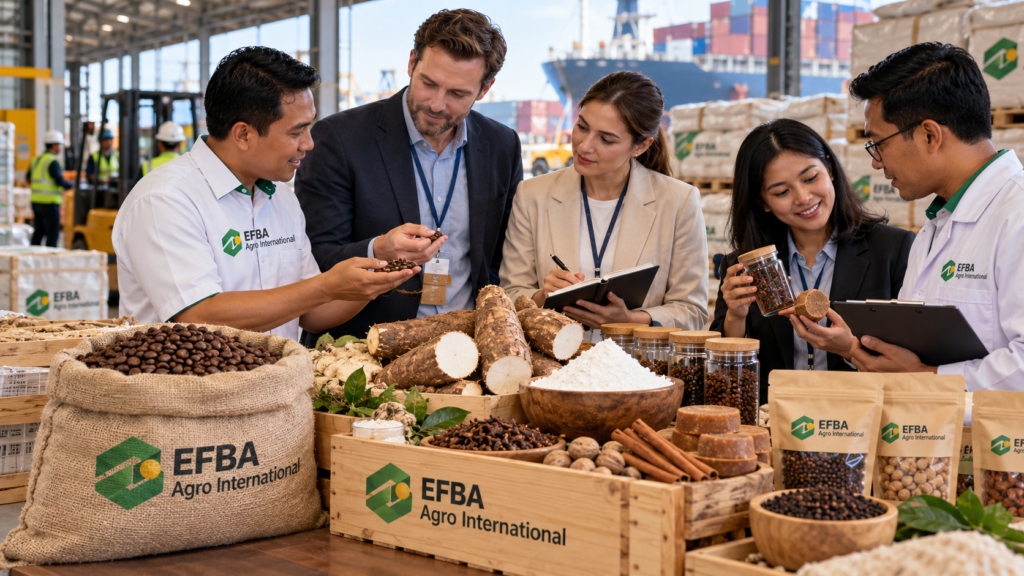
Indonesia offers a diverse agricultural base for global food and beverage manufacturers, importers, distributors, roasters, ingredient companies, and wholesale buyers. For companies sourcing agricultural products Indonesia, the country provides commodities ranging from cassava-based ingredients and coffee to palm sugar, spices, candlenut, and specialty products such as cascara. Its tropical climate, broad plantation areas, long farming traditions, and regional crop diversity create a wide sourcing landscape for international buyers.
However, sourcing agricultural products Indonesia should involve more than identifying a commodity and requesting the lowest price. Commercial buyers need to evaluate origin, specifications, processing method, moisture, purity, food-industry application, packaging, order volume, quality consistency, documentation, and logistics before committing to a supplier. Agricultural commodities naturally vary according to crop, season, location, post-harvest handling, and processing conditions, so a product name alone does not provide enough information for an industrial purchasing decision.
A better sourcing process connects the raw material with measurable specifications and the buyer’s intended application. This approach becomes especially important when procurement teams compare several agricultural products Indonesia for different manufacturing needs. Buyers should therefore begin with function, quality requirements, and application before moving toward commercial negotiation.
Indonesia’s export base also shows the scale of its participation in international trade. BPS-Statistics Indonesia reported total Indonesian exports of US$282.51 billion in 2025, up 5.99% from 2024, while the SITC category of food and live animals accounted for approximately US$23.53 billion and animal and vegetable oils and fats for US$31.11 billion. These national figures cover many industries and should not be interpreted as EFBA Agro’s sales or the market size of its portfolio, but they provide useful context for buyers evaluating agricultural products Indonesia within global commodity supply chains.
For buyers seeking Indonesian ingredients, EFBA Agro International publishes a commodity portfolio that includes cassava and its derivatives, Gayo Arabica coffee, cascara, candlenut, palm products, and Arenga palm sugar. Its website also states that its procurement network includes sourcing from its own farms and plantations while collaborating with local farmers. The company also manages procurement, processing coordination, quality, packaging, documentation, and export logistics for commercial buyers seeking agricultural products Indonesia.
What Agricultural Products Indonesia Offers for Food and Beverage Industries
For food and beverage procurement, agricultural products Indonesia can serve several different functions. Some commodities operate as functional ingredients, such as tapioca starch and MOCAF, while others provide distinctive flavor, sensory, or origin value, including Gayo Arabica coffee, cascara, palm sugar, candlenut, and spices. The right commodity therefore depends on what the manufacturer wants to produce rather than simply on which products are available.
A practical buyer framework is:
Application → Commodity → Origin → Specification → Processing → Sample → Quality Evaluation → Packaging → Commercial Terms → Logistics
This structure is particularly important when sourcing agricultural products Indonesia because two suppliers may offer the same commodity name but provide different moisture levels, grades, purity, processing methods, packaging configurations, or sensory characteristics. The sourcing article you provided uses the same principle for cascara, where procurement moves through origin, processing, moisture, purity, sensory profile, sample evaluation, packaging, and logistics rather than price alone.
7 Agricultural Products Indonesia Relevant to Global F&B Buyers
1. Food-Grade Tapioca Flour for Food Processing
Among the most relevant agricultural products Indonesia for food processing is tapioca flour, which comes from cassava and can function as a starch ingredient in multiple applications. EFBA Agro publishes food-grade tapioca specifications covering appearance, starch content, moisture, ash, pH, whiteness, viscosity, crude fibre, and SO₂. These parameters allow buyers to begin procurement with measurable criteria rather than generic terms such as “premium starch.”
The company’s stated applications include crackers, cakes, sauces, food processing, and thickening. For industrial buyers, one of tapioca’s main advantages is its functional versatility. Its neutral profile and starch characteristics allow procurement teams to consider it for formulations where thickening, texture, binding, or starch functionality matters.
However, manufacturers should validate suitability against their own formulation and processing conditions. A bakery, sauce producer, snack manufacturer, and noodle company may therefore evaluate the same tapioca differently. This application-driven approach helps buyers determine whether this category of agricultural products Indonesia fits their production system.
EFBA Agro currently publishes packaging options of 25 kg or 50 kg PP sacks with PE inner lining, with larger jumbo configurations available upon request. Its product page also states an approximately 20-metric-ton load capacity per 20-foot FCL and Tanjung Priok as the listed loading port. Buyers should still reconfirm final packing, container utilisation, quotation terms, and lot specifications before issuing a purchase order. Pasted markdown
2. Modified Cassava Flour (MOCAF) for Alternative Flour Applications
MOCAF is another cassava-derived ingredient within the wider portfolio of agricultural products Indonesia, but its characteristics and applications differ from standard tapioca starch. EFBA Agro describes MOCAF as cassava flour produced through fermentation and lists applications including bread, pastries, noodles, and gluten-free products. Its published technical parameters include moisture, ash, protein, whiteness, pH, and HCN specifications.
These specifications provide product-development and procurement teams with a clearer basis for sample evaluation. MOCAF can be relevant for food manufacturers exploring cassava-based flour systems or developing products that do not rely entirely on conventional wheat flour. However, buyers should avoid treating it as a universal one-to-one substitute without formulation trials.
Flour performance depends on recipe, hydration, processing conditions, texture requirements, and the desired finished product. Commercial evaluation therefore requires both technical specifications and application testing. For buyers comparing cassava-based agricultural products Indonesia, the procurement question should not simply be “tapioca or MOCAF?” but rather which ingredient best matches the required function.
Use:
Product Requirement → Functional Need → Ingredient Selection → Sample Trial → Production Test → Commercial Decision
This buyer-first approach reduces the risk of selecting an ingredient based only on category trends rather than formulation performance. Pasted markdown
3. Gayo Arabica Coffee for Roasters and Beverage Companies
Coffee is one of the best-known agricultural products Indonesia in international markets, and Gayo Arabica from Aceh represents a distinctive origin-based option for commercial buyers. EFBA Agro describes its Gayo coffee as sourced from the Gayo Highlands at approximately 1,200–1,600 metres above sea level, with medium-to-full body, balanced acidity, and floral or herbal characteristics.
Its product information lists green and roasted coffee options, while a separate sourcing article positions the product for roasters, importers, distributors, cafés, and other commercial buyers. For procurement teams, origin becomes particularly important because coffee quality can vary according to altitude, variety, processing, moisture, defect count, bean size, storage, and crop period.
Coffee also provides a strong example of why buyers should assess agricultural products Indonesia through specifications rather than relying only on origin names. EFBA Agro’s published specification for Gayo Arabica includes Grade 1, semi-washed processing, screen size, moisture, defect parameters, and tasting notes. Buyers should still confirm the applicable lot specification and request a sample before making a bulk commitment.
Indonesia’s current export data reinforces the commercial relevance of coffee. BPS reports coffee export value of approximately US$1.008 billion for January–July 2026, with net export weight of about 208.1 thousand tonnes over the same period. These are national figures rather than EFBA Agro volumes, but they demonstrate the scale at which Indonesian coffee participates in international trade. Pasted markdown
4. Cascara for Specialty Beverage Development
Cascara represents another specialty category within agricultural products Indonesia. It consists of the dried outer skin of the coffee cherry and creates a commercial opportunity that differs from conventional coffee beans. Instead of roasting it as coffee, product developers can evaluate properly processed cascara for brewed beverages, specialty tea-style applications, syrups, kombucha, cold beverages, and other concepts.
EFBA Agro describes its Gayo-origin cascara as having fruity and floral characteristics with notes associated with raisin, hibiscus, plum, and rosehip. Cascara also illustrates Indonesia’s potential to generate higher-value ingredients from existing agricultural ecosystems rather than exporting only primary commodities.
However, international buyers need to examine drying, cleanliness, moisture, purity, sensory characteristics, packaging, and destination-market requirements. EFBA Agro currently publishes general cascara specifications of maximum 10–12% moisture and minimum 99% purity. Buyers should still confirm each lot because agricultural characteristics can vary.
For product developers evaluating specialty agricultural products Indonesia, the buying decision can follow:
Specification + Sensory Evaluation + Intended Application = Better Ingredient Selection
A cascara suitable as a standalone infusion may perform differently in a blended RTD beverage or syrup formulation. Sampling before bulk purchasing allows buyers to test the actual material under their own development conditions. Pasted markdown
5. Granulated Arenga Palm Sugar for Food and Beverage Sweetening
Granulated Arenga palm sugar is another example of agricultural products Indonesia that can serve both functional and sensory roles in food and beverage manufacturing. Producers make this ingredient from the sap of Arenga pinnata, and it offers a distinctive caramel-like profile compared with conventional refined sweeteners. EFBA Agro supplies granulated Arenga palm sugar and lists uses across coffee, tea, bakery, chocolate, sauces, beverages, and specialty retail applications.
The company’s published specifications include raw material, granule form, colour, mesh size, moisture, total sugar, and solubility. For global buyers, one of the product’s distinguishing characteristics is not simply sweetness but its flavour contribution. A beverage company may value its caramel character differently from a bakery or sauce manufacturer.
Application testing should therefore consider sweetness intensity, colour impact, aroma, solubility, and interaction with other ingredients. Manufacturers should also define whether they require bulk industrial supply, smaller format packaging, or specifications connected to particular certification requirements.
EFBA Agro currently lists bulk packaging in 25 kg or 50 kg kraft paper bags with PE inner liners, with additional configurations available by discussion. Buyers sourcing this category of agricultural products Indonesia should confirm certification requirements, specifications, packaging, lead time, and destination-market documentation before concluding an order. Pasted markdown
6. Candlenut for Culinary and Ingredient Applications
Candlenut, known locally as kemiri, forms part of Indonesia’s long culinary tradition and represents another commercially relevant category of agricultural products Indonesia. EFBA Agro identifies food applications where candlenut contributes savoury character and natural thickening, while its oil content also creates non-food uses outside the scope of this article. For F&B buyers, relevant purchasing factors include kernel grade, colour, moisture, purity, oil content, cleanliness, packaging, and consistency.
EFBA Agro publishes a shelled Grade A specification with whole kernels, maximum 7% moisture, minimum 99% purity, and other product parameters. These published figures provide a useful starting point, but buyers should still request confirmation for the actual lot and test the material against their intended processing system.
Agricultural sourcing should always distinguish between a general website specification and contractual parameters for a specific shipment. Candlenut also demonstrates one advantage of sourcing agricultural products Indonesia: several ingredients carry strong regional culinary associations instead of functioning only as generic commodities.
For food manufacturers developing Southeast Asian sauces, spice pastes, seasoning products, or prepared foods, that culinary context may become part of the product’s value proposition. Pasted markdown
7. Indonesian Spices for Food and Beverage Formulations
Spices remain an important category within agricultural products Indonesia because the country has a long historical association with spice cultivation and trade. EFBA Agro’s published portfolio and articles reference commodities including black pepper, nutmeg, cloves, ginger, turmeric, vanilla, and other spice products.
These ingredients can serve manufacturers of seasoning blends, sauces, bakery products, beverages, extracts, and specialty foods. However, the exact application and regulatory requirements depend on the commodity and target market. EFBA Agro states that it works with farming regions and supply partners to support sourcing and international supply.
Official statistics also show active international trade in this category. BPS recorded approximately US$313.8 million in exports of medicinal, aromatic, and spice plants during January–July 2026. That figure represents the national category rather than EFBA Agro’s individual portfolio, but it demonstrates that aromatic and spice commodities remain part of Indonesia’s current agricultural export structure.
For buyers, spice sourcing requires more than checking aroma. Procurement specifications may need to cover origin, variety, moisture, purity, foreign matter, microbiological requirements, particle size or form, packaging, treatment, and applicable destination-market regulations. Each commodity should therefore undergo independent evaluation rather than using a single generic specification for all agricultural products Indonesia. Pasted markdown
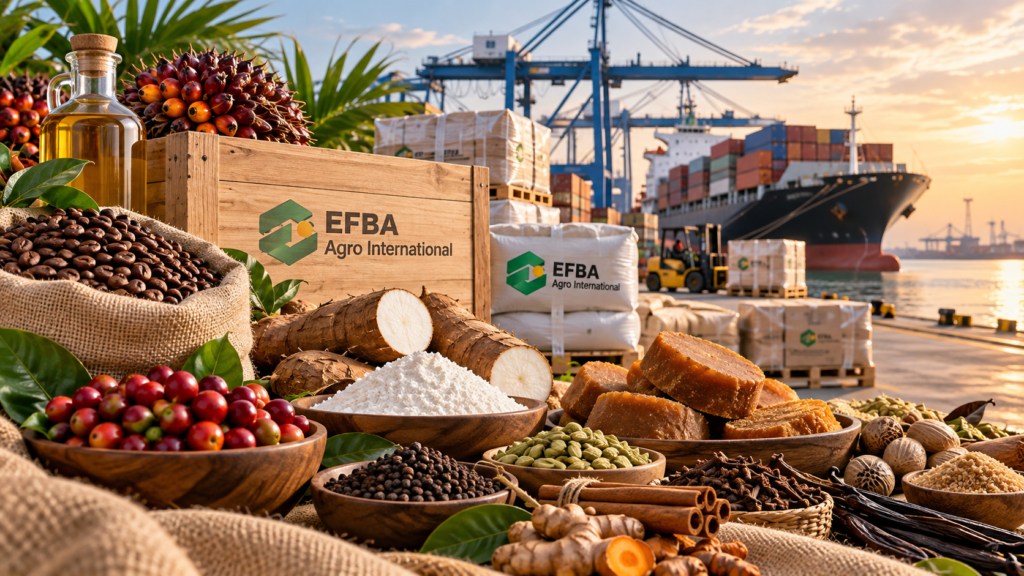
What Makes Indonesian Agricultural Products Relevant to Global F&B Industries?
1. Diverse Tropical Raw-Material Base
Indonesia’s geography supports multiple agricultural ecosystems and allows food manufacturers to source different ingredient categories from one origin country. BPS’s latest Indonesian Permanent Estate Crops Statistics 2025, released in August 2026 and revised in September, covers production and planted areas for oil palm, coffee, cocoa, tea, clove, coconut, nutmeg, pepper, sago, and other leading estate crops across provinces. The same publication also contains export and import data compiled from customs documentation. Badan Pusat Statistik Indonesia
This diversity matters because global F&B businesses increasingly operate multi-ingredient supply chains. A company may need coffee for beverage production, cassava starch for formulation, palm sugar for sweetening, and spices for flavour development. Indonesia’s agricultural diversity can create procurement opportunities across several of those categories, although supplier qualification still needs to happen commodity by commodity.
2. Ingredients with Functional and Sensory Value
Indonesia’s value for buyers is not limited to raw-volume production. Tapioca offers functional starch characteristics, MOCAF provides a cassava-based flour option, Gayo coffee brings origin-specific sensory value, cascara creates specialty beverage possibilities, palm sugar contributes sweetness with a characteristic flavour, and spices provide aroma and formulation identity. These are different commercial functions, so buyers can evaluate Indonesian agriculture from both technical and product-development perspectives.
The buying decision therefore becomes:
Origin Value + Technical Function + Sensory Character + Consistency + Commercial Feasibility
That combination matters more than country of origin alone. An ingredient may have a strong story but still fail industrial requirements if specification, supply continuity, packaging, or logistics do not meet the buyer’s needs.
3. Opportunities for Traceable Regional Sourcing
Global buyers often want to understand where agricultural ingredients come from and how they move through the supply chain. Origin becomes particularly important for specialty products such as Gayo coffee and cascara, where geography and post-harvest processing contribute to product identity. For cassava, palm sugar, candlenut, and spices, traceability can similarly help procurement teams understand the raw-material base and supplier network.
EFBA Agro’s website states that it sources through its own farms and plantation network while collaborating with local farmers. It also describes an extensive procurement network and a sourcing model intended to connect agricultural production with wholesale and export buyers. Efba Agro International
Because traceability requirements differ by buyer and destination, commercial purchasers should still request the exact documentation needed for their programme. A general sourcing statement should not replace lot-specific documentation or buyer-side supplier qualification.
What Should Global Buyers Check Before Ordering Agricultural Products from Indonesia?
The first step should be a clear purchasing specification. Buyers need to tell the supplier what product they require, how the ingredient will be used, what quality parameters matter, how much volume is needed, what packaging is acceptable, and where the shipment will go. Without those details, quotations from different suppliers may not be directly comparable.
A practical checklist includes:
- origin and production region;
- commodity type, variety, or grade;
- processing and post-harvest method;
- moisture, purity, and other technical specifications;
- sensory characteristics when relevant;
- sample availability and approval criteria;
- expected recurring volume and MOQ;
- packaging, liner, labelling, and pallet configuration;
- required quality or certification documents;
- loading port and destination;
- Incoterm and commercial terms;
- import requirements in the destination market;
- lead time, harvest cycle, and supply continuity.
The same buyer-driven approach appears in EFBA Agro’s existing cascara sourcing content, which recommends comparing measurable parameters before bulk purchasing instead of relying only on promotional descriptions. Cascara Wholesale_ Sourcing Dri…
Why Is Sampling Important for Agricultural Ingredients?
A technical specification provides a useful screening tool, but physical evaluation remains important. Agricultural commodities can vary in appearance, aroma, moisture, particle characteristics, flavour, or processing performance, and those variations can influence the finished food or beverage. Product developers therefore need to evaluate material under their actual formulation and processing conditions whenever possible.
EFBA Agro publishes a cooperation flow in which the buyer communicates the required product, specification, and volume, after which matching supply and samples can be prepared for buyer evaluation. The cascara article describes the flow as Buyer Requirement → Product Matching → Sample → Sample Testing → Buyer Approval → Cooperation.
For other commodities, the exact sample process may differ according to product and commercial volume. Nevertheless, the principle remains useful: approval should ideally connect the written specification with the actual material that procurement and R&D teams have evaluated.
Official Data: How Significant Is Indonesia’s Food and Agricultural Export Base?
BPS reported that Indonesia’s total export value reached US$282.505 billion in 2025, representing year-on-year growth of 5.99%. Under SITC classification, food and live animals contributed approximately US$23.529 billion, beverages and tobacco approximately US$2.188 billion, while animal and vegetable oils and fats reached around US$31.107 billion. These figures demonstrate the scale of Indonesia’s broader food-related export economy, although they cover categories far wider than EFBA Agro’s portfolio. Badan Pusat Statistik Indonesia
Current 2026 commodity data also provide more specific agricultural context. BPS recorded coffee exports of approximately US$1.008 billion during January–July 2026 and medicinal, aromatic, and spice plant exports of approximately US$313.8 million over the same period. Coffee export volume during January–July reached around 208.1 thousand tonnes. Badan Pusat Statistik Indonesia
Meanwhile, BPS’s latest estate-crop publication covers Indonesia’s 2025 production and area data for oil palm, coffee, cocoa, rubber, tea, clove, coconut, sago, nutmeg, pepper, and other strategic crops. The publication combines plantation survey data with smallholder information from the Directorate General of Estate Crops and trade data from customs records. Badan Pusat Statistik Indonesia
For buyers, these national statistics should be used as market context rather than as a substitute for supplier due diligence. A country may have large agricultural production while export-ready availability for a particular specification can still depend on harvest conditions, processing capacity, quality requirements, and the supplier’s procurement network.
How Does EFBA Agro Work with Farmers and Producers?
EFBA Agro states on its official website that its procurement network sources from its own farms and plantations while collaborating with local farmers. The company positions this network as the foundation for agricultural commodity procurement and describes its role as connecting Indonesian production with commercial buyers through processing coordination, quality management, packaging, documentation, and export logistics. Efba Agro International
This point is relevant because a global buyer is rarely purchasing only the crop itself. The buyer also needs the commodity to reach the required specification, be packed appropriately, have the agreed documentation, and arrive through a workable commercial and logistical process. The supply relationship therefore extends from the farm and processing stage to final shipment preparation.
EFBA Agro’s existing cascara article uses a similar approach, stating that the company works with producers and processing partners to maintain product consistency from origin to destination and support recurring wholesale requirements through its procurement network. Cascara Wholesale_ Sourcing Dri…
EFBA Agro Expertise in Indonesian Agricultural Supply
EFBA Agro International positions itself as an Indonesian agricultural commodity sourcing and wholesale export partner. Its official portfolio includes food-grade tapioca flour, Modified Cassava Flour, Gayo Arabica coffee, cascara, candlenut, palm products, and Arenga palm sugar, while company articles also present spices and related Indonesian agricultural ingredients for global markets. Efba Agro International
The company provides product-specific information rather than presenting all commodities under one generic specification. For example, its tapioca page publishes starch, moisture, whiteness, viscosity, and packaging parameters; MOCAF has separate moisture, ash, protein, whiteness, pH, and HCN parameters; while Gayo Arabica information covers origin, processing, defect value, screen size, moisture, flavour, and logistics. Efba Agro International
EFBA Agro also states that it coordinates the export process from buyer requirements through procurement and quality control, packaging and documentation, to shipping and logistics. The cascara sourcing material similarly shows a buyer-oriented process where specifications and sample evaluation come before a commercial order. Cascara Wholesale_ Sourcing Dri…
As part of the broader PT EFBA Digital Mulia ecosystem, this expertise remains specifically focused on agricultural sourcing and trade. PT EFBA Digital Mulia itself publishes general trading and business services, while EFBA Agro is the specialised platform for agricultural commodities and international wholesale sourcing. EFBA
Framework for Sourcing Agricultural Products from Indonesia
Global procurement teams can use the following framework:
1. APPLICATION
What food or beverage will the ingredient be used for?
2. PRODUCT
Which Indonesian commodity fits that application?
3. ORIGIN
Where does the raw material come from?
4. SPECIFICATION
What grade, moisture, purity, size, sensory, or functional parameters are required?
5. PROCESSING
How is the raw material processed and handled?
6. SAMPLE
Can the buyer evaluate representative material before bulk procurement?
7. COMMERCIAL FIT
Do MOQ, price, lead time, packaging, and supply capacity match the project?
8. QUALITY CONTROL
How will conformity with the agreed specification be checked?
9. EXPORT READINESS
What packaging and documentation are needed?
10. REPEAT SUPPLY
How will future volume, crop cycles, and quality consistency be managed?
In short:
Buyer Requirement → Specification → Supplier Matching → Sample → Evaluation → Approval → Order → QC → Export → Delivery → Review
This structure is more reliable than beginning only with “What is your price per kilogram?” because international procurement needs to evaluate both product quality and supply-chain execution.
FAQ About Agricultural Products Indonesia
What agricultural products does Indonesia supply to global food and beverage industries?
Indonesia supplies a broad range of food-related agricultural commodities, including coffee, cassava derivatives, palm-based products, sugar, spices, coconut products, cocoa, and other plantation crops. EFBA Agro’s own published portfolio includes tapioca flour, MOCAF, Gayo Arabica coffee, cascara, candlenut, palm products, and Arenga palm sugar. The exact product suitable for a buyer depends on its formulation, quality specification, required volume, and destination market. Buyers should therefore begin with application requirements rather than selecting a commodity purely by price.
What Indonesian agricultural ingredients does EFBA Agro supply?
EFBA Agro lists cassava and its derivatives, coffee beans and cascara, candlenut, palm products, and Arenga palm sugar among its principal commodities. The website provides separate technical information for products including food-grade tapioca flour, MOCAF, Gayo Arabica coffee, cascara, candlenut, and granulated palm sugar. Availability, specifications, packaging, MOQ, and logistics can differ by commodity. Buyers should reconfirm the current terms when requesting a commercial quotation. Efba Agro International
Does EFBA Agro work with Indonesian farmers?
Yes. EFBA Agro’s official website states that its procurement network sources from its own farms and plantations while collaborating with local farmers. The company also states that it works with producers and processing partners to support agricultural sourcing and consistency. Buyers with specific traceability requirements should request the documentation applicable to the actual commodity and shipment. Efba Agro International
Can global buyers request samples before ordering?
EFBA Agro’s published cooperation process includes matching the buyer’s requirements with available supply, sample preparation, buyer testing, and confirmation before cooperation proceeds. This approach is particularly valuable for products where sensory profile, appearance, moisture, purity, or processing characteristics need evaluation. Sample conditions may depend on the commodity and destination. International buyers should therefore discuss sample size, shipping arrangements, and testing criteria directly with the supplier. Cascara Wholesale_ Sourcing Dri…
Which Indonesian products are suitable for beverage companies?
Relevant products can include Gayo Arabica coffee, cascara, Arenga palm sugar, and selected spices depending on the formulation. Coffee serves roasters and beverage brands, cascara can be evaluated for tea-style beverages and specialty formulations, while palm sugar provides sweetness and characteristic caramel notes. Spices can contribute flavour and aromatic profiles to beverages and extracts. Every ingredient should still undergo buyer-side application testing.
Which products are suitable for food manufacturers?
Food manufacturers may evaluate tapioca flour for starch and thickening applications, MOCAF for cassava-based flour formulations, candlenut for culinary products, palm sugar for sweetening, and spices for flavour systems. Technical fit depends on recipe, processing conditions, quality standards, and final-product requirements. Buyers should request specifications and samples before industrial adoption. This reduces the risk of selecting an ingredient based only on a product description.
What should buyers check before importing Indonesian agricultural products?
Buyers should check origin, grade, processing, moisture, purity, technical specifications, packaging, sample availability, MOQ, lead time, quality-control procedures, export documentation, and destination-market requirements. Agricultural products can vary by crop and harvest, so lot-specific requirements should be agreed before shipment. International import regulations may also differ by commodity and country. The buyer should confirm destination-market requirements with its customs broker or relevant authority.
Source Indonesian Agricultural Products with EFBA Agro
Indonesia offers more than a large agricultural production base. For global F&B businesses, its value lies in the combination of functional ingredients, origin-specific products, tropical flavours, and value-added agricultural processing, from food-grade cassava flour and Gayo coffee to cascara, palm sugar, candlenut, and spices. Successful sourcing, however, depends on turning those commodities into clearly specified, tested, commercially workable supply programmes.

EFBA Agro International supports commercial buyers through an agricultural procurement network that the company states includes its own farms and plantations, local farmer collaboration, producers, and processing partners. Its published process connects buyer requirements with procurement, quality control, packaging, documentation, and export logistics, while product pages provide technical starting points for several key commodities. Efba Agro International
International buyers can begin by sharing the required commodity, application, specification, annual or trial volume, packaging preference, and destination. From there, the appropriate sourcing process can move through product matching, sampling where applicable, specification confirmation, commercial quotation, quality control, and export preparation.
Do not start with “What is the cheapest Indonesian commodity available?” Start with “What ingredient specification does our product require, and which Indonesian supply chain can deliver it consistently?”