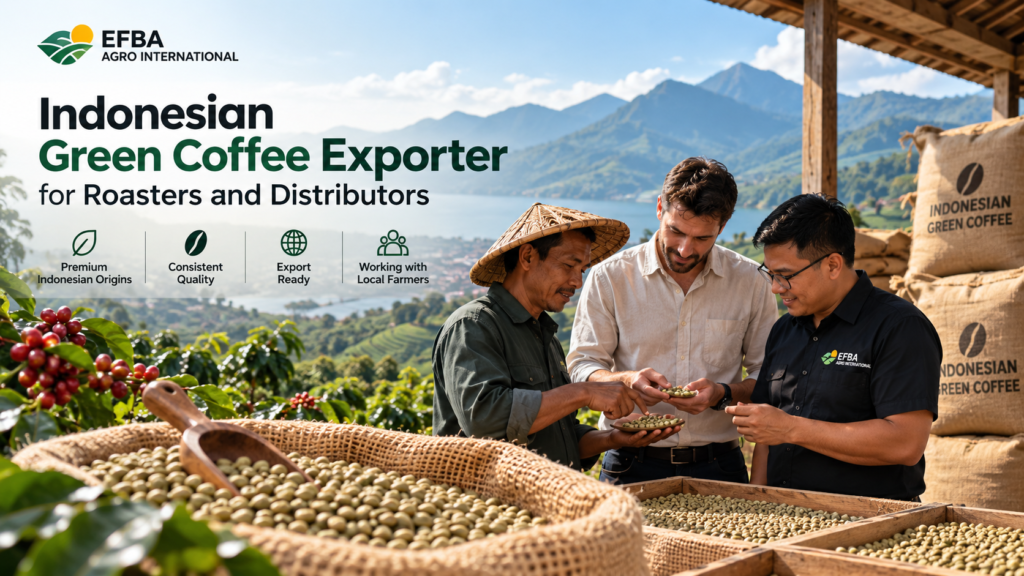
Indonesia offers a diverse coffee supply base for international roasters, importers, distributors, and coffee businesses seeking origin-specific green beans. Different growing regions, elevations, coffee types, post-harvest methods, and local farming environments give buyers multiple options when developing single-origin products, espresso blends, specialty coffee, or wholesale coffee programs.
However, selecting an Indonesian green coffee exporter requires more than comparing origin names and prices. Professional buyers need to evaluate coffee type, origin, processing method, moisture, physical quality, defects, sensory potential, samples, packaging, volume, documentation, and export arrangements before confirming a commercial order.
Official data support Indonesia’s position as an established coffee-producing and exporting country. BPS-Statistics Indonesia’s latest 2025 permanent estate crop publication contains coffee area and production data by province as well as export-import statistics. BPS also maintains coffee export statistics by major destination country through 2025.
For international buyers, EFBA Agro International operates as an Indonesian agricultural commodity sourcing and wholesale export business. Its official website includes coffee beans and cascara in its commodity portfolio and states that EFBA Agro works with its own farms and plantations while collaborating with local farmers, producers, and processing partners.
What Is Indonesian Green Coffee?
Green coffee refers to coffee beans that have completed the relevant harvesting and post-harvest stages but have not undergone roasting. These unroasted beans become the raw material that coffee roasters use to create different roast profiles according to their intended flavor, brewing method, customer segment, and commercial positioning.
For buyers working with an Indonesian green coffee exporter, understanding this supply chain helps clarify how coffee moves from origin to commercial roasting:
Coffee Cherry → Harvesting → Processing → Drying → Hulling → Sorting → Green Coffee → Export → Roasting → Finished Coffee
For roasters, buying green coffee provides greater control over the finished product because roasting remains in the buyer’s hands. Therefore, international buyers should evaluate green beans differently from finished roasted coffee. Raw material quality needs to support the intended roasting strategy.
EFBA Agro publishes Indonesian coffee as part of its agricultural commodity portfolio. Its official site specifically identifies Gayo Arabica Coffee from the Aceh highlands and positions coffee beans and cascara among the commodities it handles for wholesale and export markets.
What Does Green Coffee Taste Like?
Green coffee does not taste like the roasted coffee normally served in cafés. Before roasting, the beans have not undergone the heat-driven reactions responsible for many familiar roasted, caramelized, chocolate-like, nutty, or smoky characteristics.
For commercial buyers, however, the more relevant question is not simply how an unroasted bean tastes. Roasters need to understand its sensory potential after roasting because the final cup develops through a combination of origin, variety, growing environment, post-harvest processing, green-bean quality, roasting, and brewing.
The relationship can be summarized as:
Origin → Variety → Processing → Green Bean Quality → Roast Profile → Brewing → Final Cup
This is why buyers should avoid purchasing green coffee solely from generic descriptions such as “fruity,” “chocolate,” or “full-bodied.” A representative sample followed by sample roasting and cupping provides a stronger basis for commercial evaluation.
When evaluating an Indonesian green coffee exporter, buyers should therefore request representative samples rather than relying only on general flavor descriptions.
EFBA Agro describes its Gayo Arabica from Aceh as having full body and a complex flavor profile. That published description can provide initial product context, but international buyers should still verify the actual lot and sample before placing larger orders.
What Color Are Green Coffee Beans?
Despite the name, green coffee does not always appear bright green. Depending on coffee type, origin, processing, drying, storage, age, and physical condition, unroasted beans can range from pale green and greenish to bluish-green or yellowish-green.
Color can provide useful visual information, but it should never become the only quality indicator. Professional buyers should evaluate it alongside moisture, defects, bean uniformity, aroma, processing information, storage condition, and the agreed commercial specification.
Therefore, a stronger B2B evaluation follows:
Appearance → Physical Specification → Sample → Roast Test → Cupping → Commercial Approval
This approach helps roasters and distributors determine whether the actual lot fits their intended application rather than relying only on photographs or general origin descriptions. An Indonesian green coffee exporter should therefore provide sufficient product information to support lot-level evaluation.
What Does Green Coffee Contain?
Green coffee naturally contains carbohydrates, proteins and amino acids, lipids, caffeine, organic acids, and phenolic compounds. Among the components frequently associated with green coffee are caffeine and chlorogenic acids, while roasting progressively changes the chemical composition of the beans.
Actual composition should not be assumed to be identical across every coffee lot. Coffee species, variety, growing conditions, geographical origin, processing, storage, and analytical methods can influence measured values.
This distinction becomes particularly important when the buyer intends to use green coffee for extracts, functional ingredients, or other products requiring specific compositional parameters. In such cases, general information about coffee cannot replace appropriate analysis of the commercial lot.
The safer procurement principle is:
Required Parameter → Representative Lot → Laboratory Analysis → Specification Confirmation → Commercial Approval
What Are the Potential Benefits of Green Coffee?
Green coffee receives considerable attention because unroasted beans retain chlorogenic acids and naturally contain caffeine. However, whole green coffee beans, brewed green coffee, and concentrated green coffee bean extracts are not interchangeable products. Therefore, health-related findings from one format should not automatically apply to another.
For a B2B agricultural supplier, the more reliable positioning focuses on product origin, quality parameters, consistency, traceability, samples, packaging, and export readiness. Buyers developing functional beverages, extracts, supplements, or other formulations should separately evaluate the formulation, analytical requirements, regulatory framework, and permitted claims in the destination market.
Therefore, for commercial green coffee sourcing:
Product Quality + Specification + Intended Application + Appropriate Testing = Better Product Development
This approach keeps the discussion useful for roasters and manufacturers without turning a green coffee commodity description into unsupported medical claims.
What Can Green Coffee Be Used For?
Green coffee primarily serves as the raw material for coffee roasting. Specialty roasters, commercial roasters, private-label manufacturers, distributors, café groups, and other coffee businesses can purchase green beans and develop roast profiles that match their market positioning.
Beyond conventional roasting, green coffee can also enter further processing for coffee extracts, beverage ingredients, or other coffee-derived applications, depending on the buyer’s processing capabilities and applicable regulations. The appropriate application therefore depends on the intended finished product rather than the raw material alone.
Common commercial routes include:
- Green Coffee → Roasting → Whole Bean Coffee
- Green Coffee → Roasting → Ground Coffee
- Green Coffee → Roasting → Espresso / Filter / Blend
- Green Coffee → Further Processing → Coffee-Derived Ingredient
For buyers sourcing these products through an Indonesian green coffee exporter, the intended application should guide discussions about coffee type, origin, specification, processing, and commercial requirements.
EFBA Agro’s wider agricultural portfolio covers food, beverage, supplement, and industrial applications. However, buyers should confirm whether a specific green coffee lot meets the requirements of their intended processed product.
Why Source Green Coffee from Indonesia?
Indonesia has a broad coffee production base across multiple provinces. BPS’s latest permanent estate crop publication provides coffee area and production information by province, combining plantation survey data with smallholder data from Indonesia’s Directorate General of Estate Crops.
For international buyers, this creates access to different origins rather than a single uniform Indonesian coffee profile. At the same time, origin alone does not guarantee quality because agricultural products can vary between farms, harvests, processing methods, storage conditions, and individual lots.
Therefore, choosing an Indonesian green coffee exporter should involve lot-level evaluation rather than relying solely on the reputation of an origin.
A professional sourcing process should follow:
Indonesia → Region → Producer → Processing → Lot → Specification → Sample → Evaluation → Purchase
Within this process, several factors deserve particular attention.
1. Start with the Coffee Origin
Origin gives buyers the first layer of information about the coffee. Growing environment, altitude, local climate, farming practices, coffee type, and processing traditions can influence the characteristics that eventually appear after roasting.
EFBA Agro currently publishes Gayo Arabica Coffee from Aceh’s highlands within its official commodity portfolio. Its dedicated Indonesian Arabica supplier article also identifies Gayo coffee as part of its offering for international roasters, distributors, café chains, importers, and other commercial buyers.
Buyers interested in Gayo should still request information about the specific commercial lot rather than assuming every coffee from the region will perform identically.
2. Determine Arabica or Robusta Requirements
Arabica and Robusta serve different commercial requirements. A specialty roaster developing an origin-focused product may have different priorities from a buyer producing espresso blends, commercial coffee, or other large-volume applications.
Therefore, the decision should begin with the finished product:
Target Customer → Product Positioning → Desired Cup → Coffee Type → Origin → Specification
The goal is not to determine which coffee type is universally “better.” Buyers should determine which raw material best supports the intended product, customer, price position, and roasting strategy.
An Indonesian green coffee exporter should therefore understand the buyer’s intended application before recommending an origin or coffee type.
3. Check the Processing Method
Post-harvest processing influences the physical and sensory development of coffee. Buyers may encounter washed, natural, wet-hulled, honey, or other processing approaches depending on origin and available supply.
Processing information becomes especially important for roasters because it provides context before sample roasting and cupping. Nevertheless, a processing label by itself should not replace actual lot evaluation.
A useful sequence is:
Harvest → Processing → Drying → Sorting → Storage → Sample Evaluation
EFBA Agro’s existing Arabica content similarly advises buyers to ask suppliers about processing before placing an order.
4. Verify Moisture and Physical Quality
Moisture matters for green coffee storage and quality stability. EFBA Agro’s existing Indonesian Arabica content discusses post-harvest drying around the 10–12% range before storage and export preparation, while also advising buyers to confirm the specification for the actual lot.
When working with an Indonesian green coffee exporter, buyers should confirm moisture and other physical specifications for the actual commercial lot rather than assuming that every shipment follows identical parameters.
Buyers should evaluate moisture together with physical defects, storage conditions, packaging, shipping duration, and destination climate. When the procurement specification requires a particular parameter, request documentation or appropriate testing rather than relying solely on a general website description.
A practical evaluation is:
Moisture + Defects + Physical Condition + Storage + Packaging = Green Bean Quality Control
5. Request a Sample from an Indonesian Green Coffee Exporter
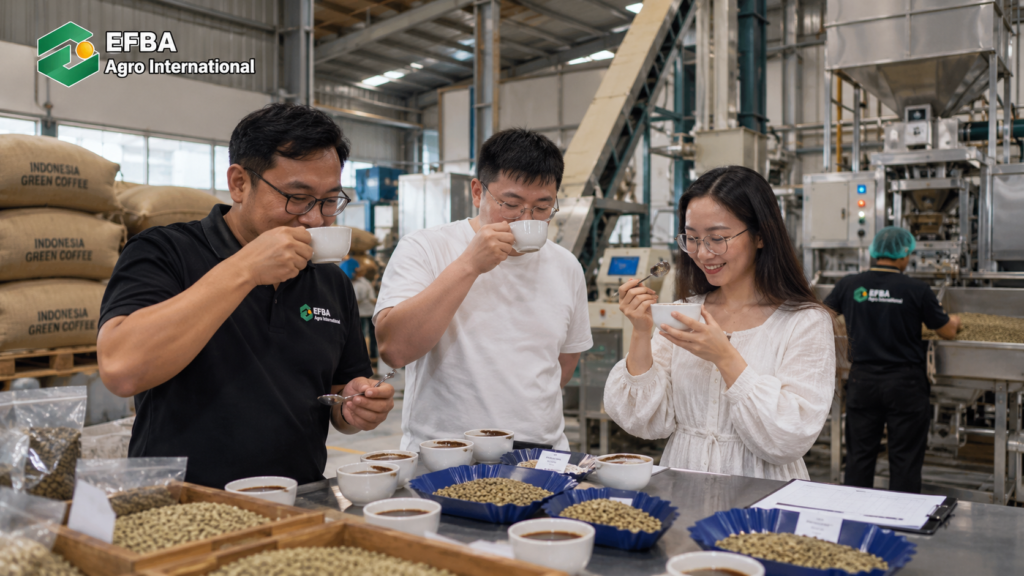
A product description gives buyers useful preliminary information, but a physical sample provides much stronger evidence. Roasters can inspect the beans, perform sample roasting, conduct cupping, and compare the coffee with their target product before committing to commercial quantities.
When evaluating an Indonesian green coffee exporter, buyers should request a representative sample from the commercial supply whenever possible. This step helps verify whether the actual coffee meets the expected physical and sensory requirements.
EFBA Agro’s sourcing model follows a similar buyer-oriented approach. Its published process involves understanding buyer requirements, matching those requirements with available supply, preparing a sample, allowing buyer testing, and proceeding after confirmation. This sample-based process also appears in its Cascara sourcing reference.
The recommended flow is:
Buyer Requirement → Product Matching → Sample → Roast → Cupping → Approval → Commercial Order
For repeat procurement, the approved sample can also become a useful reference when discussing future quality expectations.
6. Match Green Coffee with the Intended Roast Program
Green coffee should fit the product the buyer intends to sell. A bean intended for a differentiated single-origin filter product may require different characteristics from coffee used in a commercial espresso blend.
Roasters should therefore conduct sample roasting under conditions relevant to their intended production. Cupping can then help determine whether the coffee delivers the desired sensory direction and whether adjustments in roast development improve the result.
The commercial decision becomes:
Green Bean → Sample Roast → Cupping → Roast Adjustment → Product Fit → Approval
This process gives the roaster more information than selecting coffee based solely on origin reputation. It also helps buyers communicate clearer product requirements to an Indonesian green coffee exporter before placing a commercial order.
7. Compare an Indonesian Green Coffee Exporter Beyond Price
Price remains important, especially for wholesale and distribution businesses. However, comparing two offers solely on price per kilogram can hide differences in quality, specifications, defects, packaging, consistency, and logistics.
A more useful comparison is:
Price + Specification + Quality + Consistency + Packaging + Logistics + Reliability
For example, a lower-priced coffee may become less attractive when the lot requires additional sorting, produces inconsistent roasting results, or does not match the intended sensory profile.
Therefore, procurement teams should request comparable specifications when evaluating an Indonesian green coffee exporter. This approach helps buyers compare the overall commercial value rather than focusing only on the initial purchase price.
8. Confirm Packaging for Wholesale Supply
Packaging protects green coffee during storage, handling, consolidation, and international transportation. Requirements can differ according to shipment volume, destination, buyer preference, and logistics conditions.
International buyers should discuss bag type, net weight, inner protection where applicable, labels, pallet requirements, and shipment configuration before issuing the final purchase order.
The sequence is:
Coffee → Inner Protection → Outer Bag → Label → Pallet → Container → Shipment
When sourcing from an Indonesian green coffee exporter, buyers should align final packaging with the actual commercial agreement, destination requirements, shipment configuration, and product specification.
9. Check Export Documentation and Logistics
International procurement does not stop after sample approval. The exporter and buyer need to align packaging, commercial documentation, destination requirements, shipping method, Incoterm, and delivery schedule.
Therefore, buyers should discuss documentation and logistics with the Indonesian green coffee exporter before finalizing the shipment. Specific import requirements can differ by destination, so both parties need to confirm the applicable requirements for the actual transaction.
EFBA Agro states that its team manages export activities from secure packaging and documentation through delivery arrangements. Its website also asks prospective buyers to specify destination country, destination port, preferred Incoterm, shipping method, purchase timeline, and target delivery date.
EFBA Agro’s published general export workflow is:
Need & Demand Analysis → Procurement & Quality Control → Packaging & Documentation → Shipping & Logistics
Specific import requirements can differ by destination. Therefore, buyers should confirm applicable documentation before shipment.
10. Build Procurement Around Supply Consistency
One successful shipment does not automatically guarantee that every future agricultural lot will be identical. Harvest conditions, weather, processing, storage, and raw-material availability can influence coffee supply.
For this reason, buyers evaluating an Indonesian green coffee exporter for recurring procurement should consider consistency alongside individual lot quality. Clear specifications, sample approval, quality control, and post-shipment evaluation can help both parties maintain aligned expectations.
EFBA Agro states that it works closely with producers and processing partners to maintain product consistency from origin to destination and support bulk orders with clear specifications and delivery arrangements. It also states that its procurement network includes its own farms and plantations and collaboration with local farmers.
For recurring procurement, buyers can use:
Forecast → Specification → Sample Approval → Order → QC → Shipment → Evaluation → Repeat Order
This creates a stronger foundation for long-term coffee sourcing than treating every purchase as an isolated transaction.
Indonesian Coffee-Producing Regions for Global Buyers
Indonesia should not be treated as a single coffee profile. Different islands and highland areas contribute to the country’s diverse coffee identity, while the actual commercial characteristics still depend on the specific producer, lot, processing method, and crop.
For EFBA Agro specifically, the origin that can be directly verified from its current commodity portfolio is Gayo Arabica from Aceh’s highlands. The company describes Gayo as one of Indonesia’s well-known Arabica origins with full body and complex flavor notes.
For broader Indonesian sourcing, buyers may encounter coffee-producing areas across Sumatra, Java, Sulawesi, Bali, Nusa Tenggara, and other regions represented in Indonesia’s coffee production statistics. However, buyers should confirm which origins an Indonesian green coffee exporter can actually supply at the time of inquiry rather than assuming continuous availability from every Indonesian origin.
BPS’s current publication provides provincial coffee production data that buyers can use as national sourcing context.
This distinction improves trustworthiness:
Indonesia Coffee Origin ≠ Automatically Available Supplier Lot
Instead:
Buyer Origin Requirement → Current Supply Check → Specification → Sample → Confirmation
Official Data: Indonesia’s Green Coffee Production and Export Base
Indonesia’s position as a coffee origin has support from current official statistics. BPS released Indonesian Permanent Estate Crops Statistics 2025 on August 31, 2026 and revised the publication on September 16, 2026. It contains coffee planted-area and production data by province, along with export and import data compiled from Indonesian customs documentation.
BPS also maintains Exports of Coffee by Major Countries of Destination, 2000–2025, last updated July 27, 2026. The dataset records Indonesian coffee exports to international markets including Japan, Singapore, the United States, Malaysia, Italy, Egypt, Germany, and other destinations.
More recent 2026 agricultural export statistics also show coffee continuing to contribute meaningful export value. BPS’s monthly agricultural export table records coffee export value of US$120.0 million in January, US$109.6 million in February, US$72.9 million in March, US$125.5 million in April, US$180.9 million in May, US$177.3 million in June, and US$221.4 million in July 2026. The table showed a cumulative US$1.0076 billion through July at the time of its September 21 update.
These national statistics demonstrate Indonesia’s established coffee-production and export ecosystem. For buyers searching for an Indonesian green coffee exporter, the data provide useful context about Indonesia’s role in international coffee trade.
However, these figures represent national trade activity. They do not represent EFBA Agro’s individual export volume, capacity, or sales performance.
What Should Buyers Check Before Ordering from an Indonesian Green Coffee Exporter?
Before requesting a final quotation from an Indonesian green coffee exporter, international buyers should create a clear purchasing specification. This allows the supplier to understand the required product and helps procurement teams compare offers on equivalent commercial terms.
A practical buyer checklist includes:
- coffee type: Arabica, Robusta, or another specified requirement;
- preferred origin;
- processing method;
- grade or required quality;
- moisture requirement;
- physical defect tolerance;
- desired sensory profile;
- sample availability;
- estimated order quantity;
- order frequency;
- preferred packaging;
- required certifications, where applicable;
- COA or laboratory-report requirement;
- destination country and port;
- preferred Incoterm and shipping method;
- expected purchase and delivery timeline.
EFBA Agro’s current quotation form already requests many of these variables, including quantity, frequency, grade, packaging, certification, laboratory-report requirements, destination, Incoterm, shipping method, and delivery timing.
This approach shifts procurement away from:
“What is your cheapest green coffee?”
toward:
“Which coffee matches our specification, volume, application, and destination?”
How Does EFBA Agro Handle Indonesian Green Coffee Sourcing?
EFBA Agro International positions its business around procurement, processing coordination, wholesale supply, and export of Indonesian agricultural commodities. Its published portfolio explicitly includes coffee beans and cascara alongside cassava derivatives, candlenut, palm oil, and palm sugar. Pasted markdown
The company states that its procurement network includes its own farms and plantations while collaborating with local farmers. EFBA Agro also says it works closely with producers and processing partners to maintain consistency from origin to destination and support bulk requirements.
For buyers seeking an Indonesian green coffee exporter, this sourcing structure connects Indonesian origin supply with product matching, quality control, packaging, documentation, and export logistics.
The process can be summarized as:
Indonesian Origin → Farms & Local Farmers → Producers / Processing Partners → Product Matching → Quality Control → Packaging → Documentation → Export Logistics
This positioning provides a stronger E-E-A-T foundation than making unverifiable claims about the number of farmers, farms, certifications, or export volumes.
EFBA Agro Expertise as an Indonesian Green Coffee Exporter
As an Indonesian green coffee exporter, EFBA Agro’s relevant expertise lies in Indonesian agricultural commodity procurement, wholesale supply, and international trade. Its official website identifies coffee beans and cascara as part of its core commodity focus and describes its role in connecting international buyers with Indonesian agricultural products. Pasted markdown
For green coffee buyers, the sourcing discussion can begin with origin, coffee type, processing method, required specification, estimated volume, packaging, destination, and delivery requirements. Therefore, buyers can provide clear commercial requirements from the beginning rather than relying on a generic request for Indonesian coffee.
For coffee, EFBA Agro currently publishes Gayo Arabica Coffee from Aceh and has dedicated content for international buyers looking for Indonesian Arabica. That content discusses origin, processing, moisture, quality control, green versus roasted coffee, specifications, packaging, MOQ considerations, documentation, and supplier evaluation. Efba Agro
EFBA Agro also publishes an end-to-end export approach covering procurement and quality control, packaging and documentation, and shipping and logistics. Its broader sourcing network involves farms, plantations, local farmers, producers, and processing partners. Efba Agro
As part of the wider PT EFBA Digital Mulia ecosystem, EFBA Agro focuses this activity specifically on agricultural commodities and international sourcing.
For green coffee buyers, the practical relationship becomes:
Buyer Requirement → Indonesian Coffee Sourcing → Sample → Buyer Evaluation → Specification Confirmation → Bulk Requirement → Export Preparation → Shipment
Why Source Green Coffee Through EFBA Agro?
International roasters and distributors generally need more than access to coffee-growing regions. They need a sourcing partner that can understand product requirements, coordinate supply, provide samples where applicable, communicate commercial specifications, and prepare export arrangements.
EFBA Agro publishes information covering these stages. Its website describes an extensive procurement network, collaboration with local farmers, producer and processing partnerships, bulk-order support, quality services, and end-to-end export logistics. Efba Agro
The company also provides buyers with a detailed quotation form rather than only a generic contact form. International buyers can communicate product, quantity, quality, packaging, certification, laboratory-report, destination, Incoterm, shipping, and timeline requirements before progressing with the sourcing discussion. Efba Agro
Therefore, buyers can begin with:
Requirement → Supply Matching → Sample → Evaluation → Commercial Agreement → QC → Packaging → Documentation → Shipment
Agricultural and international-trade risks still need to be managed, but a structured procurement process gives both buyer and supplier clearer expectations.
FAQ About Indonesian Green Coffee Exporter
What is Indonesian green coffee?
Indonesian green coffee refers to unroasted coffee beans produced in Indonesia that have completed the relevant harvesting and post-harvest stages. Roasters purchase these beans as raw material and develop their own roast profiles according to origin, intended cup characteristics, brewing method, and customer requirements.
What does green coffee taste like?
Unroasted green coffee does not have the same roasted, caramelized, chocolate-like, or smoky characteristics associated with finished coffee. For professional buyers, the more useful evaluation comes from sample roasting and cupping because the final sensory profile depends on the green bean, origin, processing, roast development, and brewing method.
What color are green coffee beans?
Green coffee can appear pale green, greenish, bluish-green, or yellowish-green. Color can vary according to coffee type, processing, drying, storage, age, and physical condition, so professional buyers should evaluate it together with moisture, defects, aroma, uniformity, and other specifications.
Does green coffee contain caffeine?
Yes. Green coffee naturally contains caffeine together with chlorogenic acids and other naturally occurring compounds. The actual concentrations vary, so manufacturers requiring specific values should request appropriate analysis for the commercial lot rather than relying on general coffee data.
Where does EFBA Agro’s coffee come from?
EFBA Agro currently lists Gayo Arabica Coffee originating from the highlands of Aceh within its commodity portfolio. Its official website also states that its wider agricultural procurement network includes its own farms and plantations and collaboration with local farmers. Buyers should confirm the origin and availability of the specific coffee lot they require. Efba Agro
Does EFBA Agro work with local farmers?
Yes. EFBA Agro states on its official website that it sources products from its own farms and plantations while collaborating with local farmers. It also states that it works closely with producers and processing partners to support product consistency and wholesale requirements. Efba Agro
Can international roasters request samples?
EFBA Agro’s published sourcing process includes product matching, sample preparation, buyer testing, and confirmation before cooperation proceeds. For green coffee, sample roasting and cupping are particularly useful before larger commercial commitments. Efba Agro
What should I provide when requesting a green coffee quotation?
Provide the desired coffee type and origin, required quantity, order frequency, quality specification, packaging, certification requirements if applicable, laboratory-report requirements, destination country and port, Incoterm, shipping preference, and expected purchase timeline. EFBA Agro’s current quotation form requests these B2B details. Efba Agro
Is Indonesia an established coffee-exporting country?
Yes. BPS maintains official coffee export statistics through 2025 and records shipments to numerous international destinations. Its latest permanent estate crop publication also provides coffee production and area data by Indonesian province. Badan Pusat Statistik Indonesia
Source Indonesian Green Coffee for Your Business
Reliable green coffee sourcing begins with more than asking for a price. Roasters, distributors, importers, and other commercial buyers should define the required coffee type, origin, processing, quality, volume, packaging, destination, and commercial requirements before comparing suppliers.
The recommended process is:
Requirement → Origin → Specification → Supplier → Sample → Roast & Cupping → Approval → Bulk Order → Quality Control → Export → Delivery
EFBA Agro International provides Indonesian agricultural sourcing and wholesale export services and currently includes Gayo Arabica coffee within its published commodity portfolio. Its procurement network includes farms and plantations, collaboration with local farmers, and partnerships with producers and processors, while its export workflow covers quality control, packaging, documentation, and logistics. Efba Agro
International roasters and distributors seeking an Indonesian green coffee exporter can begin by communicating their required origin, quantity, quality specification, packaging, destination, and purchase timeline to EFBA Agro.