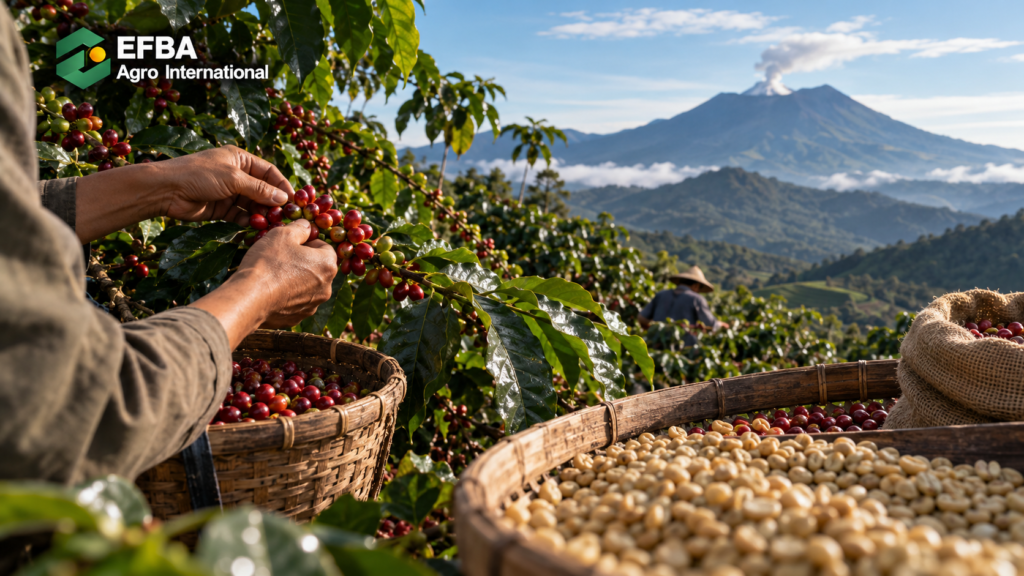
Indonesia is widely recognized for coffee origins with distinctive sensory characteristics. Gayo, Java, and other highland producing areas can offer different combinations of body, acidity, aroma, sweetness, and aftertaste.
One factor often associated with Indonesian coffee is volcanic soil. However, volcanic soil Indonesian coffee should not be treated as a simple explanation for why a coffee tastes good. Soil interacts with altitude, climate, cultivar, water availability, farm management, cherry maturity, processing, drying, storage, and roasting.
For international buyers, understanding volcanic soil Indonesian coffee means looking at terroir as a complete system rather than focusing on soil alone.
A practical way to understand coffee quality is:
Origin → Soil → Altitude → Climate → Cultivar → Farming → Processing → Drying → Green Bean Quality → Roasting → Cup Profile
EFBA Agro International supplies Indonesian agricultural commodities for wholesale and export markets, including coffee beans and cascara. Its coffee portfolio includes Gayo Arabica from the highlands of Aceh. Buyers can communicate their specifications, request samples, evaluate coffee quality, and confirm suitability before commercial cooperation. EFBA Agro International
Does Volcanic Soil Affect Indonesian Coffee Flavor?
Yes, soil conditions can influence coffee growth and bean development, but volcanic soil does not directly create one specific flavor.
For volcanic soil Indonesian coffee, soil provides the physical and chemical environment in which coffee roots develop and obtain water and nutrients. Differences in soil properties can therefore influence plant development and interact with other environmental factors affecting bean characteristics.
Research from Indonesia’s agricultural research repository examining Arabica coffee in the Garut highlands investigated relationships between altitude, soil chemical properties, and physical bean quality. The researchers noted that altitude affects climatic conditions, while soil chemical properties are among the factors associated with coffee growth, productivity, quality, and flavor. Repository Pertanian
A more accurate relationship is therefore:
Volcanic Environment → Soil Properties → Plant Nutrition & Growth → Cherry Development → Bean Composition → Potential Cup Quality
The word potential is important. Favorable soil conditions do not guarantee excellent coffee. Poor harvesting, fermentation, drying, storage, or roasting can reduce the quality of the final product.
What Is Volcanic Soil?
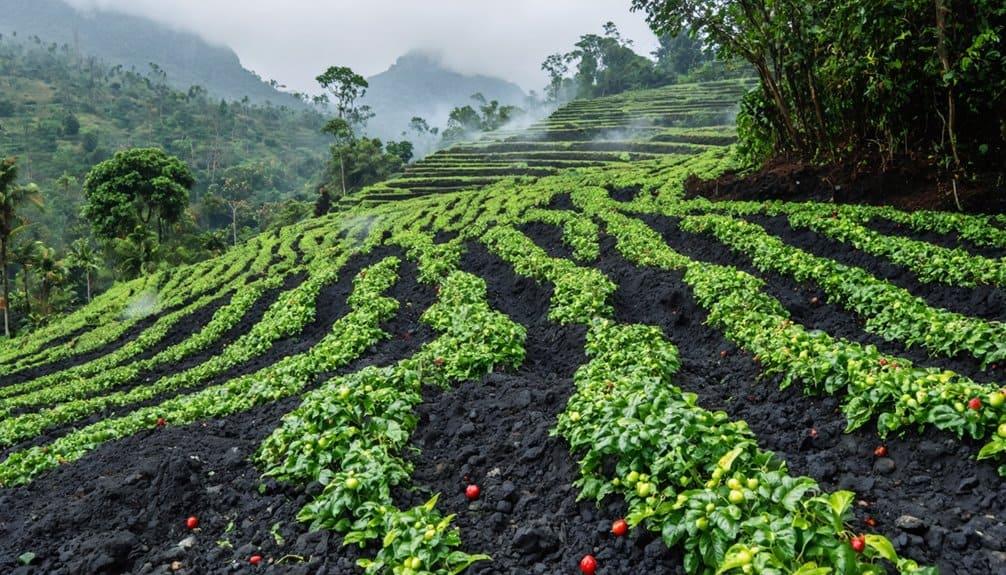
Volcanic soils develop from volcanic materials such as ash and other deposits that weather over time. Their characteristics can vary depending on parent material, climate, age, drainage, land management, and local environmental conditions.
For coffee farming, the important question is not simply whether the soil is volcanic. Growers and buyers should consider factors such as:
- Soil structure
- Drainage
- Organic matter
- Soil acidity
- Nutrient availability
- Root-zone conditions
Therefore:
Volcanic Soil ≠ Automatically Premium Coffee
A more useful model is:
Suitable Soil + Suitable Climate + Altitude + Cultivar + Farm Management + Proper Processing = Better Quality Potential
This distinction is important when evaluating volcanic soil Indonesian coffee because an origin story should support quality evaluation rather than replace it.
5 Ways Volcanic Soil Can Relate to Indonesian Coffee Quality
1. Soil Influences Coffee Plant Nutrition
Coffee plants require suitable soil conditions to support root development and nutrient uptake. Soil chemistry therefore becomes part of the growing environment that influences plant health and cherry development.
For volcanic soil Indonesian coffee, buyers should avoid assuming that descriptions such as “mineral-rich volcanic soil” automatically translate into specific mineral flavors in the cup.
Coffee flavor is the result of complex biological and chemical processes. It is not simply a direct transfer of a soil mineral into a recognizable tasting note.
For sourcing purposes, evaluate the finished coffee instead:
Growing Environment → Healthy Cherry → Processing → Green Bean → Cupping
This approach provides stronger evidence than relying only on marketing descriptions about terroir.
2. Soil and Altitude Work Together
Many Indonesian Arabica coffees grow in highland environments. Altitude affects temperature and other climatic conditions, while soil influences the environment surrounding the coffee plant’s root system.
Indonesian research on Arabica coffee grown at 1,400 and 1,700 meters above sea level found that altitude significantly affected total sensory score and flavor. The same study also found that cultivar and processing method influenced different quality attributes. Repository Pertanian
This shows why Indonesian coffee terroir cannot be explained by a single variable.
Altitude → Climate
Soil → Growing Environment
Cultivar → Genetic Potential
Processing → Flavor Development
Together, these factors contribute to the characteristics found in the final cup.
3. Growing Conditions Influence Bean Development
Coffee cherries develop over several months. During this period, plant health, water availability, temperature, nutrition, sunlight, and farm management can affect their development.
These conditions may influence physical and biochemical characteristics that later become relevant during processing and roasting.
Indonesian research has also examined relationships between biochemical components and sensory attributes in specialty Arabica coffee. Researchers evaluated caffeine, trigonelline, chlorogenic acid, sucrose, and lipids alongside aroma, flavor, aftertaste, acidity, body, balance, sweetness, and other sensory characteristics. Repository Pertanian
This reinforces an important point about volcanic-origin Indonesian coffee:
Soil affects the plant environment, but sensory quality emerges from multiple interacting variables.
4. Volcanic Origin Does Not Replace Processing
Two coffees grown in similar geographic areas can still taste different if producers process them differently.
Methods such as washed, natural, honey, and other controlled approaches can influence how coffee characteristics are expressed after harvesting. Fermentation management, drying conditions, moisture control, storage, and roasting also contribute to the final cup.
Therefore, buyers evaluating Indonesian coffee from volcanic regions should look beyond geographic and geological descriptions.
Important sourcing information includes:
- Origin and elevation
- Cultivar
- Harvest period
- Processing method
- Drying method
- Green bean moisture
- Screen size
- Defect levels
- Cupping results
- Roasting suitability
A practical sourcing framework is:
Soil & Origin → Farm Conditions → Harvest → Processing → Drying → Green Bean Quality → Cupping
This provides a more reliable basis for evaluating coffee than assuming volcanic origin alone determines quality.
5. Volcanic Soil Should Be Evaluated as Part of Terroir
The concept of terroir is useful because coffee characteristics are influenced by the interaction between place, environment, farming practices, genetics, and post-harvest processing.
For volcanic soil Indonesian coffee, soil is therefore one component of a much larger production system.
Two Indonesian coffees may both be described as volcanic-origin Arabica yet show substantial differences in aroma, acidity, body, sweetness, or aftertaste. These differences can be associated with altitude, microclimate, cultivar, farm practices, harvesting, processing, drying, storage, and roasting.
For international sourcing, the practical question is therefore not:
“Does volcanic soil make Indonesian coffee better?”
A more useful question is:
“How do soil, altitude, climate, cultivar, farming, and processing interact to create the characteristics of this particular coffee?”
This approach allows buyers to evaluate volcanic soil Indonesian coffee using measurable and sensory evidence rather than relying solely on an origin narrative.
What Should International Coffee Buyers Evaluate?
When sourcing Indonesian Arabica, volcanic origin can provide useful geographical and environmental context, but it should be considered alongside actual coffee specifications.
A professional buyer can request information covering:
- Origin — region, farm, cooperative, or producing area.
- Elevation — approximate altitude where the coffee is grown.
- Cultivar — the genetic variety of the coffee plant.
- Harvest period — when the cherries were harvested.
- Processing — washed, natural, honey, or other methods.
- Drying — drying method and moisture management.
- Green bean specifications — screen size, defects, moisture, and grading.
- Cupping profile — aroma, acidity, body, sweetness, aftertaste, and overall sensory characteristics.
- Sample evaluation — physical and sensory assessment before commercial purchasing.
This information gives buyers a clearer picture of what they are actually sourcing.
For buyers interested in volcanic soil Indonesian coffee, the key is to connect origin information with measurable green bean specifications and cup performance.
Volcanic Soil Indonesian Coffee: A Terroir Perspective
Volcanic soils can be an important part of the growing environment in several Indonesian coffee-producing regions. However, soil alone does not determine coffee quality.
The final characteristics of Indonesian Arabica coffee emerge from a chain of interconnected factors:
Soil + Altitude + Climate + Cultivar + Farming + Harvest + Processing + Drying + Storage + Roasting
That is why volcanic soil Indonesian coffee should be evaluated as part of terroir rather than as a standalone quality claim.
For international buyers, the most useful approach is to combine origin information with samples, specifications, physical quality checks, and cupping evaluation.
In other words:
Volcanic soil provides context.
Terroir explains the environment.
Processing shapes the expression.
Cupping provides evidence.
This makes the evaluation of Indonesian coffee more practical, transparent, and relevant for wholesale and export sourcing.
EFBA Agro International supports buyers looking for Indonesian agricultural commodities by providing access to coffee beans and other products for international sourcing. Buyers can discuss requirements, request samples, and evaluate product suitability before moving toward commercial cooperation. Visit EFBA Agro International
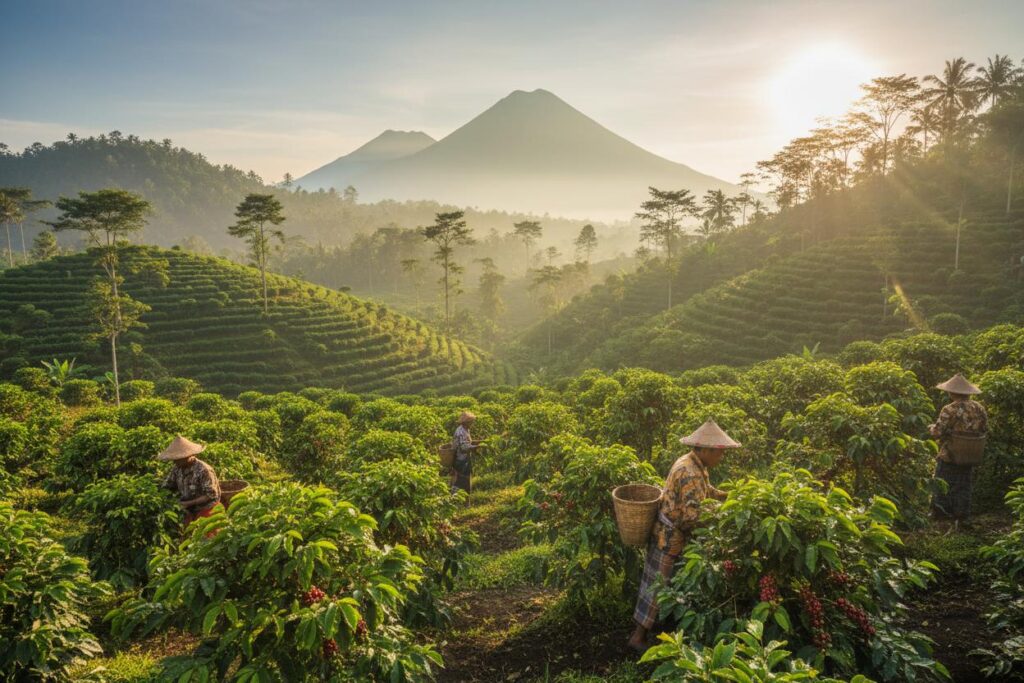
Washed processing may emphasize a cleaner cup and clearer acidity. Natural processing can increase fruit-forward characteristics and sweetness, while Indonesia’s wet-hulled processing is often associated with heavier body and characteristic Indonesian profiles.
EFBA Agro’s published Indonesian Arabica sourcing guide distinguishes natural, washed, and wet-hulled processing because buyers may select different processes according to their desired roasting and sensory profile. EFBA Agro International
Therefore:
Terroir Creates Potential → Processing Shapes Expression → Roasting Develops Flavor → Brewing Reveals the Cup
This is why professional buyers should request processing information together with origin and altitude. For volcanic soil Indonesian coffee, processing details are particularly relevant because soil and geography describe the growing environment, while post-harvest practices influence how those characteristics are expressed in the final cup.
5. Volcanic Soil Is Only One Part of Terroir
The concept of terroir helps prevent coffee quality from being reduced to a single environmental factor.
For volcanic soil Indonesian coffee, terroir may include:
Soil + Altitude + Rainfall + Temperature + Topography + Cultivar + Farm Practices
Post-harvest factors add another layer:
Harvesting + Processing + Fermentation + Drying + Sorting + Storage
Roasting and brewing then influence how these characteristics are perceived by the final consumer.
This explains why two Indonesian Arabica coffees can come from volcanic highlands yet produce noticeably different cups. Volcanic soil provides useful origin context, but it does not determine the final sensory profile by itself.
Does Volcanic Soil Make Indonesian Coffee Taste Better?
Not automatically.
Volcanic growing environments may provide suitable conditions for coffee cultivation, but volcanic soil Indonesian coffee should still be evaluated based on the actual green bean lot. Buyers should not assume that coffee is premium simply because it is described as volcanic-grown.
A more reliable evaluation combines:
Origin → Altitude → Cultivar → Processing → Moisture → Defects → Physical Quality → Sample Roast → Cupping
Research conducted on five Arabica cultivars grown in Garut at approximately 1,300 meters above sea level found differences in bean size and caffeine content among cultivars. Under the conditions of that study, all five cultivars achieved cup scores above 80. Repository Pertanian
This illustrates why cultivar and production conditions should be considered alongside geographic origin.
For commercial sourcing, buyers can therefore treat volcanic soil as origin context while using specifications and sample evaluation to assess the actual coffee. In other words, coffee from volcanic environments should be evaluated through both its growing conditions and the measurable quality of the green bean lot.
What Flavor Can Indonesian Volcanic-Grown Coffee Have?
There is no single “volcanic coffee flavor.”
Depending on origin, cultivar, altitude, processing, roast profile, and other variables, Indonesian coffee may present combinations of body, acidity, sweetness, floral notes, herbal characteristics, spice, chocolate, fruit, or earthy characteristics.
For example, EFBA Agro describes its Gayo Arabica Coffee from Aceh as having medium-to-full body, balanced acidity, and floral and herbal aromatic characteristics. Its published product specification for a Grade 1 semi-washed product also lists full body, low acidity, and notes associated with spice, dark chocolate, tobacco, and earthy characteristics. EFBA Agro International
These descriptions refer specifically to EFBA Agro’s published Gayo product profile. They should not be generalized to every Indonesian coffee or every Gayo lot.
Professional buyers should confirm the characteristics of the actual lot through samples. This is particularly important when evaluating volcanic-origin Indonesian coffee, because origin descriptions cannot replace physical inspection, sample roasting, and cupping.
Indonesian Coffee Quality Is More Than Terroir
A suitable growing environment creates potential. Maintaining that potential after harvest requires careful handling throughout the supply chain.
Coffee quality can change across:
Cherry Selection → Processing → Fermentation → Drying → Sorting → Storage → Packaging → Transportation
Poor drying can lead to inconsistent moisture, while unsuitable storage conditions can affect bean stability. Uncontrolled fermentation may also introduce unwanted sensory characteristics.
EFBA Agro’s guide for Indonesian Arabica Coffee Supplier emphasizes this broader sourcing chain. The guide recommends evaluating origin, variety, processing method, grade, moisture, defect specifications, cup profile, harvest information, packaging, MOQ, documentation, and lead time. EFBA Agro International
For buyers evaluating volcanic soil Indonesian coffee, this creates a more practical sourcing framework:
Terroir + Processing + Specifications + Quality Control + Traceability = Better Procurement Decision
Ultimately, volcanic soil is only one part of the story behind Indonesian coffee. A more reliable approach is to connect origin information with measurable green bean specifications, sample evaluation, cupping results, and consistent quality control before making a commercial purchasing decision.
For international buyers, this approach provides a clearer way to evaluate Indonesian coffee based on evidence rather than relying solely on geological or origin-based marketing claims.
Why Indonesia Matters in the Global Coffee Market
Indonesia remains an important global coffee producer.
The latest BPS-Statistics Indonesia Permanent Estate Crops Statistics 2025, released on August 31, 2026 and revised on September 16, provides updated official data covering coffee plantation area and production by province, together with export and import data. BPS compiles these figures from its estate-crop survey, smallholder data from the Directorate General of Estate Crops, and customs trade documents. Badan Pusat Statistik Indonesia
Meanwhile, USDA’s latest available 2025/26 semi-annual assessment revised Indonesian coffee production to 12.5 million 60-kg bags, approximately 18% above its 2024/25 estimate. The same report put green coffee exports at 7.8 million bags and noted that Arabica production is concentrated primarily in the mountains of northern Sumatra, with smaller production in Java, Bali, and Sulawesi. USDA Apps
These numbers matter for buyers because Indonesia offers both production scale and diverse origins.
However, national production volume does not determine the quality of a specific shipment. International buyers still need to evaluate the individual lot.
Gayo Arabica: One of EFBA Agro’s Indonesian Coffee Origins
Within its coffee portfolio, EFBA Agro International specifically publishes Gayo Arabica Coffee from Aceh.
EFBA Agro states that its Gayo Arabica originates from the Gayo Highlands and is grown at approximately 1,200–1,600 meters above sea level. The product is offered for commercial coffee applications and is positioned for international sourcing. Efba Agro International
Its published product page lists specifications for a Gayo Grade 1 product including semi-washed processing, screen size 16+, maximum defect value of 11 per 300 g, and moisture around 12.0–12.5% maximum. Because coffee is an agricultural product, buyers should confirm the actual specifications and availability for each commercial lot before purchasing. Efba Agro International
For international buyers, this illustrates why origin needs to connect with measurable specifications:
Gayo Highlands → Altitude → Process → Grade → Screen → Moisture → Defects → Cup Profile → Sample
That chain provides more useful procurement information than simply describing the coffee as premium or volcanic-grown.
What Should Coffee Buyers Check Beyond Volcanic Soil?
If you are an importer, roaster, distributor, café group, or private-label coffee company, use volcanic origin as the beginning of the evaluation rather than the final purchasing criterion.
First, verify origin and altitude. Next, identify cultivar and processing method where available. Then review moisture, defect tolerance, screen size, crop or harvest information, packaging, storage, and logistics.
Most importantly, request a sample.
EFBA Agro’s published cooperation process follows a similar sequence:
Buyer Requirement → Product Matching → Sample → Sample Testing → Buyer Confirmation → Commercial Cooperation
The EFBA Agro website states that clients can communicate product specifications and volume requirements. Its team then matches the requirement with available raw materials and farmer networks, prepares samples, and allows the client to evaluate suitability before continuing the cooperation. Efba Agro International
This process is particularly relevant for coffee because sensory descriptions alone cannot replace physical testing.
How EFBA Agro Supports Indonesian Coffee Buyers
EFBA Agro International describes itself as an Indonesian exporter and direct source of agricultural commodities, including coffee beans and cascara alongside other agricultural products. Its business model focuses on procurement, processing, wholesale supply, and export. Efba Agro International
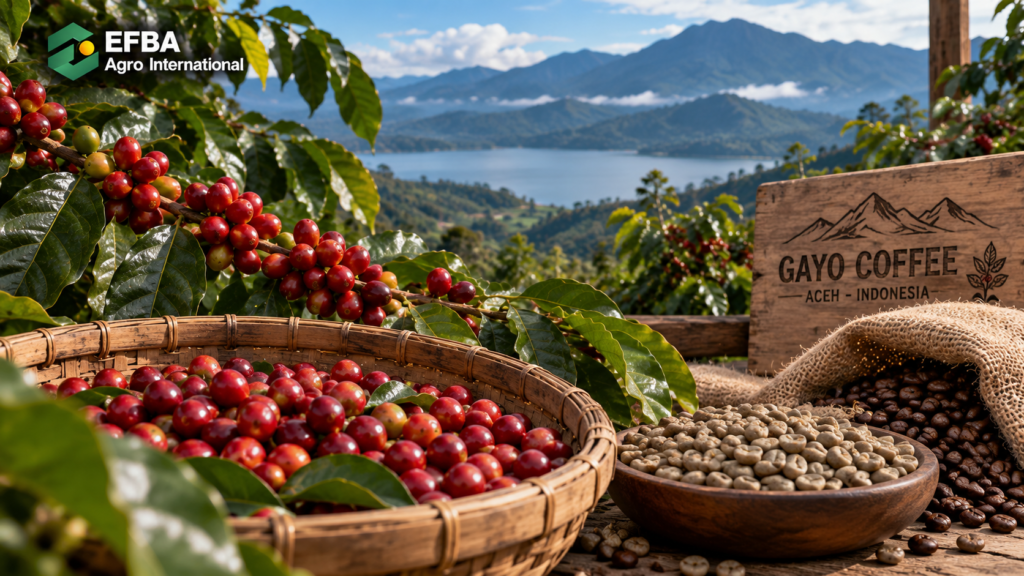
For coffee buyers, EFBA Agro’s published sourcing content emphasizes several commercial factors:
Quality → Specification → Traceability → Sample Evaluation → Packaging → Export Documentation → Logistics → Supply Consistency
Its Gayo Arabica product page also publishes green-bean specifications, packaging information, processing details, and export-oriented information. Therefore, buyers can begin discussions with a clearer product requirement instead of requesting generic “premium Indonesian coffee.” Efba Agro International
EFBA Agro also supplies Cascara from Gayo, which expands its coffee-related portfolio beyond beans. The published cascara specification identifies Arabica coffee fruit as the origin and lists sun drying, moisture parameters, purity, and sensory characteristics. Efba Agro International
This makes EFBA Agro relevant to buyers seeking Indonesian coffee-related agricultural commodities for wholesale and international markets.
EFBA Agro and the EFBA Business Ecosystem
EFBA Agro operates within the broader EFBA business ecosystem. For international buyers, this relationship can provide context about the business group behind its agricultural sourcing activities.
However, product quality should still be evaluated through the actual commodity, specifications, samples, and agreed commercial terms rather than corporate affiliation alone.
For information about the wider group and its business ecosystem, buyers can visit EFBA Digital Mulia.
The practical sourcing principle remains:
Company Information + Product Specification + Sample + Quality Evaluation + Commercial Terms = Procurement Decision
FAQ About Volcanic Soil and Indonesian Coffee
Why is volcanic soil important for Indonesian coffee?
Volcanic soil forms part of the growing environment and can influence soil structure, chemistry, nutrient availability, and plant development. However, coffee quality also depends on altitude, cultivar, climate, farm management, processing, drying, storage, and roasting.
Does volcanic soil make coffee taste better?
Not automatically. Favorable soil can support healthy coffee production, but volcanic soil alone does not guarantee specialty quality. Buyers should evaluate the actual coffee through specifications, sample roasting, physical inspection, and cupping.
What does volcanic soil Indonesian coffee taste like?
There is no single flavor profile. Indonesian coffee can show different combinations of body, acidity, sweetness, fruit, floral, herbal, spice, chocolate, or earthy characteristics depending on origin, cultivar, processing, and roast profile.
Does volcanic soil directly give coffee mineral flavors?
It is more accurate to say that soil influences the plant’s growing environment. Coffee flavor develops through complex interactions involving plant physiology, bean chemistry, cultivar, climate, processing, roasting, and brewing. Buyers should therefore avoid interpreting tasting notes as a direct transfer of soil minerals into the cup.
Is Gayo coffee grown in Indonesian highlands?
Yes. Gayo Arabica originates from the Gayo Highlands in Aceh. EFBA Agro publishes Gayo Arabica in its portfolio and describes its product as originating at approximately 1,200–1,600 meters above sea level. Efba Agro International
What affects Indonesian coffee quality besides soil?
Important factors include altitude, climate, cultivar, cherry ripeness, farming practices, processing, fermentation, drying, moisture, sorting, storage, packaging, roasting, and brewing.
How should international buyers evaluate Indonesian coffee?
Buyers should evaluate origin, cultivar, altitude, processing method, grade, moisture, defect tolerance, screen size, harvest information, packaging, traceability, and cup profile. Requesting and testing samples before a large commercial order helps reduce procurement risk.
Does EFBA Agro supply Indonesian coffee?
Yes. EFBA Agro International lists coffee beans among its agricultural commodities and specifically publishes Gayo Arabica Coffee from Aceh in its portfolio. Its website also describes a sample-based sourcing process for matching buyer requirements with available products. Efba Agro International
Can buyers request samples from EFBA Agro?
EFBA Agro’s published cooperation process includes product matching, sample preparation, buyer sample testing, confirmation, and then commercial cooperation. Actual sample availability and commercial terms should be confirmed directly for the required product and lot. Efba Agro International
Source Indonesian Coffee by Quality, Not Origin Story Alone
Volcanic soil Indonesian coffee is an important part of Indonesia’s terroir story, but volcanic soil should never become the only reason to classify a coffee as premium.
A stronger approach connects:
Soil → Altitude → Climate → Cultivar → Processing → Green Bean Quality → Cupping → Commercial Specification
For international buyers, this approach makes sourcing decisions more objective. Origin tells you where the coffee comes from; specifications and samples tell you whether the coffee fits your business.
EFBA Agro International supplies Indonesian agricultural commodities for wholesale and export markets, including Gayo Arabica coffee, coffee beans, and cascara. Its published sourcing process allows buyers to communicate requirements, match products, request samples, evaluate suitability, and proceed toward commercial cooperation. Efba Agro International

Looking for Indonesian coffee for your roasting, distribution, private-label, or wholesale business? Discuss your required origin, processing method, grade, volume, packaging, and destination with EFBA Agro International before placing a commercial order.
Grow and develop your sourcing business with the wider EFBA ecosystem through EFBA Digital Mulia.