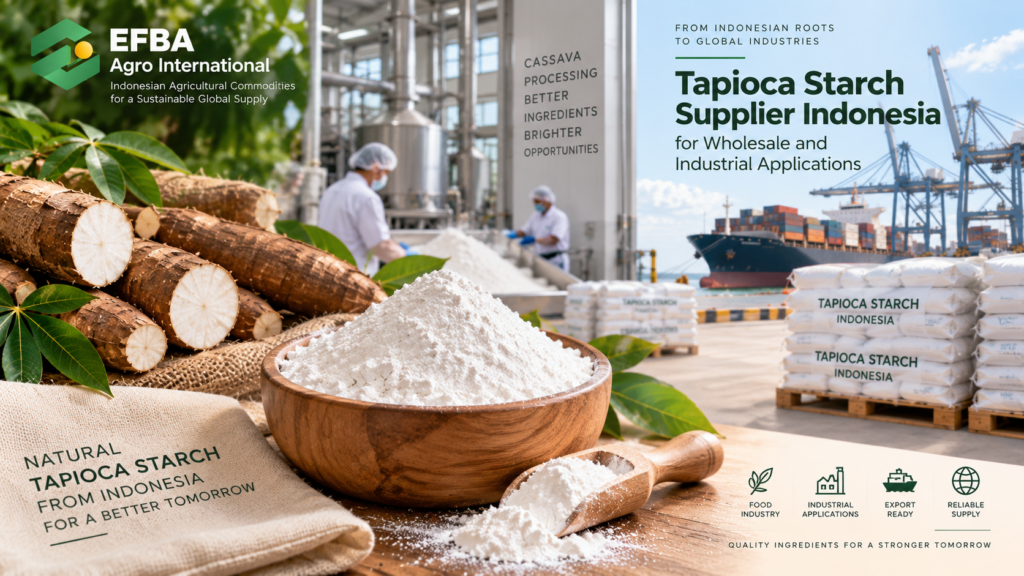
EFBA Agro provides sourcing information for international buyers looking for a reliable tapioca starch supplier Indonesia for wholesale, food manufacturing, distribution, and industrial applications.
Indonesian tapioca starch is derived from cassava (Manihot esculenta) and can serve different commercial applications depending on its grade and technical specifications. Therefore, buyers should evaluate more than price when selecting a supplier.
For bulk procurement, important factors include product specification, grade, moisture, whiteness, particle size, viscosity, packaging, required volume, supply consistency, documentation, logistics, and commercial terms.
A practical sourcing process follows:
Application → Specification → Sample → Quality Verification → Volume → Packaging → Documentation → Logistics → Shipment
For international buyers, this approach helps ensure that the selected tapioca starch matches both manufacturing requirements and procurement plans.
Indonesian Tapioca Starch for Global Buyers
Indonesia has an established cassava agricultural and processing base. As a result, cassava-derived products such as tapioca starch can support domestic manufacturing as well as international commercial requirements.
However, sourcing from a cassava-producing country does not automatically guarantee product suitability.
International buyers still need to verify the actual grade, specification, quality consistency, available volume, packaging, documentation, and export readiness before placing a commercial order.
Therefore, a stronger sourcing decision starts with the intended application.
What will the tapioca starch be used for?
The answer determines the specifications, testing requirements, packaging, and commercial arrangement that buyers should discuss with the supplier.
Tapioca Starch Product Specifications
Technical specifications are among the first factors buyers should evaluate when comparing Indonesian tapioca starch suppliers.
Depending on the grade and application, relevant parameters may include appearance, moisture, whiteness, starch content, particle size, pH, viscosity, ash, microbiological requirements, shelf life, and storage conditions.
A preliminary sourcing framework may include:
| Parameter | Buyer Evaluation |
|---|---|
| Product | Tapioca Starch |
| Origin | Indonesia |
| Raw Material | Cassava |
| Appearance | Fine powder |
| Grade | Based on intended application |
| Moisture | According to specification |
| Whiteness | According to specification |
| Particle Size / Mesh | According to buyer requirement |
| pH | According to specification |
| Viscosity | Application dependent |
| Packaging | Subject to current product availability |
| Required Volume | Confirm during inquiry |
| Documentation | Based on product and destination |
| Shipment | Based on destination and commercial terms |
Actual specifications can vary according to the available product, grade, processor, and buyer requirement. Therefore, international buyers should request the current specification sheet or Certificate of Analysis (COA) before finalizing procurement.
When available, buyers should also send their required specification sheet to the supplier. This step allows both parties to identify technical differences before moving to sample testing or commercial negotiation.
Food Grade and Industrial Tapioca Starch
Tapioca starch can support both food and non-food manufacturing. Nevertheless, buyers should not assume that products for different applications have identical specifications.
Food Grade Tapioca Starch
Food manufacturers may evaluate tapioca starch based on physical, functional, and microbiological requirements.
Depending on the formulation, relevant characteristics can include:
- moisture;
- whiteness;
- particle size;
- starch content;
- pH;
- viscosity;
- texture performance; and
- microbiological parameters.
The final requirement depends on the manufacturing process and destination market.
For this reason, food manufacturers should communicate the intended application before requesting a quotation.
Tapioca Starch for Industrial Applications
Industrial users may require different functional characteristics.
Potential applications include paper, corrugated board, adhesives, textiles, and other starch-based formulations.
In this context, procurement teams should explain the required function and processing conditions. Afterward, the supplier can determine whether the available product is technically relevant.
A useful framework is:
Industrial Process → Required Function → Specification → Trial → Commercial Volume
Bulk Tapioca Starch Packaging
Packaging plays an important role in wholesale procurement because it influences handling, storage, container utilization, logistics, and landed cost.
EFBA Agro’s existing tapioca product information includes references to 25 kg export packaging and 50 kg bulk formats.
However, buyers should confirm current availability for the specific product before placing an order.
Before shipment, discuss:
Net Weight → Bag Material → Labeling → Pallet Requirement → Container Loading → Destination
For private-label or specific packaging requirements, buyers should communicate those requirements during the initial commercial discussion.
This step reduces the risk of packaging changes later in the procurement process.
MOQ, Supply Capacity, and Commercial Requirements
For wholesale procurement, buyers should not evaluate only whether a supplier can fulfill one order.
A more important question is:
Can the supplier support the required procurement schedule consistently?
Therefore, an inquiry should include expected order quantity, purchasing frequency, target delivery schedule, packaging, and destination.
Supply discussions may cover:
- required quantity;
- purchasing frequency;
- available capacity;
- packaging configuration;
- production or preparation lead time;
- container requirements;
- origin port;
- destination port; and
- preferred commercial terms.
MOQ, lead time, and commercial arrangements can vary according to the actual product and shipment. Consequently, buyers should confirm current terms when requesting a quotation rather than relying on generic figures.
Export Terms and International Shipment
International tapioca starch procurement involves both product supply and logistics planning.
Depending on the transaction, commercial discussions may involve terms such as FOB, CIF, or other agreed Incoterms. The appropriate arrangement depends on the supplier offer, buyer preference, shipping route, and destination.
Before confirming an order, procurement teams should clarify:
Product → Quantity → Packaging → Incoterm → Origin Port → Destination Port → Lead Time → Shipment
This information allows the supplier and buyer to evaluate the commercial requirement more accurately.
Furthermore, shipping configuration can influence landed cost. For this reason, unit price alone should not become the only basis for supplier comparison.
Export Documentation for Tapioca Starch from Indonesia
Documentation requirements depend on the product, application, destination country, buyer requirements, and applicable import regulations.
Depending on the transaction, commercial documentation may include documents such as:
- commercial invoice;
- packing list;
- Certificate of Analysis, where applicable;
- Certificate of Origin, where applicable;
- shipping documents; and
- other product or destination-specific documentation.
Requirements should always be confirmed before shipment.
Rather than assuming that every country requires identical documentation, buyers should communicate their import requirements during the sourcing process.
As a result, both parties have more time to identify documentation requirements before the goods enter the shipping stage.
What Is the HS Code for Tapioca Starch?
Tapioca or manioc starch is generally associated with HS heading 1108.14, which covers manioc (cassava) starch.
However, tariff classifications can depend on the actual product and the customs system used by the destination country.
Therefore, importers should confirm the applicable HS classification with their customs broker, freight forwarder, or relevant customs authority before shipment.
The HS code should not replace a technical product description. Instead, procurement documentation should clearly identify the product, specification, quantity, origin, and intended commercial transaction.
How to Request a Tapioca Starch Quotation
A detailed Request for Quotation (RFQ) helps suppliers evaluate requirements more accurately.
Instead of sending only:
“Please send tapioca starch price.”
provide the following information:
| RFQ Information | What to Provide |
|---|---|
| Product | Tapioca starch |
| Application | Food / industrial / other |
| Specification | Required parameters or specification sheet |
| Quantity | Trial or commercial volume |
| Frequency | One-time / monthly / recurring |
| Packaging | Required bag size or configuration |
| Destination Country | Import destination |
| Destination Port | Required port |
| Commercial Term | Preferred Incoterm, if available |
| Additional Requirements | Documentation, labeling, testing, etc. |
Therefore, a stronger RFQ follows:
Application → Specification → Quantity → Packaging → Frequency → Destination → Commercial Terms → Quotation
This format reduces unnecessary communication and allows both parties to focus on technical and commercial compatibility from the beginning.
Why Source Tapioca Starch from Indonesia?
Indonesia has a significant cassava agricultural base and a broader processing ecosystem for cassava-derived commodities.
Official Indonesian agricultural statistics also recognize cassava within the country’s food and agricultural economy.
Nevertheless, country of origin alone should not determine a procurement decision.
For international buyers, the more important factors remain:
Specification → Quality Consistency → Supply Capacity → Packaging → Documentation → Logistics → Commercial Terms
In other words, Indonesia provides the sourcing context, while actual supplier capability determines whether a product matches the buyer’s requirement.
What Is Tapioca Starch?
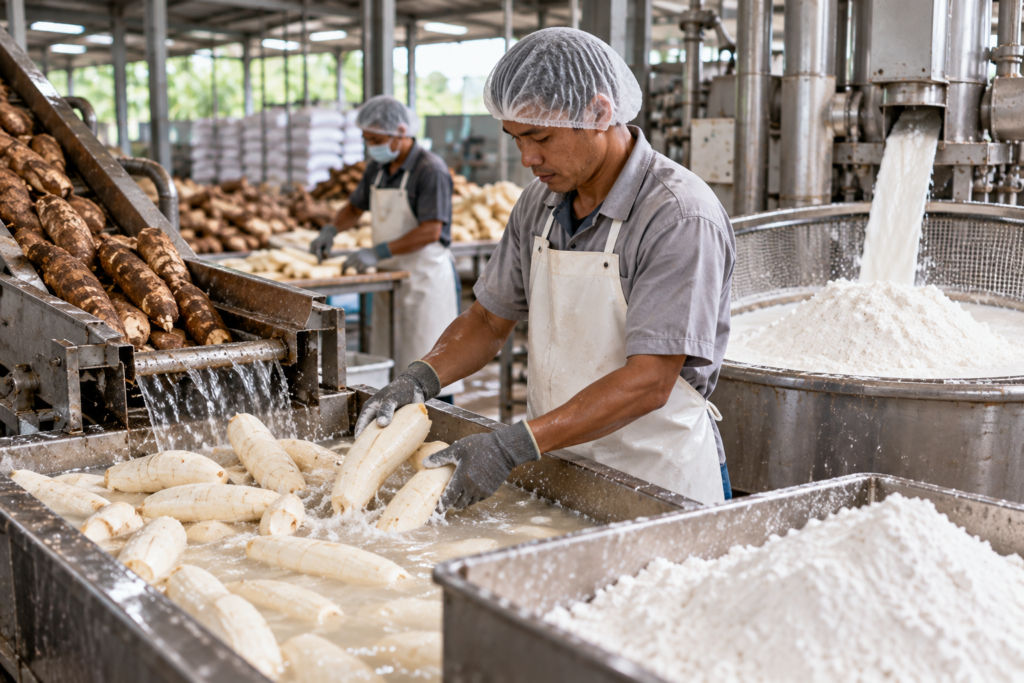
Tapioca starch is a refined starch obtained from cassava roots (Manihot esculenta). During processing, manufacturers separate the starch component from other parts of the cassava root and subsequently dry it into a fine powder. This processing method distinguishes tapioca starch from cassava flour, which generally retains more of the root material.
Tapioca starch is valued for functional characteristics such as thickening, binding, viscosity, texture development, elasticity, and its relatively neutral sensory profile. As a result, manufacturers can use it across various food and industrial applications.
Tapioca Starch vs Cassava Flour
Although both products originate from cassava, tapioca starch and cassava flour are not necessarily interchangeable.
| Factor | Tapioca Starch | Cassava Flour |
|---|---|---|
| Source | Cassava root | Cassava root |
| Main Material | Extracted starch fraction | More of the processed root |
| Texture | Fine starch powder | Flour |
| Typical Selection | Functional starch applications | Flour-based applications |
| Buyer Priority | Starch performance | Flour characteristics |
Therefore, international buyers should not purchase solely based on product terminology.
Instead, confirm the technical specification and intended application before ordering commercial quantities.
This distinction becomes especially important because terms such as tapioca starch, tapioca flour, and cassava flour can be used differently across markets.
Tapioca Starch Applications
Tapioca starch supports a variety of manufacturing applications because of its functional starch properties.
Food Manufacturing
Food processors may use tapioca starch to support thickening, binding, viscosity, elasticity, texture, crispness, and formulation stability.
Potential applications include:
| Application | Potential Function |
|---|---|
| Sauces & Soups | Thickening and viscosity |
| Bakery | Texture and binding |
| Snacks | Texture and crispness |
| Noodles | Binding and elasticity |
| Coatings | Texture and adhesion |
| Fillings | Viscosity and consistency |
| Desserts | Texture development |
Actual performance depends on the starch grade, formulation, processing conditions, and other ingredients.
Therefore, manufacturers should test the selected grade within their own formulation before moving to repeated commercial procurement.
Industrial Applications
Outside food manufacturing, starch-based raw materials can support industrial processes involving:
- paper;
- corrugated board;
- adhesives;
- textiles; and
- other starch-based formulations.
Again, the correct grade depends on technical requirements.
For industrial sourcing, buyers should communicate the intended function rather than requesting tapioca starch solely by product name.
How to Choose a Tapioca Starch Supplier in Indonesia
Selecting a tapioca starch supplier Indonesia should begin with technical compatibility and supply reliability rather than the lowest quotation.
A practical supplier evaluation follows:
Supplier → Specification → Sample → Quality → Capacity → Documentation → Logistics → Commercial Terms
1. Verify the Specification
First, compare the available product specification with the manufacturing requirement.
Do not assume that every white tapioca starch powder performs identically.
Small differences in moisture, particle size, viscosity, pH, whiteness, or other parameters may affect manufacturing performance depending on the application.
2. Request Samples When Appropriate
Next, consider sample testing before committing to a larger commercial quantity.
Food manufacturers can conduct formulation trials. Meanwhile, industrial users can evaluate performance under their own processing conditions.
Sample approval does not replace shipment-level quality control. Nevertheless, it provides a useful starting point for technical evaluation.
3. Evaluate Quality Consistency
For recurring procurement, consistency between shipments becomes important.
A material that performs well during an initial trial should ideally maintain the characteristics required for subsequent production.
Therefore, discuss specification control and quality documentation as part of supplier evaluation.
4. Confirm Supply Capacity
After technical evaluation, discuss commercial volume.
Buyers should communicate required quantity, purchasing frequency, expected growth, and procurement schedule.
The objective is not simply to determine whether one shipment can be supplied. Instead, procurement teams need to understand whether supply can support recurring commercial requirements.
5. Review Packaging and Logistics
Packaging and logistics can influence both product handling and total procurement cost.
Consequently, buyers should confirm bag configuration, pallet requirements, container planning, origin port, destination port, commercial terms, and estimated lead time.
6. Confirm Documentation
Finally, define documentation requirements before shipment.
Destination markets may have different import requirements. Thus, the buyer should communicate required documents early in the commercial process.
Price vs Total Procurement Cost
The cheapest tapioca starch quotation does not always result in the lowest procurement cost.
For example, an inexpensive product may create additional costs when specifications fluctuate, packaging causes handling problems, shipments arrive late, or material performance affects manufacturing efficiency.
Therefore, evaluate: Product Price + Quality + Logistics + Inventory + Reliability + Production Impact = Total Procurement Cost
This perspective becomes especially important for manufacturers that depend on repeatable raw-material performance.

EFBA Agro International publishes tapioca and cassava-based products as part of its agricultural commodity portfolio. For global buyers searching for a tapioca starch supplier Indonesia, EFBA Agro provides product information covering characteristics, food and industrial applications, export packaging, supplier considerations, and bulk sourcing requirements.
For buyers requiring a finer export format, EFBA Agro’s Tapioca Flour White Fine Powder 25kg provides information about refined cassava starch, functional qualities, food and non-food applications, supplier selection, and export considerations. The published page identifies 25 kg bags as an export format and describes applications across food manufacturing and industrial sectors, giving international buyers additional information when evaluating Indonesian tapioca products.
For larger bulk requirements, buyers can also review EFBA Agro’s Tapioca Flour Bulk 50kg for Worldwide Importers. Buyers comparing a tapioca starch supplier Indonesia can use these product pages to understand the relationship between tapioca starch → tapioca flour → cassava → bulk sourcing → Indonesian agricultural commodities before discussing specifications and commercial requirements.
EFBA Agro’s published material also emphasizes collaboration with processors, mills, and agricultural sourcing networks as part of its export approach. International buyers should still confirm specifications, available capacity, packaging, documentation, logistics, and commercial terms for each actual order because requirements can differ according to product application and destination market.
EFBA Business Expertise for Wholesale and Industrial Buyers
Commodity procurement is not only a product decision. For companies entering a new market or developing a manufacturing business, choosing a tapioca starch supplier Indonesia may also involve pricing, financial planning, sourcing strategy, operational requirements, logistics, and broader commercial considerations.
Within the EFBA ecosystem, PT EFBA Digital Mulia’s Business Consulting services cover business planning, financial planning, market research, management, operations and human resources, and business coaching. EFBA states that its consultants have experience developing corporations since 2013, providing a broader business perspective beyond individual commodity transactions.
EFBA’s approach to business planning also emphasizes testing assumptions before committing larger resources. Industrial buyers or companies developing cassava-based products can apply the same principle when evaluating suppliers by following Market Need → Product → Specification → Supplier → Cost → Logistics → Commercial Viability → Procurement Plan.
EFBA’s guide on consultation before starting a business similarly emphasizes market validation, financial planning, operations, risk, and action planning rather than making decisions based only on assumptions. For companies evaluating a tapioca starch supplier Indonesia, these considerations can support a more structured procurement decision alongside product specifications, supplier capacity, and logistics.
FAQ About Tapioca Starch Supplier Indonesia
Where can I find a tapioca starch supplier in Indonesia?
Indonesia has suppliers and exporters serving domestic and international markets. Buyers looking for a tapioca starch supplier Indonesia should compare product specifications, samples, quality consistency, available volume, packaging, documentation, export capability, lead time, and logistics before selecting a supplier.
EFBA Agro publishes tapioca and cassava-based commodity information for international buyers, including product pages covering 25 kg and 50 kg bulk formats. These resources can help buyers understand available product formats before discussing current specifications, quantity, packaging, and commercial requirements.
How do I choose a tapioca starch supplier Indonesia for wholesale orders?
When choosing a tapioca starch supplier Indonesia for wholesale procurement, buyers should start with their intended application and required specification. The evaluation should then cover sample performance, quality consistency, supply capacity, MOQ, packaging, documentation, logistics capability, lead time, and commercial terms.
Price remains important, but it should not become the only purchasing criterion. For manufacturers, consistent raw-material performance and reliable supply can be particularly important because variations in starch characteristics may affect production processes and finished-product quality.
What is Indonesian tapioca starch made from?
Indonesian tapioca starch comes from cassava roots (Manihot esculenta). Manufacturers extract the starch component from cassava and process it into a fine powder suitable for different food or industrial applications, depending on the grade and specification.
Cassava flour also comes from cassava, but its production and composition differ because it generally retains more of the root material. Buyers should therefore verify whether their formulation requires tapioca starch, tapioca flour, or cassava flour before requesting a quotation.
Is tapioca starch the same as cassava flour?
No. Both originate from cassava, but tapioca starch primarily consists of extracted starch, while cassava flour generally comes from processed cassava root material. As a result, their composition, functional characteristics, texture, and potential applications can differ.
This distinction is particularly important when contacting a tapioca starch supplier Indonesia because product terminology may vary between markets. Buyers should confirm the technical specification and intended application instead of relying only on the commercial product name.
What industries use tapioca starch?
Food manufacturers use tapioca starch in applications that may require thickening, binding, texture development, viscosity, elasticity, or crispness. Applications can include bakery products, sauces, soups, noodles, snacks, coatings, fillings, desserts, and other processed foods.
Non-food industries may also use starch-based materials in paper, adhesives, textiles, and other industrial formulations. Buyers should communicate the intended application to the tapioca starch supplier Indonesia so both parties can determine whether the available grade and specification match the manufacturing requirement.
Can I buy tapioca starch in bulk from Indonesia?
Yes, international buyers can explore bulk tapioca sourcing options from Indonesia. EFBA Agro currently publishes tapioca-related information covering 25 kg export bags and 50 kg bulk formats, giving wholesalers, distributors, and manufacturers different references for commercial procurement.
Before placing a bulk order with a tapioca starch supplier Indonesia, buyers should confirm current packaging, MOQ, available volume, specifications, production capacity, lead time, documentation, and logistics. These factors help determine whether the available supply matches the buyer’s procurement schedule and destination requirements.
What specifications should I request from a tapioca starch supplier?
Depending on the application, buyers may need to evaluate appearance, whiteness, moisture, starch content, particle size, pH, viscosity, ash, microbiological parameters, packaging, shelf life, and storage requirements. The exact specification should follow the manufacturing process, intended application, and destination-market requirements.
When contacting a tapioca starch supplier Indonesia, buyers should provide their required specification sheet when available. If a detailed specification is not yet available, communicating the intended application can help make the initial sourcing discussion more relevant.
Is Indonesian tapioca starch suitable for food manufacturing?
Tapioca starch can serve as a functional ingredient in food manufacturing, depending on its grade, specification, and intended application. Potential functions include thickening, binding, texture modification, viscosity development, elasticity, and supporting particular characteristics of the finished product.
Food manufacturers evaluating a tapioca starch supplier Indonesia should confirm the product grade, technical specification, regulatory suitability, and actual performance within their formulation. Where appropriate, manufacturers can also request samples for testing before moving to larger commercial quantities.
Is tapioca starch available for industrial applications?
Yes. Starch-based materials can support paper, textile, adhesive, and other industrial applications, depending on their technical characteristics. Industrial and food-grade requirements should not automatically be treated as equivalent because each manufacturing process may require different performance parameters.
Industrial buyers should therefore explain the required function and technical parameters when contacting a tapioca starch supplier Indonesia. Clear application information helps both parties determine whether the available product matches the intended manufacturing process.
What information should I send when requesting a quotation?
A useful quotation request should include the product application, required specification, quantity, packaging, purchasing frequency, destination country, destination port, and preferred Incoterm or commercial terms. Providing this information allows a tapioca starch supplier Indonesia to evaluate the requirement more accurately and determine whether the available product matches the buyer’s technical and commercial needs.
For B2B procurement, buyers can follow Application → Specification → Quantity → Packaging → Destination → Commercial Terms → Quotation. This framework also reduces unnecessary communication because the supplier receives the essential sourcing information from the beginning.
Looking for a Tapioca Starch Supplier Indonesia?
For manufacturers, wholesalers, distributors, and industrial buyers, choosing a tapioca starch supplier Indonesia should begin with the intended application and technical specification rather than price alone. Buyers need to confirm whether the starch performs as required, whether the supplier can support commercial volumes, and whether packaging, documentation, logistics, and delivery schedules match the procurement plan.
A structured sourcing process can follow Application → Specification → Supplier → Sample → Quality Verification → Volume → Packaging → Documentation → Logistics → Shipment. This approach is particularly important for wholesale and industrial procurement because consistent raw-material performance can influence production efficiency, procurement continuity, and finished-product quality.
Global buyers searching for a tapioca starch supplier Indonesia can review EFBA Agro International, the Tapioca Flour White Fine Powder 25kg guide, and the Tapioca Flour Bulk 50kg guide before discussing their requirements with the EFBA Agro team. Buyers should prepare information about application, technical specifications, quantity, packaging, destination, purchasing frequency, and shipment requirements so the sourcing discussion can focus on the most relevant commercial requirements.