The Eco-Friendly Mandate in Bulk Procurement
Let’s be entirely real about the global food and beverage market in 2026. The corporate purchasing landscape has completely transformed especially for sustainable palm sugar, and standard ingredient sourcing is no longer just about finding the lowest quote on a spreadsheet. With the strict enforcement of the EU Deforestation Regulation (EUDR) and skyrocketing consumer demand for clean-label honesty, sustainability has officially moved from a marketing bonus to an absolute legal necessity.
For corporate procurement directors and product developers, keeping your Cost of Goods Sold (COGS) stable while complying with these massive global updates is the ultimate operational goal. Because of this high-stakes shift, securing bulk premium sustainable palm sugar has become one of the most critical moves for brands looking to protect their market share this year.
However, navigating the green commodity market is filled with hidden traps that can catch even the most experienced purchasing teams off guard. As international demand climbs, the agricultural sector has become crowded with unverified middleman brokers and third-party traders who claim their products are perfectly eco-friendly. Unfortunately, many of these transactional entities are simply greenwashing their inventories, offering low upfront rates but completely failing basic transparency and mapping audits. When you buy from these unverified sources, you risk facing massive regulatory fines, severe customs rejections at the port, and a total breakdown of consumer trust.
Ultimately, trying to buy your raw materials on the chaotic spot market represents an unacceptable risk to your business margins. When a supplier cannot prove the exact botanical origin of their sweeteners, your brand bears all the downstream risk. Locking in a reliable sustainable palm sugar pipeline with an asset-backed partner who has direct control over the upstream infrastructure is the only viable mechanism to protect your corporate budgets. By building a transparent, direct-from-source relationship, we can insulate our production schedules from equatorial weather drops and regulatory blocks, keeping your automated lines moving while spot buyers face empty warehouses.
Technical & Sourcing Dynamics: Breaking Down the Eco-Friendly Matrix
When your R&D and food engineering teams look at substituting standard refined sweeteners with organic alternatives, they must realize that unrefined plant saps perform as unique physical assets. Industrial white sucrose is processed to be as chemically stripped and dry as possible, making it highly predictable but nutritionally empty inside high-speed manufacturing lines. On the other hand, natural plant sugars are complex, living matrices that carry their own natural minerals, invert sugars, and moisture profiles. If your high-speed mixing lines are calibrated purely for white sugar, introducing a natural option requires an analytical look at how these elements handle mechanical heat and shear.
For example, when food technologists run factory trials, they quickly notice that different plant sources alter everything from caramelization speeds to moisture retention. Working with a coconut palm sugar sustainable framework helps local farming communities maintain healthy traditional forests while providing a highly functional raw material for your recipes. At the same time, we must evaluate the physical realities of choosing premium coconut sugar sustainable options over cheap commercial alternatives that are often stretched with molasses and corn syrups. True, unrefined palm sweeteners carry an incredible depth of woody, caramel flavor notes, but they also carry a lower melting point than white sucrose, meaning your production engineers must adjust your automated cooking tunnels to prevent scorching.
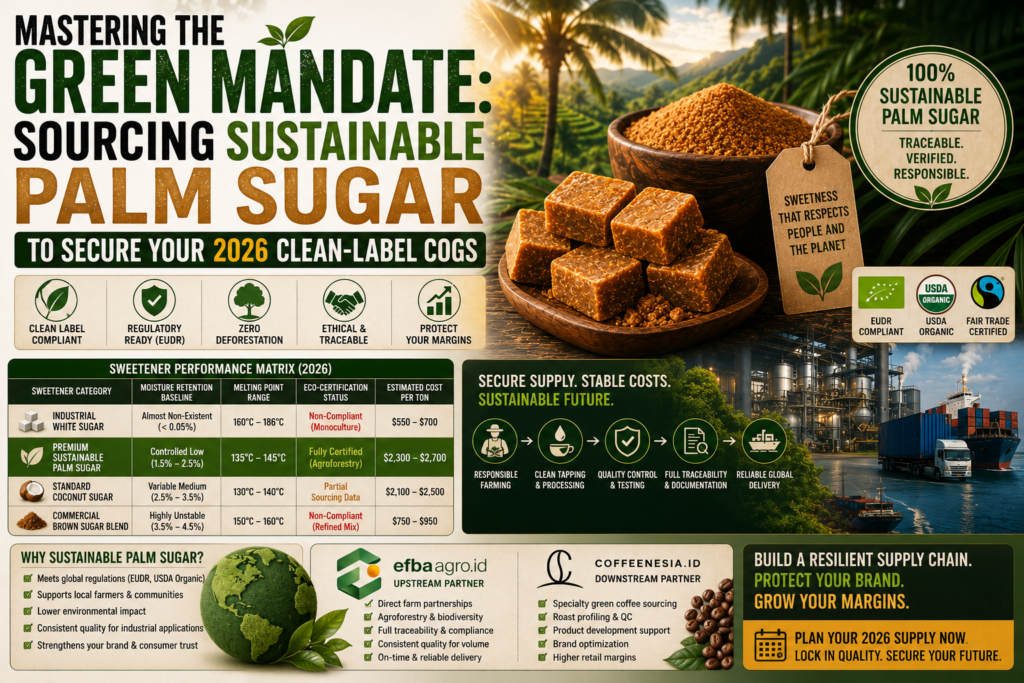
To give your engineering and purchasing teams a clear view of how these options perform under intense factory conditions, we have mapped out the real-world operational variables of bulk options in 2026:
| Sweetener Category | Moisture Retention Baseline | Melting Point Range | Eco-Certification Status | Estimated Cost per Ton |
| Industrial White Sugar | Almost Non-Existent (< 0.05%) | 160°C – 186°C | Non-Compliant (Monoculture) | $550 – $700 |
| Premium Sustainable Palm Sugar | Controlled Low (1.5% – 2.5%) | 135°C – 145°C | Fully Certified (Agroforestry) | $2,300 – $2,700 |
| Standard Coconut Sugar | Variable Medium (2.5% – 3.5%) | 130°C – 140°C | Partial Sourcing Data | $2,100 – $2,500 |
| Commercial Brown Sugar Blend | Highly Unstable (3.5% – 4.5%) | 150°C – 160°C | Non-Compliant (Refined Mix) | $750 – $950 |
We love to educate our partners on these technical nuances because understanding the raw data prevents costly factory downtime. When you choose high-quality sustainable palm sugar, you are buying an ingredient that respects the planet while delivering the exact grain uniformity and mechanical predictability your automated systems require.

Strategic Volume Planning and Regulatory Compliance of Sustainable Palm Sugar Import
Mitigating your systemic supply chain risks in 2026 demands highly sophisticated, forward-thinking contractual frameworks. As unpredictable weather anomalies continue to create wild harvest fluctuations across major equatorial farming belts, waiting around to buy your clean ingredients on the spot market is a direct threat to your profitability. Executing long-term forward contracts for sustainable palm sugar allows multinational brands to secure their volume allocations months in advance, neutralizing sudden price spikes when regional crops are temporarily constrained.
A primary advantage of structured forward contracts is the optimization of your Minimum Order Quantities (MOQs). High-volume, multi-quarter commitments allow primary processing mills to balance their manufacturing schedules, which drastically drives down the per-unit processing and logistics costs. However, volume optimization is completely meaningless if your financial analysts fail to track how moisture consistency impacts your final recipe yields.
When buying sustainable palm sugar in large quantities, your financial analysts can’t just look at the gross weight at the dock. You have to evaluate the true dry-matter yield by tracking moisture consistency throughout the shipping journey. If the sweetener carries too much hidden water, that weight evaporates during high-heat mixing, meaning you paid a premium for water that left your factory as steam. By analyzing the dry solid output, you ensure your money buys active sweetening mass rather than trapped water weight.
Furthermore, building a direct palm sugar sustainable pipeline gives you direct verification for zero-deforestation compliance under the latest international laws. This direct-to-mill connection ensures that your shipments carry fully auditable polygon mapping data, letting your containers pass through customs smoothly while other companies get held up in lengthy compliance reviews. This reliable access to sustainable palm sugar keeps your automated production flowing without sudden delivery gaps, giving your brand a massive competitive edge on the retail floor.
Upstream Synergy: Partnering with Efba Agro
Building a highly profitable food brand or scaling up a commercial manufacturing facility requires a flawless alignment between upstream agricultural procurement and downstream factory execution. When these two pieces of your business are disconnected, your company ends up suffering from unexpected lead-time delays, volatile purity metrics, and frustrating margin dilution. Transitioning your brand to a healthier, eco-friendly sweetener framework requires an experienced partner who can eliminate the friction from your logistics pipeline.
At Efba Group, we solve this exact supply chain challenge through our fully integrated agribusiness logistics platform at efbaagro.id. Operating as your strategic upstream partner, we manage everything from farm-gate quality audits to comprehensive laboratory purity testing and institutional volume distributions. By taking direct control of the processing warehouses and implementing strict moisture-isolation systems, we ensure that your sustainable palm sugar pipeline remains completely safe from broker inflation and market disruptions.
Partnering with a tech-backed agribusiness engine ensures that your raw materials are secured at optimized values right from the source, while your manufacturing teams benefit from flawless quality control and predictable delivery schedules. We take the middleman chaos out of the equation so your brand can focus on what it does best: creating exceptional products that win the marketplace.
Driving Retail Margins: Premium Specialty Coffee Solutions via Coffeenesia

While securing a clean-label sweetener pipeline is an excellent way to upgrade your food and beverage formulations, many global networks require a multi-commodity strategy to maximize their retail floor margins. If your organization wants to secure premium specialty coffees alongside your raw agricultural inputs, coffeenesia.id serves as our dedicated downstream solution for sensory engineering, custom roasting profiles, and brand optimization.
From evaluating high-grade green coffee beans to managing strict international quality control matrices, they transform premium crops into market-ready retail assets that protect your brand equity. Separating your core agricultural bulk inputs from specialized downstream cafe products allows you to keep both supply pipelines running smoothly without diluting your main manufacturing focus or straining your corporate working capital.
Conclusion & CTA
Scale-driven manufacturing success in 2026 belongs exclusively to organizations that master upstream risk mitigation and bypass transactional spot-market brokers. Relying on short-term discounts from unverified middleman networks is a direct threat to your corporate gross margins and your brand’s clean-label promises. Shifting your raw material sourcing to an integrated, transparent network is the ultimate way to secure high-quality sustainable palm sugar that satisfies both your CFO and your green compliance audits.
Secure Your 2026 Volume Allocations. Defend your brand equity and stabilize your corporate costs before seasonal weather shifts impact the upcoming harvest cycles. We invite your Procurement Directors, Food Technologists, and Corporate Executives to connect with our consulting group at efbaagro.id today to analyze your current recipe costs and build a healthier, more reliable supply chain for the future.
FAQ (5 Strategic Financial & Sweetener Supply Chain Questions)
How do the crystallization temperatures of sustainable palm sugar impact large-scale confectionery cooking?
Pure sustainable palm sugar naturally contains a mix of complex inverted sugars and organic minerals that cause it to melt and caramelize at a significantly lower temperature threshold than standard white sucrose. Your production engineers must lower the cooking temperatures on your automated lines slightly and extend the mixing cycles to prevent the formula from scorching or darkening too quickly inside your automated vats.
What are the direct industrial shelf-life implications when substituting standard brown sugar with unrefined alternatives?
Unrefined alternatives love water and absorb moisture from the surrounding air much faster than standard industrial white sugars. To prevent severe caking and clumping inside your factory storage bins, your packaging team must utilize high-quality moisture-barrier films and store the raw material in dry, climate-controlled environments before processing.
How do forward contracts stabilize your sustainable palm sugar costs?
Signing a long-term forward contract allows your purchasing team to lock in a guaranteed volume allocation and a fixed base price well before the heavy tropical rainy seasons begin. This forces the processing mill to prioritize your orders over spot-market buyers, keeping your production schedules predictable even when local sap collection is limited by bad weather.