The High Stakes of Cross-Contact Sourcing for Gluten Free Flour Supplier
Let’s look at the operational realities facing the global food manufacturing sector in 2026. Industrial bakeries, snack giants, and packaged food brands are completely updating their production strategies because global consumer demand for certified clean-label and allergen-free products is breaking records month after month. For procurement directors and food technologists, this market shift means that securing a high-purity gluten free flour supplier is no longer a simple purchasing task for the department. It has transformed into a high-stakes risk-management priority where a single cross-contact mistake can immediately cause massive financial liabilities and destroy your brand equity.
The major challenge when sourcing bulk allergen-free ingredients is the hidden threat of particulate cross-contact throughout the international supply chain. Many corporate buying teams fall into the trap of working with generic open-market brokers who offer very low upfront spot prices to secure quick quarterly deals. Unfortunately, these transactional brokers frequently source their products from shared-facility mills that process traditional wheat, rye, and barley on the same machinery lines. When these unverified ingredients are subjected to strict laboratory ELISA purity tests at the port, even a tiny trace of hidden gluten will cause immediate customs rejections and devastating production delays.
Relying on unverified intermediaries who cannot prove the physical isolation of their processing lines exposes your manufacturing facility to unacceptable operational risks. Choosing an unverified vendor instead of a dedicated, asset-backed gluten free flour supplier creates severe business risks that can foul up automated blending lines and lead to costly product recalls. Locking in a certified, traceable supply pipeline with a trusted gluten free flour supplier who maintains complete control over the upstream agricultural fields is the ultimate defensive play to safeguard your corporate margins. By establishing a direct contract with an infrastructure-backed partner, we can protect our multi-site operations from seasonal crop drops and regulatory border blocks, ensuring absolute purity from the field to the final retail package.
The Milling Physics Matrix: Optimizing Particle Size Distribution
To achieve absolute dough consistency and perfect structural rise inside high-speed automated baking lines, your production engineers must evaluate alternative ingredients through a strict mechanical lens. Traditional wheat flour relies heavily on its internal gluten protein network to trap gas and create structural elasticity during the baking phase. When you formulate with gluten-free bases like cassava, rice, or sorghum, you must rely entirely on the physical characteristics of the starch granules to build your crumb structure. This is why an elite gluten free flour supplier will focus extensively on pneumatic air classification and precise particle size distribution to deliver high-performance functional powders.
During high-speed impact milling, the physical friction of the spinning blades generates significant localized heat that can easily shatter the delicate starch cells. When evaluating a potential gluten free flour supplier, your technical teams must review their starch damage metrics very closely. If the milling process inflicts excessive starch damage, the broken granules will absorb water far too quickly and unevenly, turning your automated dough mixes into a sticky paste that chokes up high-speed conveyor lines. Utilizing advanced pin mills equipped with integrated cooling systems prevents this structural breakdown, keeping the native starch matrix completely intact so your recipes bake with an optimized volume and a perfectly smooth texture.
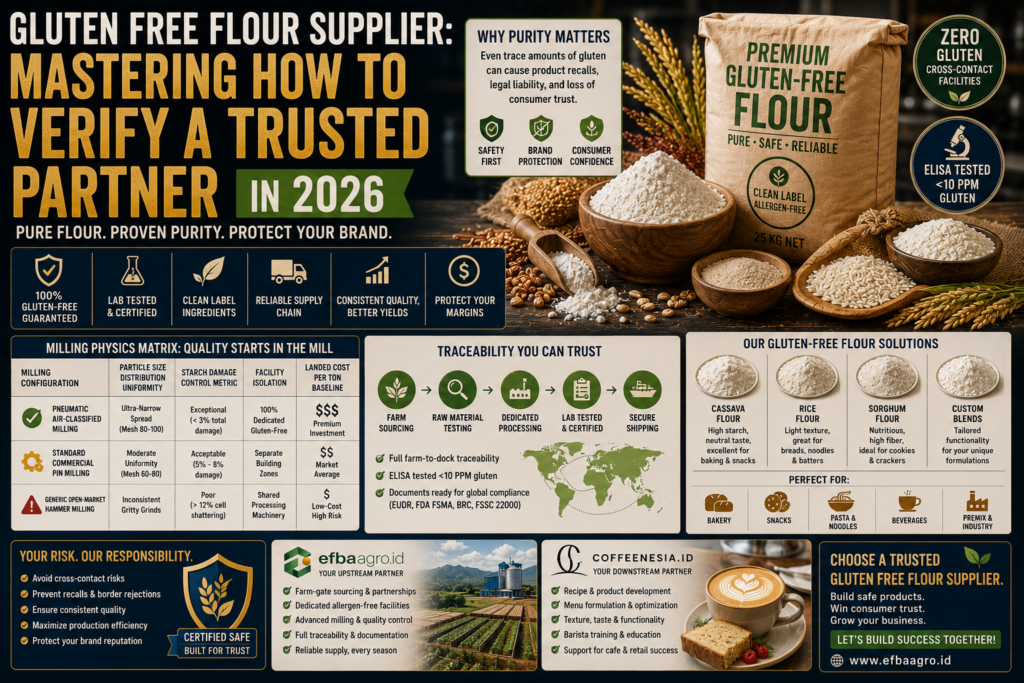
To give your engineering teams and purchasing directors a clear, data-driven framework for evaluating milling setups, we have benchmarked the standard processing outputs from verified gluten free flour manufacturers against generic open-market options below:
| Industrial Milling Configuration | Particle Size Distribution Uniformity | Starch Damage Control Metric | Dedicated Zero-Gluten Facility Isolation | Landed Cost Per Ton Baseline |
| Pneumatic Air-Classified Milling | Ultra-Narrow Spread (Mesh 80-100) | Exceptional (< 3% total damage) | 100% Guaranteed Isolated Lines | Premium Structural Investment |
| Standard Commercial Pin Milling | Moderate Uniformity (Mesh 60-80) | Acceptable (5% to 8% damage) | Separate Building Zones | Moderate Market Average |
| Generic Open-Market Hammer Milling | Inconsistent Gritty Grinds | Poor (> 12% cell shattering) | Shared Processing Machinery | Low-Cost Volatile Spot Price |
Reviewing the baseline standards provided by a high-tier gluten free flour supplier reveals that grain size uniformity directly determines your final baking yields. When you purchase an ingredient with a highly uniform particle spread, you eliminate the gritty textures and uneven moisture distribution that ruin large commercial batches. This precise physical sorting ensures that your automated blending systems operate with maximum efficiency, protecting your production speeds and delivering a premium mouthfeel that keeps your consumers coming back.

Strategic Volume Planning and Supply Chain Traceability
Protecting a multinational food brand from extreme market inflation in 2026 requires moving past short-term spot purchases and adopting advanced, multi-quarter forward allocations. As changing global weather patterns continue to cause unexpected crop drops across major equatorial farming belts, operating without long-term volume guarantees is a massive threat to your profitability. Locking in multi-quarter contracts with reliable wholesale gluten free flour suppliers protects your corporate budgets from sudden price shocks and guarantees that your production facility receives priority shipping status during regional harvest drops.
A primary advantage of working with a direct, infrastructure-backed source is the ability to manage the physical consistency of your raw materials over long long-distance shipping routes. When fine powders let’s say tapioca starch travel across different climate zones, they can easily absorb ambient humidity if the container insulation is poor, leading to severe clumping inside your automated storage silos. To evaluate your true manufacturing yields accurately, your procurement teams must monitor the true dry-matter yield by tracking moisture consistency in plain text rather than looking at raw incoming weight alone. By calculating the active carbohydrate mass after subtracting out the transit moisture percentage, your finance department ensures you pay strictly for functional baking material rather than trapped environmental weight.
Furthermore, relying on a certified gluten free flour supplier ensures full audit readiness under the strict 2026 international environmental tracking laws. Modern zero-deforestation laws like the EUDR require absolute farm-to-dock logistics tracking, forcing global food brands to maintain fully verified polygon mapping data for all agricultural lands. Our framework as a global gluten free flour supplier emphasizes complete verification, providing your compliance teams with clear digital records that prove your raw inputs were grown responsibly without causing tropical deforestation. This transparent approach allows your shipping containers to clear international customs smoothly, completely bypassing the expensive port rejections that ruin spot-market buyers.
Upstream Synergy: Secure Farm-Gate Sourcing via Efba Agro

Building a highly successful commercial food brand requires a flawless, transparent connection between upstream agricultural harvesting and downstream factory execution. When your purchasing department operates on fragmented spot deals with unverified middleman networks, your business faces erratic delivery timelines, fluctuating purity metrics, and sudden margin dilution whenever logistics bottlenecks hit the shipping lanes. Transitioning your brand to premium, allergen-free bases demands an experienced partner who owns the local agricultural infrastructure and understands international compliance laws.
This is exactly where our fully integrated agribusiness logistics platform at efbaagro.id provides real operational value for your enterprise as an internal pipeline engine. Operating as a primary gluten free flour supplier, our ecosystem at efbaagro.id takes direct control of farm-gate quality checks, advanced laboratory purity testing, and secure cross-border shipping loops. We work directly with traditional farming cooperatives to ensure that our crops are harvested, cleaned, and processed inside dedicated allergen-free facilities long before they ever reach the shipping docks.
Your designated gluten free flour supplier must bridge the gap from farm-gate to factory gate with absolute transparency and zero broker inflation. By managing the intense agricultural and bureaucratic complexities of the international trade, we shield your corporate supply chain from unexpected delivery delays and market disruptions. We handle the heavy logistics and regulatory compliance checks so your executive team can focus entirely on production efficiency, market expansion, and product innovation.
Driving Retail Margins: Specialty Bakery and Cafe Customization via Coffeenesia

While securing your raw agricultural assets at the farm gate through our internal systems at efbaagro.id is vital for long-term supply safety, transforming those clean crops into high-margin retail success stories requires world-class sensory design and product optimization. If your organization looks to align its premium flour inputs with downstream retail execution—such as texture optimization for ready-to-drink blended beverages, specialty gluten-free cafe pastries, or brand-specific bakery optimization—coffeenesia.id serves as the dedicated external solution for beverage program engineering and sensory alignment.
From calibrating mouthfeel parameters in plant-based beverages to optimizing the crumb structures of gluten-free baked goods for commercial displays, their team meticulously matches raw material characteristics with modern consumer taste expectations. A collaborative gluten free flour supplier understands that downstream optimization relies on upstream perfection, which is why we coordinate our milling specifications with your specific culinary goals. Separating your bulk agricultural inputs from specialized retail product engineering allows your corporate team to optimize container space, maximize shipping efficiencies, and drive impressive retail margins across all sales channels.
Conclusion & CTA
Long-term commercial success in the competitive 2026 packaged food landscape belongs exclusively to organizations that eliminate upstream processing risks and focus heavily on raw material consistency. Relying on transactional brokers who sell unverified, poorly milled flours is an open invitation for line blockages, allergen cross-contact failures, and devastating margin erosion. Choosing the right gluten free flour supplier determines your competitive strength and dictates your factory’s daily output efficiency over the long haul.
Let’s make your raw material sourcing completely reliable, safe, and transparent this year. We invite your procurement directors, industrial bakery managers, and food technologists to connect with our expert advisory team at efbaagro.id today to run a comprehensive processing yield audit, optimize your flour specs, and connect with our team to see how we operate as a premier gluten free flour supplier for the upcoming quarters.
FAQ (5 Strategic Allergen-Free Supply Chain Questions)
How does a dedicated gluten free flour supplier maintain zero cross-contact inside a modern milling facility?
An elite gluten free flour supplier prevents cross-contact by operating a 100% dedicated, isolated processing facility that never allows gluten-containing grains like wheat or rye past the security gates. Every incoming batch of raw roots or grains undergoes strict testing protocols using advanced ELISA strip kits at the reception bays before entering the pneumatic milling lines.
What packaging specifications are required to protect bulk gluten-free flour from humidity during ocean transit?
To protect your bulk flour from humidity shifts during long sea transit, the milled powder must be packed inside multi-layer kraft paper bags fitted with a thick inner polyethylene (PE) plastic liner or heavy-duty hermetic bulk bags. This protective moisture barrier completely seals the fine particles from external humidity changes, keeping the powder dry and free-flowing to prevent severe caking before it arrives at your factory.
How do multi-quarter forward contracts protect food brands from sudden harvest drops?
Signing a long-term forward contract allows your procurement team to secure a guaranteed volume allocation and a fixed base price directly with the primary processing mills well before the local harvest season begins. This agreement forces the mill to reserve fresh agricultural allocations for your specific flour batches, shielding your corporate budgets from open-market price spikes when extreme weather patterns temporarily limit local crop yields.