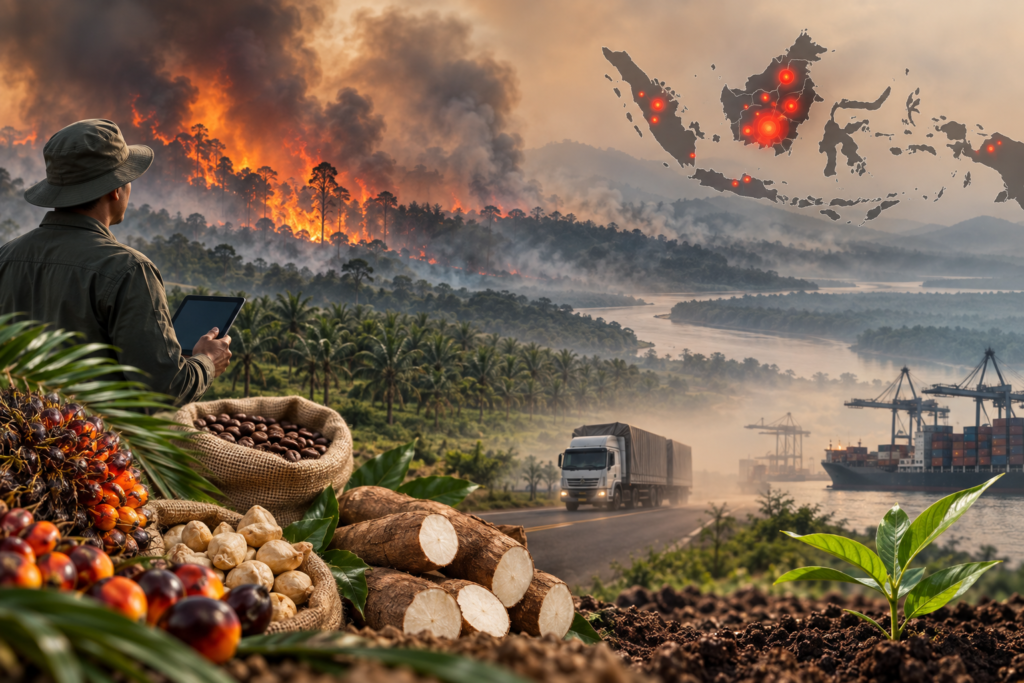
Indonesia’s forest and land fires have again become an important issue for agriculture and commodity buyers in 2026, particularly as fires and haze affect parts of Kalimantan and Sumatra. For international buyers, understanding Indonesia forest fires agriculture risks is increasingly important when evaluating sourcing and supply-chain exposure.
On September 15, 2026, Indonesia’s Ministry of Forestry reported 1,437 high-confidence hotspots nationwide, up from 592 a day earlier. Central Kalimantan alone recorded 689 high-confidence hotspots. The government responded with ground firefighting, water bombing, aerial patrols, land rewetting, and weather modification operations.
BMKG had also reported that during its previous 10-day monitoring period, Central Kalimantan accumulated 2,526 high-confidence hotspots and West Kalimantan 2,102. Smoke was detected across several provinces, including West, Central, South, and East Kalimantan.
For international agricultural buyers, the important question is not only where fires occur. Procurement teams also need to understand how Indonesia forest fires agriculture risks may affect farming operations, transportation, processing, quality control, and commodity delivery.
Table of Contents
ToggleHow Can Indonesia Forest Fires Affect Agriculture?
Buyers searching for information about Indonesia forest fires agriculture generally want to understand whether current fires could disrupt agricultural production or Indonesian commodity supply.
The short answer is: they can, but the impact is not uniform across Indonesia or across commodities.
Indonesia is geographically large, and agricultural commodities come from different production regions. A fire event in Kalimantan should therefore not automatically indicate a nationwide agricultural supply disruption.
Instead, buyers should evaluate risk through several connected factors:
Commodity Origin → Fire Location → Drought Exposure → Production → Processing → Transportation → Export Logistics
This distinction is particularly important for importers, distributors, food manufacturers, and commodity procurement teams assessing Indonesia forest fires agriculture exposure.
Can Forest Fires Disrupt Indonesian Commodity Supply?
Yes. Forest and peatland fires can disrupt agricultural supply chains through production losses, worker exposure to smoke, transportation problems, reduced visibility, drought, infrastructure disruption, and delays in processing or logistics.
However, buyers should evaluate the exposure of each commodity individually.
The current situation illustrates why.
Recent haze in West Kalimantan reduced visibility in Pontianak to less than one kilometre and disrupted flights, according to reporting on September 15.
This situation does not mean every Indonesian agricultural commodity is experiencing a supply shortage.
Instead, buyers should examine where their product originates and how it reaches the export port. This approach provides a more accurate assessment of Indonesia forest fires agriculture supply-chain risk.
1. Fires Can Directly Affect Agricultural Land
The most obvious impact occurs when fire reaches plantations, farms, or surrounding agricultural areas.
Plants can suffer direct heat damage, while severe fires may destroy vegetation and reduce future production capacity.
Peat fires create an additional challenge.
BMKG notes that fires on peatland can persist longer because flames and heat may spread below the ground surface, making suppression more difficult.
For this reason, an Indonesia forest fires agriculture risk assessment should consider not only visible fire activity but also surrounding land conditions and the location of production areas.
2. Drought Can Affect Crops Even Without Direct Fire Damage
Fire itself is only part of the problem.
BMKG reported that the current dry atmospheric conditions are associated with a very strong El Niño, with the Niño 3.4 sea-surface temperature anomaly reaching +2.74°C in late August 2026. BMKG expected El Niño conditions to persist into early 2027.
Prolonged dry conditions can create agricultural pressure even when farms do not experience direct fire damage.
Depending on the crop and production system, drought can influence water availability, plant development, yield, harvesting schedules, and raw-material availability.
Therefore, buyers should evaluate:
Drought Risk + Fire Risk + Logistics Risk
as interconnected elements rather than separate issues.
For commodity procurement teams, this combined approach provides a more useful understanding of Indonesia forest fires agriculture conditions.
3. Smoke and Haze Can Affect Agricultural Operations
Agriculture still depends heavily on people working across farms, plantations, warehouses, processing facilities, and transportation networks.
Severe haze can make outdoor operations more difficult.
Reuters reported earlier this month that Indonesia had intensified firefighting operations across six provinces in Kalimantan and Sumatra. The haze had also contributed to more than 50,000 reported acute respiratory infection cases across seven provinces during July and August, according to an Indonesian Health Ministry official cited by Reuters.
For agricultural businesses, deteriorating air conditions can therefore become an operational continuity issue, not simply an environmental issue.
This operational dimension is important when assessing Indonesia forest fires agriculture risks because supply continuity depends on people, processing facilities, transportation, and logistics as well as crop availability.
4. Transportation Can Become a Supply-Chain Bottleneck
A commodity can remain available at the farm while still experiencing delivery problems.
Forest-fire haze can reduce visibility and interfere with transportation.
The current West Kalimantan episode demonstrates this risk: thick haze in Pontianak disrupted flights and reduced visibility below one kilometre.
Agricultural exporters consequently need to monitor the entire supply chain:
Farm → Collection → Processing → Warehouse → Port → Shipment
A disruption at one stage can extend lead times even when production itself remains unaffected.
For international buyers, evaluating these logistics connections provides a clearer picture of potential Indonesia forest fires agriculture supply-chain disruption.
5. Commodity Origin Matters
International buyers should avoid treating Indonesia as one single sourcing location.
EFBA Agro’s product portfolio itself illustrates this point.
For example, EFBA Agro’s Gayo Arabica Coffee comes from the Gayo Highlands of Aceh. The company’s Cascara also originates from Gayo coffee plantations in Aceh.
Meanwhile, products such as Modified Cassava Flour (MOCAF) depend on cassava sourcing and processing supply chains, while Candlenut represents another agricultural sourcing category within EFBA Agro’s portfolio.
These different origins matter because fire exposure, drought conditions, transportation routes, processing locations, and export logistics can vary considerably between commodities.
Therefore, rather than asking whether Indonesian agriculture as a whole faces disruption, buyers should ask:
“Is the production region, processing facility, transportation route, or export port for my specific commodity exposed to the current disruption?”
That distinction produces a much more accurate supply-risk assessment and prevents buyers from interpreting regional Indonesia forest fires agriculture conditions as a nationwide commodity shortage.
What Is Happening in Kalimantan in September 2026?
The current situation deserves attention, but it also requires accurate interpretation.
According to Indonesia’s Ministry of Forestry, 1,437 high-confidence hotspots were detected nationally by the evening of September 14, compared with 592 the previous day. Central Kalimantan accounted for 689.
BMKG’s monitoring for September 11–17 identified Central and West Kalimantan among the main hotspot concentrations and confirmed smoke across multiple Kalimantan provinces.
Reuters also reported that wildfire emissions from Indonesia reached 19.7 million metric tons of CO₂ between September 1 and 7, based on the EU Copernicus Fire Emissions Watch. Reuters described the 2026 season as Indonesia’s most intense wildfire season in 11 years.
At the same time, hotspot counts can change rapidly as weather and firefighting conditions change.
Therefore, buyers should treat these figures as dated monitoring indicators rather than proof that all Indonesian agricultural production faces disruption.
For commodity buyers, the most useful approach to Indonesia forest fires agriculture risk is to combine current hotspot information with commodity origin, production location, processing capacity, transportation routes, inventory availability, and export logistics.
In other words, a high hotspot count in one Indonesian province does not automatically mean every agricultural commodity faces the same level of supply risk.
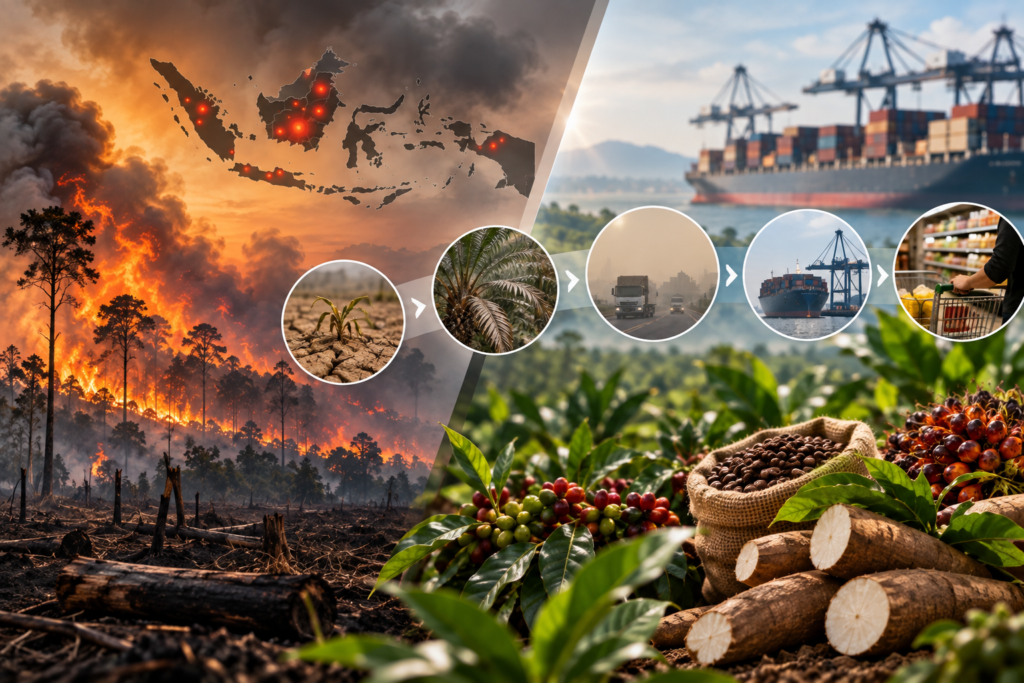
How a Forest Fire Can Affect a Commodity Shipment
Consider a hypothetical food manufacturer sourcing an Indonesian agricultural commodity.
The farm itself remains unaffected by fire. However, smoke reduces visibility around the collection area. Truck movement becomes slower, raw materials reach the processor later, processing schedules shift, and cargo misses its original logistics window.
The result can be:
Environmental Event → Operational Delay → Longer Lead Time → Shipment Delay
Now consider another supplier whose production region and logistics route are outside the affected area.
Its supply chain may continue operating normally.
This is why international buyers need origin-level and route-level information, rather than relying only on national headlines.
Which EFBA Agro Commodities Should Buyers Monitor?
EFBA Agro International currently focuses on cassava and its derivatives, coffee and cascara, candlenut, palm products, and other Indonesian agricultural commodities.
For cassava-based ingredients, buyers can review EFBA Agro’s Modified Cassava Flour (MOCAF) specifications, including product specifications, packaging, load capacity, and logistics information.
Coffee buyers can review Gayo Arabica Coffee, which EFBA Agro identifies as originating from Aceh’s Gayo Highlands. Beverage manufacturers can also explore Cascara from Gayo coffee plantations.
Food, spice, cosmetic, and industrial buyers can review EFBA Agro’s Indonesian Candlenut specifications and sourcing information.
These product pages help buyers evaluate commodities based on origin, specifications, processing, packaging, and logistics rather than assuming that one environmental event affects every Indonesian commodity equally.
Expertise: How EFBA Agro Approaches Commodity Supply
EFBA Agro International describes its business as procurement, processing, and wholesale export of Indonesian agricultural products, with a portfolio that includes cassava derivatives, coffee beans, cascara, candlenut, palm oil, and palm sugar. The company also states that it works through sourcing partnerships and agricultural supply networks for international buyers.
For commodity buyers, this sourcing perspective becomes particularly relevant during periods of environmental uncertainty.
Supply reliability should be evaluated through:
Origin Verification → Product Specification → Quality Control → Availability → Logistics → Export Coordination
The broader EFBA business ecosystem also provides experience across business consulting, management, marketing, legal services, product development, and digital solutions. PT EFBA Digital Mulia states that its technical team consists of professionals from different backgrounds, while its contact page reports team members with 9 to more than 17 years of business experience.
This relationship strengthens the broader business perspective behind EFBA Agro: agricultural sourcing is not only about finding a product. It also involves quality, risk, logistics, documentation, supplier coordination, and business continuity.
Internal Links: Explore Indonesian Agricultural Commodities
Global buyers evaluating Indonesian sourcing can explore the EFBA Agro International commodity portfolio for available agricultural products and sourcing information.
For specific requirements, see Modified Cassava Flour (MOCAF), Gayo Arabica Coffee, Cascara, and Candlenut.
For broader business expertise within the same ecosystem, visit EFBA Digital Mulia.
FAQ
How do Indonesia forest fires affect agriculture?
Indonesia forest fires can affect agriculture through direct crop damage, drought stress, smoke exposure, worker disruption, transportation delays, and interruptions to processing or logistics. The actual impact depends on the commodity and production location.
Are the current forest fires affecting all Indonesian agricultural commodities?
No. Current fires and haze are concentrated in particular regions. Commodity exposure needs to be assessed according to production origin, processing location, logistics route, and port access.
What is happening in Kalimantan now?
As of September 15, 2026, Indonesia’s Ministry of Forestry reported elevated high-confidence hotspots, particularly in Kalimantan. BMKG has also observed extensive hotspot concentrations and smoke across multiple Kalimantan provinces.
Can forest fires increase commodity prices?
They can contribute to price pressure if production, processing, transportation, or available supply is materially disrupted. However, price effects depend on the specific commodity, scale and duration of disruption, inventories, alternative sourcing, and market demand.
Are Gayo coffee and cascara produced in Kalimantan?
EFBA Agro identifies its Gayo Arabica Coffee and cascara as originating from the Gayo region of Aceh, not Kalimantan.
What should international buyers monitor?
Buyers should monitor production origin, weather, hotspot location, raw-material availability, processing capacity, transportation, port conditions, lead time, inventory, and shipment schedules.
How can buyers reduce sourcing risk?
Rather than reacting only to headlines, buyers can request updated information about commodity origin, availability, specifications, processing schedules, logistics, and estimated shipment timelines before confirming bulk procurement.
Build a More Resilient Indonesian Commodity Supply Chain
The current Kalimantan fires are a reminder that agricultural procurement requires more than comparing prices.
Global buyers need visibility into where commodities originate, how they are processed, how they reach the port, and what risks may affect delivery.
The latest fire conditions should therefore encourage stronger supply-chain monitoring—not the assumption that every Indonesian agricultural commodity is unavailable.
EFBA Agro International supports global buyers sourcing Indonesian agricultural commodities including cassava derivatives, Gayo Arabica coffee, cascara, candlenut, and other export-oriented products.
Contact EFBA Agro International to discuss current availability, specifications, bulk requirements, packaging, and export logistics.
Know the origin. Monitor the risk. Verify the supply. Build a more resilient sourcing strategy.