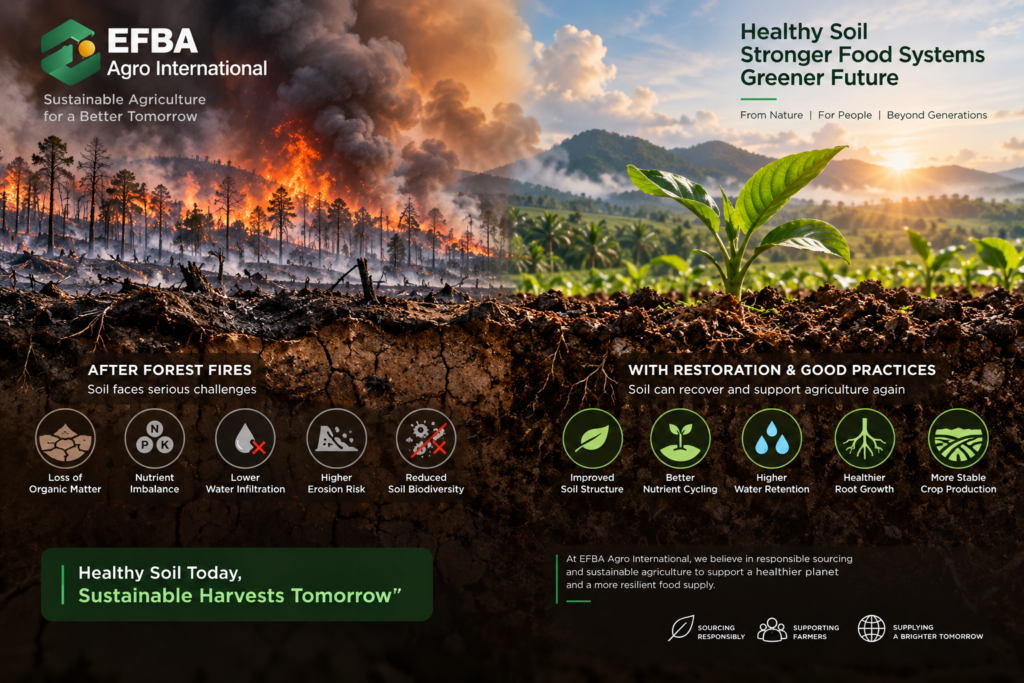
Forest and land fires have received significant attention in Indonesia, particularly following increased hotspot activity across parts of Kalimantan in September 2026. Beyond visible vegetation loss and smoke pollution, forest fire soil quality is an important environmental issue because burning can alter the physical, chemical, and biological characteristics of agricultural land. These changes may influence water availability, nutrient cycling, soil stability, and long-term crop productivity.
On September 15, 2026, Indonesia’s Ministry of Forestry reported 1,437 high-confidence hotspots nationwide, compared with 592 the previous day. Central Kalimantan accounted for 689 high-confidence hotspots, making it one of the main areas requiring intensified fire-control operations. However, hotspot detection does not automatically indicate agricultural land damage or confirmed soil degradation.
Understanding the relationship between forest fire soil quality and agricultural productivity is therefore essential for producers, land managers, and international commodity buyers. Low-severity fires may temporarily increase the availability of certain minerals through ash deposition. In contrast, severe or repeated fires can reduce organic matter, damage soil organisms, weaken soil structure, increase water repellency, and accelerate erosion.
For agricultural supply chains, these effects matter because healthy soil supports crop growth, raw-material availability, and production stability. Nevertheless, the actual consequences depend on fire severity, soil conditions, vegetation, rainfall, and the location of affected production areas.
Table of Contents
ToggleHow Do Forest Fires Affect Soil Quality?
Forest fire soil quality refers to changes in soil condition associated with exposure to fire, including changes in organic matter, nutrients, microbial activity, structure, and water infiltration. Fire may alter several soil properties simultaneously, but the severity and duration of those changes differ between affected locations. Consequently, not every burned area experiences the same level of agricultural damage.
According to the Food and Agriculture Organization (FAO), wildfire effects on soil can range from negligible to long-lasting. Fire may influence physical characteristics such as soil stability and water repellency, chemical characteristics such as pH and nutrient availability, and biological characteristics such as microbial activity. These interconnected changes help explain why soil recovery requires a broader assessment than simply observing vegetation regrowth.
The relationship between fire and agricultural productivity can be summarized through the following sequence:
Fire Severity → Soil Changes → Water and Nutrient Availability → Plant Recovery → Agricultural Productivity
For producers assessing forest fire soil quality, this framework highlights the importance of evaluating soil conditions before making decisions about land rehabilitation or future crop production. Visible ash or new vegetation alone cannot determine whether soil health has fully recovered.
Does Forest Fire Damage Soil Quality?
Yes, forest fires can damage soil quality, especially when burning is severe, prolonged, or repeated. However, scientific research indicates that the effects depend on fire intensity, soil characteristics, and environmental conditions. Therefore, a low-severity surface fire may produce different outcomes from a high-severity fire that substantially heats the upper soil layers.
Research discussed in the Journal of Forestry Research indicates that some low-intensity fires can temporarily increase soil pH and the availability of selected mineral nutrients. Ash deposits may contribute calcium, magnesium, potassium, or phosphorus to the soil surface. Nevertheless, these short-term chemical changes should not be interpreted as proof of improved long-term soil fertility.
By contrast, severe burning may reduce organic matter and nitrogen, disrupt biological activity, damage soil aggregates, and increase water repellency. Such changes can reduce infiltration and leave exposed soil more vulnerable to runoff and erosion. As a result, agricultural recovery may become more difficult after repeated or intense fires.
Low-Severity Fire → Temporary Changes in Nutrient Availability
High-Severity Fire → Organic Matter Loss → Biological Disruption → Reduced Infiltration → Higher Erosion Risk
Evaluating forest fire soil quality therefore requires an understanding of both short-term nutrient responses and longer-term degradation risks. A complete assessment should consider the physical, chemical, and biological condition of the affected land.
1. Forest Fire Soil Quality and Organic Matter Loss
Organic matter is essential for maintaining productive agricultural soil because it supports water retention, nutrient storage, microbial activity, and soil structure. During severe fires, elevated temperatures can consume part of the organic material present in vegetation residues and upper soil layers. Consequently, the soil may lose some of the properties that support healthy plant growth.
Scientific reviews indicate that high-intensity fires can substantially reduce soil organic matter, although the extent of the effect depends on fire temperature, duration, available fuel, and initial soil characteristics. Repeated burning can further complicate recovery by reducing the opportunity for organic material to accumulate again. This makes fire history an important consideration when examining agricultural soil.
For producers, organic matter loss is important because soil productivity depends on more than fertilizer application. Soil structure, biological activity, and water-holding capacity work together to influence crop development. Therefore, replacing nutrients alone may not restore all functions affected by severe burning.
A forest fire soil quality assessment should examine organic matter alongside infiltration, aggregate stability, and biological indicators. These measurements can help land managers understand which soil functions need further evaluation or rehabilitation.
2. Forest Fires Can Temporarily Increase Soil Nutrients
Not every immediate soil change following a fire is negative. Ash produced through vegetation combustion contains minerals that can temporarily alter nutrient availability and soil chemistry. However, the amount and persistence of those changes depend on the original vegetation, fire intensity, rainfall, and soil characteristics.
Research reviewed in the Journal of Forestry Research describes cases in which calcium, magnesium, potassium, phosphorus, and certain mineral forms of nitrogen increase after burning. These changes can explain why some burned soils initially appear nutrient-rich. Nevertheless, nutrient availability should not be confused with the overall condition of the soil ecosystem.
Severe fires can also cause nitrogen loss and substantial reductions in organic matter. Furthermore, rainfall may redistribute or remove nutrients through surface runoff, especially where vegetation no longer protects the soil. As a result, an initial nutrient increase does not necessarily lead to lasting agricultural benefits.
More Ash ≠ Better Long-Term Soil Quality
This distinction is important when interpreting forest fire soil quality because chemical measurements taken immediately after burning may not reflect long-term fertility. Producers should consider how nutrient availability changes over time and whether the soil can retain those nutrients during subsequent rainfall.
3. High Temperatures Can Damage Soil Biology
Healthy agricultural soil contains microorganisms and other organisms that contribute to decomposition, nutrient cycling, and ecological balance. Bacteria, fungi, and other soil organisms interact with organic matter and plant roots in ways that support soil functioning. Therefore, changes in biological communities can influence recovery after environmental disturbances.
Forest fires can alter microbial activity and community composition, particularly when elevated temperatures affect biologically active soil layers. FAO identifies biological properties as one of the main soil dimensions affected by wildfire. However, the extent and duration of biological disruption depend on fire severity and subsequent environmental conditions.
For agriculture, microbial recovery matters because biological processes help regulate how nutrients become available to plants. A soil surface may appear stable even while microbial communities remain altered. Consequently, visible vegetation recovery should not be treated as the only indicator of soil health.
A comprehensive forest fire soil quality evaluation should consider biological indicators alongside nutrient availability and physical structure. This broader approach helps explain why agricultural productivity may recover differently across burned areas.
4. Forest Fire Soil Quality and Water Repellency
One important consequence of severe burning is the possible development or strengthening of soil water repellency, also called hydrophobicity. Certain fire-related changes can make soil less receptive to water infiltration, depending on soil properties and heating conditions. As a result, rainfall may move across the surface instead of entering the soil efficiently.
Research indicates that high-intensity fires can increase water repellency and reduce infiltration under some conditions. This creates a challenge for land recovery because plants depend on sufficient soil moisture for root establishment and growth. Reduced infiltration may also increase the volume of surface runoff during heavy rainfall.
The process can be illustrated as follows:
Severe Fire → Increased Water Repellency → Reduced Infiltration → Surface Runoff → Soil Erosion
For agricultural areas, this sequence may contribute to the loss of topsoil, ash, and nutrients. Furthermore, erosion can create consequences that persist beyond the original fire event. The degree of damage depends on rainfall intensity, slope, vegetation cover, and soil condition.
Therefore, water infiltration is an important parameter when evaluating forest fire soil quality after severe burning. Producers may need to assess both soil moisture behavior and erosion susceptibility before making land-management decisions.
5. Soil Erosion Can Become a Long-Term Agricultural Risk
The environmental consequences of forest fires do not necessarily end when flames disappear. Vegetation normally helps shield soil from rainfall impact, while roots contribute to surface stability. When burning removes vegetation cover, exposed soil becomes more vulnerable to erosion.
Heavy rainfall after a fire can transport loose soil particles, ash, and nutrients away from affected areas. Moreover, reduced infiltration and weakened soil aggregates may intensify runoff under suitable conditions. Scientific literature associates severe fires with increased erosion risk, particularly where protective vegetation has been substantially reduced.
The possible sequence is:
Fire → Vegetation Loss → Exposed Soil → Heavy Rainfall → Runoff → Erosion → Nutrient Loss
For farmers and agricultural businesses, soil erosion can reduce the availability of fertile topsoil and complicate crop establishment. However, the actual level of risk varies according to topography, rainfall, burn severity, and remaining vegetation cover.
These conditions explain why forest fire soil quality should be evaluated beyond the immediate post-fire period. Monitoring over months or longer may provide a clearer understanding of erosion, nutrient retention, and vegetation recovery.
6. Peatland Fires Create Additional Soil Quality Challenges
Indonesia has extensive peatland areas that require special attention during forest and land fire management. Unlike some surface vegetation fires, peat fires can spread beneath the ground and remain active even when visible flames are limited. These conditions make detection, extinguishing, and recovery more difficult.
In September 2026, Indonesia’s Ministry of Forestry reported that affected peatland areas containing underground embers required repeated cooling and extinguishing operations. Such fires can reignite when heat remains beneath the surface. Therefore, peat moisture and continued monitoring are important components of fire management.
BMKG also reported supporting weather-modification operations in Kalimantan to increase rainfall and soil moisture. In West Kalimantan, the agency described how induced rainfall helped increase peatland moisture, cool affected areas, reduce haze, and suppress new fire emergence. These operations illustrate the importance of water conditions in managing peat-related fire risks.
The relationship can be summarized as:
Peat Moisture → Fire Risk → Underground Burning → Peat Condition → Recovery
For Indonesia, forest fire soil quality assessments should distinguish peatland from mineral soils because their composition, fire behavior, and recovery challenges are different. Agricultural risk evaluation should account for these site-specific characteristics rather than applying one general conclusion to all burned land.
Forest Fire Soil Quality in Indonesia: September 2026 Conditions
Forest and land fire monitoring in September 2026 provides context for understanding environmental risks across parts of Indonesia. However, satellite hotspot counts should not be confused with confirmed burned agricultural land or measured soil degradation. Accurate interpretation requires information about fire locations, land characteristics, and verified damage.
According to Indonesia’s Ministry of Forestry, 1,437 high-confidence hotspots were detected nationally as of the evening of September 14, 2026, up from 592 one day earlier. Central Kalimantan accounted for 689 hotspots during that reporting period. Earlier monitoring on September 4 recorded 818 high-confidence hotspots nationwide, including 252 in Central Kalimantan, 165 in South Sumatra, and 124 in West Kalimantan.
Government fire-management responses included ground operations, water bombing, aerial patrols, land rewetting, and weather modification. These measures reflect the importance of controlling fires and reducing their environmental effects. Nevertheless, hotspot statistics alone cannot establish the severity of soil damage or determine the impact on agricultural commodity production.
For analysts evaluating forest fire soil quality, verified ground observations remain necessary. A detected hotspot represents thermal activity rather than proof that a specific plantation, farming area, or commodity-producing region has suffered damage.
Furthermore, Indonesian agriculture operates across diverse geographic regions. Conditions in one province should not automatically be applied to other production areas without supporting evidence.
Short-Term vs. Long-Term Forest Fire Soil Quality Effects
Understanding forest fire soil quality requires distinguishing immediate chemical changes from longer-term physical and biological effects. Some soils may recover relatively quickly following brief, low-severity burning. Other areas may experience prolonged degradation after repeated or severe fire events.
Consider two hypothetical agricultural areas with different fire histories.
Area A: Low-Severity Fire
Area A experiences a brief fire that mainly affects surface vegetation. Ash deposits minerals, causing temporary changes in nutrient availability, while much of the underlying soil structure remains intact. Under favorable rainfall and vegetation conditions, recovery may occur relatively quickly.
However, even low-severity fires require site-specific evaluation. Producers should examine soil stability, remaining vegetation, and relevant quality indicators before assuming that agricultural conditions have returned to normal.
Area B: Repeated High-Severity Fires
Area B experiences repeated high-severity burning that reduces organic matter, disrupts soil organisms, and weakens soil structure. Increased water repellency may limit infiltration, while heavy rainfall can accelerate surface runoff and erosion. Consequently, vegetation recovery and long-term agricultural productivity may face greater challenges.
The possible sequence is:
Severe Fire → Organic Matter Loss → Poor Infiltration → Erosion → Nutrient Loss → Slower Vegetation Recovery
These examples demonstrate why forest fire soil quality cannot be reduced to a simple conclusion that fire always damages or improves soil. Fire severity, soil characteristics, rainfall, and post-fire conditions influence the actual outcome. Therefore, recovery planning should rely on local assessments rather than generalized assumptions.
How Could Forest Fire Soil Quality Affect Agricultural Commodities?
The relationship between forest fires and agricultural commodities is often indirect unless production areas themselves experience burning. Soil degradation may influence plant establishment, root development, moisture availability, nutrient cycling, and eventually crop productivity. However, the scale of those effects depends on the location and severity of environmental damage.
For international commodity buyers, agricultural risk can be evaluated through the following sequence:
Soil Health → Crop Health → Yield → Raw-Material Availability → Processing → Commodity Supply
When forest fire soil quality deteriorates in an agricultural production area, the consequences may include reduced growing conditions or additional land-management requirements. Nevertheless, such outcomes should not be assumed without evidence connecting the fire to the relevant crop and production site.
Indonesia has geographically diverse agricultural supply chains. For example, forest fire activity in Kalimantan should not automatically be interpreted as a direct threat to Gayo coffee plantations in Aceh or cassava production in other regions. Commodity exposure must be evaluated according to the actual production origin and supply-chain conditions.
Therefore, buyers should combine environmental monitoring with supplier-specific information about product availability, sourcing locations, quality requirements, and shipment arrangements. This provides a more useful procurement perspective than responding only to general reports about forest fires.
EFBA Agro International and Agricultural Supply Monitoring
EFBA Agro International publishes procurement, sourcing, and wholesale export services for selected Indonesian agricultural commodities. Its portfolio includes cassava-based products, coffee beans, cascara, candlenut, palm products, and other agricultural materials. The company also describes sourcing coordination through commercial relationships and supplier networks.
These activities are relevant when international buyers evaluate agricultural supply chains exposed to environmental uncertainty. However, published sourcing services should not be interpreted as evidence that every supplier, plantation, or commodity lot has undergone a verified environmental risk assessment. Buyers should request transaction-specific information where such verification is necessary.
Understanding forest fire soil quality may support sourcing discussions when fires affect agricultural production areas. For example, buyers can ask about the geographic origin of a commodity, relevant production conditions, quality specifications, and potential logistics constraints. This approach helps separate actual purchasing risks from general environmental concerns.
A practical agricultural sourcing framework is:
Production Origin → Environmental Conditions → Raw Material → Processing → Quality Control → Logistics → Export
EFBA Agro publishes origin and specification information for selected commodities. For example, its Gayo cascara offering includes sourcing information from Aceh and purchasing specifications involving moisture, purity, processing, packaging, and export arrangements. These details can help international buyers discuss product requirements more precisely.
In addition, the wider EFBA business network includes business management and consulting activities. EFBA Digital Mulia describes experience in supporting business operations and development across different commercial sectors. Such business-management perspectives can complement commodity procurement discussions, although environmental conditions still require independent, location-specific verification.
For global buyers, the most important consideration is understanding whether an environmental event directly affects a relevant supplier or commodity origin. Forest fire soil quality should therefore be assessed alongside production locations, product specifications, available quantities, and documented supply conditions.
Conclusion: Why Forest Fire Soil Quality Matters for Agriculture
Forest fires can influence agricultural soil through changes in organic matter, nutrient availability, biological activity, water infiltration, and erosion risk. However, the severity of those effects varies according to fire intensity, recurrence, soil type, vegetation, and rainfall conditions. Therefore, not every burned area will experience the same agricultural consequences.
Understanding forest fire soil quality helps producers, land managers, and commodity buyers evaluate potential environmental risks more carefully. In particular, soil assessments should examine physical, chemical, and biological characteristics rather than relying only on visible vegetation or ash deposits. Long-term monitoring may also be necessary when severe burning increases erosion or slows ecological recovery.
For international agricultural buyers, environmental monitoring becomes more useful when combined with verified product origins, supplier communication, and procurement requirements. Consequently, responsible sourcing decisions should consider actual supply-chain exposure rather than treating regional fire headlines as direct evidence of commodity shortages.
To explore Indonesian agricultural commodities and discuss sourcing requirements, visit EFBA Agro International. International buyers can request information about available products, technical specifications, sourcing arrangements, and commercial terms before planning purchases.
Reliable agricultural sourcing begins with verified product information, awareness of environmental risks, and transparent communication between buyers and suppliers.

Explore Indonesian Agricultural Commodities and Forest Fire Soil Quality Risks
International buyers can explore the EFBA Agro International commodity portfolio for sourcing information on Indonesian agricultural products. EFBA Agro publishes selected commodities, including cassava derivatives, Gayo Arabica coffee, cascara, candlenut, and palm products. Understanding forest fire soil quality is relevant when assessing agricultural sourcing risks, particularly where fires directly affect commodity-producing areas or their surrounding ecosystems.
For coffee-derived products, buyers can review Cascara – Dried Coffee Husk. EFBA Agro identifies this product as originating from Gayo coffee plantations in Aceh. Therefore, international buyers should evaluate the actual production location, environmental conditions, and product specifications rather than assuming that fire activity elsewhere in Indonesia directly affects the same supply chain.
The relationship between forest fire soil quality and agricultural productivity can also inform sourcing assessments for cassava derivatives, Gayo Arabica coffee, candlenut, and palm-based commodities. However, environmental exposure differs according to geographic origin, soil type, vegetation, and local production conditions. Buyers should verify whether a specific agricultural area has experienced fire-related damage before drawing conclusions about commodity quality or availability.
For broader corporate and business-development expertise within the same ecosystem, readers can visit PT EFBA Digital Mulia. Additionally, buyers seeking authoritative environmental information can follow updates from Indonesia’s Ministry of Forestry and BMKG. These official sources provide information that can support environmental monitoring, although location-specific soil assessments remain necessary to determine actual agricultural impacts.
Frequently Asked Questions About Forest Fire Soil Quality
1. How do forest fires affect soil quality?
Forest fires can change the physical, chemical, and biological properties of soil. Depending on fire severity, effects may include changes in soil pH, nutrient availability, organic matter, microbial activity, water repellency, and infiltration. Severe burning can also weaken soil structure and increase erosion risk, particularly when vegetation loss exposes the soil to heavy rainfall.
Understanding forest fire soil quality requires evaluating these changes together rather than focusing on a single indicator. The extent of soil damage depends on fire intensity, duration, soil characteristics, and post-fire environmental conditions.
2. Can ash from forest fires make soil more fertile?
Ash from burned vegetation can temporarily increase the availability of minerals such as calcium, magnesium, potassium, and phosphorus. These chemical changes may improve the availability of certain nutrients under specific conditions. However, temporary nutrient enrichment does not necessarily indicate an improvement in overall soil health.
Severe fires can simultaneously reduce organic matter, cause nitrogen losses, and disrupt soil biological activity. Furthermore, rainfall may remove nutrients through runoff and erosion. Therefore, forest fire soil quality should be assessed through long-term soil conditions rather than short-term changes caused by ash deposition.
3. How long does soil take to recover after a forest fire?
There is no universal recovery period because soil conditions vary according to fire severity, frequency, soil type, vegetation, rainfall, and post-fire land management. Some areas affected by low-severity fires may recover relatively quickly, while heavily burned soils can require considerably longer periods. Recovery may also differ between soil chemistry, biological activity, and physical structure.
A reliable forest fire soil quality assessment should examine organic matter, soil stability, infiltration, microbial activity, and erosion risk. Monitoring these indicators over time helps land managers evaluate recovery more accurately.
4. Can forest fires affect agricultural production?
Yes. Forest fires can affect agricultural production when farming areas or their supporting ecosystems experience fire-related damage. Soil degradation may influence root development, water availability, nutrient cycling, crop establishment, and long-term productivity.
However, the agricultural consequences depend on the location and severity of the fire. Changes in forest fire soil quality do not automatically indicate lower production across an entire region or country. Buyers should examine verified production conditions before estimating potential supply disruptions.
5. Why are peatland fires particularly difficult?
Peatland fires can spread beneath the soil surface and remain active even when visible flames have diminished. Underground burning can make fire detection, extinguishing, and recovery more complicated than in areas affected only by surface vegetation fires. Indonesia’s Ministry of Forestry has reported repeated cooling and extinguishing operations to prevent underground embers from reigniting.
Peatland conditions also require particular attention when evaluating forest fire soil quality because peat soils differ from mineral soils in their composition and response to burning. Moisture management and continued monitoring are important for reducing further fire risks.
6. Does the Kalimantan fire situation affect all Indonesian agricultural commodities?
No. Fire activity in Kalimantan does not automatically mean agricultural commodities from every Indonesian production region face the same environmental risks. Indonesia has geographically diverse agricultural areas, and the consequences of fire depend on actual exposure, local soil conditions, and the affected supply chain.
For example, buyers sourcing Gayo Arabica coffee from Aceh should not assume that forest fires in Kalimantan directly affect the same plantations. Instead, procurement teams should verify commodity origin, proximity to affected locations, processing facilities, transportation routes, and relevant field conditions.
7. What should agricultural buyers monitor after major forest fires?
International buyers should monitor production origin, verified fire exposure, soil and weather conditions, crop health, raw-material availability, processing capacity, quality specifications, logistics, and shipment schedules. These factors can help companies understand whether an environmental event creates actual procurement risks.
Monitoring forest fire soil quality becomes particularly relevant when agricultural production areas have experienced severe or repeated burning. However, buyers should also communicate directly with suppliers to confirm current product availability and documented quality requirements.
Conclusion: Why Forest Fire Soil Quality Matters for Agricultural Supply Chains
Forest fires are not only about visible flames, smoke, and vegetation loss. Their environmental effects may continue beneath the surface through changes in soil organic matter, nutrient availability, biological activity, water infiltration, and erosion risk. These changes can influence agricultural productivity when they affect relevant crop-producing areas.
Understanding forest fire soil quality helps producers, land managers, and international commodity buyers evaluate potential environmental risks more accurately. However, a satellite hotspot or regional fire report does not automatically prove soil degradation or agricultural supply disruption. Buyers should distinguish reported fire activity from verified environmental impacts on specific production locations.
For international procurement, a practical environmental risk assessment can follow this framework:
Commodity Origin → Environmental Exposure → Forest Fire Soil Quality → Crop Condition → Product Quality → Availability → Logistics
This framework helps buyers connect environmental information with actual sourcing requirements. Furthermore, combining supplier communication, product specifications, and location-specific monitoring can support more informed purchasing decisions.
Source Indonesian Agricultural Commodities with EFBA Agro International
EFBA Agro International provides a contact point for international businesses interested in Indonesian agricultural commodities, including cassava derivatives, Gayo Arabica coffee, cascara, candlenut, and palm products. Buyers can discuss product specifications, purchasing quantities, available products, packaging requirements, and export arrangements according to their commercial needs.
For businesses evaluating environmental risks, understanding forest fire soil quality can complement supplier assessments when fire activity is relevant to the actual production origin. Nevertheless, current availability, technical specifications, sourcing conditions, and commercial terms should be confirmed directly before placing an order.
Visit EFBA Agro International to explore its agricultural commodity portfolio and submit your sourcing requirements.
Understand the origin. Verify environmental conditions. Protect product quality. Build a more resilient agricultural supply chain.