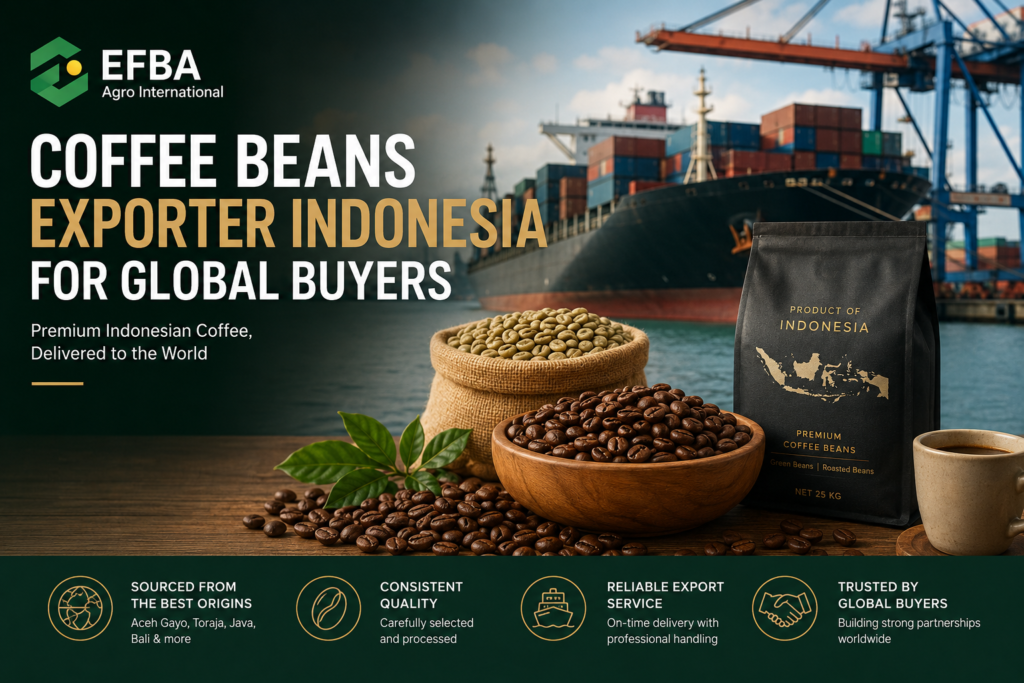
International buyers searching for coffee beans exporter Indonesia
are generally looking for a reliable Indonesian supplier that can provide quality
coffee beans, consistent supply, competitive sourcing, and international export support.
These buyers may include:
- Coffee importers
- Coffee roasters
- Coffee distributors
- Cafés and coffee chains
- Food and beverage manufacturers
- Private-label coffee brands
- Specialty coffee businesses
- International trading companies
However, choosing a coffee exporter should not be based on price alone.
Buyers also need to evaluate coffee origin, processing method, quality,
traceability, packaging, available volume, documentation, and shipping capabilities.
Why Choose an Indonesian Coffee Beans Exporter?
Indonesia is a major coffee-producing country with diverse growing regions
and distinctive coffee origins. A reliable
coffee beans exporter Indonesia
can help international buyers source Indonesian coffee based on their required:
- Origin
- Coffee variety
- Grade
- Processing method
- Quality
- Quantity
- Packaging
- Destination market
Indonesian coffee is available from several well-known origins, including
Gayo, Mandheling, Java, Toraja, Flores, and Kintamani.
For buyers interested in premium and specialty coffee, Indonesian Arabica
can provide opportunities to develop origin-specific coffee products
for international markets.
EFBA Agro International
provides sourcing and wholesale export solutions for Indonesian agricultural
commodities, including coffee beans and cascara.
Indonesian Coffee Beans for International Buyers
Indonesia’s geographical diversity creates different coffee-growing
environments across the country. Coffee is cultivated across various
islands and highland areas. Therefore, coffee from one region can have
different characteristics from coffee produced in another region.
Some Indonesian coffee origins include:
Gayo Coffee
Gayo coffee originates from the highlands of Aceh and is one of
Indonesia’s well-known Arabica coffee origins.
For buyers interested in specialty coffee, Gayo can be considered
based on its origin, processing method, grade, and sensory profile.
More information about Gayo coffee and its processing characteristics
can also be explored through
Gayo Coffee from Indonesia
on Coffeenesia.
Mandheling Coffee
Mandheling coffee is associated with North Sumatra and is widely
recognized as an Indonesian coffee origin. It can be an option for
buyers looking for Indonesian coffee with a distinctive regional identity.
Java Coffee
Java has a long history of coffee cultivation. Java coffee can provide
another option for international buyers interested in developing
an Indonesian-origin coffee portfolio.
Toraja Coffee
Toraja coffee originates from South Sulawesi. Its regional characteristics
make it relevant for buyers interested in origin-specific Indonesian coffee.
Flores Coffee
Flores is another Indonesian coffee-producing region that offers
opportunities for international coffee sourcing.

Image source:
Pexels
.
Kintamani Coffee
Kintamani coffee originates from Bali and is another Indonesian coffee
option for global buyers looking for diverse origins.
What Should Buyers Check?
Before choosing a coffee beans exporter Indonesia,
buyers should evaluate specific product and supplier information.
| Factor | What Buyers Should Check |
|---|---|
| Origin | Region, province, and growing area |
| Variety | Arabica, Robusta, or specific varieties |
| Grade | Commercial or specialty grade |
| Processing | Washed, natural, honey, semi-washed, etc. |
| Moisture | Moisture specification |
| Defects | Defect level and quality classification |
| Bean Size | Screen size or grading |
| Harvest | Crop and harvest information |
| Quantity | Available and recurring supply |
| Packaging | Export packaging options |
| Traceability | Farm, cooperative, or sourcing information |
| Shipping | Port, destination, and delivery terms |
For example, a specialty coffee buyer may request:
Gayo Arabica → Specialty Grade → Natural Process → Specific Moisture
→ Export Packaging → Sample Approval → Bulk Order
.
Meanwhile, a commercial coffee roaster may have completely different
requirements. This is why a professional
Indonesian coffee supplier
should be able to discuss specifications before providing a final quotation.
Understanding Indonesian Coffee Processing Methods
Processing is one of the important factors that can influence
coffee characteristics.
Washed Process
In washed processing, the coffee fruit is removed before the beans
are dried. This process can produce a cleaner and more defined cup profile.
Natural Process
In natural processing, coffee cherries are dried with the fruit
surrounding the beans. This can contribute to fruity and sweet characteristics.
Honey Process
Honey processing removes some of the coffee fruit before drying.
The resulting profile can vary depending on the amount of mucilage
remaining and the drying process.
Semi-Washed Process
Semi-washed processing is particularly associated with Indonesian coffee.
This method can contribute to distinctive body and flavor characteristics.
Coffeenesia
provides examples of Gayo coffee using different processing methods,
including Natural and Semi-Wash. This can be useful for buyers who
want to understand how Indonesian coffee processing affects the final product.
You can explore the related
Indonesian coffee beans and Gayo coffee information
for additional product references.
Expertise: What Makes a Reliable Coffee Beans Exporter?
Selecting an exporter is not simply about finding a company that
can ship coffee overseas. A reliable
coffee beans exporter Indonesia
should understand the complete sourcing process.
1. Product Sourcing
The exporter should have access to reliable local sourcing networks.
This is important because coffee availability and quality can vary
depending on origin and harvest.
2. Quality Control
Coffee should be evaluated according to agreed specifications.
Quality control can involve:
- Visual inspection
- Moisture measurement
- Defect evaluation
- Bean grading
- Sampling
- Cupping
- Packaging inspection
3. Traceability
International buyers increasingly require information about where
products come from. Traceability can include information about:
Origin → Farmer / Cooperative → Processing → Quality Control → Export
This provides buyers with greater visibility throughout the supply chain.
4. Export Preparation
An experienced Indonesia coffee exporter should
understand the requirements involved in preparing agricultural
commodities for international shipment.
This includes product preparation, packaging, documentation,
logistics coordination, and communication with international buyers.
5. Consistent Communication
International sourcing requires clear communication.
Buyers need accurate information about:
- Price
- Quantity
- Specifications
- Availability
- Lead time
- Packaging
- Shipping
- Documentation
Therefore, supplier communication can be just as important as product quality.
Case Study: From Indonesian Coffee Sourcing to Global Product Development
Imagine an international coffee company wants to develop a new
Indonesian-origin coffee product. The company initially needs:
Indonesian Arabica Coffee.
However, simply purchasing coffee beans is not enough.
The buyer needs to determine:
- Which origin is suitable?
- Which processing method should be selected?
- What grade is required?
- What quantity is available?
- How should the coffee be packaged?
- What export documentation is required?
- How will the product be positioned in the target market?
A structured sourcing process can therefore look like this:
Buyer Requirement → Origin Selection → Sample → Quality Evaluation
→ Price & Quantity → Order Confirmation → Quality Control
→ Export Preparation → International Shipment
This approach allows the buyer to evaluate the coffee before moving
into larger-scale procurement.
For specialty coffee businesses, the process can go further.
The buyer may select a specific origin and processing method, then
develop the product into a branded coffee offering.
Product / Service Recommendation: EFBA Agro International
For international businesses looking for a
coffee beans exporter Indonesia,
EFBA Agro International
can be considered as a sourcing partner for Indonesian agricultural commodities.
EFBA Agro’s agricultural commodity portfolio includes
coffee beans and cascara, alongside other Indonesian
commodities such as cassava and its derivatives, candlenut,
palm oil, and palm sugar.
The sourcing process can be adjusted according to buyer requirements,
including:
- Product type
- Origin
- Quality
- Quantity
- Processing
- Packaging
- Export destination
For businesses that are looking for more than raw coffee beans,
EFBA’s broader ecosystem can also support coffee product development.
For example, businesses interested in creating their own coffee
products can explore
Maklon Kopi
,
including private-label and custom coffee product options.
This creates an opportunity to move from:
Coffee Beans → Product Development → Branding → Packaging
→ Marketing → Sales
Businesses looking for powdered beverage production can also explore
jasa maklon bubuk minuman
,
which can support coffee powder and other powdered beverage products.
Explore Related EFBA Services
For businesses interested in developing a complete coffee business
ecosystem, several related services can be connected to this article.
Coffee Sourcing
Explore
coffee beans and agricultural commodities from EFBA Agro
for international sourcing requirements.
Coffee Product Development
Businesses that want to develop their own coffee brand can explore
Maklon Kopi
.
Powdered Beverage Manufacturing
For businesses interested in coffee powder and other powdered beverages,
explore
jasa maklon bubuk minuman
.
Indonesian Coffee Information
For more detailed information about Indonesian coffee origins and
Gayo coffee, readers can explore
Coffeenesia
.
This internal linking structure creates a relationship between:
EFBA Agro → Coffee Sourcing → Coffeenesia → Coffee Knowledge
→ EFBA Maklon → Coffee Product Development
FAQ
What is a coffee beans exporter Indonesia?
A coffee beans exporter Indonesia is a supplier
or company that sources Indonesian coffee beans and facilitates
international sales and shipments to buyers in other countries.
What Indonesian coffee origins can international buyers source?
International buyers can explore origins such as Gayo, Mandheling,
Java, Toraja, Flores, and Kintamani, depending on availability
and product specifications.
Is Indonesian coffee available as green coffee beans?
Yes. Indonesian green coffee beans are commonly sourced by international
coffee roasters and importers that prefer to control their own roasting process.
What should I check before choosing a coffee beans exporter?
Buyers should evaluate origin, variety, grade, processing method,
moisture, defects, quantity, traceability, packaging, export documentation,
and supplier communication.
Can I request coffee samples before placing a bulk order?
Sample evaluation is generally recommended, particularly for specialty
coffee buyers with specific quality and sensory requirements.
Can EFBA Agro help international buyers source Indonesian coffee?
Yes.
EFBA Agro
provides agricultural commodity sourcing and wholesale export solutions
from Indonesia, including coffee beans and cascara.
Can I develop my own coffee brand after sourcing the beans?
Yes. Businesses can explore product development and
maklon kopi
options to transform coffee into branded products for their target market.
Looking for a Coffee Beans Exporter Indonesia?
Finding the right coffee beans exporter Indonesia
is an important step for international businesses that want to build
a reliable Indonesian coffee supply chain.
Whether you are looking for green coffee beans, Indonesian Arabica,
specialty coffee, Gayo coffee, or other Indonesian coffee products,
the right sourcing partner can help you evaluate product specifications,
quality, volume, packaging, and export requirements.
EFBA Agro International is ready to discuss your Indonesian
coffee sourcing requirements.
Looking for an Indonesian coffee supplier?
Contact EFBA Agro International
to discuss your required coffee origin, specifications, quantity,
and export destination.