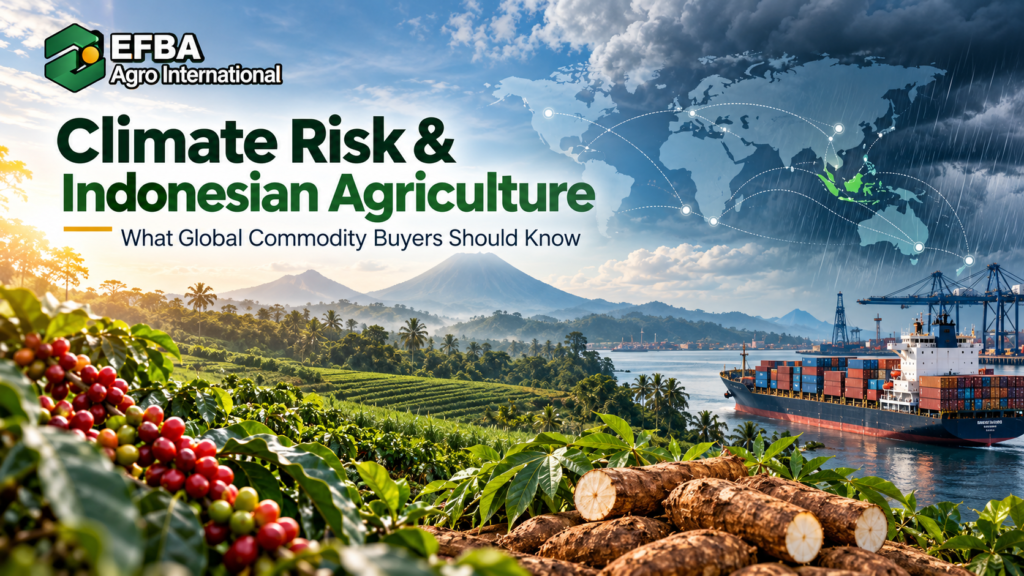
Climate Risk and Indonesian Agriculture: What Global Commodity Buyers Should Know
Indonesia supplies coffee, cassava derivatives, spices, palm-based products, and other agricultural commodities to international markets. However, changing rainfall patterns, prolonged dry seasons, and extreme weather can affect harvest schedules, product quality, and logistics. Understanding climate risk agriculture Indonesia is therefore essential for international buyers who want to secure reliable agricultural supplies.
Climate risk in Indonesian agriculture can affect global buyers through changing crop availability, inconsistent product quality, longer procurement lead times, and potential shipment disruptions. Importers can reduce these risks by monitoring regional weather, diversifying sourcing origins, verifying product specifications, and coordinating realistic delivery schedules with suppliers.
For international food manufacturers and wholesale distributors, climate risk does not mean Indonesia is no longer a viable sourcing destination. Instead, buyers need stronger supplier evaluation, flexible procurement strategies, and reliable information about regional production conditions. Understanding climate risk agriculture Indonesia helps procurement teams make more informed decisions and prepare for seasonal supply uncertainty.
What Is Climate Risk in Indonesian Agriculture?
Climate risk refers to the potential effects of changing weather patterns, climate variability, and longer-term climate change on agricultural production and supply chains. In Indonesia, the main concerns include drought, excessive rainfall, flooding, changing growing seasons, and disruptions to harvesting or transportation. These conditions can affect farmers, processors, commodity suppliers, and international buyers differently.
Indonesia’s agricultural production regions experience different climate conditions. For example, coffee-producing highlands may face different rainfall and harvesting challenges from cassava-producing lowlands or candlenut sourcing areas. Consequently, procurement teams should evaluate climate risk agriculture Indonesia by commodity and production origin rather than treating the country as a single agricultural climate zone.
Furthermore, buyers should distinguish short-term weather events from long-term climate trends. El Niño and the Indian Ocean Dipole influence seasonal climate variability, while climate change can alter underlying risk patterns over time. Both factors require attention, but they should not be interpreted as identical phenomena.
Why Climate Risk Agriculture Indonesia Matters to Global Commodity Buyers
International buyers usually evaluate product specifications, pricing, and logistics before purchasing agricultural materials. However, climate conditions can influence all three factors by affecting harvest timing, processing conditions, and raw material availability. Therefore, understanding climate risk agriculture Indonesia helps buyers incorporate weather-related uncertainty into purchasing decisions.
1. Drought Can Affect Crop Availability
Prolonged dry periods may reduce soil moisture and increase water stress in agricultural production areas. Depending on the crop, growth stage, and local conditions, water shortages can affect crop development and harvest quantities. However, buyers should avoid assuming that every drought causes the same production loss across Indonesia.
For bulk procurement, the main concern is whether suppliers can secure the required quantity within the agreed delivery period. Importers should therefore discuss production origins, seasonal availability, and alternative sourcing arrangements before confirming recurring orders.
2. Heavy Rainfall Can Disrupt Harvesting and Processing
Excessive rainfall can delay harvesting, drying, and transportation activities. For commodities such as coffee, unsuitable drying conditions may create quality-management challenges when producers cannot maintain appropriate moisture controls. Similarly, wet weather can complicate handling and storage for agricultural ingredients.
Buyers should request clear quality specifications and understand each supplier’s handling procedures. Moreover, sample evaluation and appropriate inspection arrangements help procurement teams assess whether available lots meet their requirements.
3. Extreme Weather Can Increase Logistics Uncertainty
Flooding, damaged roads, and severe weather can interrupt commodity collection from production regions. Such disruptions may affect the movement of agricultural materials to processing facilities, warehouses, or export ports. As a result, purchasing teams may need additional scheduling flexibility.
Companies evaluating climate risk agriculture Indonesia should review collection routes, processing locations, and estimated shipping lead times. Furthermore, purchase agreements should clarify communication procedures when weather-related disruptions affect delivery schedules.
4. Climate Conditions Can Influence Product Quality
Weather variability can influence crop maturity, harvesting practices, and post-harvest handling. However, the commercial consequences depend on the commodity and the processing methods applied. Therefore, quality verification remains essential even when overall agricultural production appears sufficient.
For example, coffee importers may examine moisture, defects, and cup characteristics. Meanwhile, food manufacturers purchasing cassava-based starch should evaluate moisture, purity, viscosity, and other functional specifications relevant to their production requirements.
5. Seasonal Changes Can Affect Purchasing Schedules
Agricultural commodities do not always follow fixed production schedules. When rainfall patterns change, harvesting and processing windows may shift depending on location and crop conditions. Consequently, buyers relying on rigid procurement calendars may encounter unexpected supply gaps.
To manage this risk, procurement teams should communicate anticipated purchasing volumes earlier and request updated information from suppliers. Additionally, staggered procurement arrangements can support more flexible inventory planning and reduce exposure to seasonal disruptions.
Climate Risk Agriculture Indonesia: Impact on Key Agricultural Commodities
Different agricultural commodities respond to climate conditions in different ways. Therefore, global buyers should assess the relationship between agricultural production, processing requirements, and product quality before signing supply agreements. The following comparison highlights relevant considerations for commodities within EFBA Agro International’s published portfolio.
| Commodity | Climate-Related Exposure | What Buyers Should Verify |
|---|---|---|
| Gayo Arabica coffee | Rainfall variability, flowering and harvesting conditions, drying constraints | Origin, harvest period, moisture, defects, samples |
| Cassava and tapioca flour | Water stress, root availability, harvesting and processing schedules | Raw material availability, starch specifications, production lead time |
| Modified Cassava Flour (MOCAF) | Cassava supply variability and processing conditions | Moisture, particle size, functionality, packaging |
| Candlenut | Harvest variability and post-harvest drying | Moisture, cleanliness, available grade, supply volume |
| Cascara | Weather-sensitive coffee harvesting and drying | Product safety, moisture, handling, destination-market eligibility |
| Palm-based products | Production-region weather and logistics variability | Grade, technical specifications, sourcing conditions, shipment terms |
| Arenga palm sugar | Raw material collection and processing conditions | Moisture, product form, consistency, packaging |
These considerations represent potential procurement risks rather than verified crop losses or forecasts for EFBA Agro’s individual suppliers. Buyers should request information about actual production origins, available inventory, and quality documentation before ordering.
Understanding climate risk agriculture Indonesia by commodity helps importers identify which purchasing requirements deserve additional attention. For example, coffee buyers may prioritize post-harvest drying conditions, while cassava-based ingredient buyers may focus on raw material availability and processing capacity. This commodity-specific approach supports more realistic sourcing decisions.
Official Data: Climate Risk Agriculture Indonesia Outlook in 2026
Global commodity buyers should use official meteorological information to support agricultural sourcing decisions. Indonesia’s Meteorology, Climatology, and Geophysics Agency (BMKG) publishes seasonal forecasts, rainfall outlooks, and climate monitoring updates that help purchasing teams identify regions requiring additional attention. These sources provide useful context for evaluating climate risk agriculture Indonesia, although forecasts do not directly establish actual commodity losses.
Indonesia’s 2026 Dry Season Outlook
In its March 2026 seasonal forecast, BMKG projected below-normal rainfall during the dry season across approximately 64.5% of Indonesia’s seasonal zones. The agency also forecast that 57.2% of seasonal zones would experience a longer-than-normal dry season. These projections indicated the potential for prolonged dry conditions across substantial parts of the country.
However, seasonal forecasts describe anticipated conditions rather than guaranteed agricultural outcomes. Buyers should compare forecasts with updated field information, production conditions, and actual commodity availability before making procurement commitments.
Source: BMKG — Indonesia Dry Season Forecast 2026.
El Niño and Rainfall Conditions in October 2026
In its 8 October 2026 update, BMKG reported that very strong El Niño conditions and a positive Indian Ocean Dipole were influencing Indonesia’s atmosphere. For 11–20 October, the agency forecast low rainfall across 66.09% of Indonesia, with medium rainfall across 32.67% and high rainfall across 1.24%. Nevertheless, localized moderate to heavy rainfall remained possible in certain areas.
These figures highlight the importance of regional monitoring when assessing climate risk agriculture Indonesia. Buyers sourcing from different islands or agricultural production regions should evaluate the weather conditions relevant to their specific commodity origins instead of relying on a single national assumption.
Source: BMKG — Weather Outlook, 9–15 October 2026.
Regional Climate Risks in Asia
The World Meteorological Organization’s State of the Climate in Asia 2025, published in June 2026, highlights severe drought, flooding, extreme heat, and other weather hazards affecting the region. The report reinforces the importance of monitoring climate extremes and developing early-warning and adaptation measures.
However, regional climate findings should not be treated as direct evidence of production losses for individual Indonesian commodities. Importers should combine broader climate information with national forecasts and supplier-specific quality and availability data.
Source: WMO — State of the Climate in Asia 2025.
5 Practical Strategies to Manage Climate Risk Agriculture Indonesia
Climate risk management becomes more useful when procurement teams translate weather information into practical purchasing decisions. Importers should focus on supplier qualification, quality verification, purchasing schedules, and contingency planning. The following five strategies can help global buyers manage climate-related sourcing uncertainty.
1. Monitor Climate Conditions by Production Region
Identify where agricultural materials originate and monitor weather conditions for those locations. For example, a buyer sourcing Gayo Arabica should prioritize relevant climate conditions in Aceh rather than relying solely on a national rainfall summary. Likewise, cassava-based ingredient buyers should monitor the regions supplying their processing partners.
2. Diversify Sources Where Commercially Feasible
Avoid relying on a single production location when product requirements allow alternative origins. Multiple sourcing arrangements may reduce exposure to localized weather disruptions. However, buyers must verify that alternative suppliers meet equivalent quality, documentation, and delivery requirements.
3. Confirm Quality Specifications Before Bulk Purchasing
Climate variability can increase the importance of consistent incoming quality checks. Buyers should therefore request technical specifications, representative samples, and lot-specific test results when appropriate. In addition, purchasing agreements should define acceptance criteria and inspection responsibilities.
4. Build Flexible Inventory and Shipment Plans
Consider realistic harvest schedules, processing lead times, shipping windows, and inventory requirements. Buyers may need to adjust purchasing frequency or delivery arrangements when production conditions change. Nevertheless, inventory decisions should also account for storage costs, shelf life, and available working capital.
5. Maintain Clear Communication with Suppliers
Discuss potential disruptions before they affect confirmed purchase orders. Suppliers should communicate material availability, quality concerns, or schedule changes as early as possible. Meanwhile, buyers should provide accurate demand forecasts and confirm their critical purchasing requirements.
Managing climate risk agriculture Indonesia requires cooperation between buyers, suppliers, producers, and logistics partners. Although procurement planning cannot eliminate all weather-related disruptions, stronger communication and clearer specifications can help companies respond more effectively to changing supply conditions.
How EFBA Agro Supports Climate-Resilient Agricultural Commodity Sourcing
EFBA Agro International presents itself as an Indonesian agricultural commodity sourcing and export partner serving international wholesalers, food manufacturers, distributors, and industrial buyers. Its official website describes procurement coordination, product specification matching, sample evaluation, quality requirements, and export preparation within its sourcing process.
The company’s published portfolio includes Gayo Arabica coffee, tapioca flour, Modified Cassava Flour (MOCAF), candlenut, cascara, palm products, and arenga palm sugar. These commodities have different harvesting, processing, and storage considerations. Therefore, buyers should discuss product-specific requirements rather than assume every commodity follows the same supply schedule.
For global buyers evaluating climate risk agriculture Indonesia, EFBA Agro’s sourcing approach provides a starting point for discussing availability, product requirements, and purchasing arrangements. However, the company must confirm current sourcing conditions, product availability, and delivery commitments for each proposed transaction.
Working with Indonesian Farmers and Producers
EFBA Agro describes sourcing relationships involving Indonesian farmers, agricultural producers, and processing partners. This sourcing approach connects local agricultural production with purchasing requirements from international buyers. Furthermore, coordination across these participants can support discussions about product availability, processing, packaging, and commercial arrangements.
Climate variability makes communication with production partners especially important. However, individual farmer contracts, guaranteed supply volumes, audited climate adaptation programs, and traceability coverage require separate documentation and verification. EFBA Agro’s published sourcing model should therefore serve as a starting point for buyer due diligence rather than a guarantee of uninterrupted supply.
Product Quality and Export Preparation
EFBA Agro publishes a structured international purchasing process:
Buyer Requirements → Product Matching → Sample Evaluation → Commercial Agreement → Procurement & Quality Control → Export Documentation → Shipment
Through this process, buyers can communicate specifications, quantity requirements, packaging preferences, and destination-market conditions. Furthermore, sample evaluation provides an opportunity to verify suitability before committing to larger commercial quantities.
For example, EFBA Agro’s published food-grade tapioca flour specifications include minimum starch content of 85%, maximum moisture of 13%, and additional quality parameters. Nevertheless, buyers should confirm current availability and request lot-specific Certificates of Analysis where applicable.
International buyers can learn more through Tapioca Flour Supplier Indonesia and Cassava Supply Chain Indonesia.
Agricultural Sourcing Within the EFBA Business Ecosystem
EFBA Agro operates within the wider EFBA business ecosystem. PT EFBA Digital Mulia publishes consulting, business planning, and business development services that provide context about the group’s commercial activities. However, these services should not be interpreted as guaranteed agricultural supply capacity or climate-risk insurance.
For international commodity buyers, EFBA Agro’s relevant strengths are its published product portfolio, sourcing coordination approach, and commodity-focused export services. Each purchasing relationship still requires confirmation of available inventory, quality specifications, delivery schedules, and commercial terms.
Understanding climate risk agriculture Indonesia can help buyers prepare more realistic purchasing plans. EFBA Agro International provides a contact point for discussing Indonesian agricultural commodities, product specifications, sampling, and export requirements based on the sourcing services it publishes.
Explore EFBA Agro International to discuss agricultural sourcing requirements, request product information, and confirm current supply availability.

What Global Buyers Should Ask Before Placing an Order
What Should Global Buyers Prepare Before Requesting a Quotation?
International buyers can improve sourcing discussions by submitting a Request for Quotation (RFQ) that includes technical specifications, purchasing volumes, and delivery requirements. When evaluating climate risk agriculture Indonesia, buyers should also consider seasonal availability, potential weather disruptions, and sourcing flexibility. Providing this information helps suppliers assess product availability and propose realistic procurement arrangements.
| RFQ Requirement | Information to Provide |
|---|---|
| Commodity | Coffee, tapioca flour, MOCAF, candlenut, or other agricultural products |
| Grade and specifications | Quality limits, intended application, and inspection criteria |
| Quantity | Initial order volume and recurring monthly or quarterly demand |
| Origin requirements | Preferred Indonesian production region or acceptable alternatives |
| Packaging | Bag size, liner, labeling, and storage requirements |
| Delivery | Destination port, expected lead time, and shipment period |
| Commercial terms | Preferred Incoterm, quotation currency, and payment requirements |
| Documentation | Relevant certificates, Certificate of Analysis (CoA), and destination-market requirements |
| Climate contingency | Acceptable delivery flexibility, seasonal limitations, and alternative sourcing options |
Buyers should also ask whether current weather conditions affect harvesting, raw material collection, processing, or transportation. Furthermore, procurement teams can use official BMKG forecasts to identify climate-related concerns in the relevant production regions. However, suppliers can only confirm actual product availability and delivery commitments based on current commercial and operational circumstances.
By including climate considerations in the RFQ process, companies can better manage climate risk agriculture Indonesia while maintaining clear expectations regarding product quality, purchasing quantities, and shipment schedules.
FAQ About Climate Risk Agriculture Indonesia
1. How does climate risk affect agriculture in Indonesia?
Climate risk can affect Indonesian agriculture through drought, excessive rainfall, flooding, and changing seasonal patterns. These conditions may influence crop growth, harvesting schedules, processing, transportation, and agricultural commodity availability. However, actual impacts depend on the commodity, production region, and local farming conditions.
Understanding climate risk agriculture Indonesia helps international buyers identify possible sourcing challenges before confirming bulk orders. Therefore, buyers should combine official climate information with supplier-specific availability and quality assessments.
2. Does El Niño affect Indonesian agricultural commodity exports?
Yes, El Niño can contribute to drier conditions in parts of Indonesia, potentially affecting agricultural production and raw material availability. However, its effects vary across regions, crops, and agricultural production systems. Consequently, buyers should avoid assuming that all Indonesian commodity exports will experience the same disruption.
International procurement teams should monitor BMKG climate forecasts, evaluate commodity-specific risks, and confirm current sourcing conditions with suppliers. These steps can help businesses prepare for weather-related uncertainties without making purchasing decisions based solely on seasonal forecasts.
3. Which Indonesian commodities are exposed to climate risks?
Coffee, cassava, candlenut, palm-based products, and other agricultural commodities can experience different climate-related challenges. Risks may arise during cultivation, harvesting, drying, storage, processing, or transportation. For this reason, international buyers should evaluate potential disruptions based on production origins and commodity characteristics.
For example, excessive rainfall may complicate coffee drying, while prolonged drought can affect agricultural water availability. Understanding climate risk agriculture Indonesia across different commodities helps buyers identify which quality requirements and delivery arrangements require additional attention.
4. Can international buyers reduce climate-related supply disruptions?
International buyers can reduce their exposure by monitoring production regions, diversifying sourcing options, verifying product quality, and discussing contingency arrangements with suppliers. Flexible purchasing schedules and realistic inventory planning may also help companies respond to seasonal uncertainty. However, no sourcing strategy can eliminate every weather-related risk.
A practical approach to managing climate risk agriculture Indonesia combines regional climate monitoring with reliable procurement communication. Additionally, buyers should establish clear product specifications, delivery expectations, and procedures for reporting potential shipment disruptions.
5. Is Indonesian coffee supply affected by changing rainfall patterns?
Changing rainfall patterns may influence coffee flowering, cherry development, harvesting, and post-harvest processing. Excessive rainfall can also complicate drying activities when processing facilities cannot maintain suitable moisture conditions. Nevertheless, the effects on individual coffee shipments depend on origin, seasonal conditions, and processing practices.
International coffee buyers should verify moisture content, physical defects, processing methods, and representative samples before confirming bulk purchases. Furthermore, understanding seasonal conditions in producing regions such as Aceh can help buyers develop more realistic procurement schedules.
6. How can buyers evaluate climate risks when sourcing tapioca flour?
Buyers should consider cassava availability, processing capacity, production lead times, and required product specifications. Climate conditions may influence cassava cultivation and raw material collection, while processing and storage practices determine additional quality considerations. Therefore, procurement teams should assess both agricultural supply and manufacturing capabilities.
For tapioca flour, important specifications may include moisture, starch content, viscosity, and other functional parameters. Buyers evaluating climate risk agriculture Indonesia should also request relevant quality documentation, confirm available quantities, and establish realistic shipment schedules.
Learn more about Tapioca Flour Supplier Indonesia and Cassava Supply Chain Indonesia.
7. Does EFBA Agro source agricultural products from Indonesian farmers?
EFBA Agro International describes sourcing relationships involving Indonesian farmers, agricultural producers, and processing partners. Its published services cover product matching, procurement coordination, quality evaluation, and export preparation. This approach connects Indonesian agricultural production with commercial requirements from international buyers.
For companies concerned about climate risk agriculture Indonesia, communication with local sourcing partners can support discussions about seasonal availability, product quality, and procurement timing. However, buyers should verify origin information, current availability, and supporting documents for each proposed transaction.
8. How can global buyers contact EFBA Agro for agricultural sourcing?
International buyers can contact EFBA Agro International through its official website at efbaagro.id. Buyers should provide their commodity requirements, quality specifications, purchasing volumes, packaging preferences, destination port, and expected shipment schedule. This information helps the team understand the proposed transaction and discuss relevant sourcing options.
For agricultural commodities exposed to seasonal weather changes, buyers should also communicate any flexibility regarding sourcing origins and delivery dates. EFBA Agro can then discuss the inquiry based on its published sourcing services, while actual availability and final commercial terms require direct confirmation.
Source Indonesian Agricultural Commodities with EFBA Agro International
Climate risk agriculture Indonesia is an important consideration for global commodity procurement, but it does not eliminate the country’s agricultural sourcing opportunities. Indonesia continues to offer coffee, cassava derivatives, candlenut, palm-based products, and other agricultural commodities for international markets. However, changing seasonal conditions make supplier evaluation, product quality verification, and realistic purchasing schedules increasingly important.
International buyers can reduce sourcing uncertainty by combining official climate monitoring with clear technical specifications and flexible procurement arrangements. Additionally, communication with agricultural suppliers helps purchasing teams understand potential limitations in harvesting, processing, and transportation. These practices support better-informed decisions when evaluating climate risk agriculture Indonesia.
Looking for a reliable Indonesian agricultural commodity supplier for your next wholesale or industrial purchase? EFBA Agro International provides a sourcing contact for Gayo Arabica coffee, tapioca flour, MOCAF, candlenut, cascara, palm-based products, and other selected agricultural commodities. Its published services include buyer requirements assessment, product matching, sample evaluation, quality coordination, and export preparation according to the agreed transaction.
Visit EFBA Agro International to discuss your commodity specifications, request information about product availability, and submit your sourcing inquiry.
Reliable agricultural sourcing starts with verified product quality, stronger supplier communication, and a clear understanding of Indonesia’s changing climate conditions.

Visit EFBA Agro International to submit your Request for Quotation (RFQ), confirm current agricultural commodity availability, and discuss sourcing requirements with our team. By understanding climate risk agriculture Indonesia, international buyers can make more informed procurement decisions, evaluate potential supply disruptions, and plan reliable commodity sourcing strategies.
Better climate awareness, clear product specifications, and stronger supplier communication help global buyers manage climate risk agriculture Indonesia while building more resilient and sustainable agricultural supply chains.