
Food and beverage manufacturers need reliable ingredients to maintain product quality, production efficiency, and consistent processing results. Tapioca flour is widely used in food manufacturing because of its thickening, binding, and texture-forming properties. However, purchasing this ingredient in large quantities requires careful evaluation of starch specifications, supplier reliability, packaging, and delivery arrangements.
A tapioca flour bulk supplier provides food-grade cassava starch in wholesale quantities for food manufacturers, beverage producers, distributors, and industrial buyers. Companies should compare product specifications, request quality documentation, evaluate samples, and confirm available supply volumes before placing orders. These steps help procurement teams select tapioca starch that matches their production requirements.
EFBA Agro International offers food-grade tapioca flour as part of its Indonesian agricultural commodity portfolio. Its published product information includes technical reference specifications, bulk packaging options, and export arrangements. For companies searching for a tapioca flour bulk supplier in Indonesia, EFBA Agro provides a sourcing contact to discuss product requirements, order quantities, and international shipping arrangements.
What Is Tapioca Flour for Industrial Food Production?
Tapioca flour, also known commercially as tapioca starch, is a refined starch ingredient extracted from cassava roots (Manihot esculenta). Manufacturers process cassava through starch extraction, purification, dewatering, and drying to produce a fine powder for food applications. Its relatively neutral flavor allows food producers to use it in different recipes without introducing a strong characteristic taste.
Food manufacturers commonly use tapioca starch to improve viscosity, binding, and texture. Nevertheless, its performance depends on ingredient specifications and manufacturing conditions. Therefore, industrial buyers should identify their required grade, evaluate technical characteristics, and conduct product trials before approving a supplier.
Tapioca starch also differs from ordinary cassava flour and Modified Cassava Flour (MOCAF). Although these ingredients originate from the same crop, their composition and processing characteristics differ. When choosing a tapioca flour bulk supplier, buyers should confirm that the offered product is refined cassava starch rather than another cassava-derived flour.
Why Do Food and Beverage Industries Buy Tapioca Flour in Bulk?
Purchasing tapioca flour in bulk can simplify ingredient procurement for manufacturers with regular production requirements. However, businesses need consistent specifications rather than large quantities alone. Working with a reliable tapioca flour bulk supplier requires attention to product functionality, food safety, pricing, packaging, and logistics.
For food and beverage manufacturers, wholesale sourcing can support production planning and purchasing efficiency. Nevertheless, procurement teams should confirm supplier availability, approved specifications, and delivery requirements before establishing a long-term purchasing arrangement.
1. Consistent Ingredients for Food Manufacturing
Food manufacturers depend on ingredient consistency to maintain product characteristics across production batches. Variations in moisture, viscosity, or starch quality can affect processing performance and finished-product texture. Consequently, procurement teams should establish measurable technical requirements before accepting commercial deliveries.
A reliable tapioca flour bulk supplier should communicate the available product grade and provide relevant supporting documentation. Buyers should also agree on how commercial batches will be checked against approved specifications. This approach helps manufacturers maintain quality expectations throughout their purchasing process.
2. Thickening and Texture Development
Tapioca starch contributes viscosity and texture when manufacturers process it under suitable conditions. Food producers may use it in sauces, soups, fillings, and selected processed foods. Nevertheless, the required dosage and processing conditions depend on the product formulation and desired consistency.
For beverage-related applications, manufacturers may use tapioca starch to produce tapioca pearls and other starch-based inclusions. Buyers should conduct trials to evaluate cooking behavior, texture, and stability. Therefore, selecting a tapioca flour bulk supplier also involves confirming that the offered starch grade matches the intended manufacturing application.
3. Bulk Purchasing and Packaging Efficiency
Wholesale purchasing allows manufacturers to plan ingredient deliveries according to production schedules. Standardized packaging can also simplify warehouse handling and stock management. However, the financial benefit depends on purchasing volume, transportation costs, storage conditions, and the agreed commercial price.
EFBA Agro’s published tapioca product information lists 25 kg and 50 kg bags, with 500 kg jumbo bags available upon request. Manufacturers evaluating EFBA Agro as a tapioca flour bulk supplier should confirm packaging availability, labeling requirements, minimum order quantities, and shipment arrangements before requesting a quotation.
4. Access to Indonesian Cassava-Based Ingredients
Indonesia has an established cassava agricultural and processing sector. Its cassava crop supports different products, including refined tapioca starch and fermented cassava flour. These ingredients create sourcing opportunities for food manufacturers, ingredient distributors, and international wholesale buyers.
However, agricultural production at a national level does not guarantee uninterrupted availability from an individual supplier. Companies looking for an Indonesian tapioca flour bulk supplier should confirm current inventories, production arrangements, lead times, and shipping schedules before committing to a purchase.
Food and Beverage Applications of Bulk Tapioca Flour
Tapioca flour serves different food-processing applications depending on the required texture, formulation, and manufacturing conditions. A tapioca flour bulk supplier may offer starch for various industrial uses, but procurement teams should evaluate product performance through technical documentation and production trials.
| Industry Application | Typical Function | Key Buying Consideration |
|---|---|---|
| Noodles | Texture and elasticity support | Cooking and texture performance |
| Sauces and soups | Thickening and viscosity | Viscosity profile |
| Snacks and crackers | Binding and texture | Moisture and expansion behavior |
| Bakery products | Texture modification | Formula compatibility |
| Tapioca pearls | Starch-based texture formation | Cooking consistency |
| Processed foods | Binding and structural support | Starch quality and batch consistency |
These applications describe general industry uses rather than guaranteed performance for every supplied grade. Manufacturers should test representative samples under actual processing conditions. Consequently, choosing a tapioca flour bulk supplier requires both commercial and technical evaluation to ensure that the ingredient matches production needs.
Food-Grade Tapioca Flour Specifications from EFBA Agro
EFBA Agro publishes technical reference specifications for its food-grade tapioca flour. These parameters provide industrial buyers with a starting point when preparing purchasing requirements. For companies evaluating a tapioca flour bulk supplier in Indonesia, understanding starch quality parameters is essential before approving a commercial order.
| Parameter | Published Reference Specification |
|---|---|
| Appearance | Fine white powder |
| Starch content | Minimum 85% |
| Moisture content | Maximum 13% |
| Ash content | Maximum 0.2% |
| Whiteness | Minimum 92% |
| Acidity (pH) | 5.0–7.0 |
| Viscosity | Minimum 700 Brabender Units |
| Crude fiber | Maximum 0.2% |
| SO₂ content | Maximum 30 ppm |
Source: EFBA Agro – Tapioca Flour Supplier Indonesia and EFBA Agro’s official food-grade tapioca product information.
These figures represent published product specifications rather than laboratory results for a particular shipment. Before purchasing, buyers should request current technical specifications and relevant batch-specific documentation. They should also verify compliance with food safety and import requirements in their destination market.
A dependable tapioca flour bulk supplier should help buyers clarify the available product specifications and applicable documentation. This process supports informed purchasing decisions and helps manufacturers compare sourcing options against their internal ingredient requirements.
Bulk Packaging and Export Requirements
International procurement involves more than choosing the correct starch grade. Buyers must also confirm packaging, minimum order quantity, shipping conditions, and documentation requirements. Clear agreements help reduce misunderstandings before production or shipment begins.
When sourcing ingredients through a tapioca flour bulk supplier, international buyers should review available packaging formats, container loading quantities, delivery schedules, and commercial terms. These details help procurement teams align ingredient purchasing with warehouse capacity and production planning.
EFBA Agro publishes the following general export information for its tapioca flour offering:
| Item | Published Information |
|---|---|
| Standard packaging | 25 kg or 50 kg bags |
| Additional packaging | 500 kg jumbo bags upon request |
| Reference container load | Approximately 20 metric tons per 20-foot container |
| Minimum order quantity | One 20-foot full container load |
| Reference loading port | Tanjung Priok, Jakarta |
| Commercial quotation | FOB or CIF upon request |
The actual loading quantity, product availability, packaging options, pricing, and shipment schedule must be confirmed for each transaction. Buyers should also clarify whether their order requires a Certificate of Analysis, origin documentation, phytosanitary documentation where applicable, or other import-related paperwork.
A professional tapioca flour bulk supplier should communicate these requirements clearly before buyers finalize a purchasing agreement. This approach helps companies reduce misunderstandings regarding shipment preparation, product specifications, and commercial responsibilities.
Official Data: Indonesia’s Cassava Production and Industrial Sourcing
Indonesia’s cassava production provides important context for food manufacturers evaluating the country’s starch supply chain. According to Statistics Indonesia (BPS), national cassava production reached approximately 16.76 million metric tons in 2023, compared with approximately 14.95 million metric tons in 2022.
These figures appear in BPS agricultural production statistics included in Environmental Statistics of Indonesia 2025. They refer to harvested cassava roots, not finished tapioca flour production or export shipments. Therefore, they should not be interpreted as the supply volume available from EFBA Agro or any other individual company.
Cassava can serve multiple processing industries, and not all harvested roots become food-grade tapioca starch. For buyers searching for a tapioca flour bulk supplier in Indonesia, national production data can provide useful market context. However, procurement teams must still verify current product availability, quality specifications, processing arrangements, and shipment conditions directly with their supplier.
Official source: Statistics Indonesia (BPS) — Environmental Statistics of Indonesia 2025, agricultural crop production tables.
EFBA Agro International’s Experience in Commodity Sourcing
EFBA Agro International presents itself as an Indonesian agricultural commodity supplier and export sourcing partner. Its published portfolio includes food-grade tapioca flour, Modified Cassava Flour (MOCAF), coffee beans, cascara, candlenut, palm products, and arenga palm sugar. These products serve different wholesale, food-processing, beverage, and industrial applications.
The company’s website describes procurement coordination, product specification matching, sample evaluation, quality control, packaging, and export logistics as part of its sourcing approach. These activities are relevant for buyers who need to communicate technical requirements and organize wholesale purchasing from Indonesia.
As a potential tapioca flour bulk supplier for international food and beverage businesses, EFBA Agro publishes product-specific technical information and commercial reference terms. This information provides procurement teams with a starting point for sourcing inquiries, although buyers must confirm specifications, available quantities, and commercial arrangements for each order.
Product Sourcing and Requirement Matching
EFBA Agro’s published sourcing approach begins with understanding the buyer’s intended application, product specifications, quantity, and destination. This information helps identify potential sourcing options and clarify which technical parameters require confirmation. Furthermore, a structured inquiry allows both parties to discuss packaging and delivery requirements more efficiently.
For food manufacturers evaluating a tapioca flour bulk supplier, requirement matching helps establish whether the offered starch corresponds to the intended application. Buyers should communicate their target specifications, estimated order volumes, and delivery requirements before requesting a commercial quotation.
Sample Evaluation and Quality Documentation
EFBA Agro describes sample evaluation and quality control within its sourcing services. These steps are relevant because food manufacturers may need to verify viscosity, moisture, appearance, or other functional characteristics before ordering bulk quantities. Buyers should confirm sample arrangements and request the documentation applicable to the offered lot.
When choosing a tapioca flour bulk supplier, sample evaluation should support comparison between technical requirements and the offered ingredient. Manufacturers can use the results to determine whether additional formulation testing or specification clarification is necessary before approving a purchase.
Export Logistics and Commercial Coordination
EFBA Agro publishes export preparation and logistics coordination among its services. For tapioca flour, its product information references full-container purchasing and shipping arrangements through Jakarta. International buyers should discuss shipping terms, cargo preparation, destination requirements, and lead times before finalizing an agreement.
For companies seeking a tapioca flour bulk supplier in Indonesia, clear export coordination helps align purchasing decisions with international shipping requirements. Buyers should confirm the final packaging format, loading volume, documentation, and delivery terms directly with EFBA Agro before completing a commercial transaction.
How to Choose a Reliable Tapioca Flour Bulk Supplier
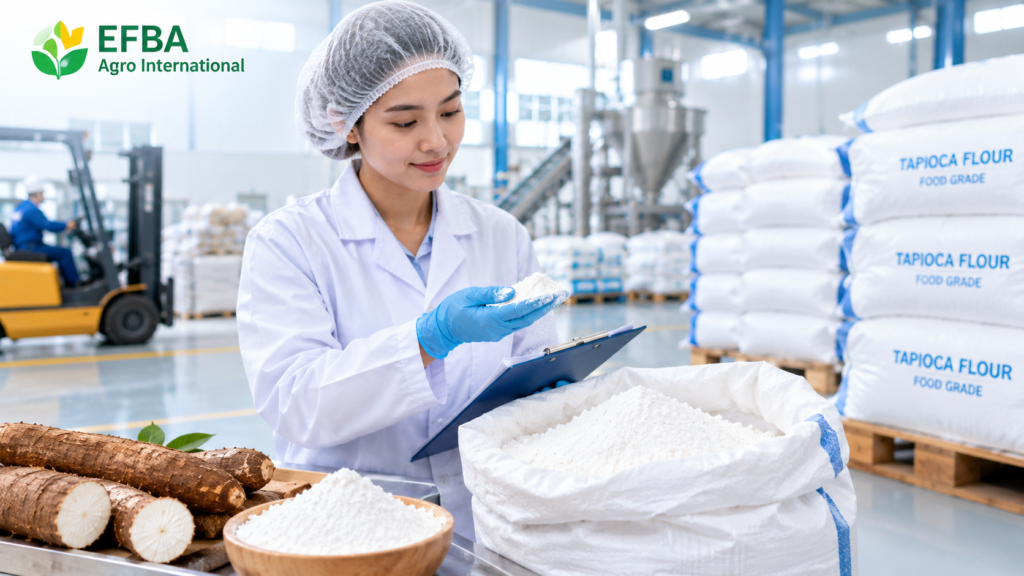
Price is only one factor when choosing a tapioca flour bulk supplier for industrial food production. Manufacturers should also evaluate technical suitability, food safety documentation, supply consistency, delivery reliability, and communication throughout the procurement process. A structured supplier assessment helps businesses reduce purchasing risks and select tapioca starch that meets their production requirements.
1. Verify Product Specifications
Before selecting a tapioca flour bulk supplier, request technical specifications that match the intended food or beverage application. Review moisture content, starch characteristics, whiteness, viscosity, and other relevant parameters. Then compare the offered specifications with your internal ingredient standards and evaluate representative samples before approving a commercial order.
2. Confirm Supply Volume and Lead Time
A reliable tapioca flour bulk supplier should communicate available order quantities, purchasing arrangements, and estimated delivery schedules. Manufacturers should specify their expected order volume and purchasing frequency to support production planning. However, suppliers may not maintain identical inventory levels throughout the year, so buyers should request written confirmation of availability and lead times.
3. Evaluate Packaging and Storage Requirements
Packaging plays an important role in maintaining ingredient quality during storage and transportation. Therefore, manufacturers should confirm that the packaging format suits their warehouse facilities, handling equipment, and production requirements. Tapioca starch should be protected against unsuitable moisture exposure and contamination, while buyers should also clarify shelf-life information and recommended storage conditions.
When evaluating a tapioca flour bulk supplier, companies should review packaging sizes, labeling requirements, and transportation arrangements. These considerations help procurement teams assess whether the offered product matches their operational needs.
4. Check Documentation and Commercial Terms
Before confirming an order with a tapioca flour bulk supplier, buyers should request relevant batch-specific quality documentation and clarify applicable certifications or destination-market requirements. They should also confirm pricing basis, Incoterms, payment conditions, delivery responsibilities, and procedures for resolving specification discrepancies.
Clear documentation and commercial agreements help manufacturers reduce procurement risks. Furthermore, transparent communication allows buyers and suppliers to establish consistent expectations regarding product quality, shipment preparation, and delivery arrangements.
Tapioca Flour vs. MOCAF: Which Should Food Manufacturers Choose?
Tapioca flour and Modified Cassava Flour (MOCAF) both originate from cassava, but they serve different formulation needs. Tapioca flour is a refined starch, while MOCAF is a fermented cassava flour. Consequently, these ingredients differ in composition, processing characteristics, and potential food applications.
When working with a tapioca flour bulk supplier, manufacturers should confirm the exact ingredient required for their production process. Although both products come from cassava, they cannot automatically replace each other without formulation testing.
| Product | Main Characteristics | Typical Application Focus |
|---|---|---|
| Tapioca flour | Refined cassava starch | Thickening, binding, viscosity, texture |
| MOCAF | Fermented cassava flour | Selected flour-based recipes and bakery formulations |
EFBA Agro offers both categories within its cassava-derived agricultural commodity portfolio. Buyers interested in alternative cassava ingredients can explore Modified Cassava Flour (MOCAF) to compare product specifications and potential applications.
For food manufacturers, selecting the appropriate ingredient depends on functional requirements, processing conditions, and finished-product expectations. Therefore, procurement teams should evaluate technical specifications and representative samples before committing to wholesale purchases.
Frequently Asked Questions About Bulk Tapioca Flour
What is a tapioca flour bulk supplier?
A tapioca flour bulk supplier provides refined cassava starch in wholesale quantities for food manufacturers, beverage producers, distributors, and industrial buyers. Suppliers may coordinate product specifications, packaging, quality documentation, and delivery arrangements. Buyers should confirm available quantities, technical requirements, and commercial conditions before placing an order.
Is tapioca flour the same as tapioca starch?
In many commercial food applications, the terms tapioca flour and tapioca starch refer to refined starch extracted from cassava roots. However, buyers should verify the product identity and technical specifications before ordering from a tapioca flour bulk supplier. Ordinary cassava flour and fermented MOCAF are different ingredients and should not automatically replace refined tapioca starch.
What industries use bulk tapioca flour?
Food manufacturers use tapioca starch in noodles, sauces, snacks, bakery formulations, and processed foods. Beverage ingredient manufacturers may also use it to produce tapioca pearls and other starch-based inclusions. Companies sourcing ingredients through a tapioca flour bulk supplier should evaluate the starch’s texture, viscosity, and processing suitability for their intended application.
What packaging options does EFBA Agro offer?
EFBA Agro publishes 25 kg and 50 kg bags for food-grade tapioca flour, with 500 kg jumbo bags available upon request. Its website also references full-container purchasing arrangements for wholesale buyers. Companies evaluating EFBA Agro as a tapioca flour bulk supplier should confirm current packaging availability, labeling requirements, and shipment arrangements before ordering.
What is the minimum order quantity for tapioca flour?
EFBA Agro’s published reference minimum order quantity is one 20-foot full container load for its food-grade tapioca flour offering. The company references approximately 20 metric tons per container. International buyers should confirm actual shipment weight, product availability, and commercial conditions directly before placing an order.
What specifications should food manufacturers check?
Food manufacturers should review moisture content, starch content, ash, whiteness, viscosity, pH, and relevant food safety parameters. They should also evaluate representative samples under actual production conditions. A suitable tapioca flour bulk supplier should communicate the offered product specifications and available quality documentation so buyers can assess compatibility with their manufacturing requirements.
Can international buyers source tapioca flour from Indonesia through EFBA Agro?
EFBA Agro publishes food-grade tapioca flour within its Indonesian agricultural commodity and export sourcing portfolio. International buyers looking for a tapioca flour bulk supplier in Indonesia can contact the company to discuss technical requirements, order volumes, packaging, and shipment destinations. Product availability, export arrangements, and final commercial terms require direct confirmation.
Source Bulk Food-Grade Tapioca Flour from EFBA Agro International
Choosing a reliable tapioca flour bulk supplier requires clear product specifications, consistent quality requirements, suitable packaging, and realistic purchasing arrangements. Food and beverage manufacturers should evaluate samples, review technical documentation, and confirm delivery conditions before committing to large-volume orders. These steps help procurement teams make informed sourcing decisions and manage ingredient purchasing more effectively.
EFBA Agro International provides a sourcing contact for Indonesian food-grade tapioca flour and other agricultural commodities. Its published services cover product sourcing, sample evaluation, procurement coordination, and export preparation. Buyers can discuss their purchasing requirements based on intended applications, order quantities, destination markets, and technical specifications.
For companies seeking a tapioca flour bulk supplier in Indonesia, EFBA Agro offers published product information and a contact point for wholesale sourcing inquiries. Manufacturers, ingredient distributors, and international buyers can review the company’s Tapioca Flour Supplier Indonesia information before requesting a quotation.
Contact EFBA Agro International to discuss your required tapioca starch specifications, bulk order volume, packaging preferences, destination port, and expected delivery schedule.

Looking for wholesale tapioca starch for your next production cycle? Visit EFBA Agro International or review its Tapioca Flour Supplier Indonesia information to prepare your sourcing inquiry.
Request a quotation with your required grade, quantity, packaging, destination port, and delivery schedule to start a specification-driven procurement discussion with EFBA Agro.