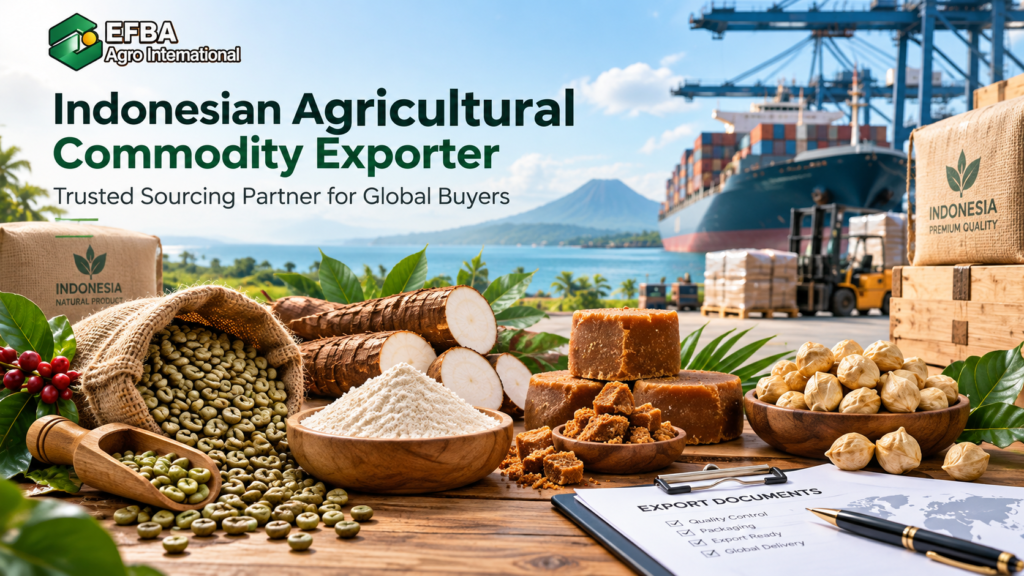
Indonesia offers international buyers a diverse selection of agricultural commodities, including coffee, cassava derivatives, candlenut, palm products, and natural sweeteners. Its tropical agricultural resources and processing industries create sourcing opportunities for food manufacturers, wholesalers, distributors, and industrial buyers. However, successful international procurement requires careful evaluation of product specifications, quality standards, supply availability, and export logistics.
An Indonesian agricultural commodity exporter connects global buyers with locally sourced agricultural products through procurement, quality verification, packaging, export documentation, and shipment coordination. Therefore, buyers should evaluate supplier capabilities, product consistency, commercial terms, and delivery requirements before committing to bulk purchases. Choosing an appropriate export partner can also simplify communication and support long-term sourcing relationships.
EFBA Agro International operates as an Indonesian agricultural commodity exporter and wholesale sourcing partner. Its published portfolio includes coffee beans, cascara, tapioca flour, modified cassava flour (MOCAF), candlenut, crude palm oil, RBD palm olein, and arenga palm sugar. Additionally, the company describes procurement, quality control, sample evaluation, export documentation, and logistics coordination within its services. These capabilities provide international buyers with a starting point for evaluating Indonesian agricultural supply opportunities.
What Is an Agricultural Commodity Exporter?
An agricultural commodity exporter is a company that supplies raw or processed agricultural products to international buyers. Exporters coordinate with farmers, plantations, processing facilities, warehouses, and logistics providers to prepare commodities for overseas markets. Their responsibilities may include sourcing products, evaluating quality, confirming availability, preparing documentation, and coordinating shipments.
In Indonesia, agricultural exporters support international trade across several commodity categories, including coffee, tropical ingredients, cassava derivatives, candlenut, and palm-based products. Moreover, these businesses help connect local agricultural production with foreign manufacturers, wholesalers, and distribution companies. However, their capabilities vary depending on product specialization, sourcing networks, and operational capacity.
For global buyers, the procurement process generally follows:
Buyer Requirements → Product Sourcing → Specification Verification → Sample Approval → Quotation → Export Preparation → Shipment
A reliable agricultural commodity exporter should explain each stage of this process and communicate realistic commercial expectations. Clear documentation, agreed product specifications, and transparent delivery terms are especially important for repeat bulk purchases. Consequently, buyers should select suppliers based on technical suitability and operational reliability rather than price alone.
Why Source Agricultural Commodities from Indonesia?
Indonesia offers several commercial advantages for international agricultural procurement. Its tropical climate supports different agricultural products, while established processing industries create opportunities for both raw and processed commodity sourcing. Furthermore, international buyers can explore products for food manufacturing, beverage production, ingredient distribution, and industrial applications.
However, sourcing performance varies by commodity, region, processing capacity, and supplier. Therefore, working with an experienced agricultural commodity exporter can help buyers evaluate available products and coordinate procurement according to specific commercial requirements.
1. Diverse Agricultural Commodity Portfolio
Indonesia produces agricultural commodities across different regions, climates, and farming systems. International buyers can explore products such as coffee, cassava derivatives, candlenut, palm sugar, and palm-based ingredients for various manufacturing applications. This diversity allows procurement teams to evaluate multiple commodity categories within the Indonesian supply market.
For example, coffee importers may prioritize origin, processing method, bean grade, and sensory quality. Meanwhile, food manufacturers purchasing tapioca flour or palm sugar may focus on moisture content, processing characteristics, packaging, and product consistency. Therefore, buyers should identify the technical requirements of each commodity before requesting a quotation.
An agricultural commodity exporter can support this process by discussing product availability, sourcing requirements, and relevant specifications. However, buyers should verify whether the supplier can meet the required grade and purchasing volume before confirming an order.
2. Access to Tropical Agricultural Origins
Indonesia’s geographic diversity supports distinctive agricultural production regions, including the Gayo Highlands in Aceh, which are associated with Arabica coffee cultivation. Different production environments can influence agricultural characteristics, processing methods, and potential commercial applications. As a result, origin information may provide additional value for buyers seeking particular product attributes.
Nevertheless, agricultural origin alone does not guarantee quality. Cultivation practices, harvesting, post-harvest processing, storage, and grading also influence the final product. Therefore, international buyers should evaluate actual specifications rather than relying exclusively on general claims about Indonesian agricultural quality.
A professional agricultural commodity exporter should help buyers understand relevant origin information and available supporting documentation. This approach allows procurement teams to assess whether the commodity matches their technical and commercial expectations.
3. Opportunities for Bulk and Wholesale Procurement
Indonesia’s agricultural supply chain includes farmers, collectors, processing companies, warehouses, and exporters serving different purchasing volumes. This network can support wholesale procurement when suppliers have sufficient sourcing capacity and appropriate processing arrangements. Additionally, some agricultural products are available in multiple grades, packaging formats, and processing conditions.
However, minimum order quantities, production lead times, and available inventory differ between commodities. For this reason, importers should communicate their required purchasing volume, product grade, packaging format, destination, and intended order frequency before requesting a commercial offer.
Choosing an agricultural commodity exporter that understands bulk procurement requirements may help simplify purchasing coordination. Nevertheless, buyers should confirm available quantities and realistic shipment schedules for each transaction.
4. Agricultural Products for Multiple Industries
Indonesian agricultural commodities serve food manufacturers, beverage companies, ingredient distributors, and other industrial buyers. Tapioca flour supports various food formulations, while coffee beans supply roasting businesses and beverage producers. Similarly, palm-based ingredients have applications that depend on their processing grade and technical characteristics.
This product diversity allows international procurement teams to identify commodities according to specific industrial requirements. However, buyers must verify applicable food safety standards, technical specifications, and destination-market regulations before commercial use.
Therefore, an agricultural commodity exporter should help buyers clarify product applications and sourcing requirements during the initial procurement discussion. Technical approval and import compliance remain essential before confirming commercial orders.
5. Potential for Long-Term Supply Partnerships
Long-term procurement relationships can reduce repeated supplier searches and improve communication regarding product specifications, purchasing schedules, and quality expectations. Indonesian exporters that maintain relationships with agricultural producers and processing partners may help coordinate future orders more effectively.
Furthermore, consistent communication allows buyers to discuss forecast volumes, changing specifications, and potential supply constraints. However, agricultural availability still depends on harvest conditions, raw material supply, processing capacity, and logistics.
For this reason, buyers should evaluate the agricultural commodity exporter’s performance after each shipment. A reliable commercial relationship should support clearer expectations, realistic supply planning, and continuous improvement in procurement coordination.
Indonesian Agricultural Commodities Available for Global Buyers
Indonesia supplies agricultural products with different characteristics, processing requirements, and industrial applications. International buyers should evaluate these commodities according to their intended use, purchasing volume, technical specifications, and destination-market regulations.
As an Indonesian agricultural commodity exporter, EFBA Agro International focuses on selected commodities for wholesale and industrial buyers. Its published portfolio covers coffee products, cassava derivatives, candlenut, palm oil products, and natural sweeteners. The following sections explain the characteristics and commercial applications of these products.
1. Indonesian Coffee Beans
Indonesia produces Arabica and Robusta coffee for domestic consumption and international trade. Among its recognized origins, Gayo Arabica coffee from Aceh attracts attention for its distinctive sensory characteristics and specialty coffee applications. However, coffee quality depends on cultivation, harvesting, processing, grading, and storage conditions.
International buyers should evaluate green bean grade, moisture content, physical defects, processing method, and cupping results before purchasing. Additionally, roasters may require particular sensory profiles or processing characteristics according to their roasting programs.
EFBA Agro lists Gayo Arabica coffee within its commodity portfolio. Through its agricultural commodity exporter services, the company can discuss sourcing requirements, product specifications, sample availability, and purchasing quantities. However, buyers should confirm the specifications and availability of each offered lot before placing an order.
2. Modified Cassava Flour (MOCAF)
Modified Cassava Flour, commonly known as MOCAF, is a cassava-derived flour produced through a fermentation-based process. Food manufacturers may use MOCAF in selected bakery products, snacks, and other formulations requiring alternative flour ingredients. Nevertheless, its performance depends on recipe composition, processing conditions, and the desired finished-product characteristics.
Buyers should assess moisture content, particle size, microbiological specifications, packaging, and product functionality before commercial use. Additionally, manufacturers may need to conduct formulation trials to determine suitable application levels.
EFBA Agro offers MOCAF within its cassava-based commodity portfolio. As an agricultural commodity exporter, the company provides a sourcing contact for international buyers evaluating Indonesian cassava products.
Explore: Modified Cassava Flour (MOCAF) – EFBA Agro.
3. Food-Grade Tapioca Flour
Tapioca flour is a starch ingredient derived from cassava roots. Food manufacturers use it in noodles, sauces, snacks, processed foods, and other applications because of its thickening and textural properties. However, tapioca starch differs from whole cassava flour and MOCAF in composition and manufacturing functionality.
Therefore, buyers should verify starch characteristics, moisture limits, purity, packaging, and relevant food safety requirements. These specifications help manufacturers determine whether the ingredient suits their production process.
EFBA Agro lists food-grade tapioca flour among its agricultural products. International buyers seeking an Indonesian agricultural commodity exporter for tapioca sourcing can discuss product specifications, procurement volumes, and shipment requirements with the company.
4. Cascara – Dried Coffee Cherry Husk
Cascara comes from the dried outer portions of coffee cherries and may serve as an ingredient in certain beverage applications. Its characteristics depend on coffee origin, harvesting, processing, drying methods, and storage conditions. Consequently, producers need appropriate handling procedures to maintain product quality.
For international buyers, food safety assessment and destination-market regulatory acceptance are particularly important. In addition, beverage manufacturers should evaluate sensory characteristics and product suitability before introducing cascara into commercial formulations.
EFBA Agro includes cascara within its agricultural commodity portfolio. Buyers can discuss sourcing requirements, product characteristics, sampling, and available documentation. However, importers must verify the product’s eligibility for their intended market before confirming procurement.
5. Indonesian Candlenut
Candlenut, locally known as kemiri, is an Indonesian agricultural ingredient used in culinary preparations. Candlenut oil also has applications in selected cosmetic and personal-care formulations. However, commercial specifications vary depending on whether buyers require whole kernels, processed materials, or oil ingredients.
Before purchasing, buyers should evaluate moisture content, cleanliness, physical appearance, processing conditions, and intended applications. Additionally, raw candlenuts require appropriate processing and should not be treated as ready-to-eat ingredients.
EFBA Agro lists candlenut among its wholesale agricultural products. An agricultural commodity exporter handling candlenut should clarify the available product form, quality requirements, and relevant export conditions before commercial transactions.
6. Palm Oil and RBD Palm Olein
Indonesia is a major producer of palm-based commodities, including Crude Palm Oil (CPO) and refined palm products. CPO serves as an input for further processing, while RBD palm olein has applications in cooking oil and selected food manufacturing operations. However, technical specifications and regulatory requirements vary according to product grade and destination.
Industrial buyers should confirm relevant quality parameters, chemical specifications, shipment volumes, and supporting documentation. Furthermore, sustainability, traceability, and other compliance requirements may apply depending on the importing market.
EFBA Agro publishes CPO and RBD palm olein within its commodity range. As an Indonesian agricultural commodity exporter, the company provides a contact point for buyers evaluating procurement opportunities in these products. Nevertheless, actual availability, commercial terms, and compliance documentation require direct confirmation.
7. Granulated and Molded Arenga Palm Sugar
Arenga palm sugar is a traditional sweetener derived from the sap of the sugar palm. Food and beverage manufacturers may use granulated or molded forms in desserts, sauces, specialty beverages, and other formulations. Its distinctive flavor can support products requiring a caramel-like sweetening profile.
However, commercial suitability depends on moisture content, granule consistency, microbiological quality, packaging, and shelf-life requirements. Therefore, international buyers should evaluate samples and review relevant specifications before bulk purchasing.
EFBA Agro offers granulated and molded arenga palm sugar within its agricultural portfolio. Buyers seeking an agricultural commodity exporter for Indonesian natural sweeteners can discuss purchasing requirements, available product formats, and documentation with the team.
Commodity Comparison for International Buyers
Choosing an agricultural commodity exporter becomes easier when buyers understand the technical requirements of each product category. The following table summarizes common applications and key procurement considerations for selected Indonesian agricultural products.
| Commodity | Typical Applications | Key Procurement Considerations |
|---|---|---|
| Gayo Arabica Coffee | Roasting and specialty coffee | Origin, grade, defects, moisture |
| MOCAF | Bakery and food formulations | Moisture, particle size, functionality |
| Tapioca Flour | Food manufacturing | Starch specifications, purity |
| Cascara | Beverage ingredients | Safety, drying, import eligibility |
| Candlenut | Food ingredients and oil processing | Moisture, quality, intended use |
| CPO / RBD Palm Olein | Food and industrial processing | Grade, chemical specifications |
| Arenga Palm Sugar | Food and beverages | Moisture, consistency, packaging |
These specifications represent general procurement considerations, not guaranteed product specifications from EFBA Agro. Therefore, buyers should request a product-specific technical specification, confirm current availability, and clarify commercial terms before purchasing.
Working with an agricultural commodity exporter that understands product specifications, quality expectations, and export requirements can help international buyers structure a more reliable sourcing process. However, every transaction still requires verification of product suitability, purchasing conditions, and destination-market compliance.
Official Data: Indonesia’s Agricultural Export Market in 2025–2026
Indonesia’s agricultural export performance provides valuable insights for international buyers evaluating the country as a sourcing destination. Official statistics from Statistics Indonesia (BPS) confirm that coffee, medicinal plants, spices, and other agricultural products contribute to Indonesia’s international trade. Furthermore, these figures help buyers understand the country’s broader agricultural export activity before selecting an agricultural commodity exporter.
According to BPS monthly agricultural export statistics, Indonesia recorded the following export values:
| Indicator | Official Data |
|---|---|
| Indonesia coffee exports, January–July 2026 | US$1,007.6 million |
| Coffee exports, July 2026 | US$221.4 million |
| Medicinal, aromatic and spice plant exports, January–July 2026 | US$313.8 million |
| Total agricultural exports in the referenced BPS table, January–July 2026 | US$3,153.4 million |
Source: Statistics Indonesia (BPS), Monthly Exports Value of Agricultural Products, updated September 21, 2026. These figures reflect the commodity coverage of the referenced table rather than every agricultural and plantation-related export classification.
Additionally, the BPS publication Indonesian Permanent Estate Crops Statistics 2025 covers coffee, cocoa, coconut, pepper, cloves, tea, and other plantation commodities. It includes production information and export-import statistics by HS Code and trading partner. Consequently, international procurement teams can use these statistics to identify relevant commodity categories and understand Indonesia’s agricultural trade landscape.
However, national export statistics do not confirm the export volume, supply capacity, or market share of any individual company. Therefore, buyers should combine official market data with direct verification of an agricultural commodity exporter’s product availability, quality standards, and commercial capabilities. This approach helps distinguish national sourcing opportunities from an individual supplier’s actual ability to fulfill an order.
Official references: BPS – Agricultural Export Statistics and BPS – Indonesian Permanent Estate Crops Statistics 2025.
How to Choose a Reliable Agricultural Commodity Exporter
Choosing a reliable agricultural commodity exporter requires more than comparing prices or requesting product catalogs. International buyers should evaluate technical specifications, sourcing capacity, quality verification, export documentation, and logistics arrangements. Moreover, a suitable supplier should communicate realistic delivery expectations and provide clear commercial information.
The following five steps can help procurement teams evaluate Indonesian agricultural exporters before committing to bulk purchases.
1. Verify Product Origin and Specifications
Start by confirming the commodity’s origin, product grade, processing method, and relevant technical parameters. These details should match the buyer’s intended application and destination-market requirements. Additionally, request laboratory reports, technical specification sheets, or other supporting documents when necessary.
A professional agricultural commodity exporter should clearly explain available product characteristics and distinguish confirmed specifications from general descriptions. Consequently, buyers can evaluate technical suitability before discussing larger purchasing commitments.
2. Evaluate Supplier Capacity and Availability
Confirm the required purchasing quantity, order frequency, processing capacity, and estimated production or shipment lead time. Agricultural commodities may experience seasonal fluctuations, so buyers should discuss supply availability and realistic procurement schedules before finalizing an agreement.
Furthermore, an agricultural commodity exporter should communicate supply limitations transparently rather than promise volumes without supporting information. This allows buyers to develop practical purchasing forecasts and reduce the risk of unexpected supply disruptions.
3. Request Samples Before Bulk Orders
Product samples allow buyers to evaluate physical characteristics, sensory properties, and technical suitability before committing to larger purchases. For coffee, evaluation may involve green bean inspection and cupping, while flour and other food ingredients may require laboratory analysis or manufacturing trials.
Therefore, buyers should agree on sample approval criteria, testing responsibilities, and acceptable quality parameters. A reliable agricultural commodity exporter should explain the sample process and clarify whether the commercial shipment must match an approved reference sample.
4. Review Pricing and Export Terms
A transparent quotation should explain product grade, purchasing quantity, packaging, price basis, payment terms, delivery conditions, and quotation validity. In addition, buyers should clarify the applicable Incoterms and responsibilities for transportation, insurance, customs clearance, and export documentation.
Comparing prices without reviewing these conditions can produce misleading conclusions about total procurement costs. Therefore, international buyers should assess each agricultural commodity exporter’s quotation using comparable specifications and delivery terms.
5. Confirm Export Documentation and Logistics
Before confirming a shipment, verify the documents required by the exporter, importing country, and specific commodity category. Depending on the transaction, these may include a commercial invoice, packing list, transport document, certificate of origin, phytosanitary certificate, or other applicable documentation.
However, requirements vary according to HS classification, destination-market regulations, and agreed trading terms. Consequently, buyers should confirm import eligibility, documentation responsibilities, and shipment arrangements before placing an order with an agricultural commodity exporter.
EFBA Agro Expertise in Agricultural Commodity Sourcing and Export
EFBA Agro International presents itself as an Indonesian agricultural commodity exporter and wholesale sourcing partner. Its official website describes services covering agricultural procurement, quality control, product specification matching, packaging, export documentation, and logistics coordination. Furthermore, the company explains its relationships with agricultural producers, local farmers, and processing partners as part of its sourcing approach.
These capabilities are relevant for international buyers seeking Indonesian commodities for wholesale distribution, food manufacturing, or industrial applications. However, the availability, specifications, and commercial terms of individual products require confirmation before purchase.
1. Agricultural Procurement and Product Matching
EFBA Agro’s published collaboration process begins by identifying buyer requirements, including commodity type, specifications, purchasing volume, and destination. The company then discusses sourcing options that correspond to these requirements. This approach helps buyers focus on products that match their technical and commercial needs.
As an agricultural commodity exporter, EFBA Agro positions its procurement services around product matching rather than a generic commodity offering. Therefore, international buyers should provide detailed specifications when requesting sourcing assistance.
2. Quality Control and Sample Evaluation
EFBA Agro describes quality verification and sample evaluation as part of its export workflow. Its published process allows buyers to review product characteristics and assess suitability before confirming commercial quantities. Additionally, this stage provides an opportunity to clarify specifications and relevant quality expectations.
For agricultural procurement, sample evaluation is especially important because product quality may vary by origin, harvest, processing, and storage conditions. Consequently, buyers should confirm the agreed quality parameters and relevant inspection arrangements before advancing to bulk purchasing.
3. Bulk Commodity Supply Coordination
EFBA Agro lists several agricultural products within its wholesale portfolio, including cassava derivatives, coffee, candlenut, and palm-based commodities. Through its published sourcing and processing relationships, the company aims to support international bulk procurement and purchasing coordination.
However, buyers should not assume that every commodity has the same MOQ, production capacity, or shipment lead time. Instead, an agricultural commodity exporter should confirm these details for each inquiry based on actual product availability and agreed specifications.
4. Export Documentation and Shipment Planning
EFBA Agro’s published export workflow includes packaging, documentation, shipping preparation, and logistics coordination. These services help buyers organize procurement activities beyond the initial selection of agricultural products. Additionally, coordination between suppliers, logistics providers, and buyers can support clearer shipment planning.
Nevertheless, export documents and delivery responsibilities depend on the commodity, destination country, and commercial agreement. Therefore, clients should clarify which documentation and logistics services EFBA Agro will provide within the confirmed scope of each transaction.
5. Business Development within the EFBA Ecosystem
EFBA Agro operates within the broader EFBA business ecosystem. PT EFBA Digital Mulia publishes services related to business consulting, business development, and corporate solutions. These activities provide additional context about the group’s commercial background and broader business operations.
However, buyers should evaluate EFBA Agro’s agricultural commodity exporter services based on its actual product portfolio, procurement coordination, quality evaluation, and export preparation capabilities. Other EFBA Group services do not automatically become part of an agricultural supply agreement. Consequently, every buyer should confirm the applicable scope, terms, and responsibilities before engaging the company.
EFBA Agro’s Agricultural Export Process
EFBA Agro publishes a structured collaboration process for global buyers seeking Indonesian agricultural commodities. The workflow covers requirement analysis, product sourcing, sample evaluation, procurement, quality control, documentation, and logistics preparation. As an agricultural commodity exporter, the company uses this process to communicate the key stages of a potential international sourcing transaction.
The process can be summarized as follows:
Buyer Requirements → Product Matching → Sample Evaluation → Commercial Agreement → Procurement & Quality Control → Export Documentation → Shipment
First, buyers communicate their required commodity, specifications, quantity, and destination. Next, EFBA Agro discusses suitable sourcing options and the sample evaluation process. After commercial confirmation, the relevant parties coordinate procurement, quality requirements, documentation, and shipment arrangements according to the agreed scope.
This structured approach can help international buyers manage procurement expectations and reduce misunderstandings during sourcing. Nevertheless, successful execution still depends on confirmed product availability, quality compliance, commercial terms, and destination-market requirements.
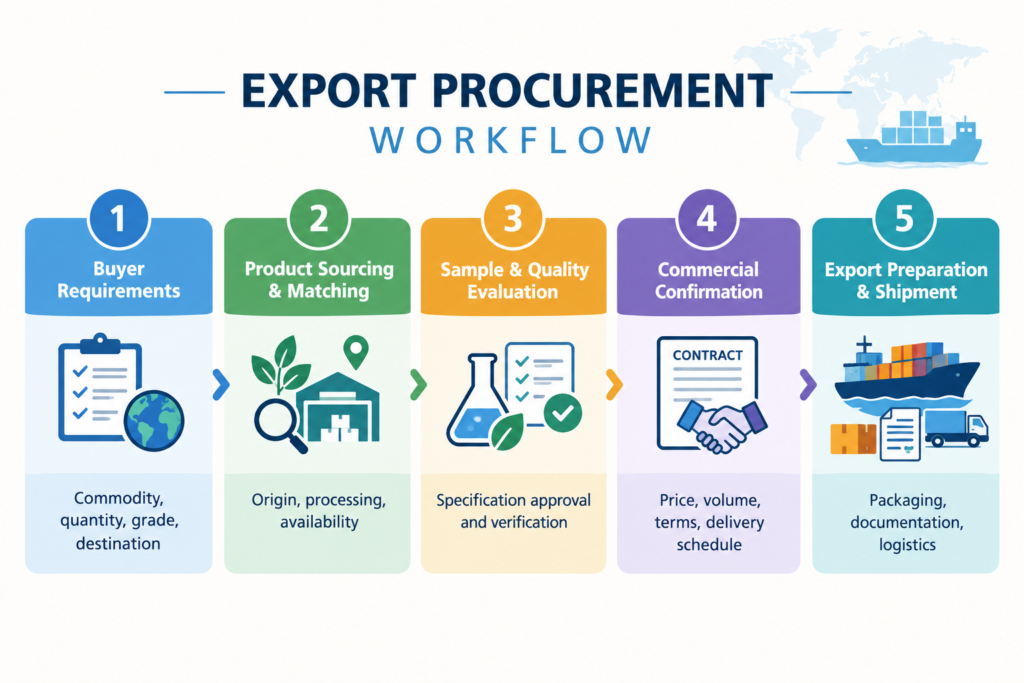
This framework helps international buyers organize their procurement process while maintaining clear communication about product suitability, quality requirements, and commercial terms. Moreover, working with an experienced agricultural commodity exporter can help procurement teams understand sourcing procedures, required documentation, and shipment coordination. However, buyers should verify each supplier’s capabilities before confirming commercial commitments.
Agricultural supply chains may also face disruptions from seasonal production changes, transportation delays, and extreme weather. Therefore, importers should evaluate potential risks when planning recurring purchases. For further information, read Indonesia Commodity Supply Chain: Managing Climate and Natural Disaster Risks.
What Should Global Buyers Prepare Before Requesting a Quotation?
International buyers can accelerate discussions with an agricultural commodity exporter by submitting a structured Request for Quotation (RFQ). Clear purchasing requirements help suppliers assess product suitability, sourcing availability, and commercial feasibility. Additionally, detailed specifications reduce misunderstandings and unnecessary quotation revisions.
Before contacting an Indonesian exporter, procurement teams should prepare the following information.
| RFQ Information | Example |
|---|---|
| Commodity | Gayo Arabica green coffee |
| Quantity | 10 metric tons |
| Required quality | Buyer-defined grade and specifications |
| Packaging | 60 kg bags, subject to agreement |
| Destination | Hamburg, Germany |
| Incoterm | FOB or CIF, to be quoted |
| Delivery schedule | Requested shipment month |
| Documentation | Applicable certificates and testing requirements |
Note: This RFQ is illustrative and does not represent a confirmed EFBA Agro offer, available inventory, product price, or minimum order quantity.
Furthermore, buyers should clarify whether they require samples, third-party inspections, laboratory testing, specific certificates, or recurring shipments. For example, coffee importers may request green bean grading and sample evaluation, while food manufacturers may prioritize microbiological specifications and ingredient functionality. Therefore, an agricultural commodity exporter should receive sufficient technical information to prepare a relevant commercial response.
A practical RFQ process follows:
Product Requirements → Technical Specifications → Quantity → Packaging → Delivery Terms → Documentation → Quotation Review
By following this framework, procurement teams can compare suppliers using consistent criteria. However, buyers should assess the total purchasing conditions rather than selecting an exporter based only on the lowest quoted price.
FAQ About Indonesian Agricultural Commodity Exporters
1. What agricultural commodities does Indonesia export?
Indonesia exports coffee, spices, plantation crops, palm-based products, and various agricultural ingredients. Its export industries also include processed products such as cassava derivatives and natural sweeteners. Additionally, these commodities serve food manufacturers, beverage companies, distributors, and industrial buyers worldwide.
However, export requirements differ according to product classification and destination country. Therefore, importers should verify applicable regulations, quality specifications, and documentation before purchasing from an Indonesian agricultural commodity exporter.
2. How can I find an Indonesian agricultural commodity exporter?
Start by identifying your required commodity, product grade, purchasing volume, and delivery destination. Next, evaluate potential suppliers based on their product portfolio, sourcing capabilities, quality control procedures, sample availability, and export experience. Furthermore, compare commercial terms and confirm whether suppliers can meet your technical requirements.
EFBA Agro International presents itself as an Indonesian agricultural commodity exporter serving international wholesale and industrial buyers. Companies interested in Indonesian agricultural sourcing can contact its team to discuss product requirements and potential procurement arrangements.
3. What products does EFBA Agro International supply?
EFBA Agro International publishes a commodity portfolio that includes Gayo Arabica coffee, cascara, modified cassava flour (MOCAF), tapioca flour, candlenut, crude palm oil, RBD palm olein, and arenga palm sugar. These products serve different commercial applications, including food manufacturing, beverage production, and industrial processing.
However, product availability, specifications, purchasing quantities, and commercial pricing may vary. Therefore, buyers should confirm current sourcing conditions directly with EFBA Agro before requesting a formal quotation.
4. Can international buyers purchase Indonesian agricultural commodities in bulk?
Yes. International buyers can purchase selected Indonesian agricultural commodities in wholesale quantities through exporters with suitable sourcing and processing arrangements. However, minimum order quantities, available grades, production lead times, and shipment conditions depend on the specific commodity and supplier.
Consequently, buyers should submit a detailed RFQ that explains the required volume, specifications, packaging, destination, and delivery schedule. This information allows an agricultural commodity exporter to assess whether the requested order is commercially feasible.
5. Does EFBA Agro provide samples before bulk purchasing?
EFBA Agro’s published buyer collaboration process includes sample provision and product evaluation before commercial confirmation. This approach allows buyers to assess quality characteristics and determine whether products meet their purchasing requirements. Additionally, sample evaluation may help identify specification differences before larger orders.
Nevertheless, sample availability, testing methods, costs, and shipment arrangements require separate confirmation. Therefore, buyers should discuss these conditions directly with EFBA Agro before beginning product evaluation.
6. What documents are required to import agricultural products from Indonesia?
Required documents depend on commodity classification, destination-market regulations, and the agreed shipping terms. Common documents may include a commercial invoice, packing list, transport document, certificate of origin, phytosanitary certificate, and other commodity-specific documentation when applicable.
Furthermore, certain products may require laboratory reports, regulatory approvals, or additional compliance documents. Consequently, buyers should confirm applicable requirements with relevant authorities and logistics providers before finalizing a purchase from an agricultural commodity exporter.
7. Why do international buyers source agricultural products from Indonesia?
Indonesia offers diverse tropical agricultural commodities, established production networks, and processing capabilities for various commercial applications. These characteristics create sourcing opportunities for food manufacturers, wholesale distributors, beverage companies, and industrial buyers. Moreover, international procurement teams can explore raw materials and processed ingredients from different Indonesian production regions.
However, buyers should evaluate product quality, total landed cost, supplier capacity, and potential supply chain disruptions before making purchasing decisions. Working with a suitable Indonesian agricultural commodity exporter can support procurement planning, but every commercial transaction still requires technical and regulatory verification.
Source Indonesian Agricultural Commodities with EFBA Agro International
Choosing the right agricultural commodity exporter requires more than identifying available raw materials. International buyers need clear product specifications, realistic sourcing information, quality verification, transparent commercial terms, and appropriate export arrangements. Furthermore, reliable communication helps procurement teams evaluate potential suppliers and manage purchasing expectations.
EFBA Agro International supports global buyers seeking Indonesian agricultural commodities for wholesale and industrial applications. Its published portfolio includes coffee beans, cassava derivatives, cascara, candlenut, palm products, and natural sweeteners. Additionally, the company describes sourcing coordination, sample evaluation, quality control, and export preparation as part of its services.
Whether your company is establishing a new sourcing relationship or evaluating additional Indonesian suppliers, EFBA Agro can discuss commodity requirements, available sourcing options, and potential procurement arrangements. Buyers should provide detailed specifications, expected purchasing volumes, destination information, and delivery requirements to support an effective initial discussion.
Looking for an Indonesian agricultural commodity exporter for your next wholesale purchase? Visit EFBA Agro International to explore available commodities and discuss your sourcing requirements.

Visit EFBA Agro International and submit your product requirements through its official quotation form. Include your desired commodity, specifications, purchasing volume, destination, and shipment timeline so the team can evaluate your inquiry.
Connect your business with Indonesian agricultural commodities through a clearer, specification-driven sourcing process.