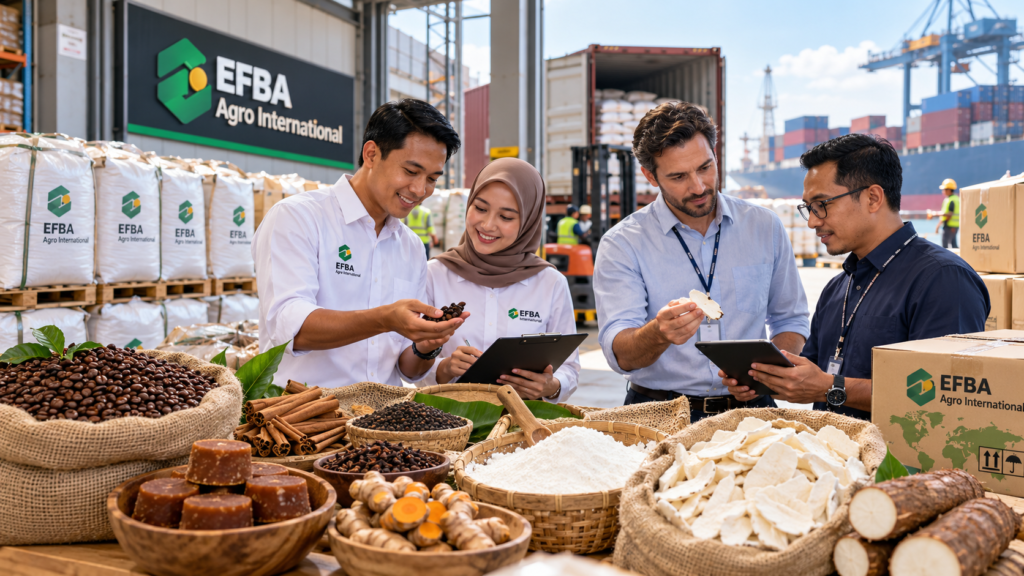
Finding an Indonesian commodity supplier involves more than locating a company that can quote a price per kilogram or metric ton. Global importers, distributors, food manufacturers, beverage companies, roasters, and industrial buyers need to evaluate product specifications, origin, processing method, packaging, minimum order quantity, consistency, quality-control procedures, documentation, and logistics before confirming a commercial order. A reliable Indonesian commodity supplier becomes more valuable when it can connect the agricultural source with measurable specifications and an export process that matches the buyer’s requirements.
Indonesia offers a broad commodity base that includes cassava derivatives, coffee, palm products, natural sweeteners, spices, and other tropical agricultural materials. BPS reported that Indonesia’s total export value reached US$282.51 billion in 2025, up 5.99% compared with 2024, while official monthly agricultural statistics show continued exports of coffee and medicinal, aromatic, and spice plants during 2026. These national figures do not represent EFBA Agro’s individual sales, but they show the scale of Indonesia’s participation in international commodity trade. Badan Pusat Statistik Indonesia
For buyers seeking an Indonesian commodity supplier, EFBA Agro International positions itself as an Indonesian agricultural commodity sourcing and wholesale export company. Its official website states that the company focuses on procurement, processing, and wholesale export, with principal commodities including cassava and derivatives, coffee beans and cascara, candlenut, palm oil, and palm sugar products. The company also provides a quotation process that asks buyers to define quantity, grade, packaging, certification needs, destination, Incoterm, and shipment method before commercial discussions proceed. Efba Agro International
What Does an Indonesian Commodity Supplier Do?
An Indonesian commodity supplier connects agricultural production with commercial buyers who need repeatable volume, clear specifications, and reliable shipment arrangements. The supplier’s role may include locating supply, coordinating processing, checking quality parameters, preparing packaging, arranging documentation, and supporting logistics according to agreed commercial terms. For wholesale buyers, this differs from purchasing a retail-ready agricultural product because a bulk order normally requires specification control and supply planning.
A practical sourcing flow is:
Buyer Requirement → Commodity Selection → Specification → Supply Matching → Sample → Approval → Bulk Order → Quality Control → Packaging → Documentation → Shipment
The exact stages differ by commodity. Coffee buyers may focus on origin, moisture, screen size, defects, and cup profile, while tapioca buyers may focus on starch, moisture, whiteness, viscosity, and packaging. Cascara buyers may need to evaluate sensory characteristics alongside moisture and purity, which is why EFBA Agro’s previous sourcing material emphasizes measurable specifications and sample approval before bulk procurement.
A good Indonesian commodity supplier therefore helps buyers move from a broad request such as “we need Indonesian agricultural products” toward a commercially usable purchasing specification. This reduces ambiguity and makes quotations from different suppliers easier to compare.
What Commodities Can an Indonesian Commodity Supplier Provide?
1. Food-Grade Tapioca Flour
Food-grade tapioca flour is one of the key products buyers may source through an Indonesian commodity supplier. Tapioca flour is a cassava-based starch used across food manufacturing, including noodles, snacks, bakery applications, sauces, and thickening systems. EFBA Agro publishes food-grade tapioca for commercial buyers and lists 25 kg or 50 kg PP sacks with PE inner lining, optional jumbo packaging, approximately 20 metric tons per 20-foot FCL, and Tanjung Priok as the listed loading port. Its current product page also lists MOQ at one 20-foot FCL. Efba Agro International
For procurement teams, the important point is that tapioca should not be bought only by visual appearance or price. Buyers may need to evaluate moisture, starch characteristics, whiteness, viscosity, pH, ash, purity, or other parameters that affect their production line. A manufacturer producing snacks may prioritize different characteristics from a sauce or bakery producer, even though both are purchasing tapioca.
The sourcing logic should therefore be:
Food Application → Functional Requirement → Tapioca Specification → Sample/Document Review → Commercial Volume
This approach allows the buyer to select material according to the finished product rather than treating all tapioca flour as interchangeable. It also helps the Indonesian commodity supplier match the product specification more accurately with the buyer’s application.
2. Modified Cassava Flour or MOCAF
MOCAF is another commodity that an Indonesian commodity supplier may offer to food manufacturers looking for cassava-based flour alternatives. Modified Cassava Flour, commonly known as MOCAF, is produced from cassava through fermentation and can be evaluated for bakery, noodle, pastry, and alternative flour applications. EFBA Agro’s published specification currently includes moisture, ash, protein, whiteness, pH, and HCN parameters.
The company lists packaging in 25 kg or 50 kg sacks with PE lining, jumbo options upon request, approximately 20 metric tons per 20-foot FCL, and MOQ at one 20-foot FCL. Efba Agro International
MOCAF differs from tapioca because buyers are evaluating a flour system rather than pure starch functionality. Product developers therefore need to test water absorption, texture, processing behaviour, colour, aroma, and finished-product performance under their own manufacturing conditions. It should not automatically be treated as a universal one-to-one wheat replacement without formulation testing.
A commercial buyer should follow:
Product Development Need → MOCAF Specification → Trial → Production Test → Procurement Decision
EFBA Agro also publishes content describing cassava supply supported through quality control, processing systems, and farmer partnerships for bulk international requirements. Efba Agro International
For buyers, choosing an Indonesian commodity supplier for MOCAF should therefore involve both specification review and application testing, not only a price comparison.
3. Gayo Arabica Coffee
Coffee is one of the most recognised categories buyers may source from an Indonesian commodity supplier. Indonesia is internationally recognised for coffee origins including Gayo in Aceh. EFBA Agro lists Gayo Arabica among its agricultural commodities and currently publishes specifications covering moisture, processing characteristics, sensory notes, packaging, load capacity, loading port, and MOQ.
Its Gayo product page lists green beans, roasted beans, and cascara as available formats, with Belawan in Medan as the listed loading port. Efba Agro International
Coffee buyers usually need significantly more information than the label “Indonesian Arabica.” Origin, altitude, crop period, processing method, screen size, moisture, defects, storage, and cup profile can all influence purchasing decisions. A roaster may also evaluate sample lots differently depending on roast profile and target market.
BPS’s agricultural export statistics show coffee export value of approximately US$1.008 billion during January–July 2026. This is a national export figure rather than EFBA Agro’s performance, but it confirms that coffee remains an important Indonesian agricultural export category. Badan Pusat Statistik Indonesia
For roasters and importers, an Indonesian commodity supplier should therefore provide more than origin information. Buyers also need lot-level data, samples, quality parameters, and logistics details before moving to commercial volume.
4. Cascara or Dried Coffee Husk
Cascara is another specialty product that an Indonesian commodity supplier can offer to beverage companies and ingredient buyers. Cascara comes from the dried skin of coffee cherries and can be used in specialty beverage applications. EFBA Agro publishes Gayo-origin cascara with fruity and floral characteristics and lists wholesale packaging in 25 kg sacks with PE inner liner, retail-sized 1 kg packaging, an MOQ of 100 kg, and shipment through Tanjung Priok or Belawan. Efba Agro International
For buyers, cascara requires closer sensory and physical evaluation than many standardised dry ingredients. Moisture, purity, cleanliness, processing, appearance, aroma, and flavour can affect its use in brewed beverages, syrups, kombucha, or other formulations. The EFBA Agro cascara sourcing article therefore recommends a process that includes specification, sample testing, buyer approval, quality control, and repeat-order evaluation.
A practical procurement flow is:
Origin → Drying → Moisture → Purity → Sensory Profile → Sample → Application Test → Bulk Order
This approach helps beverage companies purchase cascara based on actual product requirements rather than origin story alone. A capable Indonesian commodity supplier should also help buyers connect sensory characteristics with lot specifications and commercial supply conditions.
5. Granulated Arenga Palm Sugar
Granulated Arenga palm sugar is another product that global buyers may source through an Indonesian commodity supplier. Arenga palm sugar is produced from Arenga pinnata palm sap and offers a characteristic caramel-like profile that can be used in beverages, bakery, sauces, desserts, and other food formulations.
EFBA Agro publishes a granulated Arenga palm sugar specification covering colour, mesh size, moisture, sugar content, solubility, and optional certifications. It also lists bulk packaging in kraft paper bags with PE inner liners, along with retail and jumbo options upon request. Efba Agro International
For food and beverage buyers, palm sugar should be evaluated for more than sweetness. Colour, aroma, flavour intensity, solubility, granule size, moisture, and compatibility with the formulation can influence the finished product. Beverage manufacturers may prioritise solubility, while bakery manufacturers may evaluate flavour development and moisture interaction.
EFBA Agro also publishes a broader palm sugar export portfolio and states that it works through farming partnerships and quality-focused processing for international buyers. Efba Agro International
This means buyers should ask an Indonesian commodity supplier for application-relevant specifications rather than relying only on the product name or sweetness level.
6. Candlenut
Candlenut, or kemiri, is another agricultural ingredient that an Indonesian commodity supplier may provide to food manufacturers. It is commonly used in Southeast Asian culinary applications and can provide savoury flavour, fat content, and natural thickening characteristics.
EFBA Agro publishes a shelled Grade A candlenut specification with whole kernels, maximum moisture, minimum purity, oil content, and free fatty acid parameters. The company’s current product page also lists wholesale sacks, jumbo packaging upon request, Belawan as a loading port, and an MOQ of one 20-foot FCL. Efba Agro International
Food manufacturers can evaluate candlenut for sauces, spice pastes, ready meals, culinary ingredients, or other formulations connected with Southeast Asian flavour profiles. Buyers should examine kernel appearance, moisture, purity, rancidity risk, oil content, cleanliness, packaging, and storage conditions before accepting bulk material.
Because candlenut is an oil-rich agricultural product, post-harvest handling and storage can materially affect quality. Buyers should therefore treat supplier reliability and lot condition as part of the purchasing decision rather than focusing only on unit price. This makes supplier qualification especially important when selecting an Indonesian commodity supplier for recurring candlenut orders.
7. Indonesian Spices
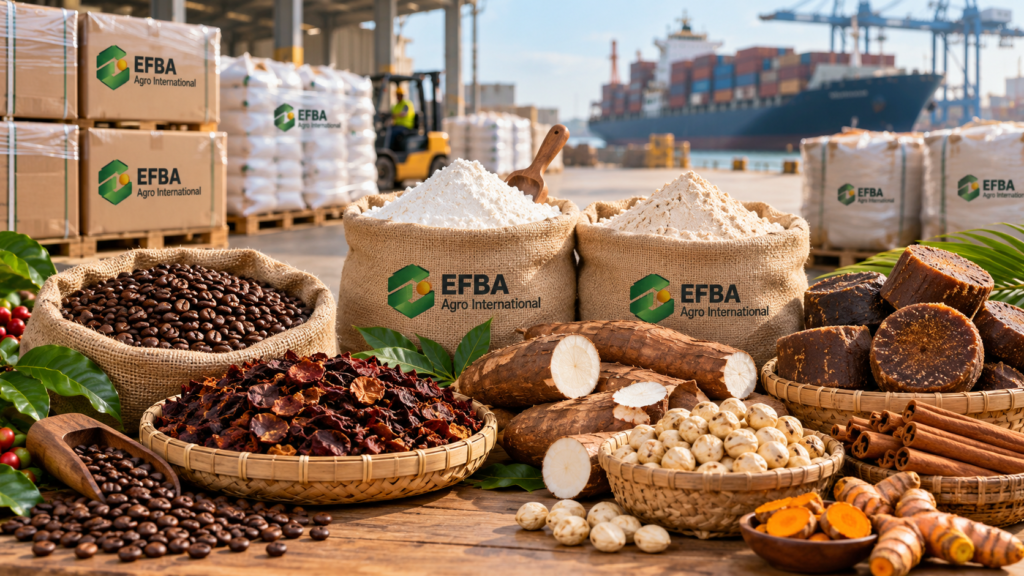
Spices represent another important category for buyers evaluating an Indonesian commodity supplier. Indonesia has a long trading history in spices and aromatic crops. EFBA Agro’s published commodity content refers to products including black pepper, nutmeg, cloves, ginger, turmeric, vanilla, and related tropical agricultural ingredients.
The company’s broader export content also states that spices are sourced through agricultural partners for international markets. Efba Agro International
Official BPS data show exports of medicinal, aromatic, and spice plants at approximately US$313.8 million during January–July 2026. Again, this is an Indonesian national figure rather than EFBA Agro’s individual sales, but it provides current market context for the category. Badan Pusat Statistik Indonesia
Spice sourcing normally requires commodity-specific specifications. Buyers may need to define moisture, purity, foreign matter, grade, size, whole or ground format, treatment requirements, microbiological parameters, packaging, and destination-market compliance depending on the final application.
For this reason, an Indonesian commodity supplier should treat each spice as a separate procurement category rather than offering one generic “Indonesian spices” specification. Buyers should request lot-specific information and confirm destination-market requirements before finalising a commercial order.
Why Do Global Buyers Source Commodities from Indonesia?
1. Broad Agricultural Diversity
Indonesia produces multiple categories of tropical crops, allowing international buyers to evaluate several ingredient groups within one source country. BPS’s latest 2025 estate-crop publication covers oil palm, coffee, cocoa, rubber, tea, clove, coconut, nutmeg, pepper, sago, and other important crops by province, together with export and import data. Badan Pusat Statistik Indonesia
This does not mean every commodity has the same supply scale, quality level, or export readiness. Instead, it shows the breadth of Indonesia’s agricultural base and why procurement teams often consider the country for coffee, sweeteners, spices, cassava ingredients, and related tropical products.
For global buyers, the value therefore comes from:
Agricultural Diversity + Processing Capability + Export Experience + Regional Origins
However, supplier qualification remains necessary because national production strength does not automatically guarantee that every supplier can meet a buyer’s individual specification.
2. Functional and Specialty Ingredients
Indonesia supplies both commodity ingredients and products with strong origin or sensory value. Tapioca and MOCAF can serve functional food applications, while Gayo coffee, cascara, palm sugar, and spices provide more distinctive sensory and origin characteristics. This combination allows global buyers to use Indonesia for both manufacturing inputs and premium specialty products.
For buyers, the comparison should therefore not be limited to price:
Price + Specification + Function + Origin + Consistency + Logistics
A cheaper product can become more expensive in practice if moisture is inconsistent, sorting losses are high, additional processing is needed, or shipment conditions do not match the buyer’s expectations.
3. Opportunity for Farmer-Linked Sourcing
EFBA Agro’s website and commodity articles describe supply relationships involving farms, plantations, local farmers, producers, and processing partners. The company presents these relationships as part of its sourcing model for agricultural products and international bulk supply. Efba Agro International
This sourcing structure can be useful for buyers seeking clearer origin information or long-term procurement programmes. However, individual traceability requirements should still be confirmed for the actual product and lot because buyers may require different documentation depending on their internal programme or destination market.
In other words, the practical objective is not simply “direct from farmers.” It is:
Origin → Procurement Network → Processing → Quality Control → Export Specification
That structure is more useful to commercial buyers because it connects agricultural production with industrial procurement requirements.
What Should Wholesale Buyers Ask an Indonesian Commodity Supplier?
Wholesale buyers should prepare a sourcing brief before requesting quotations. Without a clear specification, suppliers may quote different qualities, packaging configurations, or shipment conditions, making price comparison misleading. A structured request also reduces back-and-forth communication and allows the supplier to identify suitable supply more efficiently.
Buyers should confirm:
Product → Origin → Grade → Specification → Quantity → Frequency → Packaging → Certification → Destination → Incoterm → Timeline
EFBA Agro’s current quotation form reflects this approach. It asks potential buyers for the product, required quantity, order frequency, quality or grade, preferred packaging, required certifications, laboratory or COA requirements, destination country and port, preferred Incoterm, shipping method, and expected purchase timeline. Efba Agro International
This buyer information helps turn a generic inquiry such as “please send price” into a commercially useful request. For example, a quotation for 100 kg of cascara shipped by air will be structurally different from an FCL order of tapioca flour delivered on a CIF basis.
Why Should Buyers Request Specifications before Price?
Price only becomes meaningful when buyers know what they are comparing. Two quotations for the same commodity can represent different moisture levels, grades, packaging, minimum quantities, origins, processing methods, certifications, or freight responsibilities. As a result, comparing only the price per kilogram can create an inaccurate picture of landed cost and quality risk.
Use:
Specification → Commercial Terms → Price → Landed Cost → Risk
For agricultural commodities, the same logic applies to sample approval. EFBA Agro’s cascara sourcing workflow uses buyer requirements, product matching, sample preparation, testing, approval, and cooperation before commercial supply. Cascara Wholesale_ Sourcing Dri…
The purpose of sampling is not to guarantee that every future lot will be identical. Instead, it creates a practical reference point that allows buyer and supplier to agree on the expected product profile and quality parameters before scaling the transaction.
How Does Bulk Commodity Packaging Affect Procurement?
Bulk packaging needs to protect the product during handling, storage, container consolidation, sea freight, and destination warehousing. Packaging also affects loading efficiency, labour, labelling, palletisation, and contamination risk. Therefore, procurement teams should confirm the packaging structure before finalising the order rather than after commercial terms have been agreed.
Depending on the commodity, EFBA Agro publishes options such as:
25 kg / 50 kg sacks → PE inner lining → Jumbo Bags → Retail Packs → Custom Discussion
For example, food-grade tapioca and MOCAF are published with 25 kg or 50 kg sacks and optional jumbo configurations, while cascara is listed in 25 kg sacks with PE liner and smaller 1 kg packs. Granulated palm sugar has separate kraft-bag configurations, and coffee uses jute sacks with protective liners. Efba Agro International
This is why a buyer should state both required volume and preferred packaging at the quotation stage.
What Role Do MOQ and Order Frequency Play?
MOQ affects whether a supplier is commercially suitable for a particular buyer. A distributor purchasing container-scale volumes has different requirements from a product-development team testing a new ingredient. Buyers should therefore confirm whether the supplier supports trial quantities, partial loads, or only full-container commercial orders.
EFBA Agro’s published MOQs vary by commodity. Cascara is currently listed from 100 kg, while products such as MOCAF, tapioca, and candlenut are published around full-container requirements, and Gayo Arabica has its own stated commercial MOQ. Efba Agro International
Recurring orders also require additional planning:
Forecast → Availability → Specification → Production/Procurement → QC → Shipment → Repeat Order
Agricultural commodities are affected by harvest cycles, weather, processing capacity, and raw-material availability. Buyers planning regular procurement should therefore communicate expected annual or quarterly demand as early as possible.
Official Data: Indonesia’s Commodity and Export Position
BPS’s final annual export publication states that Indonesia exported US$282.505 billion in goods during 2025, representing growth of 5.99% compared with 2024. The data are compiled from official export declarations, postal export reports, and international trade records and are classified using HS 2022. Badan Pusat Statistik Indonesia
BPS’s earlier December 2025 trade release placed January–December exports at US$282.91 billion and non-oil-and-gas exports at US$269.84 billion. The slight difference from the later annual publication reflects the normal distinction between earlier trade releases and later compiled annual datasets, so the final annual publication is the better reference when quoting final 2025 totals. Badan Pusat Statistik Indonesia
For 2026, BPS reports coffee export value of approximately US$1.008 billion and medicinal, aromatic, and spice plants of US$313.8 million during January–July. These figures do not measure the size of the EFBA Agro business, but they demonstrate that agricultural and aromatic commodities remain active parts of Indonesia’s export economy. Badan Pusat Statistik Indonesia
The latest BPS estate-crop publication also covers provincial area and production for coffee, cocoa, tea, coconut, cloves, nutmeg, pepper, palm oil, and other crops, together with customs-based import/export statistics. This reinforces the diversity of Indonesia’s agricultural production base. Badan Pusat Statistik Indonesia
How Does EFBA Agro Handle Indonesian Commodity Sourcing?
EFBA Agro describes itself as an exporter and direct sourcing partner focused on Indonesian agricultural commodities. Its published portfolio currently includes cassava and derivatives, coffee beans and cascara, candlenut, palm oil, and palm sugar, while several company articles also present Indonesian spices and additional agricultural products for global markets. Efba Agro International
The company also publishes a buyer-oriented commercial process. Buyers are asked to state their product, specification, quantity, order frequency, packaging, certification needs, destination, Incoterm, and timeline. For products such as cascara, the published sourcing process also includes product matching and sample evaluation before commercial cooperation. Efba Agro International
For a global buyer, the sourcing flow can therefore be summarised as:
Requirement → Product Matching → Specification → Sample/Verification → Commercial Terms → Procurement → QC → Packaging → Documentation → Logistics
This structure does not remove normal agricultural or international trade risks. Instead, it gives buyer and supplier a clearer basis for managing those risks.
EFBA Agro Expertise as an Indonesian Commodity Supplier
EFBA Agro International states that it specialises in the procurement, processing, and wholesale export of agricultural commodities from Indonesia. Its principal published commodity categories include cassava and derivatives, coffee beans and cascara, candlenut, palm oil, and palm sugar, while product and article pages expand the portfolio into products such as MOCAF, tapioca, Gayo coffee, Arenga sugar, and Indonesian spices. Efba Agro International
The company also publishes product-specific technical and commercial information instead of applying one generic standard across every commodity. MOCAF has its own moisture, ash, protein, whiteness, pH, HCN, packaging, load capacity, and MOQ information, while Gayo Arabica, cascara, candlenut, and palm sugar each have separate parameters. Efba Agro International
EFBA Agro’s published content also describes collaboration with farmers and agricultural supply partners. Its cassava and palm sugar articles refer to farmer partnerships, while other commodity content describes products sourced from trusted Indonesian farmers and plantations. These claims support the company’s positioning as a procurement network rather than merely a reseller of finished packaged products. Efba Agro International
Within the broader PT EFBA Digital Mulia ecosystem, EFBA Agro’s role remains focused on agricultural commodity sourcing and international wholesale trade. The article therefore keeps EFBA Agro’s expertise limited to the agricultural sourcing, commodity, processing coordination, bulk supply, and export-related capabilities that its own website publishes.
Why Work with EFBA Agro for Wholesale Commodity Requirements?
Global buyers typically need a commodity supplier to answer five practical questions: What product can you supply? What specification will I receive? What volume can you handle? How will it be packed? How will it reach my destination? EFBA Agro publishes information relevant to each of these areas through commodity-specific specifications, MOQ, packaging details, load-port information, and a structured quotation process. Efba Agro International
The company also allows buyers to communicate certification, laboratory, packaging, shipping, and Incoterm requirements during the inquiry process. This is valuable for procurement teams because commercial feasibility depends not only on the commodity itself but also on the ability to align the supply with the buyer’s import and production requirements. Efba Agro International

The recommended buyer process is therefore:
Requirement → Technical Fit → Commercial Fit → Sample/Approval → Quality Control → Export Preparation → Shipment
A successful relationship with an Indonesian commodity supplier should make recurring procurement easier rather than forcing both parties to restart the sourcing process from zero for every shipment. Once specifications, packaging, documentation, and quality expectations become clear, buyers and suppliers can build a more efficient repeat-order process. This structure becomes particularly important for agricultural commodities where crop conditions, processing, and lot characteristics can vary.
Framework for Selecting an Indonesian Commodity Supplier
International buyers can use the following framework before confirming an Indonesian commodity supplier:
1. COMMODITY
What product do you need?
2. APPLICATION
How will the product be used?
3. ORIGIN
Where does the raw material come from?
4. SPECIFICATION
What measurable quality parameters must be met?
5. SAMPLE / VERIFICATION
Can the product be evaluated before bulk purchase?
6. COMMERCIAL VOLUME
What are MOQ, recurring requirements, and supply capacity?
7. PACKAGING
What packaging, liner, label, or pallet configuration is required?
8. QUALITY CONTROL
How will conformity be evaluated before shipment?
9. DOCUMENTATION
What export and buyer-required documents are needed?
10. LOGISTICS
Which port, Incoterm, and shipment method will be used?
In short:
Buyer Need → Commodity → Specification → Supplier → Sample → Approval → Bulk Order → QC → Documentation → Shipment → Evaluation
This framework makes the term Indonesian commodity supplier more meaningful because it connects agricultural supply with practical B2B procurement requirements. A supplier should not only identify available products, but also help buyers understand specification, volume, quality-control expectations, packaging, documentation, and shipment structure. For international procurement teams, those capabilities often determine whether a sourcing relationship can support recurring orders.
FAQ About Indonesian Commodity Supplier Services
What is an Indonesian commodity supplier?
An Indonesian commodity supplier sources and supplies agricultural or other raw commodities from Indonesia to distributors, manufacturers, importers, processors, and wholesale buyers. Depending on the product, the supplier may coordinate procurement, processing, quality control, packaging, documentation, and logistics. Buyers should evaluate suppliers based on measurable specifications, commercial capability, supply consistency, and export readiness rather than price alone. The correct sourcing process will still depend on the commodity and destination market.
What commodities does EFBA Agro supply as an Indonesian commodity supplier?
EFBA Agro’s official website lists cassava and derivatives, coffee beans and cascara, candlenut, palm oil, and palm sugar among its core commodity categories. Specific product pages currently cover food-grade tapioca flour, MOCAF, Gayo Arabica coffee, cascara, candlenut, and granulated Arenga palm sugar. Company articles also reference Indonesian spices and additional tropical commodities. Buyers should reconfirm availability and commercial specifications when requesting a quotation. Efba Agro International
Does EFBA Agro supply commodities in bulk?
Yes. EFBA Agro positions itself as a wholesale exporter and publishes bulk packaging, load capacities, MOQ, loading ports, and quotation procedures for several commodities. The exact minimum volume varies by product, ranging from smaller commercial requirements for cascara to container-based MOQs for several flour and nut products. Buyers evaluating an Indonesian commodity supplier should therefore provide the required quantity and expected order frequency when requesting pricing. Efba Agro International
Can international buyers request product specifications?
Yes. EFBA Agro publishes general specifications for multiple commodities, including MOCAF, Gayo coffee, cascara, palm sugar, and candlenut. Buyers should still reconfirm specifications for the actual commercial lot because agricultural characteristics and agreed buyer requirements can vary. A reliable Indonesian commodity supplier should help connect general product information with the specification required for a specific order. Contractual parameters should be established before shipment. Efba Agro International
Does EFBA Agro work with Indonesian farmers?
EFBA Agro’s published content describes farmer partnerships and sourcing relationships with Indonesian agricultural producers and plantations. Its cassava and other commodity articles state that farmer partnerships form part of the company’s sourcing model. This sourcing network supports EFBA Agro’s role as an Indonesian commodity supplier for international buyers. Buyers that require farm-level traceability should communicate the exact documentation needed for their individual sourcing programme. Efba Agro International
Can buyers request samples before bulk orders?
For cascara, EFBA Agro explicitly publishes a process that includes requirement matching, sample preparation, buyer testing, and confirmation before cooperation proceeds. Sample arrangements for other commodities may vary based on the product, volume, destination, and commercial terms. For buyers selecting an Indonesian commodity supplier, sample evaluation can help connect written specifications with the actual material before bulk procurement. Buyers should ask about the relevant process when submitting an inquiry.
What information should I send when requesting a quotation?
A useful request should include the commodity, grade or specification, required quantity, recurring frequency, packaging, required certification, laboratory or COA needs, destination country and port, preferred Incoterm, shipping method, and expected purchase timeline. EFBA Agro’s current quotation form requests these details directly from buyers. Providing them from the beginning allows the Indonesian commodity supplier to prepare a more relevant commercial response. Efba Agro International
How should buyers compare one Indonesian commodity supplier with another?
Buyers should compare more than price. Review product specifications, sample quality, source and origin, supply capacity, packaging, MOQ, quality-control procedures, documentation, logistics, and communication responsiveness. A suitable Indonesian commodity supplier should be able to explain how the product moves from sourcing and processing through quality control and export preparation.
The comparison can follow:
Specification Fit → Quality Consistency → Commercial Fit → Documentation → Logistics → Repeat-Supply Capability
This approach helps buyers determine whether the supplier can support a long-term procurement programme rather than only a single transaction.
Source Indonesian Commodities with EFBA Agro
Choosing an Indonesian commodity supplier should begin with specification and sourcing requirements, not price alone. Global buyers need to understand the commodity, origin, quality parameters, volume, packaging, documentation, logistics, and repeat-supply capability before confirming a commercial relationship. This is particularly important for agricultural products because crop conditions, processing, moisture, grading, and harvest availability can influence the material supplied.
EFBA Agro International supports wholesale and bulk buyers looking for Indonesian commodities including cassava-based ingredients, coffee, cascara, candlenut, palm products, palm sugar, and other published agricultural categories. Its website provides product specifications, packaging details, MOQ information, and a structured quotation process for international buyers. Efba Agro International
For buyers evaluating EFBA Agro as an Indonesian commodity supplier, the sourcing process should begin with clear technical and commercial requirements. Buyers can start by providing the required product, specification, quantity, frequency, packaging, certification, destination, Incoterm, and purchase timeline. From there, EFBA Agro can evaluate sourcing options and commercial requirements according to the commodity involved.
Request a quotation from EFBA Agro International
For the broader EFBA corporate ecosystem and business activities, buyers can also review PT EFBA Digital Mulia.
When approaching an Indonesian commodity supplier, do not begin only with “What is your lowest price?”. A more useful question is: “What specification, volume, quality standard, packaging, documentation, and delivery structure does our business require?”. That starting point gives both buyer and supplier a clearer foundation for building a commercially workable sourcing relationship.