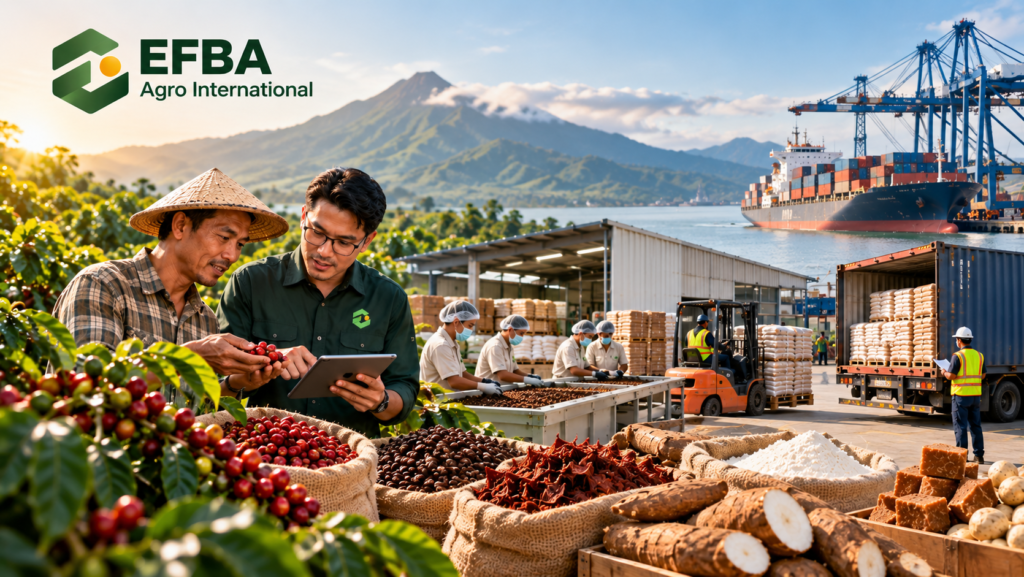
Indonesia is one of Southeast Asia’s major agricultural sourcing markets, supplying coffee, cassava products, palm products, spices, natural sweeteners, and other commodities to domestic and international industries.
However, sourcing agricultural commodities from an archipelagic country also requires effective supply chain planning. Climate variability, drought, excessive rainfall, floods, landslides, wildfires, harvest fluctuations, transportation disruptions, and port access can affect how commodities move from production areas to international buyers.
For this reason, understanding the Indonesia commodity supply chain is important for importers, distributors, manufacturers, and international procurement teams that source agricultural products from the country.
In 2026, this issue has become increasingly relevant. BMKG reported in August that 76.5% of Indonesia’s seasonal zones had entered the dry season, while low rainfall dominated 90.79% of the country and El Niño had reached very strong intensity. BMKG
For global buyers, the objective should not be to eliminate every possible disruption. Instead, procurement teams need a more resilient Indonesia commodity supply chain approach:
Origin → Availability → Quality Control → Processing → Buffer → Packaging → Logistics → Shipment → Monitoring
EFBA Agro International operates within this supply chain as an Indonesian agricultural commodity sourcing and wholesale export partner. Its published portfolio includes cassava derivatives, coffee beans, cascara, candlenut, palm oil, and palm sugar products. Efba Agro International
What Is the Indonesia Commodity Supply Chain?
The Indonesia commodity supply chain is the network that connects farms, plantations, collectors, processors, warehouses, exporters, logistics providers, ports, and international buyers involved in moving Indonesian commodities from origin to destination.
For agricultural commodities, the process generally follows:
Farm & Plantation → Collection → Processing → Quality Control → Storage → Packaging → Inland Logistics → Port → Export → Buyer
Each stage creates a different type of risk.
A drought may affect raw material availability. Heavy rainfall can disrupt harvesting or drying. Floods and landslides may interfere with transportation, while inconsistent storage conditions can affect commodity quality.
Therefore, international sourcing should evaluate the complete Indonesia commodity supply chain rather than only the supplier’s quoted price.
Why Climate Risk Matters for Indonesia’s Commodity Supply Chain
Agriculture depends heavily on weather and seasonal conditions.
Rainfall affects planting, harvesting, drying, transportation, moisture management, and production volumes. Meanwhile, prolonged dry conditions can influence water availability and increase wildfire risk.
Indonesia’s 2026 conditions illustrate why buyers need continuous monitoring of the Indonesia commodity supply chain.
BMKG’s March 2026 seasonal forecast initially projected that 64.5% of Indonesia’s seasonal zones would experience below-normal rainfall during the dry season, while 57.2% were expected to experience a longer-than-normal dry season. BMKG
Conditions then developed further. By late July, BMKG stated that El Niño had become active and could produce a drier and longer dry season, increasing the risks of drought, forest and land fires, and impacts on strategic sectors. BMKG
By August 2026, BMKG reported that El Niño had reached very strong intensity. BMKG
For commodity buyers, climate monitoring should therefore become part of procurement planning rather than an occasional reaction after disruption occurs.
1. Drought Can Affect Agricultural Production
One of the clearest climate risks is prolonged dry weather.
Agricultural production depends on water availability, although the level of exposure differs between crops and production regions.
BMKG’s updated June 2026 forecast projected that 56.18% of Indonesia’s land area would experience below-normal rainfall conditions, while almost half of the country’s land area was expected to experience a longer-than-normal dry season. BMKG
By late June, BMKG specifically warned that El Niño could create risks involving drought, food production disruption, forest and land fires, air quality, and regional inflation pressures. BMKG
For buyers, the practical implication is simple:
Climate Change → Production Risk → Availability Risk → Procurement Risk
This does not mean every Indonesian commodity will experience shortages.
Commodity exposure varies by crop, region, harvest calendar, processing system, and inventory availability. Buyers should therefore monitor the actual sourcing origin instead of applying one national assumption to every commodity.
For companies managing an Indonesia commodity supply chain, this distinction matters because procurement decisions should follow the actual production region.
2. Excessive Rainfall Can Also Disrupt Supply
Dry conditions are not the only concern.
Indonesia can experience drought in one region while another area faces heavy rainfall. BMKG’s climate monitoring regularly shows substantial spatial variation across the archipelago. BMKG
Excessive rainfall can affect agricultural commodities through delayed harvesting, higher moisture exposure, slower drying, transportation problems, or reduced access to production areas.
For commodities that require controlled drying, this becomes especially important.
A useful risk chain is:
Heavy Rain → Harvest Delay → Drying Challenge → Moisture Risk → Quality Variation
Buyers of coffee, cascara, cassava derivatives, spices, and natural sweeteners should therefore include moisture and storage requirements in their product specifications.
This approach helps procurement teams manage quality risks within the wider Indonesia commodity supply chain.
3. Floods and Landslides Can Interrupt Inland Logistics
Indonesia’s agricultural commodities often travel significant distances before reaching an export port.
Products may move from farms to collection points, processing facilities, warehouses, consolidation areas, and finally ports.
This creates an important dependency:
Production Area → Road Access → Warehouse → Port
Floods or landslides do not necessarily damage the commodity directly to disrupt supply.
A blocked road, damaged bridge, delayed trucking schedule, or inaccessible collection area can be enough to create shipment delays.
BMKG’s 2026 Climate Outlook highlighted flood and landslide risks in areas experiencing above-normal rainfall, even though the national annual outlook initially projected generally normal rainfall conditions. BMKG
For international procurement teams, logistics risk should therefore receive separate attention within the Indonesia commodity supply chain.
4. Wildfires Can Create Secondary Supply Chain Risks
Dry weather can also increase forest and land fire exposure.
BMKG warned in July 2026 that stronger El Niño conditions increased the risks of drought and forest and land fires. BMKG
By August, the agency reported that reduced rainfall had already contributed to fire events in several parts of Indonesia. BMKG
Wildfires can create indirect commodity supply chain problems through transportation restrictions, reduced visibility, air-quality deterioration, worker safety issues, and disruptions around production or logistics areas.
The supply chain impact can therefore extend beyond farms:
Dry Conditions → Fire Risk → Operational Disruption → Logistics Risk → Delivery Risk
Buyers should consider these secondary effects when planning time-sensitive shipments through the Indonesia commodity supply chain.
5. Climate Risk Can Affect Commodity Quality
Supply chain risk is not limited to volume.
Quality can also change.
Agricultural commodities often have measurable requirements involving moisture, cleanliness, physical appearance, purity, size, sensory characteristics, or processing performance.
Weather conditions during harvesting and drying can influence some of those parameters.
Therefore:
Availability ≠ Acceptable Quality
A commodity may remain available while failing to meet a buyer’s required specification.
For this reason, quality control becomes especially important during periods of unusual weather.
EFBA Agro’s published export process includes Procurement & Quality Control before packaging and shipment. The company states that products are sourced through its network and checked for compliance with agreed requirements. Efba Agro International
For international buyers, quality control should therefore remain a core component of Indonesia commodity supply chain management.
6. Avoid Depending on Price Alone
Commodity procurement teams naturally compare prices.
However, purchasing decisions based only on FOB or product price can hide other supply chain risks.
A more complete sourcing evaluation should consider:
Price + Specification + Availability + Quality + Origin + Logistics + Lead Time + Reliability
For example, a lower-priced commodity may create additional costs if inconsistent specifications lead to rejected batches, production problems, additional sorting, or delayed manufacturing.
Similarly, the lowest-priced origin may not remain economical if inland logistics become unreliable during a particular season.
For international buyers, procurement value should therefore be evaluated across the full Indonesia commodity supply chain.
7. Diversify Procurement Sources When Appropriate
One practical way to reduce concentration risk is to avoid depending unnecessarily on a single production source.
Indonesia’s agricultural production is geographically diverse.
However, diversification does not simply mean purchasing random products from different suppliers.
Buyers need to maintain consistent specifications.
The preferred structure is:
Multiple Sources → Same Specification → Quality Verification → Consolidated Procurement
EFBA Agro states that it works with producers and processing partners and maintains a procurement network for bulk agricultural commodities. Efba Agro International
Such a network can support sourcing flexibility, although actual availability still depends on commodity, specification, season, and order volume.
For buyers, supplier diversification can strengthen the Indonesia commodity supply chain when the strategy matches the product’s origin, quality requirements, and expected volume.
How to Build a More Resilient Indonesia Commodity Supply Chain
A resilient sourcing strategy requires more than adding suppliers.
Procurement teams should monitor the complete flow from origin to destination and identify the points that could create delays, quality problems, or unexpected costs.
A practical framework is:
Origin Mapping → Supplier Assessment → Quality Control → Inventory Planning → Logistics Planning → Risk Monitoring → Contingency Plan
First, identify the production region and understand its harvest calendar. Next, assess supplier capacity, product specifications, processing methods, and quality controls.
Then, review inventory requirements and logistics routes. Finally, establish contingency options for periods when weather, transportation, or production conditions change.
This approach allows buyers to manage the Indonesia commodity supply chain based on actual risk rather than reacting only after a disruption occurs.
What Should International Buyers Check?
Before placing a bulk order, international buyers can review several key areas:
- Origin: Where does the commodity come from?
- Availability: How much supply can the supplier provide?
- Specification: Does the product meet the required technical parameters?
- Quality Control: How does the supplier inspect each batch?
- Processing: What processing and post-harvest methods does the supplier use?
- Packaging: Does the packaging suit storage and international transportation?
- MOQ: What minimum quantity does the supplier require?
- Lead Time: How long does procurement and shipment normally take?
- Logistics: Which port and transportation route will the supplier use?
- Documentation: What export and import documents will the shipment require?
- Contingency: What alternatives exist if production or logistics face disruption?
Together, these factors provide a more complete view of Indonesia commodity supply chain risk.
Conclusion: Managing Risk Across Indonesia’s Commodity Supply Chain
Indonesia offers significant opportunities for international agricultural commodity buyers.
However, successful sourcing requires more than finding a competitive product price.
Climate conditions, production cycles, processing, quality, inventory, transportation, ports, documentation, and supplier capacity can all influence the final procurement outcome.
Therefore, buyers should manage the Indonesia commodity supply chain as an interconnected system:
Origin → Production → Processing → Quality → Inventory → Logistics → Port → Export → Buyer
EFBA Agro International supports Indonesian agricultural commodity sourcing through its published portfolio of coffee, cascara, cassava derivatives, candlenut, palm products, and other commodities. Efba Agro International
For international buyers, the key is not simply to find a supplier.
The goal is to build a sourcing process that connects quality, availability, logistics, and supply continuity with the buyer’s commercial requirements.
8. Use Product Specifications to Control Quality Risk
Clear specifications help buyers control quality risk throughout the Indonesia commodity supply chain.
Before requesting quotations, buyers should define the exact product requirements. Depending on the commodity, those requirements may include:
Grade → Moisture → Purity → Size → Processing → Packaging → Quantity → Destination
Clear specifications make supplier comparisons easier. They also reduce misunderstandings between buyer expectations and the products supplied.
EFBA Agro’s cooperation process starts when buyers communicate the required product, specification, and quantity. The company then checks raw-material availability and matches the requirements with its farmer and supplier network before preparing a sample. EFBA Agro International
This process creates a more structured approach to the Indonesia commodity supply chain because buyers evaluate products according to measurable requirements rather than generic commodity descriptions.
9. Approve Samples Before Larger Orders
Documentation gives buyers useful information. However, physical samples allow procurement teams to evaluate the actual product before placing a larger order.
Buyers can inspect appearance, texture, aroma, moisture, purity, processing characteristics, and other relevant parameters based on the commodity.
EFBA Agro publishes the following cooperation process:
Buyer Requirement → Product Matching → Sample → Sample Testing → Buyer Confirmation → Cooperation
The buyer can therefore test the proposed product before confirming the commercial relationship. EFBA Agro International
For recurring procurement, an approved sample can also provide a useful reference for future quality discussions.
Agricultural commodities naturally vary from one lot to another. Therefore, buyers should still confirm lot-specific specifications whenever the product or application requires it.
10. Build Buffer Time into International Procurement
International commodity procurement involves more than securing sufficient inventory.
A shipment can still create problems when the supplier has enough stock but the product cannot reach the buyer before the production schedule requires it.
For that reason, procurement teams should consider the complete timeline:
Demand Forecast → Order Timing → Production → Processing → QC → Packing → Inland Transport → Export → Transit → Buffer
Climate events, port congestion, transportation problems, and other disruptions can increase uncertainty at several stages of the Indonesia commodity supply chain.
A reasonable time buffer gives buyers more room to handle short delays without immediately disrupting production.
The appropriate buffer depends on the commodity, destination, shipping method, inventory strategy, and acceptable business risk.
11. Monitor Climate Before the Purchase Order
Climate monitoring should start before procurement teams encounter shipment problems.
BMKG publishes seasonal forecasts, climate outlooks, drought information, rainfall forecasts, and atmospheric monitoring that buyers and suppliers can use as external planning inputs. BMKG
For procurement teams, a practical process looks like this:
Climate Monitoring → Origin Monitoring → Availability Check → Procurement Decision
Weather information does not predict exact crop output. Instead, it provides an early warning that helps buyers verify availability, lead times, harvest conditions, and logistics before placing an order.
As a result, climate monitoring becomes part of proactive Indonesia commodity supply chain planning rather than a response after disruption occurs.
12. Review Logistics Before Confirming Shipment
Once the buyer confirms product availability and quality, logistics become the next critical stage.
International agricultural shipments involve packaging, documentation, inland transportation, port handling, ocean freight, and destination customs requirements.
EFBA Agro publishes an export process consisting of:
Need & Demand Analysis → Procurement & Quality Control → Packaging & Documentation → Shipping & Logistics
The company also states that its general export workflow includes documents such as the Certificate of Origin and Bill of Lading. EFBA Agro International
Document requirements can differ by commodity and destination. Therefore, buyers should confirm the applicable requirements for each transaction with their customs broker or relevant authority.
A complete logistics review helps procurement teams connect product availability with realistic delivery planning across the Indonesia commodity supply chain.
Official Data: Indonesia’s 2026 Climate Risk Has Changed During the Year
One important lesson from 2026 is that climate conditions can change during the year.
BMKG’s December 2025 Climate Outlook initially projected generally normal annual rainfall across most of Indonesia. The agency expected 94.7% of the country to experience normal annual rainfall conditions. BMKG
However, subsequent monitoring showed different conditions during the dry season.
In June, BMKG projected below-normal rainfall across 56.18% of Indonesia’s land area. BMKG
By July, BMKG reported active and strengthening El Niño conditions. The agency warned that the phenomenon could increase drought, agricultural production disruption, forest and land fires, and other risks. BMKG
By August, BMKG reported that 535 seasonal zones, or 76.5% of Indonesia, had entered the dry season. Low rainfall dominated 90.79% of the country, while 87.28% experienced below-normal rainfall. BMKG also described El Niño as very strong at that point. BMKG
For international buyers, this progression highlights an important procurement principle:
Annual Forecast → Seasonal Update → Current Monitoring → Procurement Adjustment
Therefore, companies should use the latest available information when planning the Indonesia commodity supply chain rather than relying only on forecasts published months earlier.
How Climate Risk Can Affect EFBA Agro Commodities
EFBA Agro’s published portfolio includes cassava and its derivatives, coffee beans, cascara, candlenut, palm oil, and palm sugar products. EFBA Agro International
Climate risk does not affect every commodity in the same way.
Coffee and cascara sourcing may require closer attention to harvest timing, cherry quality, drying, moisture, and access to coffee-producing regions. Cassava-based products such as tapioca flour and MOCAF also depend on raw-material availability, processing continuity, drying, storage, and inland transportation.
Candlenut and palm sugar have their own harvesting, processing, storage, and logistics requirements.
For that reason, buyers should avoid applying one generic risk model to every product.
A more practical framework is:
Commodity → Origin → Season → Processing → Specification → Logistics → Risk Plan
This approach gives buyers a more realistic picture of the Indonesia commodity supply chain and the factors that can affect each product.
Coffee and Cascara Supply
Coffee requires careful sourcing because origin, harvest cycles, weather, post-harvest processing, and quality specifications can influence the final product.
Cascara adds another consideration because coffee cherry skin requires appropriate processing and drying before commercial distribution.
For buyers sourcing these products, evaluate:
Origin → Harvest → Processing → Drying → Moisture → QC → Packaging
EFBA Agro lists Gayo Arabica Coffee and Cascara (Dried Coffee Husk) within its commodity portfolio. EFBA Agro International
Buyers evaluating Indonesian coffee risk can also read EFBA Agro’s related analysis on Indonesian Coffee Supply Risk.
For these products, buyers should connect agricultural conditions with processing capacity, quality control, and shipment planning rather than evaluating the raw material alone.
Cassava, Tapioca Flour, and MOCAF Supply
Cassava supply begins with agricultural production and continues through processing into products such as flour and starch derivatives.
For international buyers, processing consistency can matter just as much as raw-material availability.
Key considerations include:
Cassava Availability → Processing Capacity → Moisture Control → Specification → Packaging → Storage → Export
EFBA Agro publishes Tapioca Flour and Modified Cassava Flour (MOCAF) among its commodity offerings. EFBA Agro International
The company also publishes information about cassava flour sourcing, moisture control, processing, export-grade packaging, and international shipment planning. EFBA Agro International
These factors show why buyers should assess the full Indonesia commodity supply chain, from raw material availability to processing and export logistics.
Palm Sugar and Other Agricultural Commodities
Palm sugar, candlenut, and palm-based commodities add further sourcing opportunities within Indonesia.
Each product has different production and processing characteristics. Nevertheless, buyers can apply the same basic procurement logic:
Raw Material → Processing → Quality → Packaging → Storage → Logistics
EFBA Agro currently lists Granulated Arenga Palm Sugar, Molded Arenga Palm Sugar, Candlenut, RBD Palm Olein, and Crude Palm Oil within its published product portfolio. EFBA Agro International
Commodity diversification can create sourcing opportunities. However, each product still requires its own specification, quality control, and risk assessment.
Building a More Resilient Indonesia Commodity Supply Chain
Supply chain resilience does not mean eliminating every possible disruption.
Agricultural production will always face some level of weather, harvest, logistics, and market uncertainty. The practical objective is to reduce avoidable exposure and prepare for disruptions that companies can anticipate.
A structured procurement framework can follow:
Forecast Demand → Monitor Climate → Verify Origin → Check Availability → Confirm Specification → Approve Sample → Plan Volume → Quality Control → Secure Packaging → Plan Logistics → Monitor Shipment → Evaluate Supplier
This framework helps procurement teams react earlier when conditions change.
It also moves sourcing away from emergency purchasing and toward structured supply planning.
For international buyers, a resilient Indonesia commodity supply chain should connect four areas:
Product Quality + Supply Availability + Logistics Readiness + Risk Monitoring
When these areas work together, buyers can make procurement decisions with a clearer understanding of both product requirements and supply conditions.
EFBA Agro Expertise in Agricultural Commodity Supply
EFBA Agro International describes itself as an Indonesian exporter and direct source for agricultural commodities, specializing in procurement, processing, and wholesale export.
Its published portfolio includes cassava derivatives, coffee beans, cascara, candlenut, palm oil, and palm sugar. EFBA Agro International
The company states that it works with producers and processing partners to support product consistency from origin to destination. It also supports wholesale requirements through a procurement network designed for bulk orders and international buyers. EFBA Agro International
Its published export workflow covers four main stages:
Need & Demand Analysis → Procurement & Quality Control → Packaging & Documentation → Shipping & Logistics
Before cooperation begins, EFBA Agro also provides a product-matching and sampling process. Buyers communicate the required specification and quantity, EFBA Agro checks raw-material availability, prepares a sample, and allows the buyer to conduct testing before confirmation. EFBA Agro International
This process becomes particularly useful when climate conditions create additional uncertainty. Buyers can base procurement decisions on actual availability, verified specifications, and approved samples instead of generic commodity descriptions.
EFBA Agro’s Role in Supply Chain Risk Management
EFBA Agro should not be presented as a company that can eliminate climate risk, natural disasters, or every disruption within the Indonesia commodity supply chain.
Instead, its role focuses on sourcing, procurement coordination, quality control, processing, packaging, and export logistics according to the agreed product and commercial requirements.
For buyers, this distinction matters.
No supplier can control rainfall, drought, floods, wildfires, port congestion, or other external events. However, a structured sourcing partner can help buyers monitor availability, verify product specifications, coordinate samples, prepare shipments, and manage procurement requirements.
A practical risk-management structure therefore looks like:
Climate Monitoring → Origin Monitoring → Supplier Coordination → Quality Verification → Inventory Planning → Logistics Planning → Shipment Monitoring
This approach does not remove uncertainty. Instead, it gives buyers a clearer process for identifying and responding to changes.
What International Buyers Should Check Before Sourcing from Indonesia
Before placing a commercial order, procurement teams can use the following checklist:
- Origin: Where does the commodity come from?
- Availability: Can the supplier support the required volume?
- Specification: Does the product meet the required grade, moisture, purity, and processing standards?
- Sample: Can the buyer inspect and test a commercial sample?
- Quality Control: How does the supplier check the product before shipment?
- Packaging: Does the packaging suit storage and international transportation?
- MOQ: Does the minimum order quantity match the buyer’s needs?
- Lead Time: How long does the full procurement and shipping process require?
- Documentation: What export and import documents apply?
- Logistics: Which port, shipping method, and delivery terms will the transaction use?
- Risk: What climate or logistics conditions could affect the shipment?
- Communication: Who coordinates updates between supplier and buyer?
A complete checklist helps buyers evaluate the Indonesia commodity supply chain from multiple angles instead of focusing only on the quoted commodity price.
Conclusion: Building a More Reliable Indonesia Commodity Supply Chain
Indonesia offers a broad agricultural commodity base for international buyers.
However, successful sourcing requires more than identifying a product and requesting a quotation.
Buyers need to understand origin, availability, processing, quality, specifications, packaging, logistics, climate exposure, and shipment planning.
The 2026 climate developments also demonstrate why procurement teams should continue monitoring conditions throughout the year. A forecast from several months earlier may not reflect the latest situation at the sourcing origin.
Therefore, a stronger procurement process follows:
Monitor → Verify → Sample → Plan → Control → Ship → Review
For buyers looking for agricultural commodities from Indonesia, EFBA Agro International provides sourcing and wholesale export services across products including coffee, cascara, cassava derivatives, candlenut, palm products, and arenga palm sugar.
The right sourcing strategy does not attempt to remove every risk. Instead, it creates a clear process for understanding risk, verifying supply, and responding when conditions change.
For international buyers, that is the foundation of a more resilient Indonesia commodity supply chain.
No agricultural supplier can guarantee that.
Its verified role is more practical: coordinating sourcing, product matching, quality control, packaging, export documentation, and logistics for Indonesian agricultural commodities. Efba Agro International
For international buyers, that process can support a more structured supply chain:
Buyer Demand → Procurement Network → Product Matching → Sample → QC → Packaging → Export Documentation → Logistics
EFBA Agro also states that it adjusts product specifications and shipping requirements according to buyer needs. Efba Agro International
As part of the broader PT EFBA Digital Mulia ecosystem, EFBA Agro focuses specifically on agricultural commodity sourcing, wholesale requirements, and international supply.
What Should International Buyers Check Before Ordering?
Before placing an Indonesian agricultural commodity order, procurement teams should review:
- product and required grade;
- sourcing origin;
- seasonal availability;
- current climate conditions;
- required volume and purchasing frequency;
- moisture, purity, size, or other specifications;
- processing requirements;
- sample approval;
- packaging configuration;
- production and processing lead time;
- inland transportation;
- export port and shipment schedule;
- destination documentation;
- inventory buffer and contingency plan.
The goal is not to make procurement unnecessarily complicated.
Instead, these checks help buyers identify risks before they become expensive supply interruptions.
FAQ About Indonesia Commodity Supply Chain
What is the Indonesia commodity supply chain?
The Indonesia commodity supply chain connects agricultural producers, collectors, processors, warehouses, exporters, logistics providers, ports, and international buyers. The exact chain varies according to the commodity, origin, processing requirements, and destination.
How does climate change affect Indonesia’s commodity supply chain?
Climate variability can affect crop production, harvest timing, drying, water availability, quality, inland logistics, and inventory availability. In 2026, BMKG has reported strong to very strong El Niño conditions and widespread below-normal rainfall, increasing drought and wildfire risks in parts of Indonesia. BMKG
What natural disasters can disrupt commodity sourcing in Indonesia?
Relevant risks include floods, landslides, drought, extreme rainfall, and forest or land fires. Their actual impact depends on the commodity, sourcing region, processing location, transport route, and season. BMKG
How can buyers reduce commodity supply risk?
Buyers can monitor climate conditions, verify sourcing origins, define specifications, evaluate samples, maintain reasonable inventory buffers, plan orders earlier, and review logistics before confirming shipments.
Should buyers diversify Indonesian commodity suppliers?
Diversification can reduce concentration risk when multiple sources can meet the same required specification. However, adding suppliers without proper quality control may create inconsistency, so buyers should verify samples and specifications before purchasing.
What commodities does EFBA Agro supply?
EFBA Agro’s published portfolio includes cassava and its derivatives, coffee beans, cascara, candlenut, palm oil, and palm sugar products. Efba Agro International
Does EFBA Agro provide samples before bulk orders?
Yes. EFBA Agro’s published cooperation process includes buyer requirements, product matching, sample preparation, sample testing, buyer confirmation, and then commercial cooperation. Efba Agro International
How does EFBA Agro manage commodity exports?
Its published process covers need and demand analysis, procurement and quality control, packaging and documentation, and shipping and logistics. Efba Agro International
Build a More Resilient Commodity Supply Strategy from Indonesia
Indonesia offers international buyers access to a diverse agricultural commodity base. However, climate variability and natural disasters mean procurement should combine sourcing opportunities with structured risk management.
The practical approach is:
Monitor → Source → Verify → Sample → Plan → Procure → Control → Ship → Evaluate
International buyers should not wait for a disruption before reviewing availability, quality, inventory, and logistics.
EFBA Agro International supports international buyers sourcing Indonesian agricultural commodities through procurement, product matching, quality control, packaging, documentation, and export logistics. Buyers can communicate their required product, specification, volume, and destination so the sourcing process can begin with actual commercial requirements. Efba Agro International