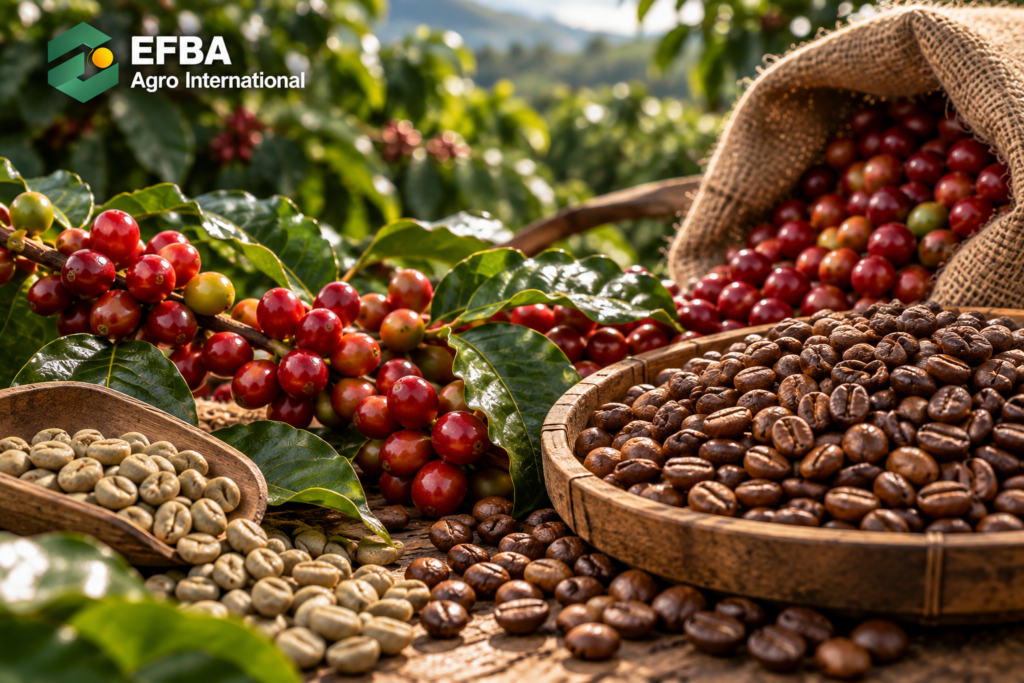
Indonesia remains an important origin for global coffee sourcing. The country supplies coffee with diverse origins, processing methods, grades, and sensory profiles, including Arabica from highland regions such as Aceh.
However, buying Indonesian coffee internationally requires more than selecting an origin and negotiating a price. Indonesian coffee supply risk can arise from harvest conditions, weather, regional availability, quality variation, post-harvest handling, logistics, documentation, and the supplier’s ability to meet agreed specifications.
For global buyers, understanding Indonesian coffee supply risk therefore requires looking beyond the country of origin. The key question is not simply “Can Indonesia supply coffee?” It is:
“Can the required coffee be supplied at the right specification, quantity, quality, timing, and commercial terms?”
A practical sourcing framework is:
Origin → Harvest → Availability → Processing → Quality → Sample → Specification → Packaging → Documentation → Logistics → Delivery
EFBA Agro International supplies Indonesian agricultural commodities for wholesale and export markets, including Indonesian coffee and Gayo Arabica from Aceh. Its published sourcing information emphasizes specifications, product matching, sample evaluation, quality requirements, packaging, and export-oriented supply. EFBA Agro International
What Are the Main Indonesian Coffee Supply Risks?
The main Indonesian coffee supply risks include seasonal availability, weather and crop conditions, inconsistent quality, specification mismatch, processing variation, price changes, limited lot availability, logistics delays, and supplier reliability.
These factors form the core of Indonesian coffee supply risk for international buyers. They do not mean Indonesian coffee is unreliable. Instead, coffee is an agricultural commodity, so buyers need a procurement system that recognizes natural production variability and manages commercial risk before shipment.
Use this framework:
Supply Risk → Quality Risk → Price Risk → Logistics Risk → Commercial Risk
Then evaluate each risk before confirming a large order.
For buyers, the objective is not to eliminate every possible Indonesian coffee supply risk. The objective is to identify risks early enough to prepare alternatives.
8 Indonesian Coffee Supply Risks Global Buyers Should Evaluate
1. Harvest and Seasonal Availability
Coffee supply follows agricultural cycles. Buyers cannot assume that every origin, grade, process, and volume remains equally available throughout the year.
Harvest timing influences fresh crop availability, while inventory from previous harvests may have different storage periods and commercial characteristics. Buyers looking for a specific origin or process therefore need to discuss availability before setting shipment schedules.
The risk becomes greater when procurement depends on a very narrow specification.
For example:
Specific Origin + Specific Process + Specific Grade + Large Volume + Short Lead Time = Higher Procurement Constraint
A buyer requiring only “Indonesian coffee” has more sourcing flexibility than a buyer requiring one specific Gayo Arabica grade, processing method, moisture specification, cup profile, and shipment date.
Risk mitigation: discuss expected volume, crop or harvest information, processing requirements, lead time, and shipment schedule early with the supplier.
When managing Indonesian coffee supply risk, buyers should also clarify whether the supplier can maintain availability throughout the expected purchasing period.
2. Weather Can Affect Coffee Production
Coffee production depends on environmental conditions throughout flowering, fruit development, harvest, and drying. Rainfall patterns, temperature, excessive rain during harvest, or unusually dry conditions can influence production and post-harvest operations.
The effect also varies by region. Indonesia has multiple coffee-producing areas with different elevations, climates, production systems, and harvest periods.
Therefore:
Weather Event ≠ Same Impact Across All Indonesian Coffee Origins
Global buyers should avoid assuming that weather disruption in one producing area represents the condition of the entire Indonesian coffee industry.
Instead, evaluate:
Weather → Origin → Harvest → Availability → Quality → Delivery
Risk mitigation: ask suppliers about the actual sourcing origin and current lot availability instead of relying only on national-level news.
This regional approach is important when evaluating Indonesian coffee supply risk because conditions can differ significantly between producing areas.
3. Coffee Quality Can Vary Between Lots
Coffee is not a manufactured commodity with perfectly identical characteristics from every harvest and lot. Origin, cultivar, cherry maturity, processing, fermentation, drying, sorting, storage, and other factors can create variation.
This makes quality consistency one of the most important components of Indonesian coffee supply risk for international buyers.
A specification should therefore define more than “premium Indonesian Arabica.”
Buyers should consider:
Origin → Process → Grade → Screen → Moisture → Defects → Cup Profile → Sample
EFBA Agro’s published guide for an Indonesian Arabica coffee supplier similarly recommends evaluating origin, variety, processing method, grade, moisture, defect specification, cup profile, packaging, MOQ, documentation, and lead time when selecting coffee for international sourcing. EFBA Agro International
Risk mitigation: establish measurable specifications and evaluate representative samples before confirming commercial volume.
4. Processing Differences Can Change the Final Cup
Indonesia uses several coffee processing methods, and processing can significantly influence sensory characteristics.
Washed, natural, and wet-hulled coffees should not be treated as interchangeable simply because they come from the same country or even the same producing region.
For buyers, this creates a potential mismatch:
Expected Flavor ≠ Actual Process ≠ Required Product
A roaster looking for a cleaner profile may require different specifications from a buyer seeking a heavier-bodied Indonesian coffee.
Therefore, confirm the processing method before purchasing.
Risk mitigation: include processing method in the product specification and evaluate the sample according to the intended roast profile and market application.
Processing variation should be included in the buyer’s Indonesian coffee supply risk assessment because the same origin can produce substantially different commercial products depending on post-harvest practices.
5. Moisture, Defects, and Post-Harvest Handling Matter
The coffee may originate from a good growing region, but poor post-harvest handling can still reduce commercial quality.
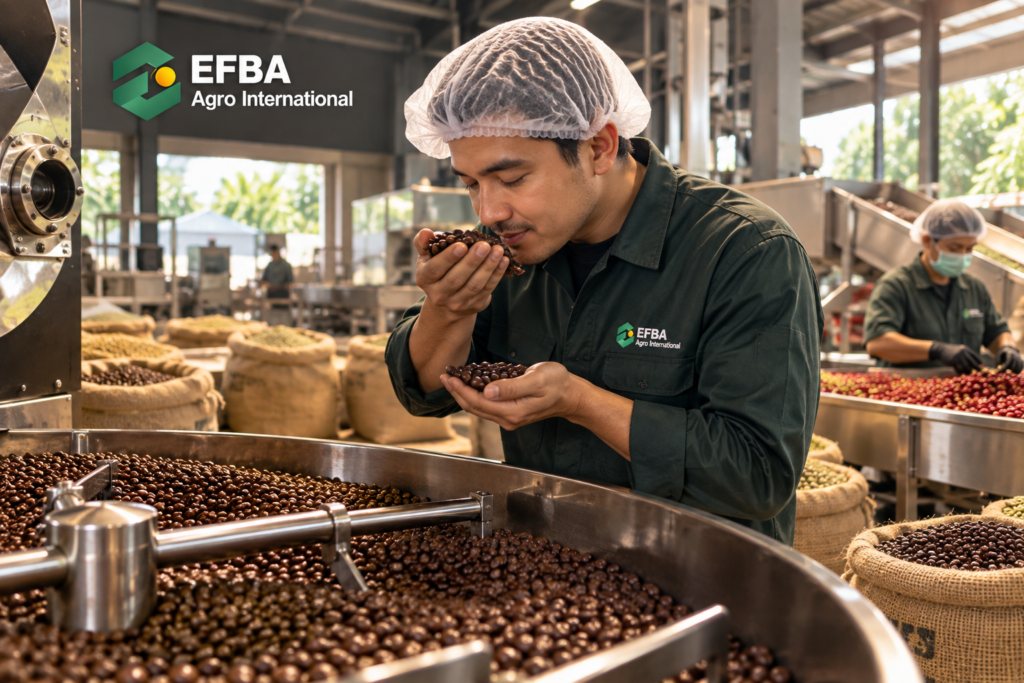
Drying, sorting, moisture control, storage, packaging, and handling influence the condition of green coffee before it reaches the buyer.
For this reason, procurement should follow:
Origin Quality → Processing → Drying → Sorting → Storage → Packaging → Shipment
Rather than:
Famous Origin → Automatically Good Coffee
For example, EFBA Agro publishes a Gayo Arabica Grade 1 product within its coffee portfolio and provides information about processing, screen size, defects, moisture, and sensory profile. These specifications demonstrate the type of information buyers should request, although actual commercial specifications still need confirmation for each available lot.
Risk mitigation: agree on measurable physical specifications and inspect or test samples before shipment.
For international buyers, post-harvest quality control is therefore another important part of Indonesian coffee supply risk management.
6. Coffee Prices Can Change
Coffee prices can move because of global market conditions, production expectations, weather, demand, inventory, currency movements, logistics costs, and origin-specific availability.
A buyer who requests a quotation but confirms the order much later may therefore face different commercial conditions.
Price risk becomes particularly important for companies with fixed retail prices or long-term contracts.
Use:
Green Coffee Cost → Freight → Import Cost → Roasting Cost → Final Cost → Margin
Buyers should calculate landed cost rather than evaluating supplier price alone.
Risk mitigation: clarify quotation validity, volume, payment terms, Incoterms, packaging, shipping terms, and what costs the quoted price includes.
Price volatility is an important component of Indonesian coffee supply risk, particularly when buyers need predictable margins over an extended period.
7. Logistics and Export Timing Can Affect Delivery
A coffee order is not complete when the beans leave the warehouse.
International supply involves several steps:
Preparation → Packing → Documentation → Inland Transport → Port → Export → Ocean/Air Freight → Import Clearance → Buyer
A delay at one stage can affect the final delivery date. Shipping schedules, container availability, port conditions, customs documentation, and destination requirements can all influence lead time.
This is especially important for roasters and distributors operating with tight inventory.
Risk mitigation: build buffer time into procurement planning and confirm documentation, packaging, shipment method, destination, and expected lead time before placing the order.
Logistics planning should therefore be part of every Indonesian coffee supply risk assessment before a commercial order is confirmed.
8. Supplier Reliability Is a Major Procurement Risk
A competitive price means little if the supplier cannot provide the agreed product consistently.
Global buyers should therefore evaluate whether a supplier can clearly explain product origin, specifications, available volume, sampling, packaging, documentation, and commercial process.
A practical supplier evaluation is:
Supplier → Product → Specification → Sample → Capacity → Documentation → Communication → Shipment
This principle also applies beyond coffee. EFBA Agro’s agricultural sourcing model focuses on matching buyer requirements with available commodities and specifications rather than treating agricultural products as completely standardized goods.
Risk mitigation: start with clear requirements and sample validation before moving toward larger commercial cooperation.
Supplier reliability is therefore a central part of Indonesian coffee supply risk, especially when buyers require repeat orders or long-term supply continuity.
Indonesia Remains Active in Global Coffee Trade
The latest BPS-Statistics Indonesia data confirms that coffee continues to represent a meaningful Indonesian agricultural export commodity.
BPS monthly agricultural export data recorded Indonesian coffee exports of approximately 208.1 thousand tonnes from January through July 2026. Monthly volume increased from 24.9 thousand tonnes in January to 49.7 thousand tonnes in July 2026. Badan Pusat Statistik Indonesia
In value terms, BPS recorded coffee exports of approximately US$1.008 billion from January through July 2026. July alone accounted for approximately US$221.4 million, compared with US$120.0 million in January. Badan Pusat Statistik Indonesia
These figures are based on Indonesian customs export documentation compiled by BPS. They demonstrate active international coffee trade, but they should not be interpreted as proof that every origin, grade, or lot is available at all times. Badan Pusat Statistik Indonesia
That distinction is important:
National Export Volume ≠ Specific Lot Availability
A buyer may see strong national export activity while still facing limited availability for a particular origin, grade, process, or quality requirement.
Official Indonesian Coffee Statistics Are Updated Regularly
BPS released its Indonesian Permanent Estate Crops Statistics 2025 on August 31, 2026 and revised the publication on September 16, 2026.
The publication includes coffee plantation area and production by province as well as export and import information. BPS combines its 2025 Estate Crops Establishment Survey with smallholder data from Indonesia’s Directorate General of Estate Crops, while international trade information comes from customs documents. Badan Pusat Statistik Indonesia
For global buyers, this reinforces an important sourcing principle:
Country Data → Origin Data → Supplier Availability → Lot Specification → Sample → Purchase Decision
National statistics provide market context. Actual procurement decisions require product-level verification.
Which Indonesian Coffee Supply Risks Matter Most to Buyers?
The answer depends on the buyer.
A specialty roaster may prioritize cup consistency, processing, origin, traceability, moisture, and defects. A distributor may focus more heavily on supply volume, packaging, landed cost, delivery schedule, and repeat availability.
A private-label business may require another combination:
Quality + Cost + Packaging + Supply Continuity + Lead Time
Therefore, buyers should rank risks according to their business model rather than use one universal checklist.
A simple matrix can help:
| Buyer Requirement | Main Risk to Check |
|---|---|
| Consistent cup profile | Lot and processing variation |
| Large volume | Availability and sourcing capacity |
| Fixed launch date | Lead time and logistics |
| Premium positioning | Origin, grade, quality and traceability |
| Stable margin | Price and landed cost |
| Repeat supply | Harvest and supplier continuity |
| Private label | Specification, packaging and timing |
The objective is to connect each business requirement with the Indonesian coffee supply risk that could prevent it from being achieved.
How Can Global Buyers Reduce Indonesian Coffee Supply Risk?
Start before the purchase order.
The strongest risk-control process is:
Requirement → Supplier Verification → Specification → Sample → Evaluation → Commercial Terms → Pre-Shipment Check → Logistics → Delivery
First, communicate the required origin, processing method, quality level, volume, packaging, and destination. Next, ask the supplier to confirm what can realistically be supplied.
Then request a representative sample when appropriate. Evaluate physical quality and cup characteristics before confirming larger commercial volume.
After quality approval, confirm:
Product + Quantity + Price + Packaging + Incoterm + Payment + Documentation + Lead Time + Destination
This approach reduces ambiguity between buyer and supplier and provides a practical framework for managing Indonesian coffee supply risk before the coffee enters international shipment.
Do Not Depend on the Lowest Price Alone
A lower purchase price does not automatically mean lower procurement cost.
Suppose a buyer receives cheaper coffee but later encounters inconsistent quality, delayed shipment, additional sorting, specification mismatch, or replacement costs. The effective cost may become higher.
Therefore, global buyers should compare:
Price + Quality + Consistency + Logistics + Communication + Risk
This is particularly important for businesses that depend on repeat orders.
Build a Coffee Supply Buffer
Buyers with recurring requirements should avoid waiting until inventory reaches a critical level before starting procurement.
A simple model is:
Current Stock → Average Usage → Lead Time → Safety Stock → Reorder Point
The appropriate safety stock depends on sales velocity, procurement lead time, storage capacity, coffee freshness strategy, and the consequences of stockouts.
For businesses purchasing from overseas, the procurement timeline should also account for export preparation and international transportation.
This gives buyers more room to respond when harvest, logistics, or availability changes.
Diversify Risk Without Losing Product Identity
Supply diversification does not necessarily mean replacing Gayo coffee with a completely different coffee whenever availability changes.
Buyers can first determine which attributes are non-negotiable.
For example:
Core Requirement: Indonesian Arabica + required quality level + approved cup profile.
Flexible Variables: exact lot, shipment timing, packaging configuration, or another approved sourcing option.
The level of flexibility depends on the product being sold. A single-origin coffee naturally requires tighter origin control than a blend.
Therefore, buyers should define:
Must Have → Preferred → Flexible
This makes contingency planning easier without compromising product positioning.
EFBA Agro Expertise in Indonesian Coffee Supply
EFBA Agro International publishes Indonesian agricultural commodities for wholesale and export markets, including coffee beans and Gayo Arabica coffee from Aceh.
Its existing Indonesian Arabica sourcing content specifically addresses factors relevant to international buyers, including origin, processing, specifications, moisture, defects, cup profile, traceability, packaging, samples, documentation, and lead time. Efba Agro International
This makes EFBA Agro’s role relevant at the procurement stage where buyer requirements need to become clear product specifications.
The sourcing flow can be summarized as:Buyer Requirement → Product Matching → Specification → Sample → Evaluation → Confirmation → Commercial Supply
For global buyers, this is more useful than beginning with a generic request such as “send your best Indonesian coffee.”
Instead, provide information such as: Origin → Process → Grade → Volume → Moisture → Defect Requirement → Cup Profile → Packaging → Destination
The clearer the requirement, the easier it becomes to determine whether the available coffee matches the intended use.
Why Gayo Arabica Matters for International Buyers
EFBA Agro publishes Indonesian Arabica Coffee Supplier content specifically around premium Gayo coffee for global buyers. The company identifies its Gayo Arabica supply as originating from the highlands of Aceh. Efba Agro International
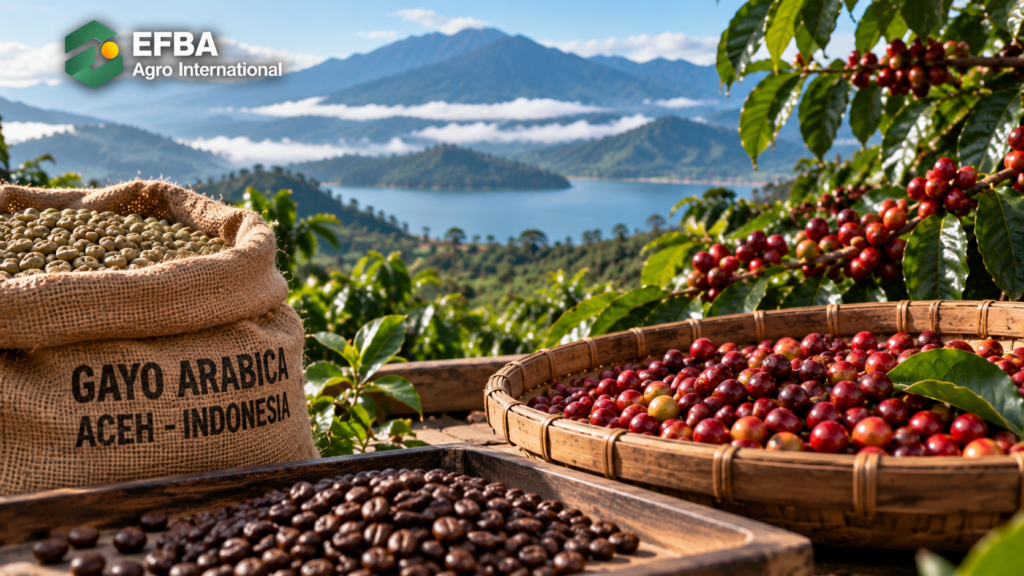
For buyers, however, “Gayo” should be the beginning of specification rather than the complete specification.
A better request is:
Gayo → Processing → Grade → Moisture → Defects → Screen → Cup → Volume → Packaging
This allows both sides to discuss a measurable commercial product.
The same principle applies to other Indonesian coffee origins. Origin communicates geographic identity, while specifications communicate what the buyer is actually purchasing.
EFBA Agro within the EFBA Business Ecosystem
EFBA Agro operates within the broader EFBA business ecosystem. The official EFBA Digital Mulia website identifies PT EFBA Digital Mulia as a business-solution company with activities that include business consulting and general business development. EFBA
For coffee buyers, however, the purchasing decision should remain product-based.
Use:
Company Verification → Product Verification → Sample → Commercial Verification → Order
Corporate information provides context about the supplier. It does not replace inspection of the actual coffee specification and commercial lot.
FAQ About Indonesian Coffee Supply Risk
What are the main Indonesian coffee supply risks?
The main risks include harvest and seasonal availability, weather, lot-to-lot quality variation, processing differences, moisture and defects, price changes, logistics delays, and supplier reliability. The level of risk varies by origin, product specification, required volume, and shipment schedule.
Is Indonesian coffee supply reliable for international buyers?
Indonesia has an established international coffee trade, with BPS recording approximately 208.1 thousand tonnes of coffee exports from January through July 2026. However, national export capacity does not guarantee continuous availability of every specific origin, process, grade, or lot. Badan Pusat Statistik Indonesia
Can weather affect Indonesian coffee supply?
Yes. Weather can influence flowering, cherry development, harvesting, drying, and regional production. However, the impact can differ between coffee-producing areas, so buyers should verify conditions at the specific sourcing origin.
Why can Indonesian coffee quality vary between shipments?
Coffee is an agricultural product. Quality can vary because of cultivar, cherry maturity, processing, fermentation, drying, sorting, moisture, storage, and lot composition. Clear specifications and representative samples help buyers manage this risk.
What specifications should coffee buyers request?
Buyers should consider origin, processing method, grade, moisture, defects, screen size, cup profile, harvest information, packaging, available volume, documentation, and lead time. Requirements should match the intended roasting and commercial application.
Should buyers request samples before ordering Indonesian coffee?
For quality-sensitive procurement, sample evaluation is an important risk-control step. A sample allows the buyer to assess physical condition and sensory suitability before committing to larger commercial volume.
How can importers reduce coffee supply disruption?
Importers can plan purchases earlier, maintain appropriate safety stock, monitor lead times, define acceptable specification flexibility, evaluate supplier communication, and prepare approved alternatives where the product allows them.
Is Gayo Arabica available from EFBA Agro?
EFBA Agro publishes Gayo Arabica from Aceh as part of its Indonesian coffee sourcing portfolio. Buyers should confirm current lot availability, volume, processing, specifications, packaging, and commercial terms directly before ordering. Efba Agro International
Does EFBA Agro supply coffee for international buyers?
EFBA Agro’s published coffee content targets international roasters, distributors, café chains, and importers and describes Indonesian agricultural commodities for wholesale and export markets. Efba Agro International
Reduce Coffee Supply Risk Before the Purchase Order
Indonesian coffee supply risk should not discourage global buyers from sourcing from Indonesia. It should encourage better procurement planning.
Indonesia continues to participate actively in international coffee trade. BPS recorded more than US$1 billion in coffee export value from January through July 2026, demonstrating the commercial scale of the sector. Badan Pusat Statistik Indonesia
However, a national export number cannot tell a buyer whether a specific Gayo Arabica lot will meet the required cup profile, moisture, defect level, quantity, packaging, and delivery schedule.
That requires a product-level sourcing process:
Requirement → Origin → Availability → Specification → Sample → Approval → Commercial Terms → Shipment
EFBA Agro International supplies Indonesian agricultural commodities for wholesale and export markets and publishes Gayo Arabica as part of its coffee portfolio. Global buyers can use EFBA Agro’s sourcing process to discuss requirements, specifications, samples, packaging, volume, and export needs before moving toward commercial cooperation. Efba Agro International
Looking for Indonesian coffee for international sourcing? Start with your required origin, process, grade, volume, packaging, destination, and expected shipment schedule so the supply requirement can be evaluated before commercial confirmation.
For broader business development within the EFBA ecosystem, visit PT EFBA Digital Mulia.