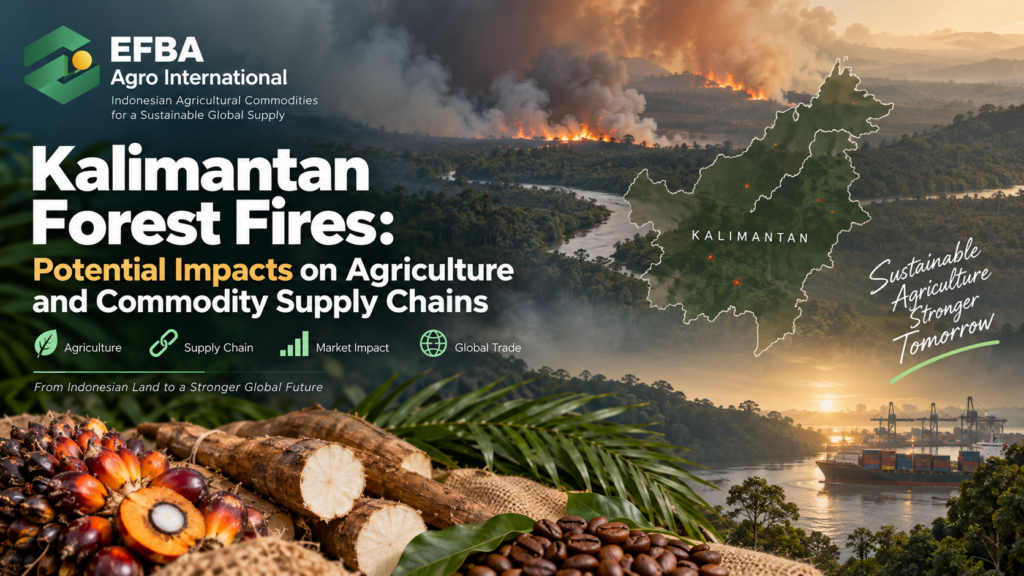
Forest and land fires in Kalimantan have returned to attention in September 2026. For agricultural businesses, global importers, exporters, and commodity buyers, the key question is clear: Are Kalimantan forest fires affecting agriculture and commodity supply chains in Indonesia?
The topic of Kalimantan forest fires agriculture has become increasingly relevant for companies monitoring Indonesian agricultural production, plantation exposure, logistics, and commodity availability. However, forest-fire reports should not automatically be interpreted as evidence of declining agricultural production because the actual impact depends on fire location, commodity origin, production exposure, and supply-chain conditions.
For global buyers, understanding Kalimantan forest fires agriculture therefore requires more than monitoring hotspot numbers. Companies should connect official environmental data with actual production areas, available stock, processing facilities, logistics routes, lead times, and shipment schedules before assessing the potential impact on Indonesian agricultural commodities.
How Could Kalimantan Forest Fires Affect Agriculture?
Kalimantan forest fires can potentially affect agriculture through direct and indirect channels. Direct exposure may occur when fires reach plantations, farms, storage facilities, or other agricultural areas. Meanwhile, indirect risks can arise from prolonged dry conditions, smoke, transportation constraints, worker activity, processing operations, or changes in logistics.
The impact of Kalimantan forest fires agriculture therefore depends on where fires occur and whether they directly or indirectly affect agricultural production and supporting infrastructure. A high number of hotspots does not mean that all agricultural production in Kalimantan is disrupted. Buyers should evaluate fire location, commodity origin, production exposure, current stock, processing status, logistics, and shipment schedules before determining the actual supply-chain impact.
A practical assessment can follow Forest Fires → Production Exposure → Agricultural Operations → Commodity Availability → Logistics → Delivery Risk. This approach helps global buyers distinguish regional environmental news from verified commodity supply conditions.
1. Latest Kalimantan Forest Fire Data
BMKG reported on September 22, 2026 that relatively dry atmospheric conditions remained across several Indonesian regions, particularly parts of Sumatra and Kalimantan. During the 10-day monitoring period through September 21, Central Kalimantan recorded the highest concentration with 5,283 high-confidence hotspots, followed by West Kalimantan with 1,357, South Kalimantan with 498, and East Kalimantan with 433.
These figures explain why Kalimantan forest fires agriculture remains an important topic for agricultural businesses and commodity procurement teams. Nevertheless, hotspot numbers alone cannot establish how many hectares of agricultural land have burned, which crops have experienced direct exposure, or whether agricultural production volumes have declined.
BMKG had also reported significant hotspot activity earlier in September. This pattern indicates that companies with supply exposure in Kalimantan should continue monitoring official updates while verifying conditions directly with producers, processors, exporters, and suppliers.
2. Why Does the Situation Matter for Agriculture?
Kalimantan contains extensive agricultural and plantation areas. Central Kalimantan provides a useful example because official BPS statistics identify oil palm and rubber as major smallholder plantation commodities in the province.
According to BPS data for 2024, smallholder oil palm in Central Kalimantan covered approximately 1.93 million hectares, with production of around 7.24 million tonnes. Rubber plantations covered approximately 432 thousand hectares, with production of around 178 thousand tonnes. These figures demonstrate the scale of plantation agriculture in a province that currently also records substantial hotspot activity.
Nevertheless, the presence of agricultural plantations and hotspots within the same province does not prove that those plantations have burned. Companies should avoid drawing that conclusion without location-specific evidence. A more reliable approach is to compare fire locations with production areas and then verify current production, available stock, processing conditions, and logistics.
3. What Crops Could Be Affected by Kalimantan Forest Fires?
Agricultural production differs across Kalimantan. In Central Kalimantan, oil palm and rubber represent two major plantation commodities based on planted area. Other agricultural activities also operate across the island, but production patterns vary between provinces, districts, and individual production areas.
For commodity buyers, this distinction matters because a regional fire event does not affect every crop in the same way. The location of plantations, farms, processing facilities, warehouses, and transportation routes can determine whether a particular commodity faces meaningful exposure.
A more accurate assessment should therefore connect Commodity → Origin → Production Area → Fire Exposure → Current Production → Available Supply. This method allows procurement teams to evaluate actual product conditions instead of assuming that every commodity from Kalimantan faces the same level of risk.
4. Do Hotspots Mean Agricultural Plantations Are Burning?
Not necessarily. A hotspot represents a detected heat anomaly that authorities use to monitor potential fire activity. Buyers should not automatically interpret each hotspot as a commercial plantation, farm, or specific crop that has burned.
For example, the 5,283 high-confidence hotspots recorded in Central Kalimantan do not mean that 5,283 plantations experienced fires. A reliable agricultural assessment requires information about fire location, proximity to plantations, actual crop exposure, current production conditions, and logistics.
Procurement teams can therefore follow Hotspot Data → Production Location → Actual Exposure → Supply Availability → Logistics → Shipment. This approach reduces the risk of making sourcing decisions based only on headline numbers.
5. Could Forest Fires Affect Commodity Production?
From a commodity sourcing perspective, Kalimantan forest fires agriculture becomes particularly relevant when environmental conditions begin to affect production, processing, transportation, or logistics. Fires may damage crops, surrounding agricultural land, infrastructure, or facilities when direct exposure occurs. At the same time, prolonged dry conditions can create operational challenges even when fires do not directly reach a plantation.
The impact can differ significantly between commodities and locations. One production area may experience direct exposure, while another area in the same province may continue operating normally. Therefore, buyers should request current production and availability information from suppliers before assuming that a regional fire event has created a commodity shortage.
Agricultural commodity supply chains typically involve several stages: Farm or Plantation → Collection → Processing → Warehouse → Inland Transportation → Port → Export Shipment. A disruption at one stage may extend lead times or require operational adjustments without necessarily creating a complete shortage.
6. Could Smoke and Dry Conditions Affect Agricultural Operations?
Agricultural supply chains depend on more than crop production. Farmers, processors, and exporters also rely on workers, collection activities, processing facilities, warehouses, inland transportation, ports, and shipment schedules. Smoke or prolonged dry conditions may therefore create operational pressure even when crops remain outside the direct fire area.
For international buyers, this distinction is important because production availability and logistics availability represent different indicators. A commodity may remain available at the production level while transportation, processing, or shipment faces temporary challenges.
Buyers should therefore ask not only “Is the plantation affected by fire?” but also “Are production, processing, logistics, and shipment operating normally?” These questions provide a more complete picture of actual commodity supply conditions.
7. Could Kalimantan Fires Disrupt Indonesian Commodity Exports?
Kalimantan forest fires do not automatically mean that Indonesian agricultural exports will face widespread disruption. Indonesia has agricultural production areas across many islands and provinces, while each commodity follows a different sourcing and logistics structure.
Buyers should therefore evaluate Commodity Origin → Available Stock → Processing → Logistics → Port → Lead Time → Shipment. If production areas, processing facilities, and transportation routes remain outside affected locations, the direct supply risk may remain limited.
On the other hand, when fires or smoke affect production or transportation, buyers may need to discuss stock availability, shipment schedules, alternative origins, or procurement planning with suppliers. The response should follow verified supply conditions rather than assumptions based on regional headlines.
8. Why Commodity Origin Matters
Commodity origin becomes especially important during regional environmental events. EFBA Agro International publishes information about Indonesian agricultural commodities including CPO, RBD Palm Olein, Granulated Arenga Palm Sugar, candlenut, coffee, tapioca products, and other agricultural commodities.
These products can originate from different production regions in Indonesia. Therefore, buyers should evaluate environmental risk according to the origin of the specific commodity rather than applying conditions in Kalimantan to the entire Indonesian agricultural sector.
In practical terms, Indonesia Origin ≠ Kalimantan Origin ≠ Fire-Affected Origin. Understanding this distinction helps international buyers make more accurate procurement decisions and avoid unnecessary assumptions about Indonesian commodity availability.
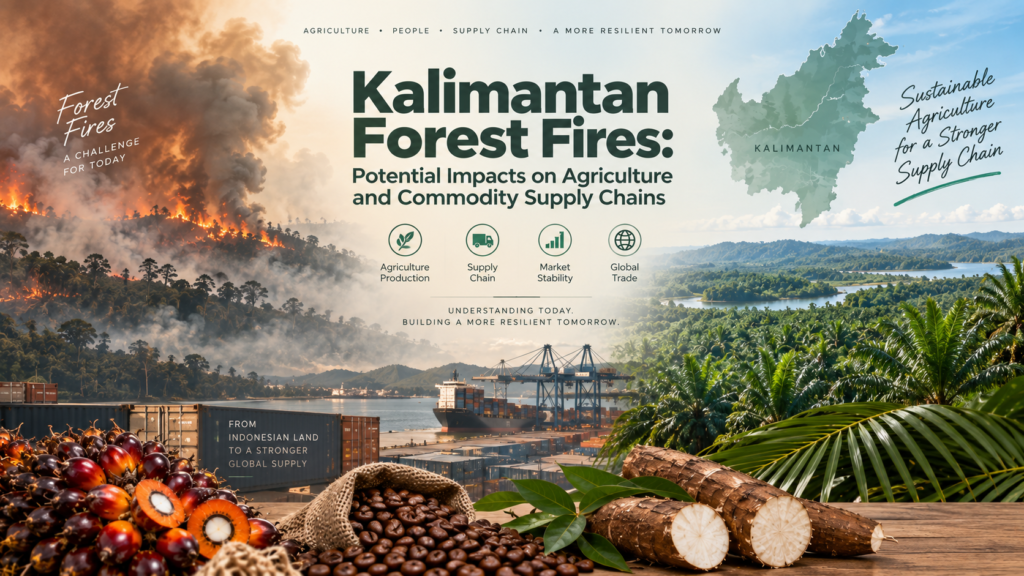
9. What Should Global Commodity Buyers Check?
When monitoring Kalimantan forest fires agriculture, global buyers should start with product-specific information rather than relying only on regional headlines. Important questions include: Where does the commodity come from? Is the production area close to reported fires? Is production operating normally? Is stock currently available? Are processing facilities operating? Are logistics routes open? What is the current lead time?
For procurement teams, Kalimantan forest fires agriculture risk becomes more relevant when fire or dry conditions have a measurable connection with the commodity being purchased. Buyers should therefore confirm product specifications, available volume, packaging, production status, logistics routes, shipment schedules, and alternative supply options. A useful procurement framework is Origin → Exposure → Available Stock → Processing → Logistics → Alternative Supply → Delivery Plan.
For example, EFBA Agro publishes detailed specifications for Granulated Arenga Palm Sugar, including information related to product characteristics, packaging, MOQ, and export supply. Product-level information gives buyers a more concrete basis for sourcing discussions than regional environmental headlines alone.
10. Are Indonesian Agricultural Commodities Still Available for Export?
Yes, Indonesian agricultural commodities may remain available for export even when forest and land fires occur in parts of Kalimantan. Availability needs to be checked product by product, origin by origin, and supplier by supplier because current forest-fire reports do not provide enough evidence to conclude that Indonesian agricultural commodities as a whole are unavailable for export.
In the context of Kalimantan forest fires agriculture, buyers should avoid assuming that environmental conditions in one region represent supply conditions across Indonesia. Global buyers should verify current production, available stock, product specifications, processing capacity, packaging, logistics, and shipment schedules. If one sourcing region experiences disruption, companies can also evaluate alternative origins where appropriate.
For businesses looking for an agricultural commodity supplier in Indonesia, EFBA Agro International publishes information about multiple agricultural commodities for commercial and export markets. Buyers can use product-specific information as a starting point before confirming current specifications, quantity, origin, packaging, availability, and shipment requirements.
11. How Can Buyers Reduce Commodity Supply Chain Risk?
Buyers can reduce uncertainty by improving visibility across the supply chain. This becomes particularly important when Kalimantan forest fires agriculture conditions raise questions about plantation exposure, production continuity, commodity availability, transportation, and export logistics.
Instead of relying only on national or regional news, procurement teams should verify commodity origin, supplier status, available inventory, processing capacity, logistics, and delivery schedules. During forest fires or other environmental disruptions, companies can follow Official Data → Commodity Origin → Actual Exposure → Current Stock → Logistics → Alternative Source → Delivery Plan → Monitoring.
This approach does not eliminate environmental risk. However, it gives buyers a clearer basis for deciding whether they should maintain an order, adjust delivery expectations, discuss alternative supply, or continue monitoring conditions. For global buyers, this is a more reliable way to evaluate Kalimantan forest fires agriculture than using hotspot numbers alone.
12. EFBA Agro Experience in Indonesian Agricultural Commodities
EFBA Agro International publishes a portfolio of Indonesian agricultural commodities for commercial markets. Its website includes agricultural products such as CPO, RBD Palm Olein, Granulated Arenga Palm Sugar, candlenut, and other commodities for domestic and international buyers.
During periods when Kalimantan forest fires agriculture becomes a concern for global buyers, product-specific sourcing information becomes increasingly important. Buyers need to distinguish commodities originating from potentially exposed areas from products sourced through other production regions in Indonesia.
EFBA Agro also publishes product-specific information designed for international buyers. Its Granulated Arenga Palm Sugar content provides commercial and product information, while buyers requiring bulk starch products can review EFBA Agro’s Tapioca Flour Bulk 50kg content for additional sourcing information.
These product pages demonstrate why commodity supply discussions should focus on origin, specifications, quantity, packaging, logistics, and current availability rather than making broad assumptions from regional environmental reports. This product-level approach also helps buyers understand whether reported forest fires have any direct relationship with the commodity they plan to source.
EFBA Agro does not position itself as a meteorological or forest-fire forecasting authority. For weather, hotspot, and forest-fire information, buyers should continue using official information from BMKG while using supplier-level information to verify actual commodity availability.
13. EFBA Business Experience in Supply and Operational Risk
Environmental conditions can create broader business questions involving procurement, operations, financial planning, and market strategy. The Kalimantan forest fires agriculture situation, for example, may encourage agricultural companies to review sourcing exposure, logistics alternatives, inventory planning, and operational continuity when their supply chains have a connection with affected areas.
Within the wider EFBA ecosystem, PT EFBA Digital Mulia’s Business Consulting service covers business planning, financial planning, market research, management, operations, human resources, and other areas of business development.
This expertise does not make EFBA a climate or forest-fire forecasting institution. Instead, it provides a business perspective for evaluating how external risks may connect with operations, financial planning, procurement decisions, and business strategy.
For agricultural companies, the decision framework can follow External Risk → Business Exposure → Operational Impact → Financial Impact → Priority → Alternative → Action Plan → Monitoring. This keeps environmental information separate from business analysis while allowing companies to connect both when making commercial decisions.
What Should Buyers Monitor During Kalimantan Forest Fires Agriculture Risks?
For global commodity buyers, monitoring Kalimantan forest fires agriculture requires a combination of official environmental information and supplier-level commercial data. Buyers should start with current BMKG information, identify the origin of the commodity, determine whether the production area has direct exposure, confirm available stock, review processing and logistics conditions, and verify the expected shipment schedule.
An effective Kalimantan forest fires agriculture monitoring process should connect environmental data with actual commercial conditions. The complete framework is Official Fire Data → Commodity Origin → Production Exposure → Available Stock → Processing → Logistics → Lead Time → Alternative Supply → Buyer Communication. BMKG provides environmental context, while producers, processors, suppliers, and exporters provide information about actual commodity availability.
This distinction strengthens sourcing decisions because hotspot data explain environmental risk, while supplier data explain actual supply conditions. Global buyers can therefore use official data to identify potential risk while relying on product-specific information to determine whether the situation has actually affected production, inventory, logistics, or delivery.
FAQ About Kalimantan Forest Fires and Agriculture
Are Kalimantan forest fires affecting agriculture?
Kalimantan forest and land fires can affect agriculture when fires directly reach production areas or when smoke, dry conditions, and logistics disruption interfere with agricultural operations. However, current hotspot data alone do not prove that agricultural production across Kalimantan has declined.
For companies monitoring Kalimantan forest fires agriculture, location-specific information remains essential. Buyers should verify commodity origin, production exposure, available stock, processing conditions, and logistics before determining the actual agricultural impact.
What does Kalimantan forest fires agriculture mean for global commodity buyers?
Kalimantan forest fires agriculture refers to the relationship between forest and land fire conditions in Kalimantan and their potential impact on agricultural production, plantations, processing, logistics, and commodity supply chains. For global buyers, the actual risk depends on commodity origin, production exposure, available stock, transportation conditions, and shipment schedules rather than hotspot numbers alone.
Understanding Kalimantan forest fires agriculture is especially relevant for procurement teams sourcing commodities from areas with potential fire exposure. Instead of assuming a regional supply disruption, buyers should connect official fire information with the specific origin and supply chain of the commodity being purchased.
How many hotspots are there in Kalimantan in September 2026?
BMKG reported on September 22, 2026 that the 10-day monitoring period through September 21 recorded 5,283 high-confidence hotspots in Central Kalimantan, 1,357 in West Kalimantan, 498 in South Kalimantan, and 433 in East Kalimantan.
These figures represent hotspot detections, not the number of plantations, farms, or crops damaged by fire. Therefore, companies evaluating Kalimantan forest fires agriculture should not use hotspot totals as direct measurements of agricultural losses.
What crops could be affected by Kalimantan forest fires?
Potential exposure depends on the exact location of the fires. Oil palm and rubber are important plantation commodities in Central Kalimantan, but hotspot data alone cannot establish whether those crops have suffered damage.
In a Kalimantan forest fires agriculture assessment, buyers need plantation-level or production-area information before drawing conclusions about crop losses, production changes, or commodity availability.
Are oil palm plantations in Kalimantan affected by forest fires?
Some plantations could face exposure when fires occur nearby, but current hotspot totals do not prove widespread oil palm damage. Companies should verify fire location, plantation location, current production, available stock, and logistics before assessing the actual impact.
For this reason, Kalimantan forest fires agriculture data should be combined with plantation-specific information rather than interpreted as evidence that the entire oil palm sector in Kalimantan faces disruption.
Could Kalimantan forest fires cause commodity shortages?
A shortage is possible if fires materially affect production, processing, inventory, or transportation. However, hotspot reports alone cannot establish a commodity shortage. Buyers should verify current production, stock availability, processing capacity, logistics, and shipment schedules.
The commercial impact of Kalimantan forest fires agriculture therefore depends on whether environmental conditions actually reach the production and supply chain of a particular commodity.
Could Kalimantan Fires Disrupt Indonesian Agricultural Exports?
Not necessarily. Indonesia has multiple agricultural production regions, and each commodity has a different supply chain. Buyers should check commodity origin, available stock, processing status, logistics routes, port access, lead times, and shipment schedules before determining export risk.
Even when Kalimantan forest fires agriculture creates regional supply concerns, those conditions should not automatically be applied to agricultural commodities originating from other parts of Indonesia.
Are Indonesian Agricultural Commodities Still Available for Export?
Availability varies by commodity, origin, supplier, volume, and current logistics conditions. Buyers should contact suppliers to confirm current stock and shipment capability rather than assuming that forest fires in one region have disrupted all Indonesian agricultural exports.
For buyers monitoring Kalimantan forest fires agriculture, the most useful information is the actual origin, current inventory, processing status, logistics route, and expected delivery schedule of the commodity they intend to purchase.
How Can Global Buyers Find Agricultural Commodity Suppliers in Indonesia?
Buyers should compare suppliers based on commodity origin, specifications, available volume, quality requirements, packaging, documentation, logistics capability, and export support. EFBA Agro publishes product information for several Indonesian agricultural commodities and provides specifications for selected products intended for commercial and export markets.
During periods of increased Kalimantan forest fires agriculture risk, buyers can also ask suppliers whether their commodity origin, production facilities, inventory, or logistics routes have direct exposure to affected areas.
Kalimantan Forest Fires Agriculture: Monitor the Risk, Verify the Supply
The September 2026 forest and land fire situation in Kalimantan deserves attention from agricultural businesses, importers, exporters, and commodity procurement teams. BMKG continues to report relatively dry conditions and substantial hotspot activity, particularly in Central Kalimantan.
However, Kalimantan forest fires agriculture should always be evaluated using product-specific and location-specific information. Hotspots do not automatically mean crop damage, lower production, commodity shortages, higher commodity prices, or interrupted Indonesian agricultural exports.
For companies following Kalimantan forest fires agriculture, the practical approach is Official Data → Commodity Origin → Actual Exposure → Available Supply → Processing → Logistics → Delivery Plan. This process provides a clearer picture of whether environmental conditions have actually affected the commodity being sourced.
Companies sourcing Indonesian agricultural commodities can review EFBA Agro International to explore relevant commodity information and then confirm product specifications, origin, current availability, required volume, packaging, and export requirements before making procurement decisions. This approach helps buyers distinguish regional environmental risks from actual commodity supply conditions.
Companies looking for Indonesian agricultural commodities for wholesale and export can explore EFBA Agro International and review relevant product information before discussing specifications, origin, volume, packaging, current availability, and shipment requirements. For broader business planning and operational evaluation, companies can also review PT EFBA Digital Mulia’s Business Consulting services.