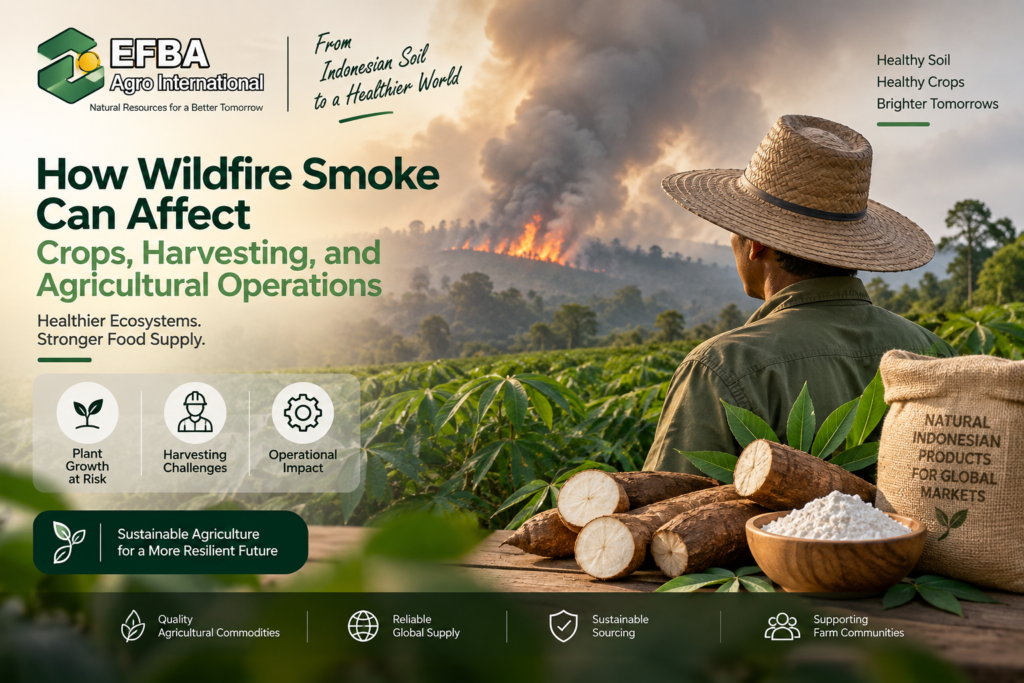
Wildfires are once again drawing attention across Indonesia in September 2026. Forest and land fires have been reported across multiple provinces, while authorities continue ground suppression, hotspot monitoring, and aerial operations in priority areas.
For agriculture, the concern extends beyond fields directly exposed to fire. Wildfire smoke agriculture risks can also emerge when smoke travels into farming regions, reducing sunlight, influencing plant physiological responses, exposing outdoor workers to particulate pollution, and complicating harvesting or logistics.
However, the effects are not identical for every crop. Smoke concentration, exposure duration, crop species, growth stage, weather, soil moisture, and distance from the fire can all influence the outcome.
For agricultural producers and commodity buyers, understanding wildfire smoke agriculture risks is therefore important for crop monitoring, harvesting, quality control, worker safety, and supply-chain risk management.
Does Wildfire Smoke Affect Agriculture?
Yes. Wildfire smoke can affect agricultural systems even when flames never reach a farm.
Smoke contains gases and fine particles that can alter incoming solar radiation. Plants depend on photosynthetically active radiation for photosynthesis, so changes in the amount and distribution of light can influence plant function.
Heavy smoke can reduce direct sunlight. In contrast, lighter smoke may increase the amount of diffuse light that reaches shaded leaves.
The result is not always a simple “smoke equals lower yield” relationship.
Under certain conditions, light smoke can increase the proportion of diffuse radiation and potentially improve canopy light-use efficiency. Dense or prolonged smoke, however, can reduce total available light enough to suppress photosynthesis.
Plant species, canopy characteristics, smoke density, and exposure duration can also influence the response.
A practical wildfire smoke agriculture framework is:
Wildfire → Smoke Concentration → Light & Air Quality Changes → Plant Response → Harvest & Quality Risk → Agricultural Operations
This framework helps explain why agricultural businesses should assess actual exposure conditions rather than assume every smoke event produces the same effect.
Indonesia’s Wildfire Situation in September 2026
The issue is particularly relevant because forest and land fires, or karhutla, remain active in parts of Indonesia.
On 17 September 2026, Indonesia’s National Disaster Management Agency (BNPB) reported that forest and land fires were still occurring in several regions. BNPB recorded approximately 20,015.35 hectares of burned land in Riau from 1 January through 16 September 2026 and approximately 3,048.68 hectares in Jambi.
In Central Kalimantan, monitoring had identified 6,435 hotspots at different confidence levels.
Earlier, BNPB reported that wildfire management was a priority across Riau, Jambi, South Sumatra, Central Kalimantan, South Kalimantan, and West Kalimantan.
In South Sumatra alone, the reported burned area had reached approximately 1,926.23 hectares as of 3 September 2026, while air quality in some areas ranged from moderate to very unhealthy.
Recent incidents are not limited to Sumatra and Kalimantan. BNPB’s 14–16 September updates also reported fires in parts of Java, Sulawesi, and other areas. For example, approximately 478 hectares had burned around Mount Butak in East Java by the 14 September update.
These figures describe reported fire conditions, not agricultural losses.
They should not be interpreted as evidence that Indonesia’s entire agricultural production or commodity supply is currently disrupted.
However, the current situation provides a strong reason for agricultural businesses to include wildfire smoke agriculture exposure in seasonal supply-risk monitoring.
How Wildfire Smoke Agriculture Risks Can Affect Photosynthesis
One of the most important connections between wildfire smoke agriculture and crop performance involves sunlight.
Plants require photosynthetically active radiation, or PAR, to perform photosynthesis. Smoke aerosols absorb and scatter solar radiation, changing both the total amount of light that reaches vegetation and the balance between direct and diffuse light.
Under relatively light smoke, increased diffuse radiation can reach leaves deeper inside a plant canopy. In some environments, this effect may improve how efficiently the whole canopy uses available light.
However, this potential benefit has limits.
When smoke becomes sufficiently dense, the reduction in total incoming radiation can outweigh the potential advantage of additional diffuse light.
Research from UC Davis illustrates this distinction. Scientists studying almond, pistachio, and walnut orchards found that heavy megafire smoke reduced tree carbohydrate reserves. According to the researchers, increased diffuse light during the smoke event was insufficient to compensate for the loss of direct light.
Therefore, agricultural businesses should avoid simplistic assumptions about smoke exposure.
Light smoke and dense, prolonged smoke can produce very different plant responses.
For this reason, a wildfire smoke agriculture assessment should consider smoke intensity, exposure duration, crop characteristics, weather conditions, and growth stage together.
Smoke Can Affect Plant Physiology Beyond Sunlight
Wildfire smoke is more than a visual haze.
According to the U.S. CDC’s National Institute for Occupational Safety and Health, wildland fire smoke is a complex mixture containing particulate matter and gases, including carbon monoxide, carbon dioxide, hydrocarbons, benzene, acrolein, and aldehydes.
Scientists continue to study how this mixture affects different plant species.
A 2024 study of ponderosa pine found evidence that wildfire smoke can influence plant physiology and leaf-atmosphere gas exchange. Researchers observed smoke-related effects on photosynthesis and stomatal function while emphasizing that responses can vary according to smoke intensity and duration.
Historical research also provides relevant context for Indonesia.
A study examining smoke haze from the 1997 Indonesian forest fires found reductions in photosynthetically active radiation and photosynthesis across three tree species. Researchers associated the response with reduced light, aerosols, and atmospheric pollutants.
However, research from 1997 does not provide evidence of current crop losses in 2026.
Instead, it demonstrates that researchers have previously documented smoke-related effects on plant function under Indonesian haze conditions.
For current wildfire smoke agriculture risk assessment, businesses still need crop-specific and location-specific monitoring.
Can Wildfire Smoke Reduce Crop Yield?
Potentially, yes, but the magnitude can vary substantially.
One of the clearest recent examples comes from orchard research in California. UC Davis researchers studied almond, pistachio, and walnut trees across 467 orchard sites from 2018 to 2022.
Their research found that exposure associated with the severe 2020 wildfire season reduced tree carbohydrate reserves, with effects continuing after the fires ended. The study reported nut yield reductions ranging from 15% to as much as 50% in some orchards.
However, buyers and producers should interpret these figures carefully.
The results should not be transferred directly to cassava, coffee, palm sugar, or other Indonesian commodities. Crop characteristics, climate, fire intensity, smoke concentration, exposure duration, and production systems differ substantially.
Instead, the research supports a broader wildfire smoke agriculture principle: sufficiently severe smoke exposure can affect plant energy storage and potentially influence later productivity.
That makes crop-specific monitoring essential.
What About Cassava and Other Indonesian Crops?
For cassava, current scientific evidence does not justify claiming that wildfire smoke will reduce Indonesian cassava production by a specific percentage.
The same caution applies when discussing other Indonesian commodities without crop-specific evidence.
A wildfire event in one province does not automatically indicate disruption to cassava, coffee, candlenut, palm sugar, or other commodities produced elsewhere.
Instead, agricultural businesses should examine several factors:
Crop → Production Area → Fire Location → Smoke Exposure → Growth Stage → Harvest Timing → Quality → Supply Availability
This approach is particularly important for international commodity buyers.
For example, a buyer sourcing cassava derivatives should verify the actual production area, current raw-material availability, processing capacity, inventory, specifications, and logistics instead of assuming that national wildfire headlines automatically indicate a cassava shortage.
The same principle applies to coffee and other agricultural products.
Wildfire Smoke Agriculture Risks Extend Beyond Crop Physiology
The relationship between wildfire smoke agriculture and agricultural operations does not stop with photosynthesis or yield.
Smoke can also affect outdoor working conditions.
Agricultural workers may spend long periods outdoors during harvesting, crop maintenance, loading, transportation, and other activities. When smoke increases particulate pollution, employers and workers need to pay closer attention to current air-quality conditions and occupational exposure.
Logistics may also face indirect effects.
Poor visibility, local road conditions, firefighting operations, temporary access restrictions, or changes in harvesting schedules can complicate the movement of agricultural commodities even when crops themselves remain unaffected.
Therefore, supply-chain monitoring should consider both production and operational conditions.
A useful framework is:
Crop Condition → Worker Safety → Harvest → Processing → Transport → Delivery
This broader perspective prevents businesses from reducing wildfire smoke agriculture risk to crop yield alone.
What Should Agricultural Producers Monitor During Wildfire Events?
Agricultural producers should begin with location-specific information.
First, determine whether fires or smoke actually affect the production area. Next, monitor air quality, weather, rainfall, wind direction, crop conditions, and harvest schedules.
Producers should also inspect plants directly rather than relying only on regional headlines.
Visible changes do not automatically prove smoke damage, but field observations can help identify conditions that require further agronomic assessment.
For commodities approaching harvest, teams should also monitor quality, processing requirements, storage, and transportation.
The objective is to create a clearer connection between environmental conditions and actual agricultural operations.
What Should Commodity Buyers Ask Suppliers?
International buyers should avoid assuming that wildfire reports automatically mean a supply shortage.
Instead, ask suppliers for current information.
Important questions include the production origin, current harvest status, raw-material availability, processing capacity, inventory, quality specifications, packaging, lead time, and logistics conditions.
Buyers can use the following sequence:
Fire Information → Production Area → Supplier Verification → Product Availability → Specification → Logistics → Delivery
When sourcing from Indonesia during periods of elevated wildfire activity, this approach provides a more useful basis for procurement decisions than national headlines alone.
A supplier should also communicate changes when environmental conditions begin to affect availability, production schedules, or delivery expectations.
Wildfire Risk Should Become Part of Supply-Chain Monitoring
Agricultural businesses cannot control weather, drought, wildfires, or smoke movement.
However, they can improve how they monitor and respond to those risks.
Companies can connect environmental monitoring with procurement and inventory planning through:
Environmental Risk → Crop Monitoring → Supplier Communication → Inventory → Logistics → Contingency Planning
For strategically important commodities, buyers may also review alternative production areas, shipment timing, inventory levels, and sourcing options.
The goal is not to assume disruption.
Instead, businesses should identify changes early enough to make informed procurement decisions.
This approach makes wildfire smoke agriculture monitoring part of broader agricultural supply-chain resilience.
Wildfire Smoke Agriculture Requires Evidence, Not Assumptions
Wildfires can affect agriculture through several pathways, but the effects vary according to location, crop, smoke concentration, duration, weather, and growth stage.
Scientific research shows that smoke can alter solar radiation and plant physiological processes. Under severe conditions, researchers have also documented effects on carbohydrate reserves and subsequent productivity in certain crops.
However, evidence from one crop or country should not automatically become a prediction for another agricultural system.
For Indonesia in September 2026, active forest and land fires provide a reason for closer monitoring. They do not prove that all agricultural commodities currently face production or supply disruption.
The more responsible approach is:
Monitor → Locate → Assess Exposure → Inspect Crop → Verify Supply → Communicate → Respond
For producers, this means monitoring actual crop and operational conditions.
For buyers, it means verifying sourcing areas, availability, specifications, processing capacity, and logistics with suppliers.
Ultimately, effective wildfire smoke agriculture risk management depends on evidence at the crop, location, and supply-chain level rather than assumptions based on wildfire headlines alone.
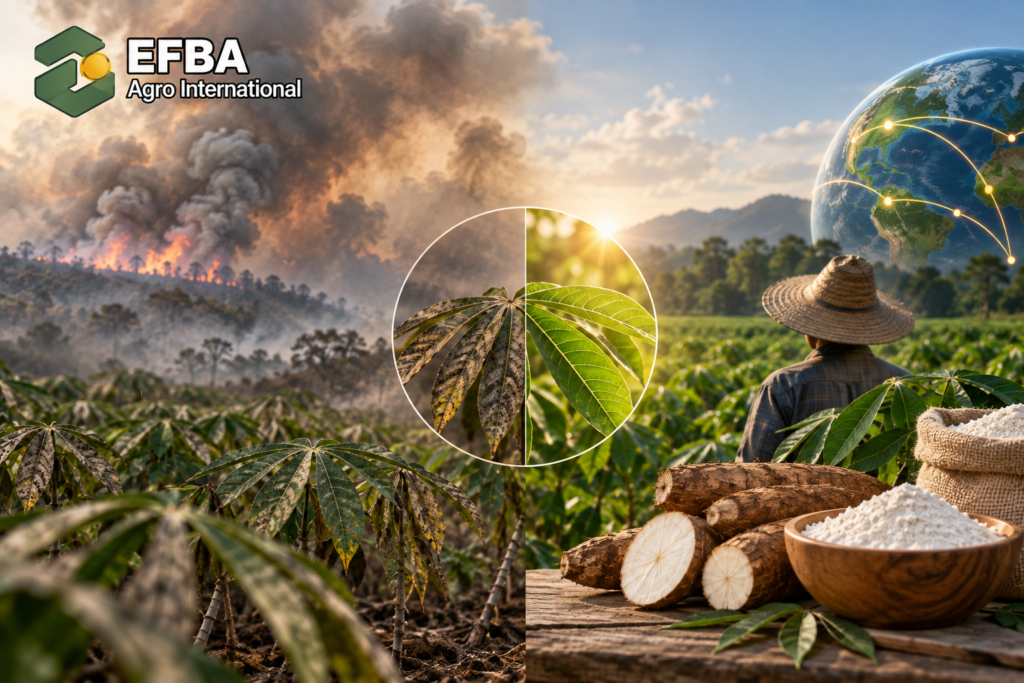
That distinction is important.
Cassava depends on photosynthesis for biomass accumulation and root development. However, the actual effects of smoke depend on factors such as smoke density, exposure duration, plant growth stage, moisture availability, temperature, and other environmental conditions.
For this reason, a cassava supplier should not automatically classify a harvest as compromised simply because wildfire smoke occurs somewhere within the same province or region.
Instead, suppliers should assess actual field conditions, production locations, crop development, and relevant quality parameters.
The same principle applies to commodities such as coffee.
Smoke around coffee-producing regions does not automatically indicate unsafe or lower-quality beans. Buyers need information about the actual production area, exposure conditions, harvesting process, post-harvest handling, storage, specifications, and quality controls before reaching conclusions.
This distinction is fundamental when evaluating wildfire smoke agriculture risks because regional fire activity does not automatically translate into product-level disruption.
Wildfire Smoke Agriculture Risks Can Affect Harvesting Operations
The agricultural impact of wildfire smoke extends beyond plants.
Harvesting frequently requires workers to spend long periods outdoors. The CDC/NIOSH explains that wildfire smoke can present a significant health hazard to outdoor workers because it contains fine particles and multiple gases.
For agricultural operations, deteriorating air quality can influence field schedules.
When smoke affects working areas, farms may need to adjust working hours, limit prolonged outdoor exposure, apply appropriate protective measures according to relevant occupational guidance, or postpone certain activities when necessary.
The operational relationship can follow:
Wildfire Smoke → Worker Exposure → Harvesting Adjustment → Operational Delay → Supply-Schedule Risk
This does not mean every smoke event will stop harvesting.
Instead, wildfire smoke agriculture risk management should include worker safety as part of operational decision-making when air quality deteriorates.
Smoke and Ash Can Complicate Product Quality Management
Smoke and ash can also create practical concerns after harvest.
Agricultural suppliers may need to increase attention to cleaning, sorting, drying, storage, packaging, and transportation when production areas experience nearby fires or heavy haze.
The appropriate controls depend on the commodity.
Fresh cassava, processed cassava flour, coffee cherries, green coffee beans, dried cascara, spices, and other agricultural products follow different processing routes and may face different exposure risks.
Therefore, suppliers should base quality decisions on product-specific specifications and actual inspection, rather than assumptions based solely on regional wildfire news.
For international buyers, documentation also becomes particularly important.
Information about product origin, specifications, processing, packaging, quality controls, and logistics helps buyers assess wildfire smoke agriculture risks more objectively.
Wildfires Can Create Agricultural Supply-Chain Risks
Even when crops remain commercially usable, wildfire events can indirectly affect agricultural operations.
Fire and smoke can restrict road access, interrupt harvesting schedules, reduce outdoor working hours, disrupt local transportation, or create uncertainty around production timing.
The risk chain can look like this:
Wildfire → Smoke/Access Risk → Harvesting → Processing → Quality Control → Transport → Export Schedule
This is why commodity buyers should evaluate more than the physical condition of the crop.
Supplier reliability increasingly depends on the ability to manage the complete supply process. During wildfire events, communication about sourcing, harvesting, processing, inventory, and logistics becomes particularly important.
A comprehensive wildfire smoke agriculture assessment should therefore consider both crop conditions and operational continuity.
What Should Agricultural Buyers Monitor During Wildfire Season?
Buyers sourcing commodities from areas affected by seasonal fires should avoid making purchasing decisions based only on headlines or hotspot maps.
A hotspot does not automatically indicate that a specific farm, warehouse, processing facility, or shipment has experienced disruption.
Instead, buyers should confirm the actual sourcing location, harvest timing, product specifications, processing status, storage conditions, packaging, and planned logistics.
Use the following sourcing framework:
Origin → Harvest → Processing → Quality Specification → Storage → Packaging → Logistics → Documentation
This approach creates greater transparency and makes supply-risk discussions more objective.
For wildfire smoke agriculture monitoring, buyers should connect regional environmental information with actual supplier and product conditions before changing procurement decisions.
Legal Compliance, Safety, Transparency, Quality, and Buyer Trust
Wildfire-related supply risks also demonstrate why agricultural trade depends on more than product availability.
The relationship can follow:
Legal Compliance → Safety → Quality Control → Transparency → Traceable Information → Buyer Trust
Legal compliance provides a framework for conducting business and trade according to applicable requirements.
Safety helps protect workers and supports appropriate handling of agricultural products.
Quality control allows suppliers to verify whether commodities meet agreed specifications instead of relying on appearance or assumptions.
Meanwhile, transparency gives buyers clearer information about product origin, specifications, processing, packaging, logistics, and potential limitations.
Together, these factors support buyer trust.
This becomes especially important during environmental events. Suppliers should avoid claiming that a commodity is “unaffected by wildfire” unless they have sufficient evidence to support the statement.
For B2B agricultural trade, transparent uncertainty is more credible than unsupported certainty.
This principle also strengthens wildfire smoke agriculture risk management because buyers can make better decisions when suppliers communicate what they know, what they have verified, and what still requires assessment.
EFBA Agro International: Indonesian Agricultural Commodities
EFBA Agro International publishes a portfolio of Indonesian agricultural commodities through its official website.
The company’s current portfolio includes Food Grade Tapioca Flour, Modified Cassava Flour (MOCAF), Gayo Arabica Coffee, Cascara, Candlenut, and other agricultural commodities.
The company states on its website that it works with farms, plantations, and local farmers within its sourcing network. EFBA Agro also describes an export process that covers packaging, documentation, and international delivery arrangements.
These descriptions come from the company itself. Buyers should therefore verify the relevant requirements, availability, specifications, documentation, and commercial terms for each shipment.
Cassava represents an important part of EFBA Agro’s published portfolio.
The company presents cassava-based products including fresh cassava, cassava chips, cassava starch, MOCAF, and tapioca flour.
For example, EFBA Agro’s published MOCAF specifications list maximum moisture of 12%, maximum ash content of 1.0%, minimum protein of 1.5%, minimum whiteness of 85%, pH of 4.5–6.5, and HCN below 10 ppm.
These figures represent EFBA Agro’s published product specifications. Buyers should reconfirm the applicable specifications for a particular order before entering a commercial agreement.
Modified Cassava Flour (MOCAF) – EFBA Agro
This distinction matters when discussing wildfire smoke agriculture risks.
A supplier’s role extends beyond stating that commodities remain available. Buyers also need product specifications, sourcing information, packaging requirements, quality information, availability, and logistics details to evaluate procurement risks more carefully.
Building Agricultural Supply Resilience
Commodity suppliers cannot eliminate wildfire risk.
However, agricultural supply chains can improve resilience when suppliers and buyers make sourcing decisions using timely and relevant information.
For suppliers, this means monitoring sourcing conditions, maintaining communication with production partners, confirming product quality, and providing realistic delivery expectations.
Buyers should also evaluate suppliers based on more than price.
A useful framework is:
Source → Specification → Quality → Documentation → Packaging → Logistics → Communication
This approach becomes increasingly important when environmental conditions introduce uncertainty into agricultural production.
Integrating wildfire smoke agriculture monitoring into procurement also helps buyers distinguish between regional environmental risk and actual disruption to a specific commodity.
For critical products, companies can additionally monitor sourcing regions, inventory levels, lead times, logistics, and alternative supply options.
The objective is not to assume that disruption will occur. Instead, businesses should improve their ability to respond when actual conditions begin to change.
Wildfire Smoke Agriculture Does Not Automatically Mean Supply Failure
The most important conclusion is that wildfire smoke agriculture should represent a risk factor, not an automatic verdict on crop quality or availability.
Heavy or prolonged smoke can reduce sunlight, influence photosynthesis, affect plant physiology, and under some documented conditions reduce crop productivity. Smoke can also create occupational risks for farm workers and operational challenges during harvesting.
However, crop responses vary according to species, smoke concentration, exposure duration, weather, plant growth stage, and local environmental conditions.
That distinction is particularly important in Indonesia in September 2026.
BNPB continues to report forest and land fires across multiple regions. However, those reports alone do not establish that all Indonesian agricultural areas or export commodities face disruption.
Buyers should therefore avoid both extremes: ignoring wildfire risks entirely or assuming that Indonesian commodities are broadly compromised.
A more reliable approach is:
Monitor → Verify → Inspect → Document → Communicate
Producers can use this process to monitor actual crop and operational conditions. Buyers can apply the same principle when checking sourcing areas, product availability, specifications, processing capacity, quality, and logistics.
For businesses sourcing Indonesian agricultural commodities, EFBA Agro International publishes information about cassava-based products, MOCAF, tapioca flour, Gayo Arabica coffee, cascara, and other commodities.
For broader information about the EFBA business ecosystem:
Ultimately, effective wildfire smoke agriculture risk management does not require businesses to claim that agricultural commodities are immune to environmental risks.
Instead, buyers and suppliers need a procurement process where origin, product specifications, quality, documentation, logistics, and communication provide enough transparency to support informed sourcing decisions.

FAQ About Wildfire Smoke and Agriculture
Can wildfire smoke damage crops?
Yes, sufficiently dense or prolonged wildfire smoke can affect plants by reducing incoming solar radiation and influencing photosynthesis and plant physiology. However, the effect varies by plant species, smoke intensity, exposure duration, weather, and growth stage.
Does wildfire smoke always reduce photosynthesis?
No. Smoke scatters light as well as absorbing it. Moderate smoke can increase diffuse light reaching shaded leaves, which under some conditions can improve canopy photosynthesis. Dense smoke, however, may reduce total available light enough to outweigh this benefit.
Can wildfire smoke reduce crop yields?
It can under some conditions. UC Davis research found substantial yield reductions in some California nut orchards following severe megafire smoke exposure. However, those results should not be directly applied to different crops or Indonesian production systems without crop-specific evidence.
Does wildfire smoke affect cassava?
There is not enough evidence to assign a specific yield-loss percentage to Indonesian cassava simply because wildfire smoke occurs nearby. Actual risk should be evaluated based on smoke intensity, duration, crop stage, weather, field conditions, and post-harvest quality.
Can smoke affect agricultural workers?
Yes. CDC/NIOSH identifies wildland fire smoke as a potential major health hazard for outdoor workers and recommends reducing worker exposure when conditions are hazardous.
Are Indonesian agricultural exports currently affected by wildfires?
Wildfires are active in several Indonesian regions as of September 2026, but official wildfire reports do not establish that all agricultural production or exports are affected. The impact needs to be evaluated by specific sourcing area, commodity, harvest period, and supply chain.
What should international buyers ask agricultural suppliers during wildfire season?
Buyers should confirm sourcing location, harvest timing, specifications, processing conditions, storage, packaging, quality inspection, documentation, and logistics schedules. These provide a more reliable basis for procurement decisions than regional fire reports alone.