Forest and land fires are again receiving significant attention in Indonesia, particularly as hotspot activity rises across parts of Kalimantan. Beyond the immediate impact of smoke and vegetation loss, the relationship between forest fire soil quality and agricultural productivity deserves closer attention.
On September 15, 2026, Indonesia’s Ministry of Forestry reported 1,437 high-confidence hotspots nationwide, compared with 592 the previous day. Central Kalimantan recorded 689 high-confidence hotspots, making it one of the main areas requiring intensified fire-control operations.
Beyond smoke and visible vegetation loss, another important issue receives less attention: what happens underneath the burned land?
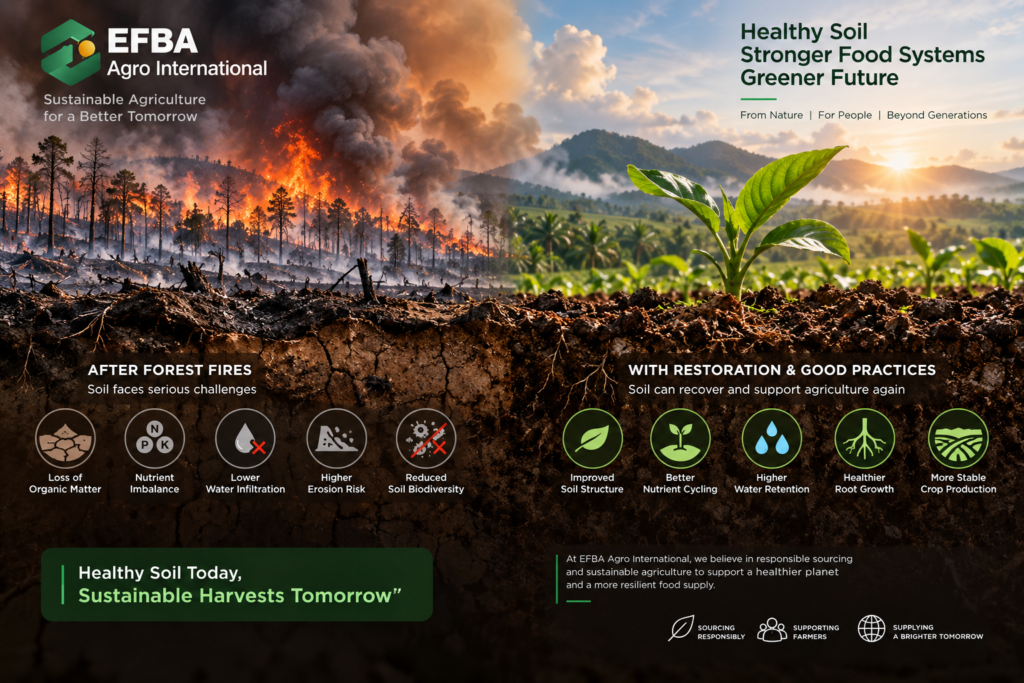
The relationship between forest fire soil quality and agriculture is complex. A low-severity fire can temporarily increase the availability of some minerals through ash deposition. In contrast, severe or repeated fires can reduce organic matter, damage soil organisms, increase water repellency, destabilize soil structure, and increase erosion risk.
For agricultural producers and global commodity buyers, these effects matter because healthy soil ultimately supports crop productivity, raw-material availability, quality, and long-term supply stability.
Table of Contents
ToggleHow Do Forest Fires Affect Soil Quality?
People searching for forest fire soil quality generally want to understand whether burned land can remain productive and how long fire-related soil damage may persist.
The answer depends heavily on fire severity, duration, recurrence, vegetation, soil characteristics, and post-fire rainfall.
FAO notes that wildfire effects on soil can range from negligible to long-lasting. Fire can alter physical properties such as soil stability and water repellency, chemical properties such as pH, organic matter, and nutrients, as well as biological properties including microbial activity and composition.
Therefore:
Fire Severity → Soil Change → Water & Nutrient Availability → Plant Recovery → Agricultural Productivity
Understanding this chain is important when assessing forest fire soil quality conditions and agricultural recovery.
Does Forest Fire Damage Soil Quality?
Yes. Forest fires can damage soil quality, especially when fires are severe, prolonged, or repeated. However, not every fire produces the same effect.
Research published in the Journal of Forestry Research found that low-intensity fires can temporarily increase certain available nutrients and soil pH because ash deposits minerals onto the surface.
High-intensity fires present a different situation.
Severe burning can reduce soil organic matter and nitrogen, damage soil organisms, destabilize soil aggregates, increase bulk density and water repellency, reduce water infiltration, and ultimately increase erosion.
In simple terms:
Low-Severity Fire → Temporary Chemical Changes
while:
High-Severity Fire → Organic Matter Loss → Biological Damage → Poorer Infiltration → Higher Erosion Risk → Slower Recovery
This distinction is essential when evaluating forest fire soil quality after a fire.
1. Fire Can Reduce Soil Organic Matter
Organic matter is one of the foundations of productive agricultural soil.
It helps soil retain water, store nutrients, support microorganisms, and maintain physical structure.
During severe fires, part of this organic material can combust.
Scientific reviews indicate that high-intensity fires can significantly decrease soil organic matter. The severity of the effect depends on temperature, duration, fuel availability, and the original characteristics of the soil.
Loss of organic matter can eventually affect the soil’s ability to support vegetation recovery.
For agriculture, this matters because soil productivity is not determined only by fertilizer inputs. Soil structure, organic matter, water retention, and biological activity work together.
For this reason, forest fire soil quality assessments should examine organic matter loss alongside other physical, chemical, and biological indicators.
2. Some Nutrients Can Increase Temporarily
Not every immediate change following a fire is negative.
Ash produced by vegetation combustion contains minerals.
Research reviewed in the Journal of Forestry Research found that after some fires, concentrations of available calcium, magnesium, potassium, phosphorus, and mineralized forms of nitrogen can increase temporarily.
This explains why burned soil can sometimes appear temporarily nutrient-rich.
However, buyers and producers should not interpret this as meaning forest fires improve agricultural land.
Nitrogen and organic matter can be lost during severe combustion, while nutrients remaining in ash may later be redistributed or lost through runoff and erosion.
Therefore:
More Ash ≠ Better Long-Term Soil
Long-term productivity depends on whether the entire soil system can recover.
This distinction is particularly important when interpreting forest fire soil quality because temporary nutrient increases do not necessarily indicate long-term soil improvement.
3. High Temperatures Can Damage Soil Biology
Healthy soil is a living ecosystem.
Bacteria, fungi, microorganisms, insects, and other soil organisms contribute to nutrient cycling and decomposition.
Fire can alter both microbial activity and microbial community composition. FAO identifies biological properties as one of the three major soil dimensions affected by wildfire, alongside physical and chemical characteristics.
The degree of biological damage again depends on fire severity.
This is particularly relevant for agriculture because biological recovery influences how efficiently nutrients circulate through the soil after disturbance.
As a result, a complete forest fire soil quality evaluation should consider biological recovery rather than focusing only on visible vegetation.
4. Burned Soil Can Become More Water-Repellent
One of the less visible consequences of severe fire is soil hydrophobicity, or increased water repellency.
Research indicates that high-intensity fires can increase soil water repellency and reduce infiltration.
This creates an important paradox.
A burned area may later receive rainfall, yet the water may not infiltrate effectively into the soil.
Instead:
Rainfall → Reduced Infiltration → Surface Runoff → Soil Erosion
This process can remove topsoil, ash, nutrients, and sediment from the affected area.
For agricultural land, losing fertile topsoil can have consequences that last considerably longer than the fire itself.
Therefore, water infiltration becomes another important indicator when evaluating forest fire soil quality after severe burning.
5. Soil Erosion Can Become the Next Risk
The environmental impact does not necessarily end when flames disappear.
Vegetation normally protects soil from direct rainfall and helps stabilize the surface through root systems.
Once fire removes that vegetation, the soil becomes more exposed.
Combined with reduced infiltration and weakened soil aggregates, heavy rainfall after fire can accelerate erosion. Scientific literature associates severe fires with lower aggregate stability and increased erosion risk.
Therefore, the post-fire sequence can become:
Fire → Vegetation Loss → Exposed Soil → Rainfall → Runoff → Erosion → Nutrient Loss
This is one reason forest fire soil quality needs evaluation over months or years rather than immediately after the fire.
6. Peatland Fires Create a Different Challenge
Indonesia has another important factor: peatland.
Unlike surface vegetation fires, peat fires can continue below ground.
Indonesia’s Ministry of Forestry reported in early September that areas containing underground embers required repeated extinguishing and cooling because fires below the peat surface could reignite.
BMKG has consequently supported weather-modification operations in Kalimantan to increase rainfall and soil moisture. In West Kalimantan, BMKG reported that induced rainfall helped increase peatland moisture, cool affected areas, reduce haze, and suppress new fire emergence.
This highlights the relationship between:
Soil Moisture → Fire Risk → Peat Condition → Recovery
These conditions make peatland particularly important when examining forest fire soil quality in Indonesia.
What Is Happening in Indonesia in September 2026?
Current conditions provide useful context, although hotspot data should not be confused with confirmed burned agricultural area.
According to Indonesia’s Ministry of Forestry, 1,437 high-confidence hotspots were detected nationally as of the evening of September 14, up sharply from 592 one day earlier. Central Kalimantan accounted for 689 of those hotspots.
Earlier monitoring on September 4 recorded 818 high-confidence hotspots nationwide, including 252 in Central Kalimantan, 165 in South Sumatra, and 124 in West Kalimantan.
The government has responded through ground operations, water bombing, aerial patrols, land rewetting, and weather modification.
These figures demonstrate the scale of current fire-management efforts.
However, they do not mean that 1,437 agricultural areas have burned, nor do they prove nationwide soil degradation. A satellite hotspot represents detected thermal activity and needs interpretation alongside verified fire locations, land type, burn severity, and field observations.
That distinction is important for maintaining the accuracy and trustworthiness of agricultural reporting.
Short-Term vs. Long-Term Forest Fire Soil Quality Effects
Consider two hypothetical agricultural areas.
Area A experiences a brief, relatively low-severity fire. Vegetation on the surface burns, ash deposits minerals, and some nutrients temporarily become more available. Soil structure remains largely intact.
Recovery may therefore occur relatively quickly.
Area B experiences repeated high-severity fires. Organic matter burns, soil organisms decline, aggregate stability deteriorates, and the soil becomes more water-repellent.
Heavy rain then occurs.
Surface runoff removes ash and topsoil.
The result may become:
Severe Fire → Organic Matter Loss → Poor Infiltration → Erosion → Nutrient Loss → Slower Vegetation Recovery
This example explains why forest fire soil quality cannot be reduced to a simple statement that fire either “damages” or “fertilizes” soil.
Severity and post-fire conditions determine the outcome.
How Could Forest Fire Soil Quality Affect Agricultural Commodities?
The connection between forest fires and commodities is usually indirect unless agricultural production areas themselves burn.
Soil degradation can influence plant establishment, root development, moisture availability, nutrient cycling, and ultimately productivity.
For commodity buyers, the relevant chain is:
Soil Health → Crop Health → Yield → Raw Material Availability → Processing → Commodity Supply
However, Indonesia is geographically diverse.
A forest fire in Kalimantan should not automatically be interpreted as a direct threat to coffee plantations in Aceh or cassava production elsewhere in Indonesia.
Commodity risk should always be evaluated according to specific production origin and supply chain exposure.
For global buyers, understanding forest fire soil quality is therefore most useful when combined with information about commodity origin, production conditions, processing facilities, and logistics.
EFBA Agro and Agricultural Supply Monitoring
EFBA Agro International specializes in the procurement, processing, and wholesale export of Indonesian agricultural commodities.
Its current portfolio includes cassava and derivatives, coffee beans and cascara, candlenut, palm products, and other agricultural commodities. EFBA Agro states that it develops its international sourcing network through strategic partnerships and responsible sourcing.
This perspective matters when environmental events occur.
For international buyers, sourcing assessment should not stop at product price.
A more complete process is:
Origin → Environmental Condition → Raw Material → Processing → Quality Control → Logistics → Export
For example, EFBA Agro identifies its Cascara as coming from Gayo plantations in Aceh, with defined specifications covering moisture, purity, processing, packaging, load capacity, and export ports.
That level of origin and specification information helps buyers separate actual commodity exposure from general environmental headlines.
The broader EFBA ecosystem also provides business-management experience. EFBA Digital Mulia states that its consulting activities in managing and developing businesses have operated since 2013, covering UKM, retail, franchise, startups, maklon businesses, and larger corporations.
For agricultural supply chains, combining commodity knowledge with risk and business analysis becomes increasingly important when environmental conditions are uncertain.
Ultimately, forest fire soil quality should not be evaluated through fire occurrence alone. Buyers and producers need to consider fire severity, soil characteristics, organic matter, biological activity, water infiltration, erosion, rainfall, recovery conditions, and the location of agricultural production.

Explore Indonesian Agricultural Commodities
International buyers can explore the EFBA Agro International commodity portfolio for sourcing information on Indonesian agricultural products. EFBA Agro currently lists commodities including cassava derivatives, Gayo Arabica coffee, cascara, candlenut, and palm products.
For coffee-derived products, buyers can review Cascara – Dried Coffee Husk. EFBA Agro identifies this product as originating from Gayo coffee plantations in Aceh.
The same environmental perspective can also support sourcing assessments for EFBA Agro’s cassava derivatives, Gayo Arabica coffee, candlenut, and palm-based commodities. The key is to evaluate where each commodity originates rather than assuming environmental conditions are uniform across Indonesia.
For broader corporate and business-development expertise within the same ecosystem, readers can visit PT EFBA Digital Mulia.
For authoritative environmental information, readers can also follow current updates from Indonesia’s Ministry of Forestry and BMKG.
FAQ
How do forest fires affect soil quality?
Forest fires can change the physical, chemical, and biological properties of soil. Effects can include changes in pH and nutrients, organic matter loss, microbial disturbance, increased water repellency, lower infiltration, and higher erosion risk.
Can ash from forest fires make soil more fertile?
Temporarily, in some cases. Ash can increase the availability of minerals such as calcium, magnesium, potassium, and phosphorus. However, severe fires can simultaneously destroy organic matter, cause nitrogen losses, and damage soil structure.
How long does soil take to recover after a forest fire?
There is no universal recovery period. Recovery depends on fire severity and frequency, soil type, vegetation, rainfall, erosion, climate, and post-fire land management.
Can forest fires affect agricultural production?
Yes, particularly when agricultural land or its surrounding ecosystem is affected. Soil degradation can influence water availability, nutrient cycling, plant recovery, and eventually agricultural productivity.
Why are peatland fires particularly difficult?
Peat can continue burning below the surface. Indonesia’s Ministry of Forestry has reported repeated extinguishing and cooling operations in peat areas to prevent underground embers from reigniting.
Does the current Kalimantan fire situation affect all Indonesian commodities?
No. Current hotspot activity does not mean all Indonesian agricultural production is affected. Buyers need to examine the commodity’s origin, proximity to affected areas, processing location, transportation routes, and verified field conditions.
What should agricultural buyers monitor after major fires?
International buyers should monitor production origin, soil and weather conditions, raw-material availability, crop condition, processing capacity, quality specifications, logistics, and shipment schedules.
CTA
Forest fires are not only about flames and smoke.
Their effects can continue beneath the surface through changes in soil organic matter, nutrients, biological activity, water infiltration, and erosion risk.
For agriculture, this makes soil condition an important part of long-term supply resilience.
However, environmental risk should always be evaluated accurately.
A hotspot in one Indonesian province does not automatically mean every Indonesian agricultural commodity is affected.
Global buyers should instead evaluate:
Origin → Environmental Exposure → Soil & Crop Condition → Quality → Availability → Logistics
EFBA Agro International supports international buyers sourcing Indonesian agricultural commodities including cassava derivatives, Gayo Arabica coffee, cascara, candlenut, and palm products.
Visit EFBA Agro International to discuss product specifications, sourcing requirements, availability, packaging, and international supply.
Understand the origin. Verify the conditions. Protect the quality. Build a more resilient agricultural supply chain.