
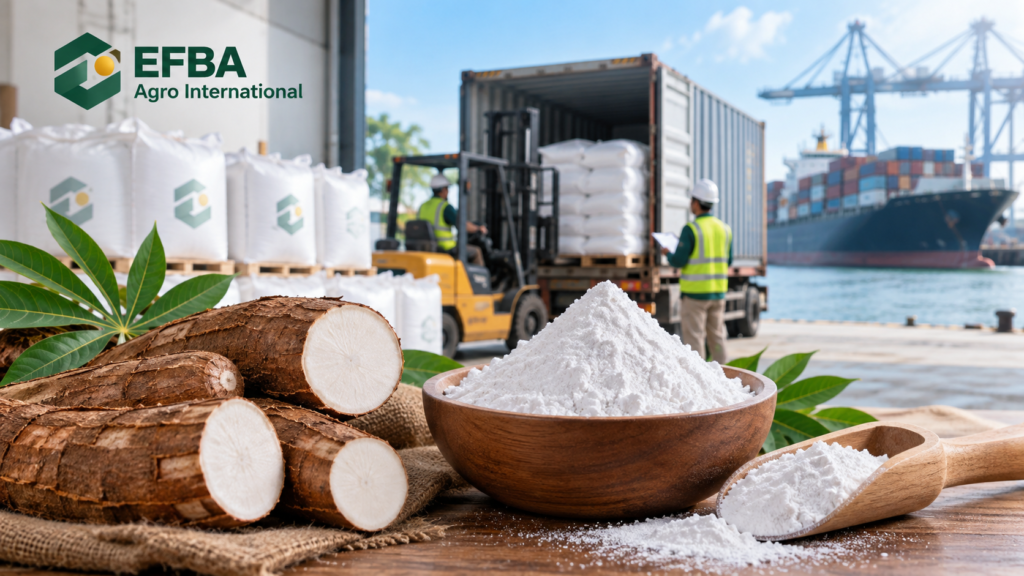
Finding a reliable tapioca starch supplier Indonesia is important for manufacturers, distributors, and international buyers that require consistent quality, clear specifications, bulk availability, and dependable export support.
Indonesia has a strong cassava-based agricultural industry, making it a relevant sourcing destination for tapioca starch. For buyers, however, selecting a supplier should involve more than comparing prices. Product specifications, functional performance, packaging, order capacity, quality consistency, and export readiness are equally important.
EFBA Agro International supplies food-grade tapioca starch from Indonesia for wholesale and industrial requirements, supported by bulk packaging and international export arrangements.
Table of Contents
ToggleWhat Should Buyers Look for in a Tapioca Starch Supplier Indonesia?
International buyers searching for a tapioca starch supplier Indonesia generally need a partner that can provide stable product specifications, scalable quantities, suitable packaging, and reliable logistics.
The supplier should clearly communicate technical parameters such as starch content, moisture, whiteness, viscosity, pH, and other specifications relevant to the buyer’s application.
Supply reliability is equally important. Industrial manufacturers depend on predictable raw-material availability because inconsistent supply can affect production schedules, inventory planning, and final product quality.
Therefore, buyers should evaluate the complete sourcing process rather than focusing only on the cost per metric ton.
Tapioca Starch for Wholesale and Industrial Applications
Tapioca starch is extracted from cassava roots and processed into a fine white powder. Its neutral characteristics and functional properties make it suitable for a wide range of food-processing applications.
Food manufacturers commonly use tapioca starch as a thickening, binding, and texture-forming ingredient. It can support applications such as noodles, crackers, bakery products, sauces, coatings, snacks, and other processed foods.
For large-scale manufacturers, consistency matters because raw-material variations can affect processing performance. Buyers therefore need to evaluate whether the supplier can maintain specifications across repeated bulk orders.
This makes supplier selection an important part of industrial procurement.
EFBA Agro Tapioca Starch Specifications
EFBA Agro International provides food-grade tapioca flour/starch with technical parameters designed for bulk food-processing requirements.
The general specification includes a minimum starch content of 85%, maximum moisture of 13%, maximum ash content of 0.2%, pH of 5.0–7.0, minimum whiteness of 92%, and minimum viscosity of 700 Brabender Units (BU).
These parameters give industrial buyers a clearer basis for evaluating whether the product matches their production requirements.
However, technical suitability should always depend on the intended application. Manufacturers should confirm the required specifications before placing a commercial order, especially when the starch will become a critical functional ingredient in a specific formulation.
For a deeper understanding of its functional role, buyers can also read Cassava Starch in Food Manufacturing.
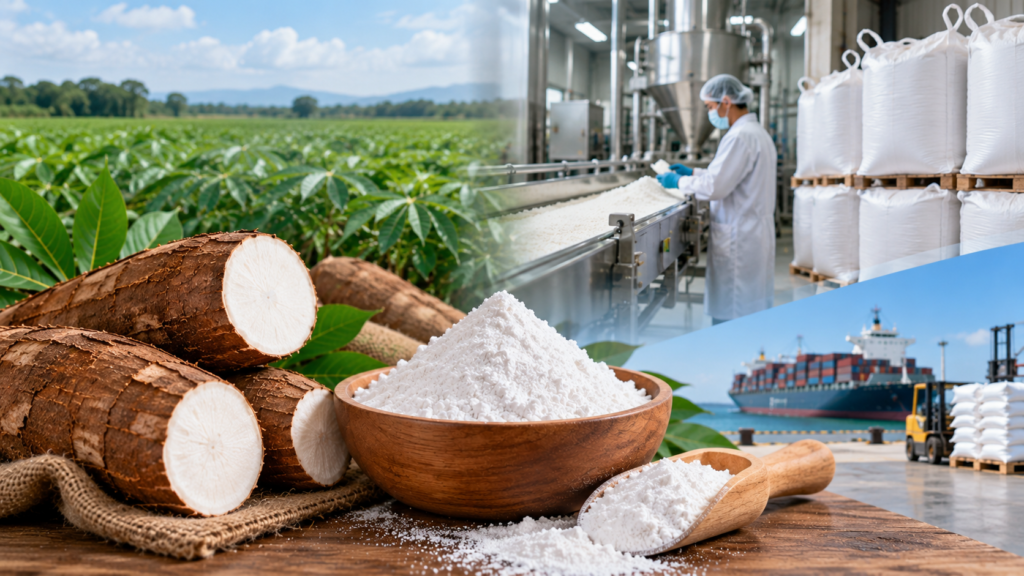
Example: Selecting Tapioca Starch for Food Manufacturing
Consider a snack manufacturer that requires tapioca starch for a high-volume production line. The purchasing team should not evaluate potential suppliers based only on price.
They may need to compare:
Product Specification → Functional Performance → Batch Consistency → Packaging → MOQ → Export Logistics → Lead Time
If the starch performs differently between shipments, the manufacturer may need to adjust formulations or processing conditions. In contrast, consistent specifications help production teams maintain more predictable manufacturing results.
The same principle applies to distributors. Wholesale buyers need packaging and shipment quantities that match their downstream customer requirements.
EFBA Agro offers 25 kg and 50 kg PP sacks with PE inner lining, while 500 kg jumbo bags are available upon request. The stated loading capacity is approximately 20 metric tons per 20-foot FCL, with a minimum order quantity of one 20-foot FCL.
Why Source Tapioca Starch from Indonesia?
Indonesia has an established cassava supply base and processing industry that supports cassava-derived products for domestic and international markets.
For international procurement teams, sourcing from Indonesia can provide access to tapioca starch alongside other cassava derivatives and agricultural commodities.
However, country of origin alone does not guarantee the right product. Buyers should still evaluate supplier capabilities, specifications, quality control, packaging, documentation, and logistics before establishing a long-term sourcing relationship.
A dependable tapioca starch supplier Indonesia should make these requirements clear from the beginning of the procurement process.
EFBA Agro International as a Sourcing Partner
EFBA Agro International focuses on the procurement, processing, wholesale, and export of Indonesian agricultural commodities. Its portfolio includes cassava and cassava derivatives alongside coffee, cascara, candlenut, palm oil, palm sugar, and other agricultural products.
For cassava-based products, the company supports buyers that require consistent specifications, bulk quantities, packaging, documentation, and export arrangements.
EFBA Agro also states that its export team manages activities from packaging and documentation through international delivery arrangements. This approach is particularly relevant for importers that need more than a product supplier and want coordinated export support.
Buyers interested specifically in bulk purchasing can review Tapioca Flour Wholesale in 25 kg and 50 kg Bags for additional sourcing information.
Choosing a Supplier for Long-Term Procurement
A long-term sourcing relationship requires consistency. Before selecting a tapioca starch supplier Indonesia, procurement teams should define the specifications, monthly or annual volume, packaging requirements, destination port, and delivery terms they need.
Buyers should then compare potential suppliers based on their ability to meet those requirements consistently.
Price remains important, but the lowest quotation does not automatically provide the lowest procurement risk. In industrial sourcing, inconsistent specifications, shipment delays, unsuitable packaging, or unclear documentation can create additional costs throughout the supply chain.
For this reason, buyers should consider quality, consistency, capacity, logistics, communication, and commercial terms together.
Companies interested in broader Indonesian business and market perspectives can also explore EFBA for additional business insights.

FAQ About Tapioca Starch Supplier Indonesia
What is tapioca starch?
Tapioca starch is a starch extracted from cassava roots. Food manufacturers use it for applications that require thickening, binding, texture development, and consistency.
What industries use tapioca starch?
Tapioca starch is widely relevant to food manufacturing, including noodles, crackers, snacks, bakery products, sauces, coatings, and other processed foods. Its suitability depends on the formulation and processing requirements.
What specifications does EFBA Agro offer?
EFBA Agro lists a general specification of at least 85% starch content, maximum 13% moisture, minimum 92% whiteness, pH 5.0–7.0, and minimum viscosity of 700 BU for its food-grade tapioca product.
What packaging is available for wholesale orders?
EFBA Agro lists 25 kg and 50 kg PP sacks with PE inner lining, while 500 kg jumbo bags are available upon request.
What is the minimum order quantity?
The product page currently states an MOQ of 1 × 20′ FCL, with an approximate loading capacity of 20 metric tons per 20′ FCL. Buyers should confirm final quantities and shipping arrangements when requesting a quotation.
How should international buyers choose a tapioca starch supplier Indonesia?
Buyers should compare technical specifications, batch consistency, supply capacity, packaging, documentation, logistics, commercial terms, and communication. Samples or technical documents can also help determine suitability before establishing regular procurement.
Source Tapioca Starch from Indonesia with EFBA Agro
Choosing the right tapioca starch supplier Indonesia can help manufacturers and distributors build a more predictable raw-material supply chain.
EFBA Agro International supports wholesale and industrial buyers with food-grade tapioca starch, defined technical specifications, bulk packaging options, and export arrangements from Indonesia.
Whether you are sourcing for food manufacturing, distribution, or recurring wholesale requirements, start by defining your required specification, quantity, packaging, destination, and delivery terms.
Contact EFBA Agro International to discuss your tapioca starch requirements and request product specifications, quotation, and export information.