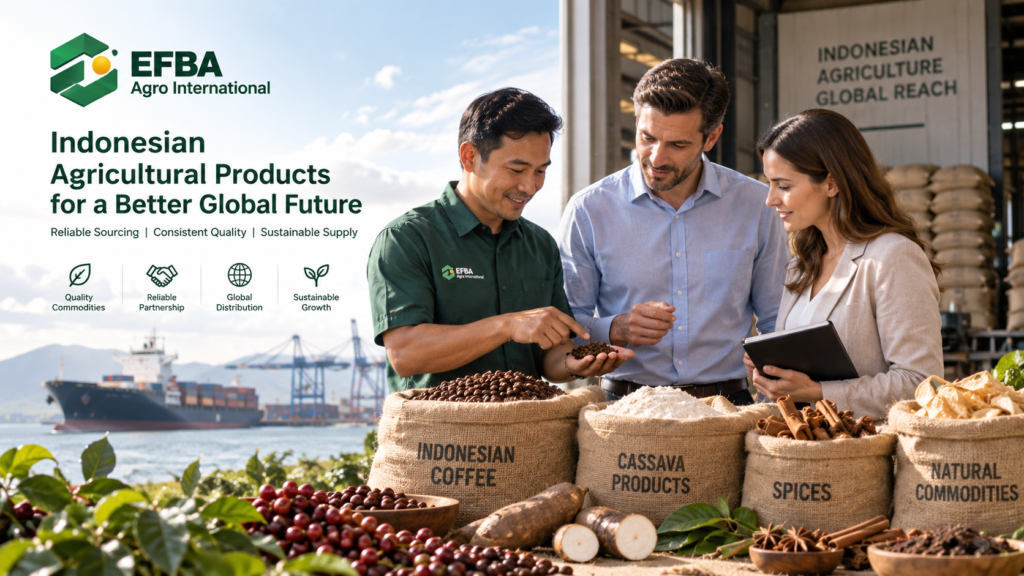
Finding the right agricultural supplier Indonesia is an important step for global buyers looking to source agricultural commodities from Indonesia. The country offers a diverse range of products, including coffee, cassava-based ingredients, tapioca flour, cascara, spices, coconut derivatives, and other agricultural commodities.
However, international sourcing is not only about finding products at competitive prices. Buyers also need to consider quality, specifications, consistency, processing methods, documentation, packaging, supply capacity, and logistics.
Therefore, working with a reliable agricultural supplier Indonesia can help importers, distributors, wholesalers, and manufacturers build a more structured sourcing process.
The right supplier can connect product requirements with sourcing, quality coordination, documentation, and shipment preparation. As a result, global buyers can focus not only on purchasing products but also on building a sustainable supply relationship.
Table of Contents
ToggleWhat Is an Agricultural Supplier Indonesia?
An agricultural supplier Indonesia is a company or sourcing partner that connects Indonesian agricultural products with domestic and international buyers.
Depending on the business model, suppliers may work with farmers, farmer groups, processors, manufacturers, warehouses, exporters, or other participants within the agricultural supply chain.
Their role can include sourcing raw materials, matching product specifications, coordinating quality requirements, preparing packaging, consolidating supply, supporting documentation, and arranging shipment.
For international buyers, this coordination is important because agricultural sourcing often involves multiple parties.
A typical supply chain may look like this:
Farm / Producer → Processing → Quality Control → Packaging → Documentation → Logistics → Buyer
When these stages work together effectively, buyers can manage product quality and supply continuity more efficiently.
Therefore, choosing the right supplier should involve more than simply comparing quotations.
Why Source Agricultural Commodities from Indonesia?
Indonesia has a diverse agricultural sector supported by different climates, growing regions, farming systems, and processing capabilities.
As a result, international buyers can source commodities for many applications. These include food manufacturing, beverages, bakery products, retail products, private-label products, and industrial processing.
Coffee is one well-known example.
Different producing regions in Indonesia offer distinctive origins, varieties, and processing characteristics. These differences create sourcing opportunities for importers, roasters, distributors, and beverage companies.
Meanwhile, cassava creates another important opportunity.
Manufacturers can process cassava into tapioca flour, cassava flour, MOCAF, and other cassava-based ingredients.
However, product availability alone does not guarantee successful procurement.
Global buyers need an agricultural supplier Indonesia that can understand product requirements and coordinate sourcing according to commercial needs.
What Global Buyers Should Look for in an Agricultural Supplier Indonesia
Choosing an agricultural supplier Indonesia should involve a structured evaluation process.
Price remains important. Nevertheless, the lowest quotation does not automatically represent the best sourcing option.
International buyers should also evaluate product specifications, quality consistency, supply capability, documentation, communication, packaging, lead time, and logistics.
In addition, buyers should consider whether the supplier can support recurring orders as purchasing volumes increase.
The following factors deserve particular attention.
Product Specification
Before requesting a commercial quotation, buyers should define the required specifications.
For agricultural commodities, specifications may include moisture level, grade, particle size, origin, variety, processing method, appearance, and packaging format.
Clear specifications reduce misunderstandings between suppliers and buyers.
For example, two companies may request cassava flour. However, one buyer may need the ingredient for bakery applications, while another requires different characteristics for food manufacturing.
Therefore, specifications should follow the intended application.
A professional agricultural supplier Indonesia should understand these requirements before moving toward commercial discussions.
Quality Consistency
A successful first shipment is important. However, consistent quality across repeat orders is even more important.
Food manufacturers and distributors often depend on stable raw material characteristics. Significant changes may affect production processes or final products.
Therefore, buyers should discuss quality parameters before confirming regular orders.
The discussion may cover sampling, inspection, testing requirements, product tolerances, and final verification.
Quality control should not become an activity that happens only before shipment. Instead, it should become part of the sourcing process.
Supply Capability
Supply capacity should match the buyer’s procurement plan.
A supplier may be able to fulfill one trial shipment but struggle when the buyer requires larger recurring orders.
Therefore, buyers should understand sourcing capacity, processing capability, lead time, seasonality, storage, and supply continuity.
This becomes particularly important when purchasing volumes begin to increase.
Agricultural products can also experience seasonal changes. Consequently, buyers and suppliers should communicate forecasts and expected demand as early as possible.
A reliable agricultural supplier Indonesia should be able to discuss these factors transparently.
Documentation and Traceability
International trade requires proper documentation.
The exact requirements depend on the commodity, destination country, shipping arrangement, and applicable regulations.
Therefore, buyers should confirm documentation requirements before shipment.
Traceability can also become important for certain commodities.
Information about origin, processing, production batch, or supply-chain activities can support quality assurance and supplier evaluation.
For products such as coffee, origin and processing information may also contribute to commercial positioning.
Communication and Responsiveness
Communication is often underestimated during international sourcing.
In reality, delayed information can affect production schedules, shipment planning, customs preparation, and inventory management.
Therefore, buyers should evaluate how suppliers respond to inquiries, specification changes, sample requests, documentation, production updates, and shipment coordination.
Clear communication becomes particularly important when buyers and suppliers operate in different countries and time zones.
A strong sourcing relationship requires transparency from both sides.
Agricultural Supplier Indonesia for Different Commodities
Indonesia offers several agricultural commodity categories for international markets.
The right product depends on the buyer’s industry, technical requirements, target market, and intended application.
EFBA Agro focuses on connecting B2B sourcing requirements with Indonesian agricultural commodities and processed agricultural ingredients.
Several product categories may be relevant for global buyers.
Indonesian Coffee
Indonesia is internationally recognized for coffee production.
International buyers may source coffee based on origin, variety, grade, processing method, and other specifications.
Gayo coffee from Aceh, for example, can be relevant for importers, roasters, distributors, and coffee businesses looking for Indonesian-origin Arabica.
Buyers should define whether they require green coffee beans, specific processing methods, grades, or other specifications before requesting quotations.
For buyers exploring this category, learn more through Indonesian Arabica Coffee Supplier for Global Buyers on EFBA Agro.
Cascara
Coffee production also creates opportunities beyond coffee beans.
Cascara comes from dried coffee cherry husks and may be used for beverages or other product development applications, depending on buyer requirements and destination-market regulations.
Therefore, cascara can create additional value within the coffee supply chain.
Buyers sourcing this commodity should discuss origin, processing, moisture, cleanliness, packaging, and intended application.
You can learn more through Cascara Supplier Indonesia for Tea, Beverage, and Functional Food Industries on EFBA Agro.
Tapioca Flour
Tapioca flour is another important cassava-derived ingredient available from Indonesia.
Food manufacturers may use tapioca-based ingredients for different applications according to formulation requirements.
Consequently, buyers should clearly define specifications before purchasing.
Instead of focusing only on price per kilogram, consider product consistency, packaging, volume, lead time, and logistics.
For a more detailed sourcing overview, read Wholesale Tapioca Flour: Sourcing Guide for Global Buyers on EFBA Agro.
MOCAF and Modified Cassava Flour
Cassava can also be processed into higher-value food ingredients.
Modified cassava flour and MOCAF can support different food applications depending on technical and formulation requirements.
For global buyers exploring this category, read MOCAF Supplier Indonesia for Gluten-Free Food Applications.
International food manufacturers can also explore EFBA Agro’s related information about modified cassava flour for industrial and food applications.
These categories demonstrate how an agricultural supplier Indonesia can support both raw commodity sourcing and processed agricultural ingredients.
Example of Agricultural Sourcing from Indonesia
Consider an overseas food manufacturer looking for cassava-based ingredients from Indonesia.
The company requires approximately 20 metric tons for an initial commercial order.
Instead of immediately requesting the lowest price, the buyer first communicates the intended application and technical specifications.
The sourcing process may follow:
Inquiry → Specification → Product Matching → Sample → Evaluation → Commercial Agreement → Production → Quality Control → Documentation → Shipment
First, the buyer provides technical requirements and estimated purchasing volume.
Next, the supplier evaluates whether the appropriate product and specifications can be fulfilled.
A sample may then be prepared for evaluation.
If the sample meets the required specifications, both parties can proceed to commercial discussions.
At this stage, they can discuss price, MOQ, packaging, payment terms, lead time, and shipping arrangements.
Production or sourcing begins after commercial confirmation. Quality checks and documentation follow before shipment.
This process helps reduce the risk of purchasing products that meet a price target but fail to meet technical requirements.
For this reason, a professional agricultural supplier Indonesia should focus on specification matching before moving toward large-volume orders.
Price Should Not Be the Only Sourcing Consideration
Commodity prices naturally influence purchasing decisions.
However, choosing a supplier only because it offers the lowest quotation can create additional risks.
For example, a cheaper product may have inconsistent specifications. Similarly, a supplier may provide competitive pricing but have limited capacity for repeat orders.
Unexpected packaging, documentation, quality, or shipment problems can also create additional costs.
Therefore, global buyers should evaluate total sourcing value.
A practical framework is:
Product Cost + Quality + Consistency + Documentation + Lead Time + Logistics + Supply Reliability
The lowest initial purchasing price does not always produce the lowest total procurement cost.
Instead, buyers should consider the complete commercial relationship.
Building a Reliable Agricultural Supply Chain in Indonesia
Agricultural sourcing involves more than a transaction between a buyer and seller.
Behind every shipment is a supply chain that may involve farmers, collectors, processors, warehouses, quality-control teams, packaging providers, logistics companies, and other stakeholders.
Therefore, coordination becomes essential.
A disruption at one stage can affect the entire process.
For example, raw material shortages can delay processing. Processing delays can then affect packaging schedules. Meanwhile, incomplete documentation may delay shipment.
For this reason, an agricultural supplier Indonesia needs to coordinate different parts of the sourcing process effectively.
Buyers and suppliers should establish clear expectations regarding specifications, quantity, timelines, communication, and responsibilities.
This approach can create a more predictable sourcing relationship.
Quality Control in Agricultural Commodity Sourcing
Quality-control requirements vary according to the commodity.
Coffee buyers, for example, may evaluate moisture, defects, origin, processing, and sensory characteristics.
Meanwhile, flour buyers may focus on moisture, particle characteristics, composition, and other technical parameters.
Therefore, quality control should follow the specifications agreed upon between the buyer and supplier.
A practical process can include:
Specification → Sampling → Inspection / Testing → Approval → Production → Final Verification
This creates several checkpoints before products reach the buyer.
However, agricultural products can naturally vary. Therefore, acceptable specifications and tolerances should be discussed before placing commercial orders.
Clear communication at this stage can reduce misunderstandings later.
From Sample Orders to Long-Term Supply
Many international sourcing relationships begin with product samples or smaller initial orders.
This stage allows buyers to evaluate the product before moving toward larger commercial quantities.
Once the sample is approved, both parties can discuss MOQ, commercial pricing, production capacity, packaging, payment terms, lead time, and shipment planning.
For recurring orders, forecasting becomes increasingly important.
For example, a buyer that requires one container every quarter can communicate its estimated annual demand.
This information helps the agricultural supplier Indonesia plan sourcing and processing more effectively.
Over time, the relationship can move from transactional purchasing toward strategic sourcing.
This type of relationship can provide greater visibility for both parties.
Expertise: EFBA Agro’s Approach as an Agricultural Supplier Indonesia
EFBA Agro approaches agricultural sourcing by connecting buyer requirements with Indonesian commodity supply.
Rather than starting only from available products, the process should begin by understanding what the buyer actually needs.
This includes the commodity, specification, application, estimated volume, packaging, destination, and purchasing schedule.
The process can be structured as:
Buyer Requirement → Supplier Matching → Specification Confirmation → Sampling → Quality Coordination → Commercial Process → Shipment
This approach is particularly relevant for B2B buyers because procurement decisions involve technical, commercial, and operational considerations.
Therefore, EFBA Agro’s role as an agricultural supplier Indonesia focuses on creating a clearer connection between buyer requirements and available sourcing opportunities.
In addition, EFBA’s broader business ecosystem provides perspectives related to business development and commercial opportunities. More information about the wider ecosystem is available through EFBA.
How to Start Sourcing Agricultural Products from Indonesia
Global buyers should begin with a clear sourcing brief.
Instead of sending only a message such as “Please send your best price,” provide enough information for the supplier to understand the actual requirement.
The initial inquiry should ideally explain the product, specification, estimated volume, packaging, destination country or port, intended application, and purchasing schedule.
For example:
Product: Tapioca Flour
Application: Food Manufacturing
Volume: 20 MT
Packaging: 25 kg bags
Destination: Buyer’s destination port
Requirement: Technical specification according to buyer requirements
This information allows the agricultural supplier Indonesia to evaluate the inquiry more accurately.
After the initial discussion, both parties can proceed with specification confirmation, sampling, commercial negotiation, and shipment planning.
A structured inquiry usually creates a more efficient sourcing process.
Why Long-Term Supplier Relationships Matter
Agricultural markets can change because of harvest cycles, weather conditions, logistics, supply, and global demand.
Therefore, long-term supplier relationships can provide benefits beyond price negotiation.
When suppliers understand the buyer’s specifications, purchasing patterns, quality expectations, and documentation requirements, repeat orders become easier to coordinate.
Buyers can also communicate demand forecasts earlier.
Meanwhile, suppliers gain better visibility into expected purchasing requirements.
As a result, both parties can prepare sourcing and production more effectively.
The goal is not simply to complete one transaction. Instead, buyers and suppliers can build a commercial relationship that supports consistency, transparency, and long-term growth.
For international companies, choosing an agricultural supplier Indonesia with a long-term sourcing perspective can therefore become an important procurement consideration.
Common Mistakes When Choosing an Agricultural Supplier Indonesia
One common mistake is choosing a supplier based only on price.
A low quotation can look attractive. However, buyers should also evaluate whether the product meets the required specifications and whether supply can remain consistent.
Another mistake is providing an incomplete sourcing brief.
Without clear information about specifications, volume, packaging, destination, and application, suppliers may struggle to prepare an accurate proposal.
Buyers should also avoid waiting until the last minute to discuss recurring orders.
Agricultural supply can be affected by seasonality, processing schedules, and logistics. Therefore, earlier forecasting can improve coordination.
Finally, global buyers should evaluate communication quality.
A reliable agricultural supplier Indonesia should communicate clearly about product requirements, availability, timelines, and commercial considerations.
FAQ About Agricultural Supplier Indonesia
What is an agricultural supplier Indonesia?
An agricultural supplier Indonesia connects Indonesian agricultural commodities and processed agricultural products with domestic or international buyers. Depending on its business model, the supplier may coordinate sourcing, specifications, quality requirements, packaging, documentation, and shipment.
What products can an agricultural supplier Indonesia provide?
An agricultural supplier Indonesia may provide coffee, cassava-based ingredients, tapioca flour, MOCAF, cascara, spices, coconut-derived products, and other agricultural commodities.
However, actual availability depends on the supplier’s sourcing network, season, volume, specifications, and product specialization.
Why should global buyers source agricultural products from Indonesia?
Indonesia has diverse agricultural production and processing capabilities. This creates opportunities for buyers seeking coffee, cassava-based ingredients, spices, coconut products, and other commodities.
However, buyers should evaluate each supplier based on product quality, specifications, capacity, documentation, communication, and commercial requirements.
Can international buyers request samples before ordering?
Depending on the commodity and supplier arrangement, buyers may request samples before confirming commercial quantities.
Sampling can help buyers evaluate whether the product meets their technical and quality requirements.
What information should buyers provide when requesting a quotation?
Buyers should provide the product name, required specifications, estimated volume, packaging, destination, intended application, and purchasing schedule when available.
Complete information helps suppliers provide more accurate commercial responses.
What is MOQ in agricultural commodity sourcing?
MOQ means Minimum Order Quantity.
The minimum quantity can vary according to the product, processing method, packaging, supplier, and shipping arrangement.
Therefore, buyers should confirm MOQ during the initial sourcing discussion.
How can buyers evaluate an agricultural supplier in Indonesia?
Buyers can evaluate product specifications, quality consistency, sourcing capability, supply capacity, documentation, communication, packaging, lead time, and experience with B2B requirements.
In addition, buyers should consider whether the supplier can support recurring purchasing requirements.
Can agricultural products be customized according to buyer specifications?
It depends on the commodity and processing capabilities.
Some products may allow adjustments in grade, processing, particle characteristics, packaging, or other parameters.
Therefore, buyers should communicate technical requirements before confirming commercial orders.
Does EFBA Agro work with global buyers?
EFBA Agro focuses on connecting B2B buyers with Indonesian agricultural commodities and sourcing opportunities.
Product availability, specifications, MOQ, packaging, lead time, and commercial terms should be discussed according to each buyer’s current requirements.
Source Quality Commodities with an Agricultural Supplier Indonesia
Finding the right agricultural supplier Indonesia requires more than identifying available products.
Global buyers should evaluate specifications, quality, consistency, supply capability, communication, packaging, documentation, lead time, and logistics.
These factors become especially important for manufacturers, importers, distributors, and wholesalers that require repeat supply.
EFBA Agro supports B2B agricultural sourcing by connecting buyer requirements with Indonesian commodities and processed agricultural ingredients.
The sourcing process follows a practical approach:
Requirement → Sourcing → Specification → Sample → Quality → Commercial Agreement → Shipment
Whether you are looking for Indonesian coffee, cascara, tapioca flour, MOCAF, cassava-based ingredients, or other agricultural commodities, begin with a clear sourcing requirement.
Provide the product specification, estimated volume, packaging requirements, destination, and intended application. This information can help EFBA Agro evaluate the appropriate sourcing opportunity.
If your company is looking for an agricultural supplier Indonesia for B2B sourcing, contact EFBA Agro to discuss product requirements and explore Indonesian agricultural commodities for your global supply chain.