Finding a reliable cascara supplier Indonesia is important for tea brands, beverage manufacturers, distributors, and food companies looking for a distinctive coffee-derived ingredient. Indonesian cascara offers a naturally fruity and floral profile while creating additional value from the coffee cherry beyond the bean.
For B2B buyers, sourcing cascara is not only about finding available supply. Product consistency, origin, processing, moisture control, packaging, documentation, and export capability are equally important when integrating cascara into commercial products.
Table of Contents
ToggleWhat Is Cascara?
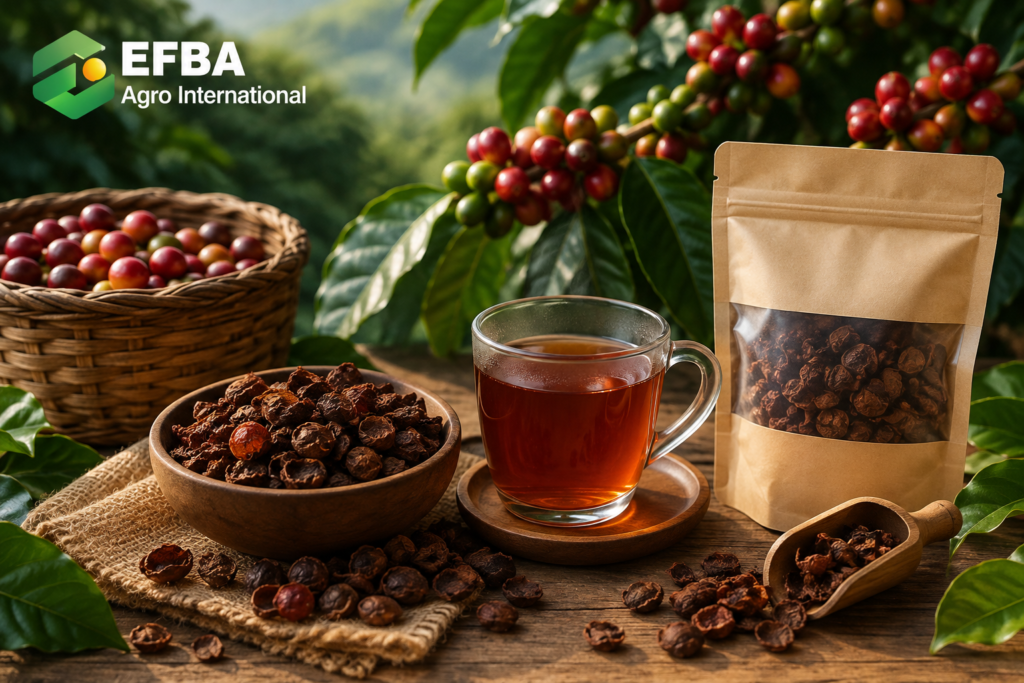
Cascara is the dried outer skin and pulp of coffee cherries separated during coffee processing. Instead of being discarded, this part of the coffee fruit can be properly dried and prepared as an ingredient for beverage applications.
Unlike roasted coffee beans, cascara produces a lighter infusion with naturally fruity and floral characteristics. EFBA Agro describes its cascara as dried coffee husk that can be processed into a tea-like beverage, providing another way to utilize the coffee fruit beyond its beans.
This characteristic makes cascara relevant for companies developing specialty tea, ready-to-drink beverages, botanical blends, and other innovative food and beverage concepts.
Why Source from a Cascara Supplier Indonesia?
Indonesia has a well-established coffee-producing ecosystem, providing access not only to coffee beans but also to coffee-derived ingredients such as cascara.
Working with a professional cascara supplier Indonesia gives international buyers the opportunity to source closer to coffee-producing regions while establishing clearer communication regarding origin, processing, specifications, volume, and export requirements.
For manufacturers, this sourcing model is especially useful when consistency and long-term procurement matter more than purchasing cascara as a one-time specialty ingredient.
EFBA Agro works with producers and processing partners to maintain product consistency from origin to destination and supports wholesale requirements for international buyers.
Cascara for Tea and Infusion Products
One of the most straightforward applications of cascara is tea and infusion.
When brewed, dried cascara can produce a beverage with a different sensory profile from traditional coffee. Its fruity and floral characteristics make it suitable for brands looking to develop products beyond conventional black tea, green tea, or roasted coffee.
Tea companies can explore cascara for standalone infusions or blends with herbs, spices, dried fruits, and other botanical ingredients.
For product developers, the final formulation should still be tested according to the desired flavor profile, brewing method, serving format, and applicable food regulations in the destination market.
Cascara for Beverage Development
Cascara also provides opportunities beyond hot tea.
Beverage companies can evaluate the ingredient for cold brew cascara, sparkling beverages, botanical drinks, café beverages, concentrates, and ready-to-drink concepts.
For example, a beverage manufacturer may develop a cascara infusion as a base and combine it with citrus, herbs, spices, or other ingredients to create a differentiated flavor profile.
The important point is that commercial applications require standardized formulation and testing. Extraction time, temperature, concentration, sweetness, acidity, stability, and packaging can all influence the final beverage.
Therefore, manufacturers should conduct their own product development and validation before moving into commercial-scale production.
Potential Applications in Functional Food and Beverage Concepts
Cascara can also be explored by companies developing modern functional food and beverage concepts.
Its coffee-fruit origin and potential for more complete utilization of harvested coffee cherries can provide an interesting product story for brands focused on natural ingredients and resource efficiency.
Potential applications may include botanical beverage blends, powdered beverage concepts, tea blends, extracts, and other formulated products where cascara’s sensory characteristics fit the intended application.
However, a supplier should avoid treating cascara as a finished functional claim by itself.
Any nutritional, antioxidant, caffeine, or health-related claim should be supported by appropriate laboratory analysis, formulation data, and the regulatory requirements of the market where the final product will be sold.
Example: From Coffee Cherry to Commercial Beverage
Consider a beverage company looking to introduce a new botanical drink.
Instead of developing another conventional tea flavor, the company evaluates cascara as its base ingredient.
The development process may follow:
Cascara Sourcing → Sample Evaluation → Sensory Testing → Formulation → Stability Testing → Pilot Production → Commercial Production
During sourcing, the buyer first evaluates origin, appearance, aroma, moisture, processing method, packaging, and other agreed specifications.
The R&D team then tests brewing characteristics and develops the formulation.
Once the formulation meets the company’s requirements, the buyer can determine the volume and purchasing schedule needed for commercial production.
This approach demonstrates why choosing the right cascara supplier Indonesia is important. A B2B supplier must support not only product availability but also consistency between purchasing cycles.
What Should B2B Buyers Check Before Purchasing Cascara?
Industrial buyers should establish specifications before placing bulk orders.
The specification may cover origin, processing method, moisture level, cleanliness, appearance, aroma, particle or cut size where relevant, packaging, storage conditions, and required documentation.
Buyers may also request samples before committing to larger quantities.
The sample can then be evaluated internally for sensory characteristics and suitability for the intended formulation.
For international procurement, requirements should also include shipping destination, expected volume, packaging format, lead time, export documentation, and applicable import requirements.
This process helps reduce differences between buyer expectations and the material delivered.
Quality and Supply Consistency Matter
For manufacturers, ingredient consistency affects the finished product.
Significant differences in aroma, flavor, moisture, cleanliness, or physical characteristics between batches can require manufacturers to adjust their formulations or processing parameters.
Therefore, a professional supplier needs a clear procurement and quality-control process.
EFBA Agro states that its export process includes understanding buyer specifications and volume requirements, procurement and quality control, secure packaging, export documentation, and shipping logistics.
This becomes particularly important for buyers planning recurring orders rather than purchasing cascara only for limited seasonal products.
Sustainability Value of Cascara
Cascara provides another commercial use for part of the coffee cherry beyond the coffee bean.
For coffee supply chains, this creates an opportunity to develop additional products from existing agricultural production.
For brands, this characteristic can support product narratives around ingredient innovation and more efficient utilization of agricultural materials.
However, sustainability communication should remain specific and verifiable. Companies should avoid making broad environmental claims unless they have evidence that supports those claims.
Choosing the Right Cascara Supplier Indonesia
A suitable cascara supplier Indonesia should be able to communicate clearly about the product and procurement process.
International buyers should consider several factors:
- origin and traceability;
- processing and drying method;
- product specifications;
- consistency between batches;
- sample availability;
- quality-control procedures;
- packaging options;
- supply capacity;
- export documentation; and
- logistics capability.
Price remains important, but it should not become the only procurement criterion.
A lower raw-material price can create additional costs when the product does not meet specification, shipments are inconsistent, or documentation causes delays.
EFBA Agro as an Indonesian Cascara Supply Partner
EFBA Agro International supplies Indonesian agricultural commodities for wholesale and international markets. Its current commodity portfolio includes Gayo Arabica coffee and cascara alongside cassava derivatives, candlenut, palm products, and other agricultural commodities.
For cascara buyers, the sourcing process can begin by defining the required specification, volume, packaging, destination country, and intended application.
The procurement team can then align available material with the buyer’s requirements before moving toward bulk supply.
This approach is particularly relevant for tea companies, beverage manufacturers, ingredient distributors, and food businesses looking for an Indonesian sourcing partner rather than simply purchasing a finished retail product.
Related Indonesian Agricultural Ingredients
Companies sourcing cascara may also require other Indonesian ingredients for food and beverage manufacturing.
EFBA Agro supplies several agricultural commodities within one sourcing ecosystem, including Gayo Arabica coffee, tapioca flour, MOCAF, candlenut, and palm-derived products.
For manufacturers evaluating starch-based ingredients, read Cassava Starch in Food Manufacturing: What Makes It Valuable?. The article discusses the use of cassava starch for thickening, texture modification, binding, and consistency in food manufacturing.
Buyers can also explore the broader EFBA Agro International commodity portfolio for Indonesian agricultural sourcing and wholesale export requirements.
For broader information about the EFBA business ecosystem and its activities in Indonesia, visit EFBA.
FAQ About Cascara Supplier Indonesia
What is cascara?
Cascara is the dried outer skin and pulp of the coffee cherry. When properly processed and dried, it can be used to create tea-like infusions and explored as an ingredient for various beverage applications.
What industries can use cascara?
Cascara can be explored by tea companies, beverage manufacturers, cafés, ingredient distributors, specialty food businesses, and companies developing botanical or functional beverage concepts.
What should buyers check before ordering cascara in bulk?
Buyers should evaluate origin, processing method, moisture, cleanliness, sensory characteristics, packaging, consistency, supply capacity, documentation, and compliance with destination-market requirements.
Can I request a cascara sample before bulk purchasing?
For B2B sourcing, sample evaluation is recommended before a large commercial order. Buyers can use samples to assess sensory characteristics and suitability for their intended formulation.
Is cascara the same as coffee?
No. Traditional coffee beverages use roasted coffee beans, while cascara comes from the dried outer portion of the coffee cherry. As a result, its brewing characteristics and sensory profile differ from roasted coffee.
Can cascara be used for functional beverages?
Cascara can be evaluated as an ingredient in functional beverage formulations. However, manufacturers should validate the formulation, composition, stability, safety, and any proposed nutritional or health claims according to applicable regulations.
How do I choose a cascara supplier Indonesia?
Look for a supplier that can provide clear information about origin, specifications, quality control, packaging, volume, documentation, and export logistics. For recurring industrial requirements, consistency and supply reliability should also be considered.
Source Cascara from Indonesia for Your Next Product
Choosing the right cascara supplier Indonesia helps tea, beverage, and food companies secure an ingredient that matches their formulation, quality, supply, and export requirements.
Whether you are developing cascara tea, botanical beverages, ready-to-drink products, or exploring new food applications, procurement should begin with clear specifications and sample evaluation.
Looking for Indonesian cascara for your business? Contact EFBA Agro International through its official website to discuss product specifications, samples, bulk volume, packaging, and export requirements for your destination market.