Cassava starch in food manufacturing has become an important topic for businesses looking for functional ingredients for different food products. Cassava starch can support various functions during food processing, including thickening, texture modification, binding, and consistency.
For food manufacturers, choosing a starch is not simply about finding an available raw material. The ingredient needs to match the requirements of the final product and the manufacturing process. This is why understanding the role of cassava starch in food manufacturing can help businesses make better decisions when developing and producing food products.
Cassava starch offers flexibility for different formulations. However, its suitability depends on the intended application, processing conditions, and required product characteristics.
İçindekiler
ToggleWhat Is Cassava Starch?
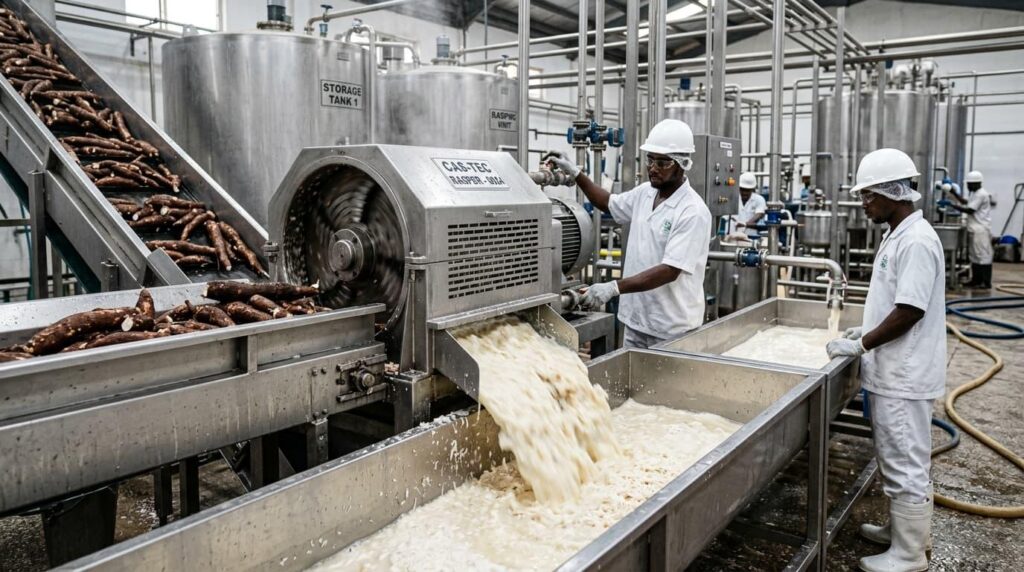
Cassava starch is obtained from cassava roots through a process that separates the starch from other components of the root. For more information about cassava and its agricultural uses, visit the Food and Agriculture Organization of the United Nations (FAO).
After processing, cassava starch is generally supplied as a fine powder that can be incorporated into different food formulations. Its functional properties make it useful for applications where manufacturers need specific characteristics from a starch-based ingredient.
Cassava starch should not be confused with cassava flour. Although both products come from cassava, they have different characteristics, processing methods, and applications.
Understanding this difference is important for businesses considering cassava starch in food manufacturing, because selecting the wrong cassava-based product can affect the intended formulation and processing results.
Why Is Cassava Starch Valuable in Food Manufacturing?
The value of cassava starch in food manufacturing comes mainly from its functional properties.
Food manufacturers often use ingredients not only because of what they contain, but also because of how they perform during processing. Starch can influence the texture, thickness, structure, and consistency of a food product.
Cassava starch can provide several useful functions, including:
Thickening
Texture modification
Binding
Structure support
Consistency improvement
The exact function depends on the formulation, processing conditions, and type of food product.
For manufacturers, this flexibility can make cassava starch in food manufacturing useful across different types of food applications.
1. Thickening Properties
One of the common functions of starch in food production is to help increase the thickness of a formulation.
Cassava starch can be used in products where manufacturers require a thicker or more consistent texture. This can include sauces, gravies, fillings, and other food preparations.
The amount of starch used and the processing conditions can influence the final result. Manufacturers therefore need to determine the appropriate formulation based on their specific product requirements.
Understanding the thickening behavior of cassava starch in food manufacturing can help product developers determine how it may perform within a particular formulation.
2. Supporting Food Texture
Texture is an important characteristic in many food products.
Cassava starch can contribute to texture by interacting with water and other ingredients during processing. Depending on the formulation, this can help manufacturers achieve a particular consistency or mouthfeel.
For businesses developing or improving food products, understanding how starch interacts with other ingredients is an important part of product development.
The role of cassava starch in food manufacturing can therefore extend beyond simply increasing thickness. Its functional properties may also contribute to the overall characteristics of the finished product.
3. Improving Product Consistency
Food manufacturers generally need their products to have consistent characteristics from one production batch to another.
A suitable starch ingredient can support consistency when it is used under controlled formulation and processing conditions.
However, the result can depend on factors such as starch specifications, dosage, processing temperature, water content, and the characteristics of other ingredients.
For this reason, manufacturers should test cassava starch under actual production conditions before applying it on a larger scale.
Consistent raw material performance is an important consideration when using cassava starch in food manufacturing for ongoing commercial production.
4. Supporting Food Formulations
Cassava starch can be incorporated into different food formulations depending on the desired product characteristics.
It may be used when manufacturers need to control thickness, texture, structure, or consistency.
This flexibility means cassava starch in food manufacturing is not limited to one specific type of food product. Its application can vary depending on the formulation and production requirements.
Manufacturers should therefore identify the desired function before determining how much starch should be included in a formulation.
Common Food Applications of Cassava Starch
Cassava starch in food manufacturing can be considered for various food applications. Some examples include:
Sauces and Gravies: Used to support thickness and consistency.
Processed Foods: Can be incorporated into formulations where starch functionality is required.
Snacks: May be used in starch-based formulations and certain snack manufacturing processes.
Bakery Products: Can be included in specific formulations depending on the desired characteristics.
Fillings and Food Preparations: May help achieve the required thickness or texture.
The appropriate application depends on the characteristics of the cassava starch and the requirements of the final product.
For this reason, manufacturers should consider the intended application rather than assuming that the same starch specification will produce identical results across every food product.
Cassava Starch and Other Starches
Food manufacturers have access to different types of starch, and each can provide different functional characteristics.
Cassava starch can be considered when manufacturers are looking for a starch ingredient with specific processing and formulation properties.
However, there is no single starch that is automatically suitable for every application. The right choice depends on the product, manufacturing process, formulation, and required specifications.
When evaluating cassava starch in food manufacturing, businesses should focus on whether the ingredient can provide the functional characteristics required by their specific product.
What Should Food Manufacturers Consider?
Before using cassava starch in a food manufacturing process, businesses should consider several factors.
Product Requirements
The first step is to determine what function the starch needs to provide.
Manufacturers should understand whether they need the starch for thickening, texture, binding, structure, consistency, or another purpose.
Processing Conditions
Temperature, processing time, water content, and other production conditions can influence how starch performs.
Testing the ingredient under actual processing conditions can help manufacturers understand whether it meets the desired requirements.
Product Specifications
Manufacturers should review relevant cassava starch quality and product specifications before purchasing cassava starch.
Depending on the application, factors such as moisture, appearance, particle size, viscosity, and other specifications may need to be considered.
Consistency
Consistent raw materials are important for manufacturers producing food products on a regular basis.
Using starch with consistent specifications can help businesses maintain more predictable production results.
These factors are particularly important when cassava starch in food manufacturing is intended for repeated commercial production rather than occasional use.
The Role of Cassava Starch in Product Development
Cassava starch can also be relevant during food product development.
When developing a new food product, manufacturers may test different starch levels and formulations to determine how they affect texture, thickness, stability, and overall product characteristics.
This process can help businesses identify the most suitable formulation before moving toward larger-scale production.
Product development should therefore consider not only whether cassava starch can be used, but also how it interacts with other ingredients and processing conditions.
Understanding cassava starch in food manufacturing during the development stage can help manufacturers make adjustments before finalizing a commercial formulation.
Why Application Testing Matters
A starch specification that works well for one food product may not necessarily produce the same result in another application.
Different formulations have different requirements, and manufacturing processes can also vary.
For this reason, application testing is an important step before large-scale production. Manufacturers can evaluate the performance of cassava starch using their own formulation and production conditions.
This can help reduce unexpected results and provide a better understanding of how the ingredient will perform in the final product.
Application testing is therefore an important consideration for businesses planning to use cassava starch in food manufacturing on a larger scale.
Frequently Asked Questions
What is cassava starch used for in food manufacturing?
Cassava starch can be used for functions such as thickening, texture modification, binding, structure support, and improving consistency in different food formulations.
Is cassava starch the same as cassava flour?
No. Cassava starch and cassava flour are different products. They have different processing methods, characteristics, and applications.
Why is cassava starch useful in food production?
Cassava starch can provide functional properties that support different food formulations. Its potential uses include improving thickness, texture, structure, and consistency.
Can cassava starch be used in processed foods?
Yes. Cassava starch can be incorporated into different processed food formulations depending on the required characteristics and manufacturing conditions.
Is cassava starch suitable for every food product?
Not necessarily. The suitability of cassava starch depends on the formulation, processing conditions, product requirements, and desired functional properties.
What should manufacturers test before using cassava starch?
Manufacturers can review relevant product specifications and test the starch under their actual formulation and processing conditions before moving to larger-scale production.
Sonuç
Cassava starch in food manufacturing can provide valuable functional properties for different food products. Its potential to support thickness, texture, consistency, binding, and formulation flexibility makes it a useful ingredient for various food applications.
However, the suitability of cassava starch depends on the specific requirements of each product. Manufacturers should consider the intended function, product specifications, processing conditions, formulation, and consistency when evaluating its use.
By understanding the role of cassava starch in food manufacturing and testing it within the intended application, businesses can make more informed decisions when developing and producing food products.