Finding a Reliable Cassava Flour Supplier Indonesia
Global food manufacturers need more than competitive pricing when sourcing tapioca flour.
They require consistent specifications, food-grade quality, scalable supply, reliable packaging, and efficient international logistics.
Indonesia has a strong cassava processing industry capable of producing tapioca flour for food manufacturing applications.
For international buyers searching for a cassava flour supplier Indonesia, the key question is therefore not simply:
“Who can supply tapioca flour?”
The better question is:
“Which supplier can maintain consistent specifications across every shipment?”
This is particularly important for manufacturers producing noodles, snacks, bakery products, sauces, processed foods, and other starch-based products.
Why Source Tapioca Flour from Indonesia?
A professional cassava flour supplier Indonesia can provide food manufacturers with cassava-based ingredients for large-scale production.
Tapioca flour—also commonly referred to as tapioca starch—is extracted from cassava roots.
It is valued for its neutral flavor, white appearance, thickening properties, and versatility.
FAO notes that cassava starch is widely used in food manufacturing as a thickener, binder, stabilizer, and ingredient in various processed foods.
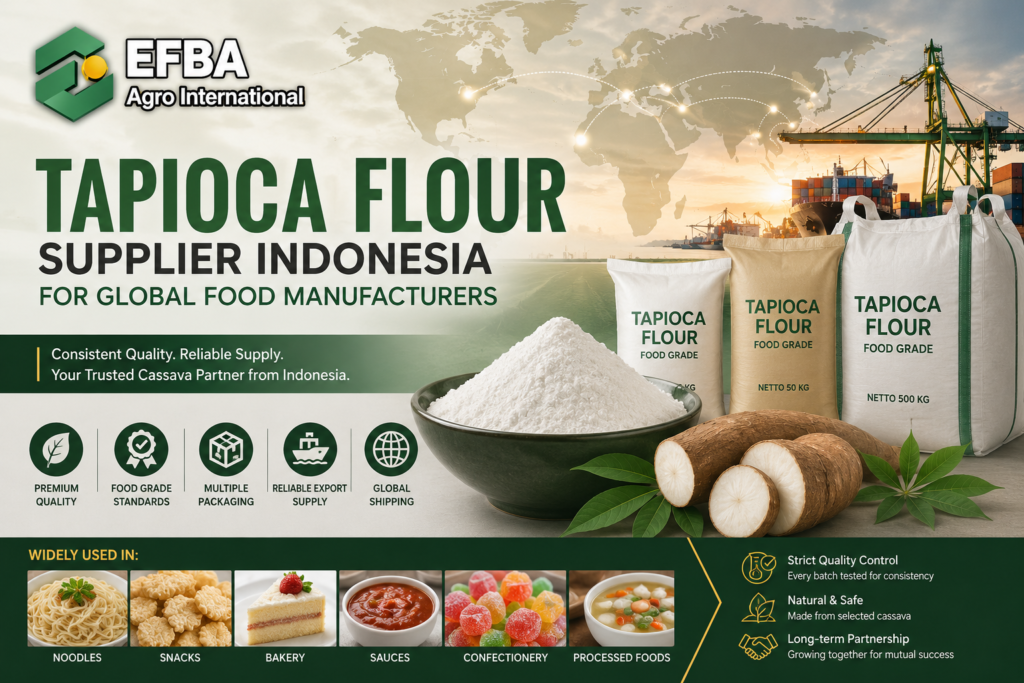
EFBA Agro supplies food-grade tapioca flour from Indonesia for international food manufacturers, distributors, processors, and bulk buyers.
The sourcing model focuses on:
Cassava Sourcing → Processing → Quality Control → Packaging → Export Logistics → Global Buyer
This integrated approach helps international buyers maintain more predictable ingredient quality and supply continuity.
What Is Tapioca Flour?
Tapioca flour is primarily the starch extracted from cassava roots.
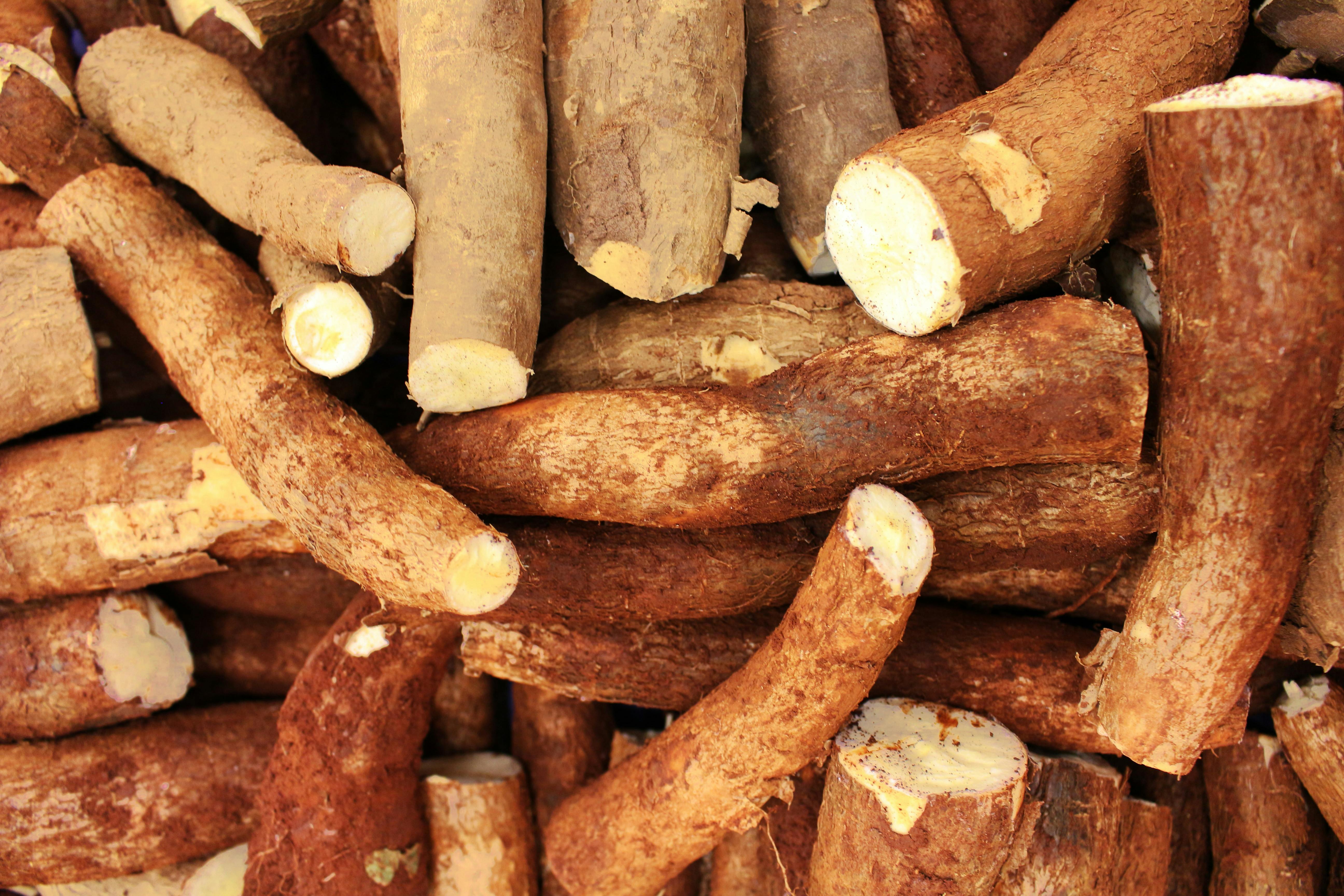
FAO explains that the product derived from cassava with very low levels of non-carbohydrate constituents is commonly known in international trade as tapioca flour.
The general production process includes:
Cassava Selection → Peeling → Washing → Grating → Starch Extraction → Separation → Drying → Milling/Sieving → Packaging
Codex guidance describes similar major processing stages for cassava starch.
These stages include selection, peeling, washing, grating, starch separation, and drying.
The resulting starch can provide functional properties required by modern food manufacturers.
Why Food Manufacturers Use Tapioca Flour
Tapioca flour offers several useful characteristics:
- neutral taste;
- high starch content;
- bright white appearance;
- thickening capability;
- binding properties;
- texture improvement;
- water-holding functionality;
- broad food-processing applications.
FAO identifies starch applications in foods such as sauces, soups, bakery products, confectionery, processed meat, and other manufactured products.
This versatility makes tapioca valuable for both traditional food production and industrial formulations.
Technical Specifications: EFBA Agro Tapioca Flour
For industrial buyers, specifications matter more than marketing claims.
EFBA Agro lists the following general specifications for its Tapioca Flour (Food Grade):
| Parameter | General Specification |
| Appearance | Fine, pure white powder |
| Starch Content | ≥ 85% |
| Moisture Content | ≤ 13% |
| Ash Content | ≤ 0.2% |
| pH | 5.0–7.0 |
| Whiteness | ≥ 92% |
| Viscosity | ≥ 700 BU |
| Crude Fiber | ≤ 0.2% |
| SO₂ Content | ≤ 30 ppm |
These parameters are particularly relevant for manufacturers.
Variations in starch, moisture, whiteness, and viscosity can affect final-product performance.
For example, inconsistent moisture can affect storage stability.
Viscosity variation can also influence texture and processing behavior.
That is why professional procurement should evaluate:
Price + Specification + Consistency + Capacity + Logistics
rather than price alone.
Tapioca Flour for Industrial Food Manufacturing
Consider a snack manufacturer producing 500,000 packs per month.
Assume each pack requires approximately 20 grams of tapioca flour.
Monthly requirement: 500,000 × 20 g = 10,000 kg
or approximately: 10 metric tons/month
If production increases to one million packs:
1,000,000 × 20 g = 20,000 kg
The manufacturer would require approximately:
20 metric tons/month
At this scale, even small specification differences can affect thousands of finished products.
For example, inconsistent starch performance could change:
- texture;
- crispness;
- viscosity;
- binding;
- production yield;
- final product consistency.
Therefore, industrial procurement should focus on batch consistency and scalable supply.
The cost per kilogram should not be the only consideration.
Export Capacity and Packaging
International food manufacturers also need suppliers capable of handling bulk logistics.
EFBA Agro currently provides several packaging options for food-grade tapioca flour:
25 kg PP Sack + PE Inner Lining
Suitable for standard industrial handling.
50 kg PP Sack + PE Inner Lining
Suitable for larger manufacturing requirements.
500 kg Jumbo Bag
Available upon request for industrial-scale procurement.
EFBA Agro lists an approximate loading capacity of:
±20 Metric Tons / 20′ FCL
with shipment available through:
Tanjung Priok Port, Jakarta, Indonesia
and a general minimum order quantity of:
1 × 20′ FCL.
For example, a buyer requiring approximately 100 metric tons could plan roughly:
100 MT ÷ 20 MT/FCL ≈ 5 × 20′ FCL
Actual loading and shipment planning should always be confirmed based on packaging configuration.
Container limits, destination requirements, and commercial terms should also be considered.
Tapioca Flour Applications for Global Manufacturers
1. Noodles
Tapioca starch can support elasticity and texture in noodle formulations.
Manufacturers may use it as part of formulations for:
- instant noodles;
- rice-based noodles;
- gluten-free noodles;
- specialty noodles.
2. Snacks and Crackers
Tapioca is widely associated with products requiring crisp texture and expansion characteristics.
Potential applications include:
Crackers | Extruded Snacks | Coated Snacks | Traditional Snacks
3. Bakery Products
Cassava-based starch can also contribute to texture modification in bakery formulations.
FAO references the use of cassava starch in biscuit manufacturing and other bakery applications.
4. Sauces and Processed Foods
One of the primary functions of starch is thickening.
Typical applications include:
Sauces → Gravies → Soups → Fillings → Processed Foods
5. Confectionery
Starch can function as an ingredient, molding material, or processing aid in various confectionery applications.
This broad application range allows food manufacturers to integrate tapioca flour into multiple product categories.
Tapioca Flour vs Modified Cassava Flour (MOCAF)
International buyers should distinguish between tapioca flour/starch and Modified Cassava Flour (MOCAF).
| Factor | Tapyoka Unu | MOCAF |
| Main Material | Cassava starch | Fermented cassava flour |
| Primary Function | Thickening & binding | Wheat flour substitution |
| Texture | Fine starch powder | Flour-like |
| Common Use | Sauce, snack, noodle, processed food | Bread, cake, pastry, noodles |
| Processing | Starch extraction | Cassava fermentation |
| Product Development | Functional starch ingredient | Alternative flour |
EFBA Agro describes MOCAF as fermented cassava flour suitable as an alternative to wheat flour.
It can be used for products such as bread, pastries, noodles, and gluten-free formulations.
Therefore, buyers should select the ingredient according to their formulation requirements.
Not all cassava-derived flours have the same characteristics or applications.
How to Choose a Cassava Flour Supplier Indonesia
Selecting a cassava flour supplier Indonesia should involve technical and commercial evaluation.
A practical procurement framework is:
Product Specification → Sample → Testing → Commercial Evaluation → Logistics → Trial Order → Long-Term Supply
1. Check Technical Specifications
Review: Starch | Moisture | Ash | pH | Whiteness | Viscosity | Fiber
2. Request Product Samples
Before placing large-volume orders, manufacturers should test samples within their own formulation.
3. Conduct Production Trials
Laboratory performance does not always represent actual production conditions.
Test the ingredient within the real manufacturing process.
4. Evaluate Packaging
International transportation requires packaging that protects the product from:
Moisture + Contamination + Physical Damage
5. Calculate Landed Cost
Do not compare suppliers based only on FOB price.
Evaluate: Product Cost + Freight + Insurance + Import Cost + Inland Logistics + Storage
6. Build Supply Continuity
Manufacturers using significant monthly volumes need more than a single shipment.
They need a supplier capable of supporting: Forecast → Production → Inventory → Shipment → Reorder
This approach transforms sourcing from transactional purchasing into strategic supply-chain management.
Why EFBA Agro?
EFBA Agro focuses on supplying Indonesian agricultural commodities and cassava-based products to international markets.
Its cassava product portfolio includes: Tapioca Flour | Modified Cassava Flour (MOCAF) | Cassava-Based Commodities
EFBA Agro’s food-grade tapioca flour is designed for applications including food thickening, crackers, cakes, sauces, and other food manufacturing processes.
The company combines: Sourcing → Quality Control → Bulk Packaging → Export Logistics
to support international buyers requiring scalable procurement from Indonesia.
Explore Indonesia’s Cassava Products
For detailed product specifications, packaging options, MOQ, and logistics information, visit the
EFBA Agro Tapioca Flour – Food Grade product page.
Manufacturers looking for a wheat-flour alternative can also explore
Modified Cassava Flour (MOCAF) from EFBA Agro For additional insight into bulk sourcing and international flour trading, read Modified Cassava Flour Bulk Supply Indonesia and Tapioca Flour Bulk 50kg for Worldwide Importers
These resources help buyers compare applications, specifications, and sourcing options across different cassava-derived products.
Business Support from EFBA
International sourcing is often connected with broader activities such as supplier assessment, market entry, business development, and establishing operations in Indonesia.
Companies requiring broader business support can explore EFBA for business development and strategic support within the EFBA ecosystem.
For technical background on cassava starch and its industrial applications, manufacturers can also review the FAO guide to cassava starch utilization
FAQ – Cassava Flour Supplier Indonesia
Is tapioca flour the same as cassava flour?
Not exactly. Tapioca flour generally refers to starch extracted from cassava roots. Cassava flour may refer to flour produced from more of the cassava root itself. Buyers should always verify technical specifications rather than relying only on product terminology.
What is tapioca flour used for?
Food manufacturers use tapioca flour for thickening, binding, and texture development.
It can also be used in bakery products, noodles, snacks, sauces, confectionery, and other processed foods.
What specifications does EFBA Agro offer?
EFBA Agro lists general specifications including minimum 85% starch, maximum 13% moisture, minimum 92% whiteness, and minimum viscosity of 700 BU. These specifications apply to its food-grade tapioca flour.
What packaging is available?
EFBA Agro lists 25 kg and 50 kg PP sacks with PE inner lining. 500 kg jumbo bags are available upon request.
What is the minimum order quantity?
The listed general MOQ for EFBA Agro’s tapioca flour is 1 × 20-foot FCL. The approximate load capacity is 20 metric tons per container.
Can tapioca flour be supplied for large food manufacturers?
Yes. Bulk tapioca flour can support industrial production. However, buyers should confirm specifications, production capacity, lead time, packaging, shipment schedule, and destination requirements before contracting supply.
How should international buyers choose a cassava flour supplier Indonesia?
Evaluate suppliers based on specifications, consistency, samples, production trials, quality control, capacity, packaging, logistics, commercial terms, and long-term supply reliability.
Source Food-Grade Tapioca Flour from Indonesia
Finding the right cassava flour supplier Indonesia is not simply about securing the lowest price. For global food manufacturers, successful sourcing depends on:
Consistent Quality → Reliable Specifications → Scalable Volume → Export-Ready Packaging → Efficient Logistics
EFBA Agro provides food-grade tapioca flour for manufacturers, distributors, processors, and international commodity buyers seeking cassava-based ingredients from Indonesia.
Whether your business produces noodles, snacks, bakery products, sauces, confectionery, or other processed foods, EFBA Agro can support your sourcing requirements with export-oriented supply solutions.
Looking for Tapioca Flour from Indonesia?
Contact EFBA Agro to discuss:
Product Specification | Sample Request | MOQ | Bulk Volume | FOB/CIF Quotation | Packaging | Destination Port | Estimated Lead Time
Ortak Olun EFBA Agro and build a reliable cassava-based ingredient supply chain from Indonesia to your global manufacturing operation.