Inside the Modern Flash Dryer
Step into any large-scale food manufacturing facility in 2026, and you will immediately see an environment intensely focused on thermodynamic control. Rising global fuel costs and electricity tariffs have forced processing managers to look past basic unit costs and closely examine the thermal efficiency of their raw material lines. Within this high-pressure manufacturing environment, the structural choices you make regarding clean-label binding agents inside your tapioca starch production lines will directly dictate your weekly processing costs. Managing the complex realities of international logistics means that a superficial understanding of your texturizer inputs is no longer sufficient to maintain high commercial yields.
The current market environment has created an urgent demand for clean-label, grain-free texturizers across the bakery, dairy, and confectionery sectors. However, the dynamics of modern tapioca starch production require high capital investments and strict engineering oversight to yield consistent, high-purity results. Many procurement departments fall into the trap of buying from unverified local mills that utilize outdated, inefficient equipment. These baseline processing centers frequently suffer from uneven thermal distribution, leading to highly volatile sulfur dioxide residues and poor fiber separation. When these low-grade shipments enter your automated pneumatic conveyor systems, they foul up your blending lines and cause immediate batch failures.
Chasing a cheap spot-market quote from unverified providers exposes your production line to severe structural inconsistencies and processing delays. When a supplier relies on legacy machinery with poor air current control, the resulting starch granules carry highly erratic moisture matrices. This technical failure causes the powder to clump prematurely inside your automated feeding hoppers, disrupting your automated recipe ratios. Understanding the physical stages of advanced tapioca starch production with an infrastructure-backed agribusiness partner is the ultimate mechanism to shield your brand from unexpected factory defects and sudden delivery shortfalls. By taking control of the milling parameters, we can eliminate processing variations and secure absolute purity on every single production run.
The Refining Journey: From Fresh Root to Uniform Granules
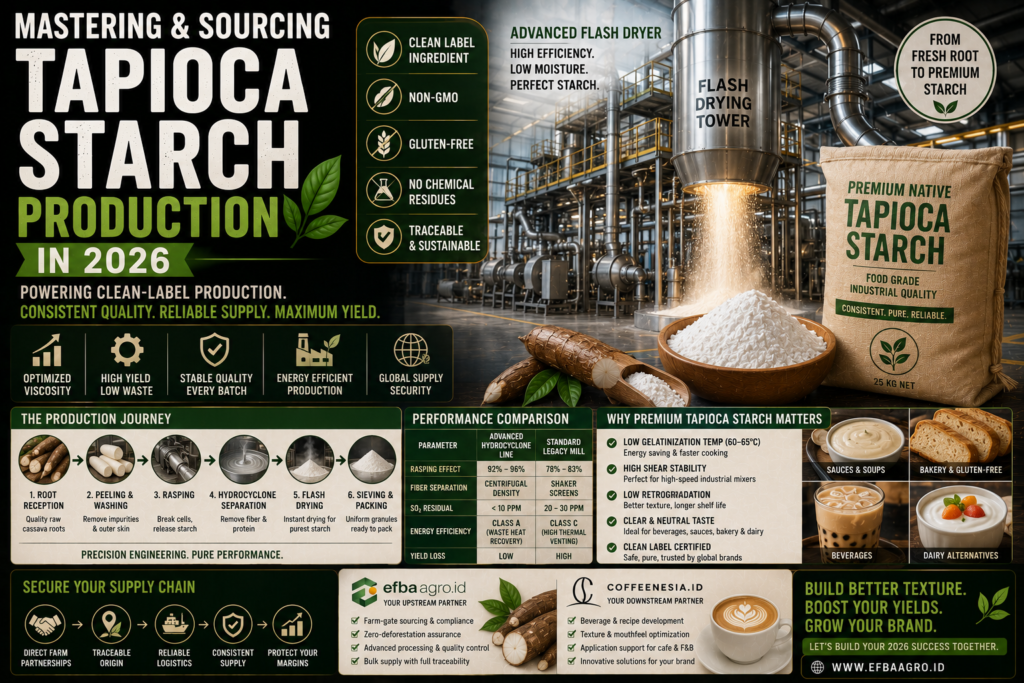
The mechanical blueprint of modern tapioca starch production starts with the physical isolation of the carbohydrate granules from the fibrous cellular walls of the cassava root. This journey begins at the automated root reception bays, where advanced root-peeling mechanics use heavy mechanical friction and high-pressure water jets to strip away the outer woody cork and peel. In outdated processing plants, inefficient peeling steps frequently slice into the root cortex, causing a significant loss of the prime starch-bearing tissue. By utilizing precise, weight-calibrated peeling drums, we can strip away the outer peel while completely preserving the inner starch matrix, keeping raw material waste to an absolute minimum.
Once the roots are thoroughly cleansed, they are immediately fed into high-speed industrial rasping machines equipped with razor-sharp stainless steel saw blades. The modern approach to automated tapioca starch production replaces traditional crushing stones with these high-velocity rasping systems to achieve a superior cell-rupturing effect. This intense mechanical slicing completely shatters the tough root cells, releasing the microscopic starch granules into a liquid suspension known as raw starch milk. If your processing mill uses dull blades or slow motor speeds, a high percentage of the starch remains trapped inside the fiber walls, which drastically lowers your raw extraction yields and alters the density of your final product.
This raw starch milk is then pumped directly into multi-stage hydrocyclone separators to execute a high-purity density extraction. Hydrocyclone extraction efficiency relies on intense centrifugal forces to separate the heavy starch granules from the lighter plant fibers and soluble proteins without using chemical additives. This advanced physical separation method achieves a flawless purification loop, yielding a refined starch milk that is completely free of cell debris and insoluble proteins. Swapping out a generic industrial tapioca powder for a highly refined native variant allows your development teams to create smooth, crystal-clear texturizing bases that never interfere with your product’s core flavor profile.
The final, and most energy-intensive, stage of the process occurs inside the high-capacity pneumatic flash drying towers. Thermal precision in tapioca starch production manifests within these massive vertical chambers, where precisely calibrated flash drying air currents instantly evaporate the remaining moisture from the starch cake. The damp starch is injected into a high-velocity stream of superheated air, which dries the particles in less than two seconds without causing premature gelatinization. This rapid thermal flash prevents thermal degradation and locks in a uniform grain distribution, ensuring that using pure tapioca flour provides highly consistent dissolution speeds in your high-capacity industrial mixers.
To help your factory managers and quality control teams benchmark these engineering metrics against standard commercial alternatives, we have outlined the core processing variables of modern milling systems below:
| Processing System Classification | Rasping Effect Percentage | Fiber Separation Method | Sulfur Dioxide Residual Baseline | Energy Efficiency Classification |
| Advanced Hydrocyclone Lines | 92% to 96% (Maximum Yield) | Centrifugal Density Separation | Below 10 Parts Per Million | Class A (Waste Heat Recovery) |
| Standard Legacy Mills | 78% to 83% (Moderate Loss) | Mechanical Shaker Screens | 20 to 30 Parts Per Million | Class C (High Thermal Venting) |
| Basic Open-Loop Systems | Below 70% (Severe Material Waste) | Manual Mesh Filtration | Above 50 Parts Per Million | Non-Classified (Inefficient Fuel Use) |
We prioritize sharing these advanced engineering metrics because maintaining a uniform processing baseline is the only reliable way to prevent texture variance in your consumer goods. When you source native tapioca starch from an automated facility using closed-loop waste heat recovery, you are buying an ingredient that respects both your financial margins and modern environmental standards. This strict focus on technical precision prevents the granule degradation that causes sauces to thin out prematurely during automated retorting or pasteurization cycles.
Managing Starch Integrity and Silo Volume Security
Securing long-term contract allocations of tapioca starch production outputs directly from primary processing facilities or tapioca starch wholesale supplier is an essential move to shield your brand from spot-market price spikes. Cassava is a highly time-sensitive crop that must be milled into dry powder within twenty-four hours of harvest to prevent rapid enzymatic browning and carbohydrate breakdown. This extreme biological window means that any regional logistics failures or unexpected fuel shortages can cause immediate production shutdowns at local mills, creating sudden shortages on the open market. Purchasing your inputs via a structured tapioca starch bulk framework allows your business to lock in guaranteed volume priorities, ensuring your factory lines keep running even during intense seasonal root shortages.
A major part of managing your ingredient budgets involves tracking how moisture levels behave over long ocean voyages and extended storage cycles. When fine starch powders are shipped in bulk, they can easily absorb ambient humidity if the container insulation is poor or the packaging liners fail. To keep your financial forecasting perfectly accurate, procurement teams evaluate usable yield by tracking moisture consistency in plain text rather than relying on raw incoming weight alone. By subtracting out the moisture percentage from the landed tonnage, your finance department ensures that your corporate capital pays strictly for active, functional carbohydrate mass rather than trapped environmental moisture.
It is also helpful for product developers to understand the distinct processing differences between highly refined starch formats and raw whole-root derivatives. Sourcing premium organic tapioca flour gives your brand a pure carbohydrate matrix that maximizes thickening power without introducing any chemical extraction residues or synthetic bleaching agents. This refined format performs completely differently on the line when compared to unrefined alternatives like bulk tapioca flour or general raw cassava powders, which still contain natural plant fibers that can disrupt the smoothness of delicate emulsions and clear beverage bases.
Furthermore, under the strict environmental compliance laws of 2026, modern standards of tapioca starch production also demand a fully auditable farm-to-dock logistics tracking system that proves zero deforestation at the original agricultural plots.
Upstream Synergy: Secure Farm-Gate Sourcing via Efba Agro

Building a highly profitable global food brand or scaling up a commercial processing plant requires a perfect, uninterrupted connection between agricultural fields and your automated manufacturing facility. When your procurement team operates on short-term spot deals with unverified middleman networks, your business faces erratic delivery timelines, fluctuating purity metrics, and sudden regulatory hold-ups at the port. Transitioning your brand to high-purity, clean-label binders demands a supportive supply partner who maintains direct influence over tapioca starch production facilities and local farming zones.
This is exactly where our fully integrated agribusiness logistics platform at efbaagro.id serves as your core internal pipeline partner. We manage the complex, messy realities of farm-gate compliance testing, zero-deforestation geolocation tracking, and cross-border customs optimization from the ground up. We work directly with traditional agricultural communities to ensure raw roots are moved from the soil to the rasping blades well within the critical twenty-four-hour processing window, yielding a final product that is perfectly sifted, uniformly dried, and completely compliant with international clean-label standards. By removing speculative brokers from your logistics trail, we give your business the volume guarantees and structural cost protections required to scale your manufacturing operations with absolute peace of mind.
Downstream Market Adaptation: Specialty Beverage Engineering via Coffeenesia

While securing your raw texturizer assets at the processing plant through our internal channels at efbaagro.id is vital for long-term supply safety, adapting those raw materials to premium retail applications requires world-class sensory design and product optimization. If your organization looks to align its raw materials derived from tapioca starch production to downstream culinary execution—such as texture adjustments for ready-to-drink blended beverages, specialty milk alternatives, or premium cafe pastries—our downstream specialty coffee and beverage engineering partner at coffeenesia.id serves as the dedicated external solution for beverage program design and brand engineering.
From calibrating mouthfeel parameters in plant-based dairy creamer formulations to optimizing the elastic matrix of gluten-free cafe baked goods, their team meticulously matches ingredient behaviors with modern consumer taste expectations. Utilizing high-purity root texturizers allows beverage developers to achieve a rich, creamy mouthfeel in dairy-free milk alternatives without masking the delicate floral and fruity notes of premium single-origin coffees. Partnering with dedicated sensory specialists means your retail products benefit from world-class culinary design while maintaining the exact same transparency and supply security you expect from your core raw materials.
Conclusion & CTA
Scale-driven manufacturing success in the competitive 2026 landscape belongs exclusively to organizations that eliminate upstream processing risks and focus heavily on consistent raw material behavior. Relying on transactional brokers who sell unverified, poorly dried starches is an open invitation for line blockages, texture breakdown, and devastating margin erosion. Managing the complex operational loops of tapioca starch production from farm gate to flash dryer is the only reliable way to protect your yields and satisfy modern clean-label consumer mandates over the long haul.
Let’s make your raw material sourcing completely reliable and energy-efficient this year. We invite your procurement directors, food technologists, and corporate executives to connect with our expert consulting team at efbaagro.id today to run a comprehensive processing yield audit, analyze your current recipe costs, and secure a steady supply chain for the coming quarters.
FAQ (5 Strategic Starch Supply Chain Questions)
How does hydrocyclone separation improve the physical purity of native starch compared to traditional shaker screens?
Traditional mechanical shaker screens rely purely on mesh barriers to filter out plant particles, which frequently allows fine root fibers and insoluble proteins to pass through into the final product. Hydrocyclone separation utilizes high-speed centrifugal forces to separate particles based entirely on their physical density, completely isolating the heavy starch granules from lighter plant debris to produce an incredibly pure starch milk with a near-zero fiber count.
What specific steps are required to manage sulfur dioxide residual levels during industrial starch processing?
Sulfur dioxide is introduced into the extraction water as a natural preservative to prevent raw cassava roots from oxidizing and turning brown during the rasping stage. To reduce residual sulfur dioxide levels below ten parts per million for clean-label compliance, advanced processing lines use multiple fresh-water washing stages inside the hydrocyclone blocks combined with high-velocity air currents in the flash drying tower to vent off any remaining gas.
How do multi-quarter forward contracts protect food brands from the volatile market spikes of fresh cassava roots?
Because fresh cassava roots spoil within twenty-four hours of harvest, processing plants are entirely dependent on a steady daily stream of incoming trucks from local farms. Signing a long-term forward contract allows the mill to schedule its processing runs months in advance and guarantee specific volume allocations for your brand, shielding your production budgets from sudden open-market price spikes when winter droughts or heavy rains temporarily limit local crop availability.