
Agricultural sourcing risk refers to potential disruptions that affect the availability, quality, price, delivery, or regulatory compliance of agricultural commodities. For international buyers, these challenges can disrupt production schedules, increase procurement costs, complicate inventory planning, and affect customer commitments.
Managing agricultural sourcing risk requires more than selecting suppliers with competitive prices. Global buyers need to verify product specifications, evaluate supplier capabilities, review samples, and establish clear procurement schedules. In addition, understanding export documentation and logistics responsibilities helps businesses reduce unexpected complications during international trade.
Indonesia offers diverse agricultural commodities, including coffee, cassava derivatives, candlenut, palm products, and natural sweeteners. EFBA Agro International supports global buyers exploring Indonesian agricultural sourcing opportunities through product matching, sourcing coordination, sample evaluation, quality control coordination, and export preparation, depending on product availability and agreed requirements.
What Is Agricultural Sourcing Risk?
Agricultural sourcing risk describes the possibility that agricultural commodities may fail to meet buyers’ expectations regarding quantity, quality, pricing, delivery schedules, or regulatory requirements. These risks arise because agricultural production depends on seasonal conditions, weather patterns, harvesting cycles, processing capabilities, and post-harvest management.
For example, coffee importers may experience differences in moisture levels, bean grades, or processing quality between shipments. Meanwhile, food manufacturers purchasing tapioca flour may encounter variations in technical specifications that affect manufacturing performance. Similarly, palm product buyers must consider quality parameters, transportation conditions, and destination-market requirements.
However, sourcing challenges do not automatically indicate that a supplier is unreliable. Instead, they highlight the importance of supplier verification, clearly defined purchasing requirements, and contingency planning.
Therefore, effective agricultural sourcing risk management helps international buyers identify potential disruptions before they affect production, purchasing budgets, or delivery commitments.
7 Agricultural Sourcing Risks Global Buyers Should Manage
Understanding agricultural sourcing risk is essential for developing a reliable international procurement strategy. Buyers need to evaluate potential disruptions across production, quality control, supplier capacity, pricing, logistics, documentation, and commercial communication.
The following seven risks deserve particular attention when sourcing agricultural commodities from Indonesia.
1. Climate and Seasonal Supply Risk
Climate conditions represent an important agricultural sourcing risk because weather patterns directly influence crop development, harvesting schedules, and raw material availability. Changes in rainfall, prolonged dry periods, or unfavorable harvesting conditions can affect agricultural output across different production regions.
For example, coffee, cassava, and candlenut respond differently to seasonal conditions depending on their growing locations, harvesting periods, and processing requirements. Consequently, buyers should not assume that agricultural commodities remain equally available throughout the year.
To reduce exposure, procurement teams should discuss seasonal availability, expected sourcing periods, and potential supply limitations with suppliers. For recurring orders, buyers can also establish purchasing forecasts and consider alternative shipment windows when necessary.
2. Product Quality and Specification Risk
Product inconsistency is another agricultural sourcing risk that international buyers must evaluate before placing commercial orders. Agricultural commodities can differ in moisture content, appearance, particle size, aroma, chemical composition, and other technical characteristics.
These variations matter because buyers often require specific product properties for food manufacturing, beverage production, or industrial applications. For instance, tapioca flour manufacturers may need particular starch specifications, while coffee importers may prioritize bean grading, moisture levels, and defect limits.
Therefore, buyers should establish written product specifications before requesting quotations. Depending on the commodity, requirements may include:
- Moisture content and acceptable limits.
- Product grade and physical characteristics.
- Microbiological or chemical parameters.
- Packaging and storage requirements.
- Relevant testing and inspection methods.
Clear specifications help procurement teams compare suppliers more accurately and reduce the possibility of receiving products that do not meet manufacturing requirements.
3. Supplier Capacity and Supply Continuity Risk
Supplier capacity can significantly influence agricultural sourcing risk, particularly when buyers require large volumes or recurring shipments. A supplier may successfully fulfill an initial order but face limitations when maintaining the same quantity, quality, or delivery schedule over time.
Therefore, buyers should distinguish between a supplier’s general product portfolio and its confirmed capacity to fulfill specific purchase requirements. Before placing an order, procurement teams need to understand current product availability, sourcing arrangements, processing lead times, and realistic shipment schedules.
In addition, buyers should evaluate whether suppliers can support repeat orders under agreed conditions. For critical agricultural inputs, qualifying alternative suppliers may also help reduce dependence on a single supply source.
However, alternative suppliers must meet the same technical and commercial requirements. Switching suppliers without appropriate verification can introduce new quality or operational risks.
4. Price and Procurement Cost Risk
Commodity price fluctuations represent another important agricultural sourcing risk for international purchasing teams. Agricultural prices can change because of harvest conditions, supply availability, market demand, processing costs, currency movements, and transportation expenses.
As a result, an attractive initial quotation does not always represent the lowest overall purchasing cost. Buyers must also consider packaging, freight, insurance, customs duties, applicable taxes, and other expenses that influence landed costs.
To improve procurement planning, request quotations that clearly identify product specifications, quantities, currencies, validity periods, and delivery terms. Furthermore, compare supplier offers using the same commercial basis to avoid inaccurate cost evaluations.
For recurring purchases, businesses can review pricing assumptions periodically and prepare alternative procurement scenarios when market conditions change.
5. Export Documentation and Regulatory Risk
Export documentation is a critical component of agricultural sourcing risk management because international shipments must comply with applicable trade requirements. Depending on the commodity and destination country, buyers may need specific commercial documents, certificates, declarations, or import approvals.
For example, documentation requirements for processed cassava ingredients may differ from those for green coffee beans or palm-derived products. Therefore, procurement teams should verify product-specific requirements before confirming commercial transactions.
Depending on the shipment, relevant documents may include:
- Commercial invoice.
- Packing list.
- Bill of lading.
- Certificate of origin.
- Applicable phytosanitary documentation.
- Relevant food safety or product-specific certificates.
However, not every agricultural shipment requires the same documents. Buyers should confirm the applicable requirements with the relevant authorities and clarify which party will prepare each document.
Clear documentation responsibilities help businesses reduce avoidable delays, customs complications, and disagreements during shipment preparation.
6. Packaging, Storage, and Transportation Risk
Improper packaging and transportation can increase agricultural sourcing risk by affecting product quality during storage and international delivery. Agricultural commodities may experience moisture exposure, contamination, physical damage, or quality deterioration when handling conditions do not match product requirements.
For example, coffee beans require suitable moisture protection during storage and transportation. Meanwhile, tapioca flour and other dry ingredients need appropriate packaging to reduce exposure to moisture and contamination.
To manage these challenges, buyers should establish packaging specifications, unit sizes, storage requirements, container conditions, and product handling instructions before shipment.
In addition, procurement teams should coordinate with suppliers and logistics providers regarding inspection procedures, shipment arrangements, and applicable protective measures.
These preparations help maintain product quality throughout the supply chain and support more predictable delivery operations.
7. Communication and Contract Risk
Communication problems can create agricultural sourcing risk even when buyers and suppliers agree on the general product category. Unclear specifications, incomplete purchase orders, different interpretations of delivery terms, and inconsistent communication may lead to avoidable commercial disputes.
International transactions can become more complex when companies operate across different countries, time zones, languages, and regulatory environments. Therefore, buyers should document important commercial requirements before confirming an order.
A clear purchasing agreement should include:
- Commodity name and product specifications.
- Agreed purchasing quantity and price.
- Packaging and inspection criteria.
- Production and delivery schedules.
- Applicable Incoterms and named delivery location.
- Required export documentation.
- Payment terms and responsibilities.
- Procedures for handling nonconforming products.
Furthermore, both parties should confirm any changes to specifications, schedules, or commercial conditions in writing. This approach helps maintain consistent expectations and supports more effective coordination throughout the purchasing process.
Why Agricultural Sourcing Risk Management Matters for Global Buyers
Managing agricultural sourcing risk helps international buyers protect procurement continuity, maintain product specifications, and improve purchasing decisions. Although suppliers cannot eliminate every disruption, structured verification and clear communication can reduce preventable problems.
For buyers sourcing Indonesian agricultural commodities, the process should begin with identifying the exact product, intended application, required quality, purchasing volume, and destination market. Subsequently, procurement teams can evaluate supplier capabilities, request samples, clarify export requirements, and establish realistic delivery schedules.
EFBA Agro International provides information on Indonesian agricultural commodities and sourcing opportunities for international buyers. Through EFBA Agro International, businesses can explore relevant products and discuss sourcing requirements based on availability and agreed commercial conditions.
Ultimately, agricultural sourcing risk management supports more informed procurement decisions by connecting product quality, supply availability, commercial terms, and international logistics planning.

How Can Global Buyers Reduce Agricultural Sourcing Risk?
Reducing agricultural sourcing risk requires a structured procurement strategy that combines supplier verification, product quality evaluation, realistic purchasing schedules, and clear commercial agreements. International buyers should assess these factors before purchasing agricultural commodities to minimize supply disruptions, unexpected costs, and quality inconsistencies.
For businesses sourcing products from Indonesia, effective procurement planning starts with understanding commodity specifications, supplier capabilities, seasonal availability, and export requirements. Furthermore, buyers need to establish appropriate quality controls and maintain consistent communication throughout the purchasing process.
The following seven strategies can help global buyers strengthen procurement reliability and manage sourcing challenges.
1. Define Product Requirements Before Requesting Quotations
Clear product specifications provide the foundation for reducing agricultural sourcing risk. Before contacting suppliers, buyers should identify the exact commodity, intended application, required grade, purchasing quantity, packaging preferences, and destination market.
For example, tapioca starch, ordinary cassava flour, and Modified Cassava Flour (MOCAF) have different characteristics and may serve different industrial applications. Therefore, food manufacturers should identify the specific ingredient required for their formulations before comparing supplier quotations.
Additionally, buyers should prepare a product specification sheet covering technical requirements, acceptable quality limits, and relevant testing methods. This approach helps suppliers evaluate purchasing inquiries more accurately and reduces misunderstandings during commercial negotiations.
2. Verify the Supplier and Its Sourcing Capabilities
Supplier verification is an essential step in agricultural sourcing risk management. International buyers should evaluate company information, available products, sourcing arrangements, communication procedures, and relevant supporting documentation before confirming an order.
However, a supplier’s published product portfolio does not automatically guarantee immediate availability or sufficient production capacity. Therefore, buyers need to confirm current stock, sourcing arrangements, processing lead times, and the ability to fulfill specific order quantities.
For recurring purchases, procurement teams should also discuss expected delivery frequency and supply continuity. These discussions help businesses determine whether a supplier can support their purchasing requirements over time.
3. Request and Evaluate Product Samples
Product sampling helps international buyers evaluate agricultural commodities before committing to bulk purchasing. Depending on the product, quality assessment may involve visual inspection, sensory evaluation, laboratory analysis, or application testing.
For example, coffee buyers may evaluate moisture content, defects, bean grading, and cup characteristics. Meanwhile, food manufacturers purchasing tapioca flour may assess particle size, moisture, and functional properties according to their production requirements.
Once buyers approve a sample, both parties should document the agreed specifications and establish suitable acceptance criteria.
Nevertheless, sample approval does not eliminate agricultural sourcing risk. Buyers should also confirm appropriate inspection arrangements for commercial shipments to verify consistency with agreed product specifications.
4. Establish Written Quality and Acceptance Criteria
Written quality standards help buyers reduce agricultural sourcing risk by clarifying the specifications that each shipment must meet. Without measurable acceptance criteria, suppliers and buyers may interpret product quality differently.
Therefore, procurement teams should prepare specification sheets that identify acceptable quality parameters, testing methods, packaging requirements, and relevant supporting documentation.
Where appropriate, the purchasing agreement should also explain inspection procedures and the steps both parties will take if products fail to meet the agreed specifications.
These measures create a consistent reference for evaluating agricultural commodities and resolving potential quality discrepancies.
5. Plan Procurement and Inventory Together
Agricultural production depends on seasonal conditions, harvesting cycles, processing capacity, and market availability. Consequently, procurement teams need to align purchasing schedules with realistic supply conditions.
To manage agricultural sourcing risk, buyers should evaluate demand forecasts, available inventory, production schedules, and estimated shipment lead times. For seasonal commodities, they should also discuss expected harvest periods and possible supply constraints with suppliers.
When commercially practical, businesses can consider safety stock, staggered purchasing schedules, or additional qualified suppliers for critical inputs.
However, inventory decisions should account for product shelf life, storage requirements, working capital, and the potential consequences of supply interruptions.
6. Confirm Export Terms and Shipping Responsibilities
International agricultural procurement requires clear agreements regarding transportation, documentation, customs procedures, and commercial responsibilities.
Buyers should understand the agreed Incoterms rule because FOB, CFR, CIF, DAP, and DDP allocate costs, transportation responsibilities, and risk differently.
Therefore, purchase contracts should specify the applicable Incoterms version, named port or destination, and responsibilities for freight, insurance where applicable, customs clearance, and supporting documents.
Furthermore, buyers should confirm destination-market import requirements before arranging shipments. Clear agreements help reduce agricultural sourcing risk associated with documentation errors, unexpected expenses, and logistics delays.
7. Review Supplier Performance After Every Shipment
Effective agricultural sourcing risk management requires continuous supplier evaluation. Buyers should review actual shipment performance to identify recurring quality issues, delivery delays, documentation discrepancies, and communication problems.
Key performance indicators may include delivery accuracy, product conformity, documentation completeness, responsiveness, and the resolution of nonconforming shipments.
For recurring orders, procurement teams should conduct periodic supplier reviews and update purchasing forecasts when business requirements change.
As a result, buyers can improve future purchasing decisions based on documented performance rather than relying solely on previous quotations or initial supplier evaluations.
Indonesian Agricultural Commodities and Their Sourcing Risks
Indonesia offers a diverse range of agricultural commodities for international food manufacturers, beverage producers, distributors, wholesalers, and industrial buyers. However, every commodity has specific technical characteristics, sourcing requirements, and potential supply chain challenges.
Understanding these differences helps global buyers manage agricultural sourcing risk when evaluating products from Indonesia.
EFBA Agro International publishes information about Indonesian agricultural commodities and provides a contact point for buyers exploring sourcing opportunities.
1. Indonesian Coffee and Gayo Arabica
Indonesia supplies different coffee varieties and origins, including Gayo Arabica from Aceh. International buyers may evaluate Indonesian coffee based on origin, variety, processing method, moisture content, grading, defects, and sensory characteristics.
For green coffee procurement, buyers should clarify the required grade, processing method, packaging, order volume, and destination market. These specifications help suppliers understand purchasing requirements and determine whether suitable products are available.
Additionally, sample evaluation can help buyers assess physical characteristics and cup quality before confirming commercial orders.
To reduce agricultural sourcing risk, coffee importers should verify actual shipment specifications and discuss seasonal availability with suppliers.
2. Tapioca Flour and Modified Cassava Flour
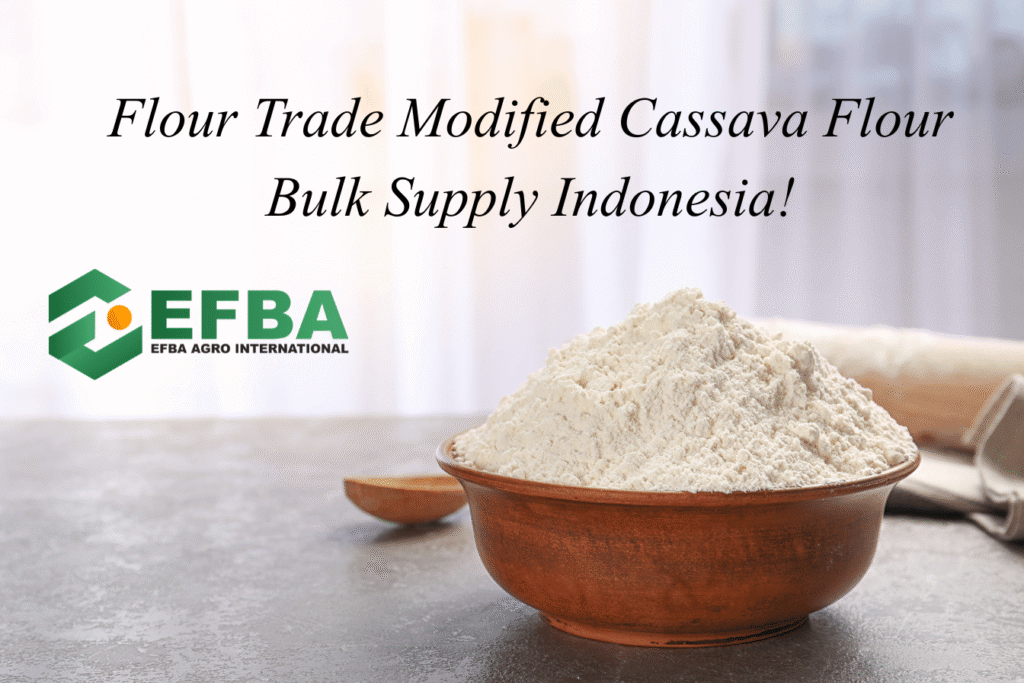
Indonesia offers cassava-derived ingredients for selected food manufacturing and industrial applications. However, tapioca flour or starch and Modified Cassava Flour (MOCAF) have different functional characteristics.
Tapioca starch supports applications requiring particular thickening or textural properties. In contrast, MOCAF is a fermented cassava flour that serves different formulation requirements.
Therefore, manufacturers should specify the exact ingredient, moisture limits, particle size, quality parameters, and packaging before requesting quotations.
For additional sourcing information, explore EFBA Agro’s Tapioca Flour Supplier Indonesia page.
3. Coffee Cascara
Coffee cascara comes from the outer fruit material of coffee cherries and may serve suitable beverage applications, depending on food safety and destination-market requirements.
Buyers should assess the product’s processing method, moisture content, cleanliness, packaging, storage conditions, and intended use. These factors influence product suitability and potential handling requirements.
Furthermore, importers should verify applicable destination regulations before ordering. Clear specifications and appropriate quality documentation help reduce agricultural sourcing risk when purchasing cascara for international markets.
4. Candlenut
Candlenut is an Indonesian agricultural commodity that serves relevant food and processing applications. International buyers should evaluate its product form, grade, cleanliness, moisture content, and packaging requirements.
In addition, procurement teams need to understand suitable storage and transportation conditions. Improper handling may affect product quality and create avoidable purchasing problems.
Therefore, buyers should request clear specifications and confirm the available grade before purchasing commercial quantities.
5. Palm Products and Arenga Palm Sugar
EFBA Agro publishes sourcing information for crude palm oil (CPO), refined, bleached and deodorized (RBD) palm olein, and arenga palm sugar.
These commodities have different technical properties and commercial applications. Consequently, buyers should identify the exact product, intended application, required specifications, and appropriate transportation arrangements.
For palm products, relevant considerations may include chemical and physical specifications, shipment quantities, packaging, and applicable documentation.
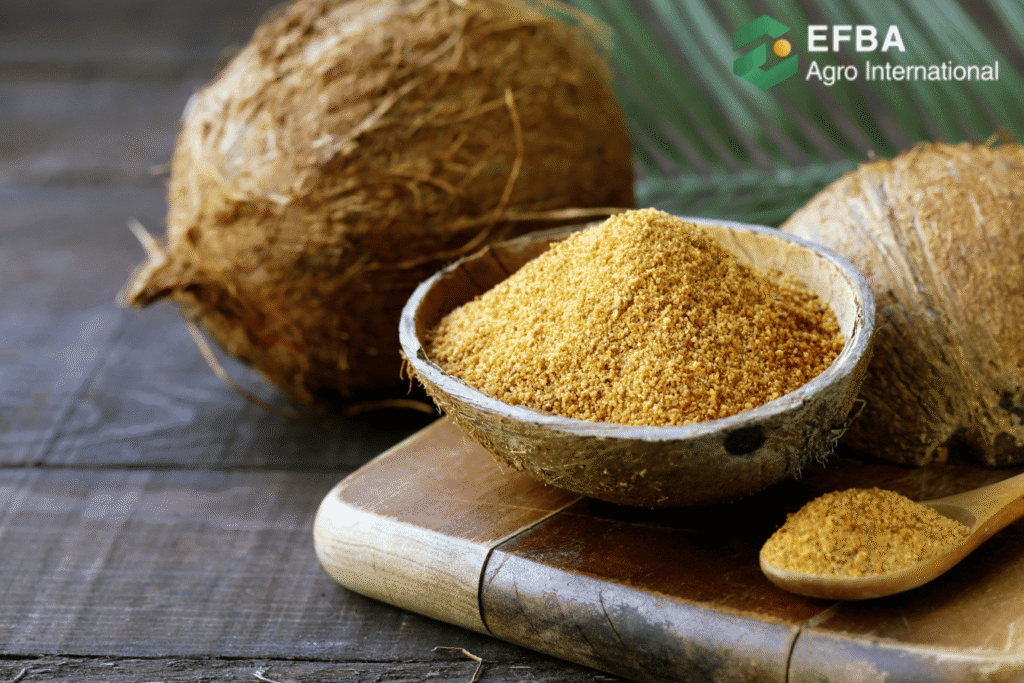
Meanwhile, arenga palm sugar buyers should evaluate moisture, product form, consistency, packaging, and shelf-life requirements.
EFBA Agro can discuss sourcing inquiries for these commodity categories according to current availability and agreed commercial conditions.
Official Data: Indonesia’s Agricultural Export Market
Official trade statistics help international buyers understand Indonesia’s position in global agricultural markets. However, national export performance does not automatically indicate that an individual supplier can fulfill a particular purchase order.
According to Indonesia’s Ministry of Agriculture, the reported export value of agricultural products reached approximately IDR 756.59 trillion in 2025, representing an increase of 28.26% compared with 2024.
The figure reflects the commodity coverage and statistical classification used in the ministry’s reporting. Therefore, buyers should consult the original publication when comparing agricultural export performance across different datasets.
Source: Indonesia’s Ministry of Agriculture – Agricultural Export Report 2025.
Meanwhile, Statistics Indonesia (BPS) published Indonesia Foreign Trade Statistics Exports 2025 on August 10, 2026.
According to the publication, Indonesia’s total merchandise exports reached approximately US$282.51 billion in 2025, increasing 5.99% compared with 2024.
However, this figure covers total Indonesian exports rather than agricultural commodities alone.
Source: BPS – Indonesia Foreign Trade Statistics Exports 2025.
These figures demonstrate Indonesia’s participation in international trade and provide relevant market context for commodity buyers.
Nevertheless, agricultural sourcing risk depends on product-specific conditions, including supplier capacity, seasonal availability, quality requirements, shipment arrangements, and destination-market regulations.
Therefore, international buyers should combine national trade statistics with supplier verification, sample evaluation, and current commercial information before making purchasing decisions.
EFBA Agro International: Supporting Agricultural Sourcing Risk Management
EFBA Agro International presents itself as an Indonesian agricultural commodity supplier and exporter serving wholesale and industrial buyers.
Its published services cover commodity sourcing, product matching, sample evaluation, quality control coordination, export documentation, and logistics arrangements.
These activities are relevant to agricultural sourcing risk management because they help buyers clarify purchasing requirements, evaluate product suitability, and discuss potential export arrangements.
However, buyers should confirm product availability, technical specifications, order quantities, and the actual scope of services directly with EFBA Agro before making commercial commitments.
1. Product Matching and Sourcing Coordination
EFBA Agro’s published sourcing process starts with identifying buyer requirements, including commodity type, specifications, quantity, packaging, and destination market.
Based on these requirements, the team can discuss relevant commodity categories and potential sourcing arrangements, subject to available supply.
For international buyers, preparing a detailed Request for Quotation (RFQ) helps establish clear communication and supports more accurate product matching.
Additionally, written purchasing requirements reduce misunderstandings about product quality, packaging, and shipment expectations.
2. Sample Evaluation and Quality Coordination
Sample evaluation is an important part of reducing agricultural sourcing risk before commercial purchasing.
EFBA Agro describes sample provision and buyer evaluation within its sourcing process. Depending on availability and agreed arrangements, buyers can discuss representative samples to assess product characteristics.
The evaluation may involve visual inspection, technical testing, or application trials according to the buyer’s requirements.
After sample approval, both parties should document the accepted specifications and clarify how they will assess commercial shipment quality.
This approach helps procurement teams establish consistent purchasing expectations before placing larger orders.
3. Export Documentation and Logistics Coordination
International agricultural trade involves coordination between product preparation, packaging, commercial documentation, and transportation.
EFBA Agro identifies export documentation and logistics coordination among its published activities. These services can support discussions about shipment requirements and the responsibilities of parties involved in an export transaction.
However, exact documentation requirements depend on the commodity, destination country, applicable regulations, and agreed commercial terms.
Therefore, buyers should verify import requirements, shipment conditions, and documentation responsibilities before confirming orders.
For further information, visit EFBA Agro International or explore its Indonesian Agricultural Commodity Exporter page.
4. Connecting Agricultural Sourcing with Business Planning
Agricultural procurement decisions affect more than purchasing costs. Supplier performance, product specifications, inventory planning, and shipment schedules can also influence production continuity and customer commitments.
Consequently, businesses should connect agricultural sourcing risk management with broader financial and operational planning.
For example, companies may need to evaluate procurement budgets, cash flow requirements, inventory carrying costs, and contingency plans when purchasing imported agricultural ingredients.
Businesses seeking broader commercial planning can explore EFBA Digital Mulia for information about its business consulting services. The appropriate scope of any engagement should reflect the company’s requirements and available services.
Frequently Asked Questions About Agricultural Sourcing Risk
1. What is agricultural sourcing risk?
Agricultural sourcing risk refers to potential disruptions or unexpected costs when purchasing agricultural commodities. Common risks include seasonal supply shortages, inconsistent product quality, price fluctuations, delivery delays, documentation problems, and regulatory compliance issues.
For international buyers, these challenges can affect production schedules, inventory planning, purchasing budgets, and customer commitments. Therefore, procurement teams should evaluate sourcing risks before confirming commercial orders.
2. How can global buyers reduce agricultural sourcing risk?
Global buyers can reduce agricultural sourcing risk by verifying suppliers, defining product specifications, evaluating samples, planning procurement schedules, and establishing clear commercial agreements.
Additionally, buyers should confirm export responsibilities, inspect product quality where appropriate, and review supplier performance after shipments. These measures help reduce preventable disruptions and improve purchasing decisions.
3. Why is Indonesia relevant for agricultural commodity sourcing?
Indonesia offers a diverse agricultural commodity portfolio, including coffee, cassava derivatives, candlenut, palm products, and natural sweeteners.
These products may interest international food manufacturers, beverage producers, wholesalers, and industrial buyers. However, importers should evaluate each commodity according to its specifications, current availability, intended application, and destination-market requirements.
4. What should buyers check before selecting an agricultural supplier?
Before choosing a supplier, buyers should review company information, product specifications, sourcing capabilities, quality documentation, and export coordination arrangements.
Furthermore, procurement teams need to confirm current availability, commercial quantities, packaging, delivery schedules, and payment conditions. Written agreements provide a clear reference for both parties throughout the transaction.
5. Can product samples help reduce agricultural sourcing risk?
Yes. Samples help buyers evaluate product characteristics before committing to commercial quantities. Depending on the commodity, evaluation may include visual inspection, sensory assessment, laboratory testing, or application trials.
However, sample approval does not guarantee that every future shipment will meet the same specifications. Therefore, buyers should establish suitable quality verification and acceptance procedures for commercial deliveries.
6. What documents may be required for agricultural exports?
Agricultural export documentation depends on the commodity, destination market, and applicable regulations.
Relevant documents may include commercial invoices, packing lists, bills of lading, certificates of origin, and applicable product-specific certificates.
Buyers should confirm the exact requirements with suppliers, logistics providers, and relevant authorities before arranging international shipments.
7. Which Indonesian agricultural commodities can buyers explore through EFBA Agro?
EFBA Agro publishes information about Gayo Arabica coffee, coffee cascara, tapioca flour, MOCAF, candlenut, CPO, RBD palm olein, and arenga palm sugar.
International buyers can explore these commodity categories and discuss product requirements with the company.
However, current availability, grades, purchasing quantities, sample arrangements, and delivery conditions require order-specific confirmation.
8. Why is agricultural sourcing risk management important for international buyers?
Agricultural sourcing risk management helps international buyers anticipate potential disruptions in supply, product quality, pricing, transportation, and regulatory compliance.
By identifying these risks early, businesses can establish clearer specifications, evaluate supplier capabilities, and develop more realistic procurement plans.
As a result, companies can make purchasing decisions with greater awareness of potential operational and financial challenges.
Build a More Resilient Agricultural Supply Chain with EFBA Agro
Managing agricultural sourcing risk starts with clear purchasing requirements, reliable supplier verification, and realistic procurement planning.
International buyers should identify product specifications, assess sourcing capabilities, evaluate samples, clarify export responsibilities, and confirm commercial terms before purchasing bulk agricultural commodities.
Furthermore, buyers should consider how seasonal availability, logistics conditions, and inventory requirements may affect their overall supply chain strategy.
EFBA Agro International helps global buyers explore Indonesian agricultural commodities and discuss sourcing requirements through its published sourcing and export process.
Whether your business needs coffee, cassava derivatives, candlenut, palm products, or natural sweeteners, effective procurement begins with understanding the required product, quantity, quality parameters, packaging, and destination market.
For sourcing inquiries, prepare the following information:
- Required agricultural commodity and intended application.
- Product grade and technical specifications.
- Purchasing quantity and expected order frequency.
- Packaging requirements and destination country.
- Preferred Incoterm and delivery schedule.
- Relevant quality and documentation requirements.
A detailed RFQ helps buyers and suppliers evaluate product suitability, commercial feasibility, and potential sourcing arrangements more efficiently.
Explore Indonesian agricultural sourcing opportunities with EFBA Agro International. Visit efbaagro.id to review available commodity categories and contact the team regarding your purchasing requirements.

Visit efbaagro.id to explore the company’s agricultural commodity portfolio and submit your sourcing inquiry.
Prepare your RFQ with the following information:
- Required commodity and intended application
- Quality specifications and documentation requirements
- Order quantity and purchasing frequency
- Packaging preferences and destination country
- Preferred Incoterm and expected delivery schedule
A clear RFQ helps both parties assess product suitability, commercial feasibility, and the next steps in the sourcing process. Contact EFBA Agro International to discuss your requirements and explore potential Indonesian agricultural supply opportunities.