
International buyers can source Indonesian agricultural commodities by defining product requirements, intended applications, quality specifications, purchasing quantities, and destination-market regulations before requesting quotations. Indonesia offers agricultural products for food manufacturing, wholesale distribution, beverage production, and industrial processing. However, successful procurement requires careful supplier evaluation, representative sample testing, and clear commercial agreements.
The market for Indonesian agricultural commodities includes both raw agricultural materials and processed ingredients, such as coffee, cassava derivatives, candlenut, palm oil products, and arenga palm sugar. These products serve different industrial applications and require commodity-specific quality standards. Therefore, buyers should evaluate technical suitability, current availability, and total purchasing costs rather than comparing prices alone.
For importers, manufacturers, and international distributors, sourcing from Indonesia requires structured procurement planning. Buyers should verify supplier credentials, request technical specifications, compare quotations, and identify applicable shipment documentation. This approach helps businesses establish more transparent purchasing arrangements and reduce avoidable supply chain uncertainty.
What Are Indonesian Agricultural Commodities?
Indonesian agricultural commodities are raw or processed agricultural products originating from Indonesia that businesses purchase for manufacturing, further processing, distribution, or commercial applications. These commodities include coffee, cassava-based ingredients, nuts, palm products, and agricultural sweeteners. Each category has distinct characteristics, processing requirements, and international purchasing considerations.
Indonesia’s agricultural sector provides opportunities for international businesses seeking ingredients for food production, beverage manufacturing, wholesale trade, and other industries. However, buyers should distinguish raw materials from processed ingredients before requesting quotations. For example, crude palm oil and refined palm olein require different specifications, while tapioca starch and Modified Cassava Flour (MOCAF) serve different formulation purposes.
Understanding these differences helps purchasing teams identify products that meet their operational requirements. Furthermore, clear product identification reduces the risk of ordering ingredients with unsuitable technical characteristics. Buyers should therefore confirm the exact commodity, processing method, and intended application before approving an order.
Which Indonesian Agricultural Commodities Should International Buyers Consider?
Indonesia offers several agricultural products relevant to international food, beverage, and industrial markets. However, not every commodity is suitable for every manufacturing application. Global buyers should evaluate product characteristics, technical specifications, and available documentation before making purchasing decisions.
The following Indonesian agricultural commodities are among the product categories published by EFBA Agro International.
1. Indonesian Coffee
Coffee is one of Indonesia’s internationally traded agricultural products. Important categories include Arabica and Robusta, which serve different roasting, beverage, and commercial applications. Buyers should identify the required coffee species, origin, processing method, grade, and product form before contacting suppliers.
For green coffee, relevant evaluations may include moisture content, physical defects, bean size, and sensory performance. Additionally, origin information and representative samples can help roasters evaluate the suitability of individual lots. Buyers should confirm current inventory and shipment schedules before placing bulk orders.
2. Modified Cassava Flour (MOCAF)
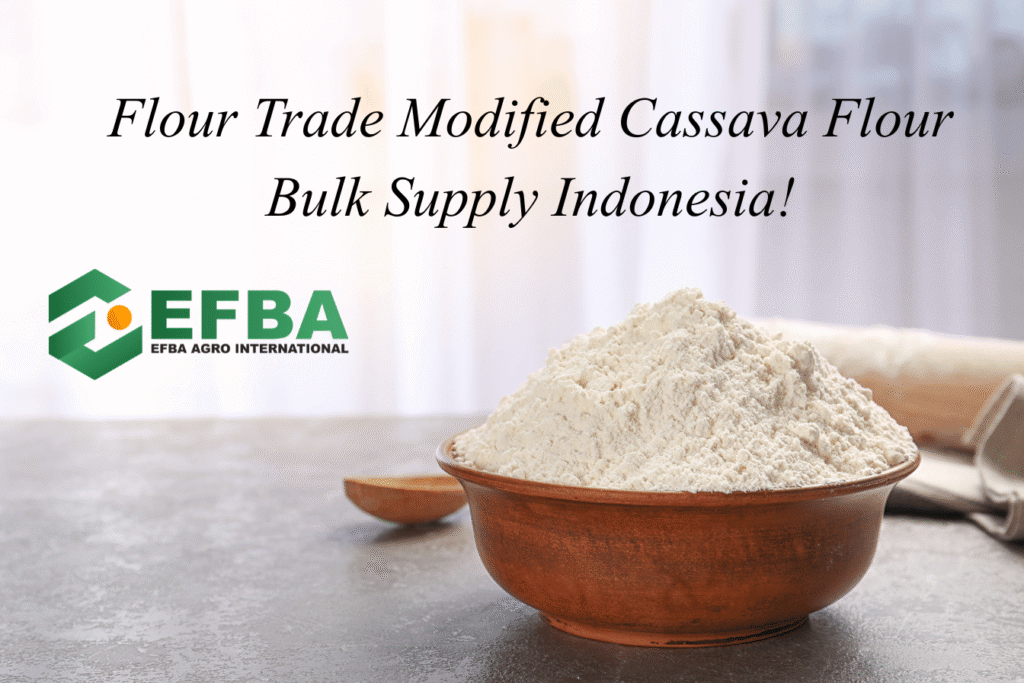
Modified Cassava Flour, commonly known as MOCAF, is a cassava-based ingredient produced through fermentation. Food manufacturers may evaluate MOCAF for selected bakery products, snacks, and other formulations depending on product requirements. However, MOCAF differs from purified tapioca starch in composition and functional characteristics.
When purchasing cassava-based Indonesian agricultural commodities, buyers should clarify the exact product identity and intended use. They should also review moisture content, particle size, functional performance, and relevant quality requirements. Application testing can help manufacturers determine whether the proposed ingredient suits their production process.
3. Food-Grade Tapioca Starch
Tapioca starch is a cassava-derived ingredient used in food manufacturing, including noodles, snacks, sauces, and other processed products. Its functional properties may influence thickening, texture development, and consistency in different formulations. Therefore, manufacturers should establish technical requirements before purchasing.
Buyers should confirm starch characteristics, moisture limits, particle size where relevant, and product consistency. Furthermore, they should distinguish tapioca starch from other cassava-based flours to avoid unsuitable ingredient substitutions. Supplier quotations should clearly identify the product being offered.
4. Candlenut
Candlenut, also known as kemiri, is used in Indonesian culinary applications and selected oil-processing activities. Procurement requirements depend on whether the buyer needs whole kernels, processed material, or another specified form. Product condition and storage requirements also influence purchasing decisions.
International buyers should establish acceptable moisture levels, foreign-matter limits, packaging requirements, and intended applications. Additionally, they should verify the relevant product safety and import requirements in their destination markets. These checks provide a clearer basis for evaluating candlenut offers.
5. Cascara, Palm Products, and Arenga Palm Sugar
Other Indonesian agricultural commodities include coffee cascara, crude palm oil, refined palm olein, and arenga palm sugar. These agricultural products serve different food, beverage, and industrial applications. However, each commodity requires technical specifications appropriate to its processing level and intended use.
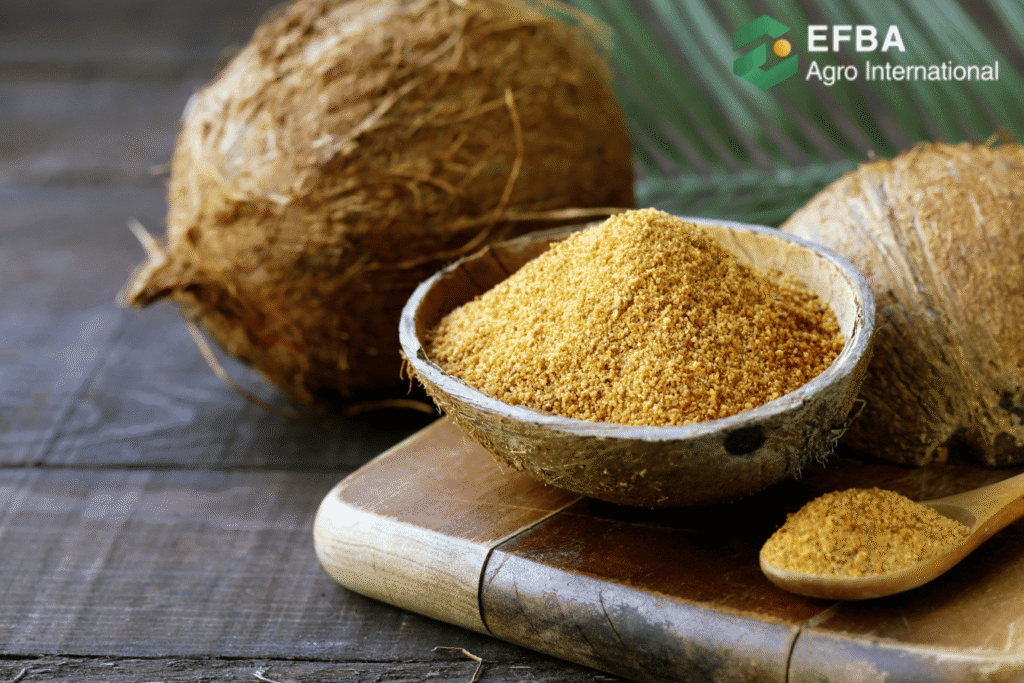
Cascara, derived from dried coffee cherry husks, may be suitable for selected beverage applications, subject to applicable destination-market regulations. Meanwhile, crude palm oil and RBD palm olein differ in processing level and chemical characteristics. Arenga palm sugar is available in different forms, including granulated and molded products, and buyers should confirm the required composition, moisture content, and packaging.
Explore the published commodity portfolio through EFBA Agro International. Buyers should contact the company to confirm current product availability, specifications, and commercial terms.
Comparing Indonesian Agricultural Commodities for International Procurement
Comparing agricultural products requires more than reviewing their names and quoted prices. International buyers should evaluate each commodity based on its intended application, technical characteristics, quality requirements, and commercial availability. Therefore, a structured comparison helps procurement teams identify questions that must be resolved before purchasing.
The following table summarizes common evaluation criteria for selected Indonesian agricultural commodities.
| Commodity | Purchasing Focus | Questions to Clarify |
|---|---|---|
| Coffee | Origin, processing, physical and sensory quality | Which lot, grade, and evaluation method apply? |
| MOCAF | Composition and application performance | How does the sample perform in the intended formulation? |
| Tapioca starch | Functional properties and consistency | Which parameters support the manufacturing process? |
| Candlenut | Product form, condition, and storage | What moisture and foreign-matter limits should apply? |
| Cascara | Processing, hygiene, and market acceptance | Does the destination permit the intended use? |
| Palm oil products | Refining level and quality parameters | Is the offer for crude oil or a specified refined fraction? |
| Arenga palm sugar | Form, composition, moisture, and packaging | Which specifications support handling and shelf life? |
These parameters represent general purchasing considerations rather than universal acceptance limits. Technical requirements may differ between manufacturers, markets, and production processes. Consequently, buyers and suppliers should establish measurable specifications for each proposed transaction.
How to Buy Indonesian Agricultural Commodities
Purchasing Indonesian agricultural commodities requires a structured approach that covers product selection, supplier verification, quality evaluation, pricing, and export documentation. These steps help international buyers communicate requirements more accurately and compare supplier offers using consistent criteria. Moreover, careful preparation can reduce misunderstandings before commercial commitments begin.
1. Define the Intended Application
Start by explaining how the agricultural product will be used in your business. For example, you may need an ingredient for manufacturing, roasting, blending, repacking, or wholesale distribution. This information helps suppliers identify suitable products and discuss relevant technical requirements.
A clear application brief also supports better product matching. Manufacturers should explain relevant processing conditions and desired product characteristics wherever possible. As a result, suppliers can prepare quotations based on more specific purchasing requirements.
2. Prepare a Written Specification
Written specifications help buyers establish measurable quality expectations before purchasing. Relevant information may include product grade, moisture content, composition, testing methods, packaging requirements, and acceptance limits. Buyers should also state the required quantity, purchasing frequency, destination, and expected delivery schedule.
For Indonesian agricultural commodities, product specifications should reflect the characteristics of the individual commodity. Coffee requires different evaluation criteria from tapioca starch, palm oil, or candlenut. Therefore, buyers should avoid using identical technical requirements for unrelated agricultural products.
3. Verify the Supplier and Supply Arrangement
Supplier verification helps international buyers understand the identity and role of the company offering the products. Buyers should review the supplier’s legal identity, business contact information, published product portfolio, and responsibilities within the proposed transaction. They should also clarify whether the company operates as a producer, processor, trader, or sourcing coordinator.
Furthermore, buyers should determine which party handles procurement, quality checks, export documentation, and shipment preparation. These responsibilities can vary depending on the supplier’s business model. Written confirmation helps establish clear expectations before an order proceeds.
4. Evaluate Samples and Supporting Reports
Representative sampling allows buyers to evaluate whether a proposed commodity meets technical requirements. Depending on the product, evaluation may involve physical inspection, laboratory analysis, functional testing, or sensory assessment. Buyers should establish acceptance criteria before conducting the evaluation.
However, sample approval does not automatically establish the quality of every future shipment. Suppliers and buyers should agree on how delivered lots will be checked against approved specifications. This approach supports more consistent procurement and quality management.
5. Compare the Complete Commercial Offer
Price comparisons should consider product specifications, grade, quantity, packaging, payment terms, and delivery arrangements. Buyers should also establish the relevant Incoterms rule, version, and named port or place. These details influence responsibilities and the overall purchasing cost.
When comparing quotations for Indonesian agricultural commodities, importers should avoid treating offers with different product specifications or delivery conditions as equivalent. Instead, they should evaluate total purchasing costs and clarify inspection, acceptance, and claims procedures. This process supports more informed commercial decisions.
6. Confirm Import Requirements Before Shipment
International import requirements may differ according to the agricultural commodity, processing level, origin, intended use, and destination country. Therefore, buyers should coordinate with their import representatives or customs professionals before confirming shipment arrangements. These checks help identify relevant documentation, permits, inspections, and certification requirements.
In addition, buyers should confirm which documents the supplier can provide and which responsibilities remain with the importer. The applicable requirements should be verified for each transaction rather than assumed from previous shipments. This preparation helps reduce avoidable customs and documentation problems.
Official Data and Regulations for Indonesian Agricultural Commodities
Official statistics and regulatory information provide useful references for businesses evaluating agricultural sourcing opportunities in Indonesia. However, national export figures do not establish the production capacity, available inventory, or shipment performance of an individual supplier. Buyers should combine market information with transaction-specific verification.
BPS Agricultural Export Statistics
BPS-Statistics Indonesia publishes export statistics that buyers can use to examine international trade patterns. For example, its coffee destination statistics cover 2000–2025, with the referenced page showing an update dated July 27, 2026. These figures can support market research and help procurement teams understand historical trade activity.
Nevertheless, statistics concerning Indonesian agricultural commodities should be interpreted according to the relevant commodity classifications, reporting periods, and units of measurement. National export performance does not guarantee that a particular supplier can fulfill an individual purchase. Therefore, commercial decisions should also consider verified supplier capabilities and current product availability.
Explore official trade information through BPS-Statistics Indonesia.
Indonesian Quarantine Authority Requirements
The Indonesian Quarantine Authority provides information about phytosanitary certification and applicable quarantine procedures for agricultural products. Its published guidance explains that certification considers Indonesian regulations and the requirements of destination countries. Depending on the commodity and circumstances, procedures may include document review, physical inspection, and laboratory testing.
For buyers sourcing Indonesian agricultural commodities, understanding relevant plant-health and import requirements is an important part of export preparation. However, not every commodity requires the same documents or inspection procedures. Importers should verify the applicable requirements before finalizing shipment arrangements.
Official information is available through Badan Karantina Indonesia.
Which Export Documents Should Buyers Discuss?
Export documentation requirements depend on the commodity, destination market, transportation method, and commercial agreement. Therefore, buyers should establish the required document list before arranging shipment. Clear responsibility for document preparation can also help avoid misunderstandings between exporters, importers, and logistics providers.
| Document | Purpose or Purchasing Consideration |
|---|---|
| Commercial invoice | Records transaction details and commercial information |
| Packing list | Identifies package quantities, weights, and contents |
| Transport document | Relates to the agreed shipment and transport method |
| Certificate of origin, where applicable | Supports origin-related requirements |
| Phytosanitary certificate, where applicable | Addresses relevant plant-health requirements |
| Analysis or inspection report | Supports agreed quality checks within its stated scope |
| Additional permits or certificates | Depends on the commodity and destination |
Importers purchasing Indonesian agricultural commodities should confirm which documents apply to their exact products. They should also establish whether additional laboratory reports, origin information, or destination-specific permits are necessary. Requirements may change according to regulations and the nature of the transaction.
The Indonesian Quarantine Authority also provides official certificate verification services. Buyers may use the relevant verification options when reviewing quarantine documents. Nevertheless, document verification does not replace a complete assessment of import requirements.
EFBA Agro International and Indonesian Agricultural Commodity Sourcing
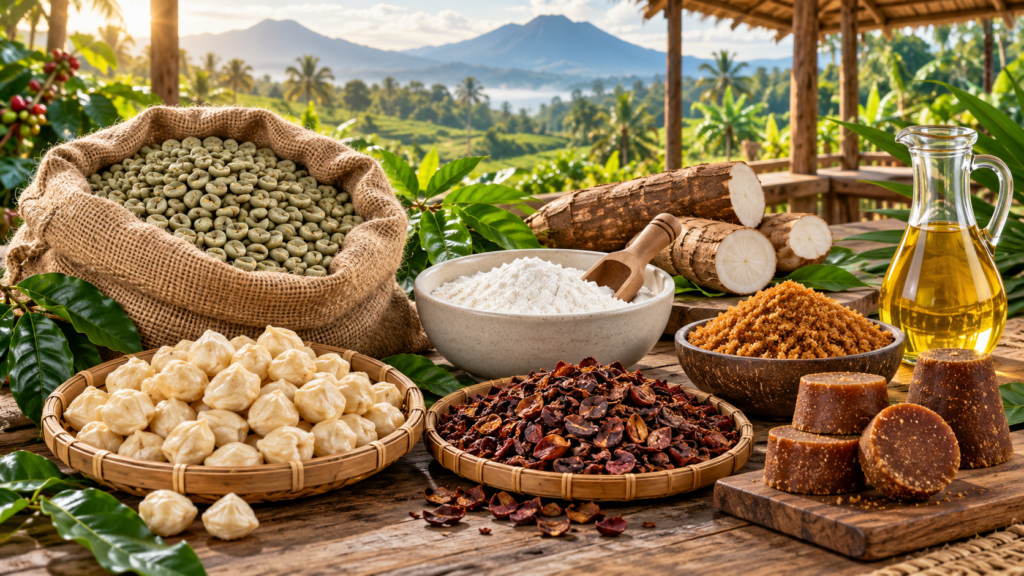
EFBA Agro International publishes a portfolio of Indonesian agricultural commodities for international buyers, including coffee, cassava derivatives, candlenut, cascara, palm products, and arenga palm sugar. These categories are relevant to businesses operating in food manufacturing, beverage production, wholesale distribution, and selected industrial sectors. Buyers can review the company’s published information as a starting point for commodity sourcing discussions.
The company’s official website provides a contact point for discussing product specifications, purchasing quantities, available samples, export requirements, and commercial arrangements. However, buyers should confirm the scope of services and current product availability for each intended transaction. Published commodity information should not be interpreted as a guarantee of unrestricted supply or immediate shipment.
For companies searching for Indonesian agricultural commodities, EFBA Agro offers an initial reference for identifying selected agricultural products and discussing sourcing requirements. Clear purchasing specifications help both parties determine whether the proposed products match the buyer’s needs. Consequently, international buyers should prepare detailed inquiries before requesting formal quotations.
Plan Your Indonesian Agricultural Commodities Procurement
Successful agricultural procurement requires more than identifying a competitive product price. Buyers should define technical specifications, verify suppliers, evaluate samples, and confirm applicable shipping requirements before approving an order. These steps help purchasing teams assess quality, commercial feasibility, and sourcing risks.
International businesses sourcing Indonesian agricultural commodities should also consider seasonal availability, product consistency, and destination-market requirements. Clear communication about purchasing volumes, delivery expectations, and documentation helps suppliers evaluate inquiries more effectively. Furthermore, written commercial agreements provide a useful reference throughout the transaction.
For product inquiries, visit EFBA Agro International and prepare a Request for Quotation (RFQ) containing the required commodity, specifications, purchasing quantity, intended application, and delivery destination.
Explore Indonesian agricultural commodities with EFBA Agro International and build a more informed procurement strategy through clear specifications, verified product quality, and transparent supplier communication.
EFBA Agro Expertise in Commodity Sourcing
EFBA Agro International describes its agricultural sourcing and export support for importers, distributors, and manufacturers. Its published collaboration process covers requirement submission, product matching, sample provision, buyer testing, and confirmation. In addition, the website outlines procurement, quality control, packaging, documentation, and logistics coordination for Indonesian agricultural commodities.
These published activities provide a starting point for discussing a sourcing project. However, buyers should confirm current product availability, order quantities, testing scope, and delivery arrangements for each selected commodity. Similarly, certification, production capacity, and shipment history should be supported by relevant, product-specific evidence.
For a broader overview of sourcing options, read Indonesian Agricultural Commodity Exporter. Buyers can also visit EFBA to learn about the wider business ecosystem. Ultimately, every purchasing agreement should clearly identify the supplier, product specifications, and responsibilities involved in the transaction.
What Should Buyers Prepare Before Requesting a Quotation?
Before sourcing Indonesian agricultural commodities, buyers should prepare a complete inquiry so suppliers can assess feasibility and develop a relevant offer. Start by specifying the product name, intended application, required quantity, quality parameters, packaging preferences, and destination port. Whenever possible, include the expected purchasing date and order frequency as well.
In addition, identify any documents or certifications required by the destination market. Ask the supplier to confirm which requirements can be fulfilled instead of assuming that every requested certificate is automatically included. Finally, provide a business contact who can approve product specifications, review samples, and resolve technical questions during the procurement process.
FAQ About Indonesian Agricultural Commodities
Which Indonesian agricultural commodities does EFBA Agro list?
EFBA Agro’s published catalogue includes coffee, cassava derivatives, cascara, candlenut, palm oil products, and arenga palm sugar. However, availability may vary by product and purchasing period. Therefore, buyers should request current specifications and written supply confirmation before placing an order.
Can buyers request samples before bulk purchasing?
Yes, EFBA Agro’s published collaboration process includes sample provision and buyer evaluation. Nevertheless, buyers should confirm sample availability, associated costs, and delivery arrangements for the selected commodity. After evaluating the sample, both parties should agree on how the commercial shipment will meet the approved specifications.
Are MOCAF and tapioca starch the same product?
No. MOCAF is processed cassava flour, whereas tapioca starch is a starch ingredient derived from cassava. Although both originate from cassava, their characteristics and formulation roles differ. Consequently, buyers should evaluate the exact product in the intended application before confirming a purchase.
Is a phytosanitary certificate required for every shipment?
Not necessarily. Requirements for Indonesian agricultural commodities depend on factors such as the commodity, its processing level, and the destination market. For this reason, buyers should confirm applicable requirements with the relevant authorities and their import representative rather than assume that every agricultural product needs identical documentation.
How can buyers compare supplier quotations accurately?
Buyers should compare equivalent product specifications, quantities, packaging, and delivery terms. In addition, include relevant inspection, logistics, and import costs when evaluating the total purchasing cost. A lower unit price may reflect a different product grade, quantity, or service scope; therefore, confirm that each quotation covers comparable requirements before making a decision.
Source Indonesian Agricultural Commodities with EFBA Agro
Sourcing Indonesian agricultural commodities successfully starts with clear purchasing requirements and verifiable product information. Buyers should align specifications, sample evaluation, commercial terms, and destination requirements before shipment. By following these steps, purchasing teams can make more informed decisions and communicate expectations to suppliers more effectively.
To discuss a potential sourcing project, visit the EFBA Agro International website. Prepare the exact commodity name, required quantity, intended application, and destination so the inquiry can focus on product suitability and the commercial arrangements that need confirmation.

Contact EFBA Agro International to discuss your agricultural commodity requirements. Share the product, quantity, application, destination, and purchasing schedule through the website’s quotation form. The team can then assess suitable options and discuss the next steps for your inquiry.