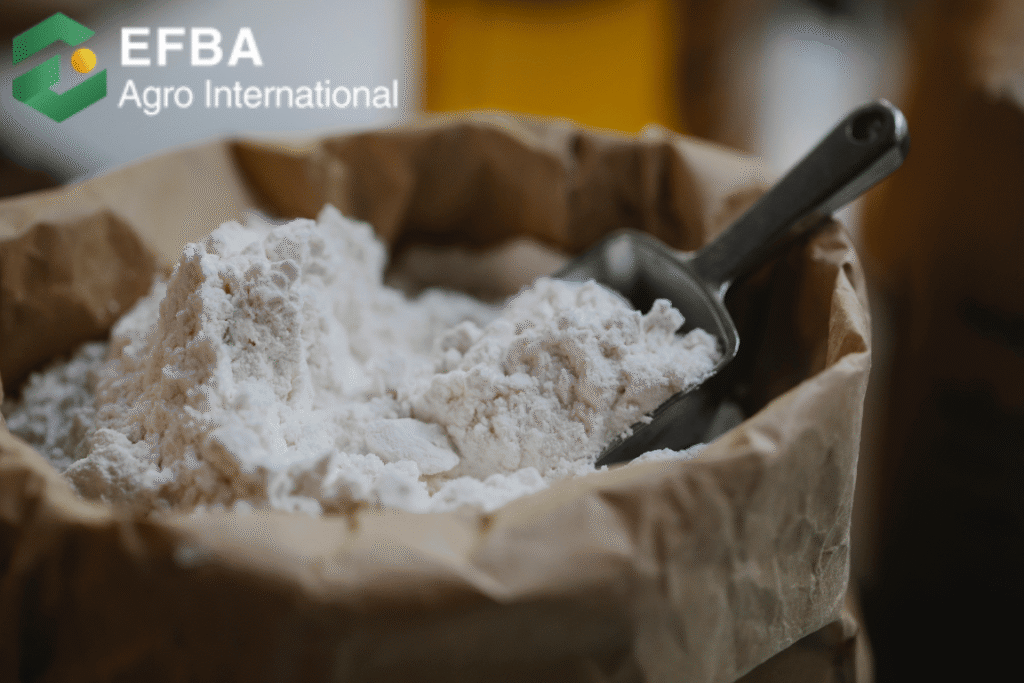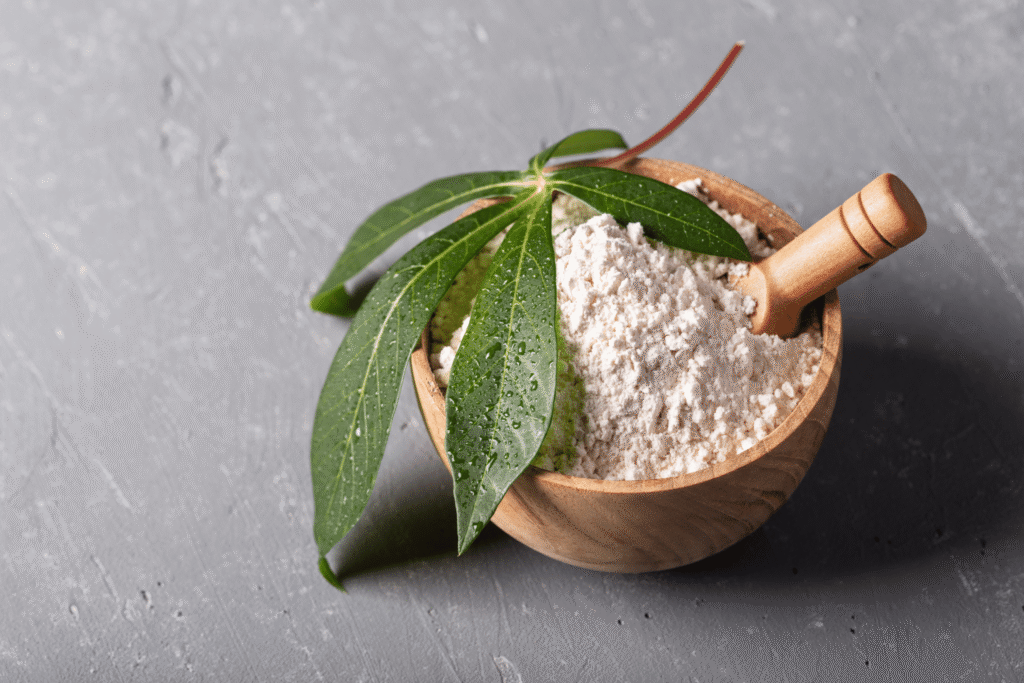
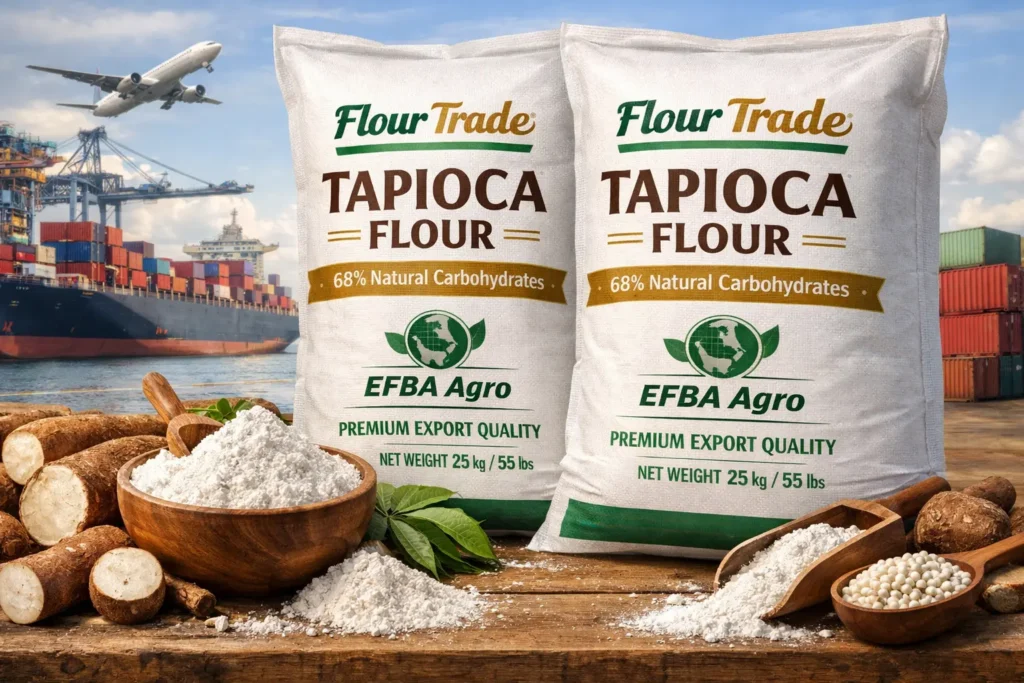
Flour Trade tapioca flour from EFBA Agro represents a premium-grade ingredient designed to meet the nutritional, functional, and regulatory demands of global markets. Derived from carefully selected cassava roots, this tapioca flour contains approximately 68 percent natural carbohydrates, making it a reliable energy source and functional starch for food and industrial applications. Its clean taste, high purity, and consistent starch profile position EFBA Agro as a trusted exporter serving manufacturers, distributors, and processors worldwide.
EFBA Agro processes tapioca flour under controlled conditions to preserve its nutritional value, functional integrity, and export readiness. Packaged in durable 25kg export-grade bags, the flour maintains optimal moisture levels, uniform particle size, and stable starch performance during long-distance shipping. International buyers rely on this consistency to support efficient production, minimize waste, and maintain predictable outcomes across diverse applications.
As global demand shifts toward clean-label, allergen-free, and naturally sourced ingredients, tapioca flour has become increasingly important. EFBA Agro aligns its sourcing, processing, and quality assurance systems with international food safety standards, enabling buyers to integrate tapioca flour seamlessly into regulated markets. The result is a dependable Flour Trade solution that supports nutritional transparency, supply stability, and scalable production.
İçindekiler
Nutritional Composition and Functional Value
Tapioca flour is primarily valued for its carbohydrate content, with approximately 68 percent naturally occurring carbohydrates that provide a fast and efficient energy source. This makes it suitable for a wide range of food formulations, from baked goods to processed foods and nutritional products. Unlike many refined flours, tapioca flour contains no gluten, cholesterol, or artificial additives, making it compatible with modern dietary preferences and regulatory requirements.
The neutral flavor profile allows manufacturers to incorporate tapioca flour without altering taste, while its starch composition contributes to texture, viscosity, and binding performance. EFBA Agro ensures that each production batch maintains consistent nutritional parameters, allowing manufacturers to label products accurately and meet consumer expectations for transparency.
In addition to its carbohydrate value, tapioca flour offers functional advantages such as heat stability and freeze-thaw resistance. These characteristics are essential for frozen foods, ready-to-eat meals, and products requiring extended shelf life. Through strict quality monitoring, EFBA Agro guarantees that nutritional consistency and functional reliability remain uniform across export shipments.
Role of Tapioca Flour in Modern Food Manufacturing
Food manufacturers increasingly rely on tapioca flour as a versatile ingredient capable of replacing wheat-based flours in gluten-free and allergen-sensitive formulations. Its high carbohydrate content contributes to structure and mouthfeel, while its starch granules enhance elasticity and moisture retention in baked products.
In large-scale production environments, consistency is critical. EFBA Agro’s Flour Trade tapioca flour delivers predictable viscosity, thickening strength, and binding capacity, allowing processors to standardize recipes across multiple facilities and regions. This predictability reduces reformulation costs and supports operational efficiency.
Sauces, soups, gravies, and dessert fillings benefit from tapioca flour’s clean thickening properties. Unlike modified starches, tapioca flour provides a natural alternative that aligns with clean-label trends. Manufacturers can achieve smooth textures without compromising nutritional positioning or regulatory compliance.
Flour Trade: Bakery, Snack, and Confectionery Application

Bakeries and snack producers value tapioca flour for its ability to improve texture in gluten-free and specialty products. When combined with other flours, it enhances chewiness, softness, and moisture retention, resulting in products that closely mimic traditional wheat-based textures.
Snack manufacturers incorporate tapioca flour into crackers, chips, and extruded snacks to achieve uniform expansion and crispness. Its carbohydrate-rich structure supports consistent frying and baking performance, even in high-volume production runs. EFBA Agro’s export-grade flour ensures that particle size and moisture remain controlled, reducing variability during processing.
In confectionery applications, tapioca flour contributes to smooth gels, elastic fillings, and stable coatings. Its neutral taste allows flavors to stand out, while its functional starch properties support precise texture control. This makes it a preferred ingredient for candies, jellies, and dessert components distributed across international markets.
Flour Trade: Global Culinary Adaptability
Tapioca flour plays an essential role in traditional and modern cuisines worldwide. In Asia, it forms the foundation for tapioca pearls, noodles, and desserts. In Latin America, it is used in breads and snacks, while European and North American markets integrate it into gluten-free baking and plant-based products.
EFBA Agro’s Flour Trade tapioca flour supports this global adaptability by delivering consistent performance regardless of application. Chefs and manufacturers benefit from reliable hydration, binding, and cooking behavior, enabling standardized recipes across regions. This consistency is particularly important for international brands seeking uniform product quality.
The flour’s natural carbohydrate profile supports consumer demand for simple, recognizable ingredients. By maintaining strict quality controls and export-grade packaging, EFBA Agro ensures that culinary performance remains stable from origin to end use.
Gluten-Free and Health-Oriented Markets
Naturally gluten-free, tapioca flour is a cornerstone ingredient for products targeting consumers with celiac disease or gluten sensitivity. Its high carbohydrate content provides energy without triggering allergenic responses, making it suitable for specialized diets and health-focused formulations.
EFBA Agro tests each batch to prevent cross-contamination and ensure compliance with international allergen standards. This commitment to safety allows manufacturers to market products confidently in regulated gluten-free categories. Consistent starch behavior further supports reliable texture in bread, cakes, and nutritional snacks.
Health-conscious markets also value tapioca flour for its clean-label appeal. Free from chemical modification and artificial additives, it aligns with consumer preferences for minimally processed ingredients. EFBA Agro’s sourcing and processing practices reinforce this positioning, supporting premium product development.
Industrial and Non-Food Applications of Tapioca Flour
Beyond food production, tapioca flour plays a vital role in a wide range of industrial and non-food applications. Its starch content offers strong binding, thickening, and film-forming properties, making it suitable for paper manufacturing, adhesives, textiles, and biodegradable materials. Companies seeking sustainable raw materials increasingly turn to tapioca flour as a renewable alternative to synthetic binders.
EFBA Agro supplies Flour Trade tapioca flour with consistent starch functionality, allowing industrial users to achieve predictable performance in production processes. Whether applied in paper coating, corrugated board adhesives, or textile finishing, the flour delivers uniform viscosity and bonding strength. This reliability supports efficiency, reduces formulation errors, and minimizes production downtime.
The growing focus on environmentally friendly manufacturing further increases the relevance of tapioca flour. As industries transition toward bio-based materials, EFBA Agro’s export-grade tapioca flour supports innovation in compostable packaging and bio-plastic development. Its natural origin and consistent quality make it a valuable input across multiple industrial sectors.
Sustainable Sourcing and Responsible Production
EFBA Agro emphasizes sustainability throughout the entire tapioca flour supply chain. Cassava roots are sourced from carefully selected farms that apply responsible agricultural practices, focusing on soil health, crop rotation, and efficient water use. This approach ensures long-term productivity while minimizing environmental impact.
Only high-yield cassava varieties with superior starch content are selected for processing. Each harvest undergoes initial quality screening before entering the milling stage. By maintaining strict sourcing criteria, EFBA Agro ensures that raw materials consistently meet performance and nutritional standards required for Flour Trade exports.
Processing facilities operate under controlled conditions to preserve starch integrity and nutritional value. Waste management and resource efficiency are integrated into daily operations, supporting sustainable output without compromising quality. This commitment strengthens EFBA Agro’s position as a responsible supplier in global markets that increasingly prioritize ethical sourcing.
Export Packaging, Storage, and Logistics
EFBA Agro packages tapioca flour in durable 25kg export-grade woven bags designed to protect product quality throughout storage and international transit. These food-grade bags prevent moisture ingress, contamination, and starch degradation, ensuring that the flour reaches buyers in optimal condition.
Proper storage plays a crucial role in maintaining performance. EFBA Agro recommends keeping tapioca flour in cool, dry environments away from humidity and direct sunlight. When stored correctly, the flour retains its particle uniformity, carbohydrate stability, and functional properties for extended periods.
The company’s logistics system supports efficient global distribution. Coordinated shipment planning, secure container loading, and compliance with international transport regulations ensure timely delivery across continents. Buyers benefit from predictable lead times and reduced risk during long-distance transport.
Flour Trade: Quality Assurance and International Compliance
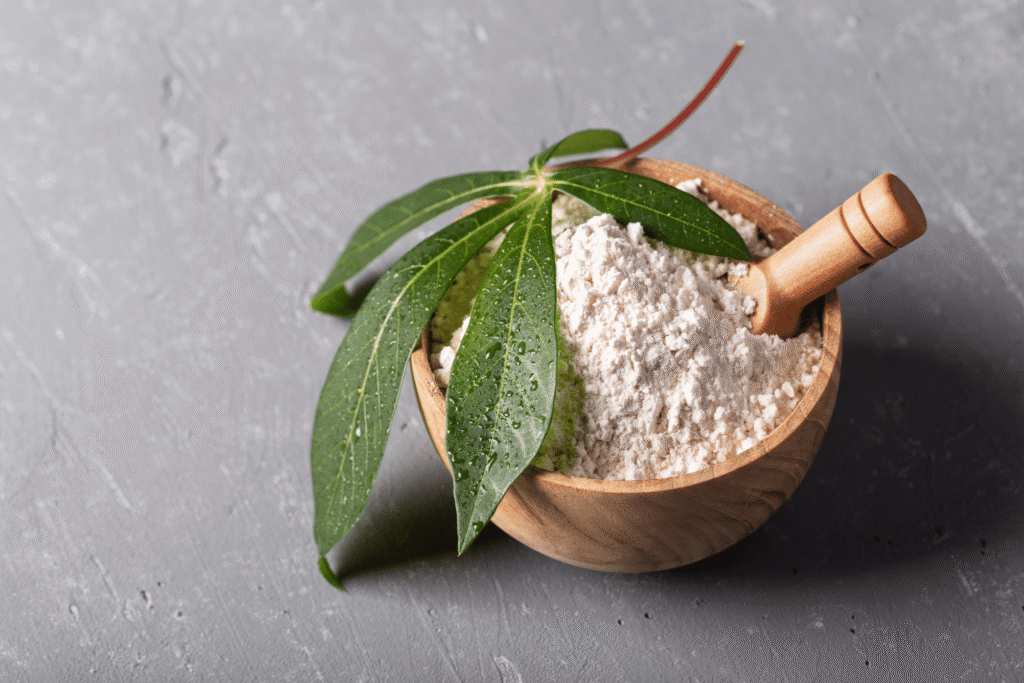
Quality control is embedded at every stage of EFBA Agro’s tapioca flour production. Each batch is tested for moisture content, particle size uniformity, starch concentration, and microbial safety. These evaluations ensure compliance with international food safety and industrial standards.
Traceability systems allow EFBA Agro to monitor products from farm to final packaging. This transparency builds confidence among international buyers who require documentation for regulatory approval and internal audits. Certificates of analysis, origin, and safety compliance accompany each shipment, simplifying customs clearance.
By maintaining rigorous quality assurance protocols, EFBA Agro reduces batch variability and supports consistent performance. Manufacturers relying on Flour Trade tapioca flour can plan production schedules confidently, knowing that each shipment meets precise specifications.
Why Choose EFBA Agro for Flour Trade Tapioca Flour
EFBA Agro combines technical expertise, sustainable sourcing, and export readiness to deliver premium tapioca flour for global markets. Buyers benefit from consistent carbohydrate content, clean-label positioning, and reliable functional performance across food and industrial applications.
The company offers responsive customer support, clear communication, and flexible order management. International clients can request samples, discuss specifications, and receive guidance tailored to their production requirements. This collaborative approach strengthens long-term partnerships and supports scalable growth.
With proven experience in global supply chains, EFBA Agro ensures that each shipment aligns with client expectations and regulatory demands. From small distributors to large manufacturers, partners gain access to a dependable Flour Trade solution backed by quality and transparency.
Global Market Trends Driving Tapioca Flour Demand
Worldwide demand for tapioca flour continues to expand, driven by gluten-free diets, clean-label food production, and sustainable manufacturing. Consumers increasingly favor products made from recognizable, natural ingredients, encouraging manufacturers to adopt tapioca flour as a core component.
The versatility of tapioca flour supports innovation across bakery, snack, plant-based, and industrial sectors. Its neutral flavor, high carbohydrate content, and functional reliability allow brands to standardize products while adapting to regional preferences.
EFBA Agro responds to these trends by supplying export-grade tapioca flour that meets evolving market expectations. Consistent quality, ethical sourcing, and efficient logistics help international buyers remain competitive and responsive to consumer demand.
Ordering Process and Buyer Support
Ordering tapioca flour from EFBA Agro is designed to be straightforward and transparent. Buyers can review product specifications through official channels or contact the sales team directly via WhatsApp for personalized consultation. Support is available for bulk orders, sampling, export documentation, and shipment planning.
Clear pricing structures, defined delivery schedules, and responsive communication ensure smooth transactions. EFBA Agro assists buyers throughout the ordering process, from initial inquiry to final delivery, ensuring accuracy and reliability.
This customer-focused approach simplifies supply chain integration and allows manufacturers, distributors, and wholesalers to secure high-quality tapioca flour efficiently.
Sonuç
Flour Trade tapioca flour from EFBA Agro delivers a balanced nutritional profile with approximately 68 percent natural carbohydrates, combined with consistent functional performance and export-grade reliability. Its adaptability across food, health, and industrial applications makes it a valuable ingredient for global markets.
By prioritizing quality assurance, sustainable sourcing, and efficient logistics, EFBA Agro supports international buyers in achieving stable production and market growth. Each shipment reflects a commitment to purity, consistency, and compliance, enabling partners to innovate confidently and meet rising global demand.
EFBA Agro International: Kalite, Dürüstlük ve Uzun Vadeli İş Birliği Üzerine Kurulu Küresel Bir Tedarikçi

EFBA Agro International, dünya genelindeki gıda üreticilerine, distribütörlere ve endüstriyel firmalara hizmet veren, Endonezya’nın en güvenilir tarım ihracatçılarından biri haline gelmiştir. Şeffaflık, kalite güvencesi ve uzun vadeli iş birliği temelleri üzerine kurulan EFBA Agro, küresel tedarik zincirlerinin değişen ihtiyaçlarını desteklemek üzere tasarlanmış bir emtia portföyü sunar.
What sets EFBA Agro apart is our commitment to direct collaboration with processors, mills, and farmer groups. This approach ensures full visibility over raw material selection, processing techniques, and quality control benchmarks. While Tapioca Flour remains one of our strongest export categories, we are equally dedicated to developing a diversified commodity line that supports a wider range of industries. Our export operations emphasize reliability, communication, and proactive updates, helping buyers plan ahead and avoid supply disruptions. EFBA Agro positions itself not just as a vendor but as a strategic partner capable of supporting long-term procurement planning across multiple product categories.
EFBA Agro’nun Tüm Ürün Portföyü: Tapyoka Unundan Premium Baharatlara ve Doğal Bileşenlere
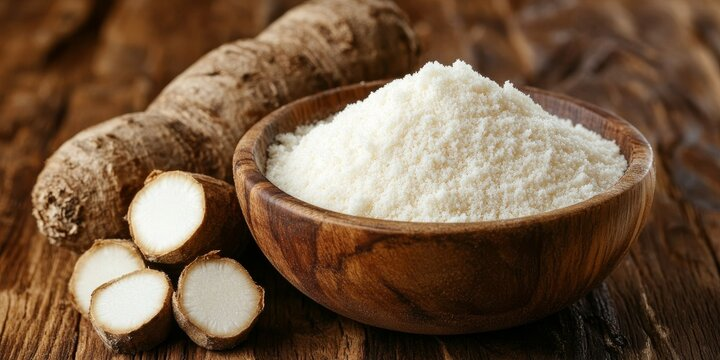
Beyond our focus on Tapyoka Unu, EFBA Agro International offers a comprehensive selection of agricultural commodities tailored for global markets. Each product category is handled with strict quality protocols, ensuring consistency from the point of harvest to export clearance. Our portfolio includes Arenga Palm Sugar (both molded and granulated), Candlenut (shelled and polished grades), Black Pepper, Vanilla Beans, Nutmeg, Cloves, Cocoa derivatives, and specialty natural ingredients sourced from Indonesia’s most productive agricultural zones. These commodities support various industries from food and beverages to natural cosmetics, wellness, and industrial formulations.
The diversity of this portfolio allows buyers to consolidate multiple SKUs under one trusted supplier, significantly reducing logistical complexity and administrative workload. Companies that purchase Tapyoka Unu often expand their partnership with EFBA Agro once they recognize the operational advantages of working with a supplier capable of managing large-volume shipments, export documentation, container optimization, and consistent communication. Our website’s commodities section highlights each product’s specifications, applications, and export readiness, ensuring that buyers can evaluate options clearly before placing an order. By offering a multi-commodity ecosystem with modern, export-focused processes, EFBA Agro reinforces its commitment to supporting long-term growth for global manufacturers and distributors.
FAQ – Flour Trade Tapioca Flour
1. What makes Flour Trade tapioca flour different from regular tapioca flour?
Flour Trade tapioca flour from EFBA Agro is produced under strict quality control to ensure consistent starch performance, moisture balance, and purity. Unlike standard tapioca flour, it is designed specifically for export markets, packed in 25kg export-grade bags, and tested to meet international food and industrial standards. This makes it more reliable for large-scale production.
2. Is Flour Trade tapioca flour suitable for gluten-free food manufacturing?
Yes, Flour Trade tapioca flour is naturally gluten-free and suitable for products targeting gluten-sensitive or celiac consumers. Each batch is tested to prevent cross-contamination, allowing manufacturers to use it confidently in gluten-free bakery items, snacks, and specialty foods while meeting regulatory requirements.
3. How does the 68 percent carbohydrate content benefit food products?
The 68 percent natural carbohydrate content provides energy and functional strength. It improves texture, elasticity, and moisture retention in baked goods while offering stable thickening in sauces and fillings. This balance supports consistent results across different recipes and processing conditions.
4. Can this tapioca flour be used for industrial applications?
Absolutely. Beyond food use, Flour Trade tapioca flour performs well as a natural binder and thickener in paper, adhesives, textiles, and biodegradable materials. Its stable starch structure ensures predictable performance in industrial formulations that require consistency and sustainability.
5. How should tapioca flour be stored to maintain quality?
To preserve quality, store the flour in a cool, dry place away from humidity and direct sunlight. Proper storage helps maintain starch functionality, particle uniformity, and shelf life, ensuring the flour performs consistently until use.
6. Does EFBA Agro provide export documentation and buyer support?
Yes. EFBA Agro supports buyers with complete export documentation, including certificates of quality and origin. The team also offers responsive consultation to help international clients manage bulk orders and logistics smoothly.
// Also Read:
Cascara Natural Tea Bulk Supplier 2025 from Indonesia – Coffeenesia Export Excellence!
Gayo Coffee 01 Single Origin Arabica Direct from Aceh By Coffeenesia!